
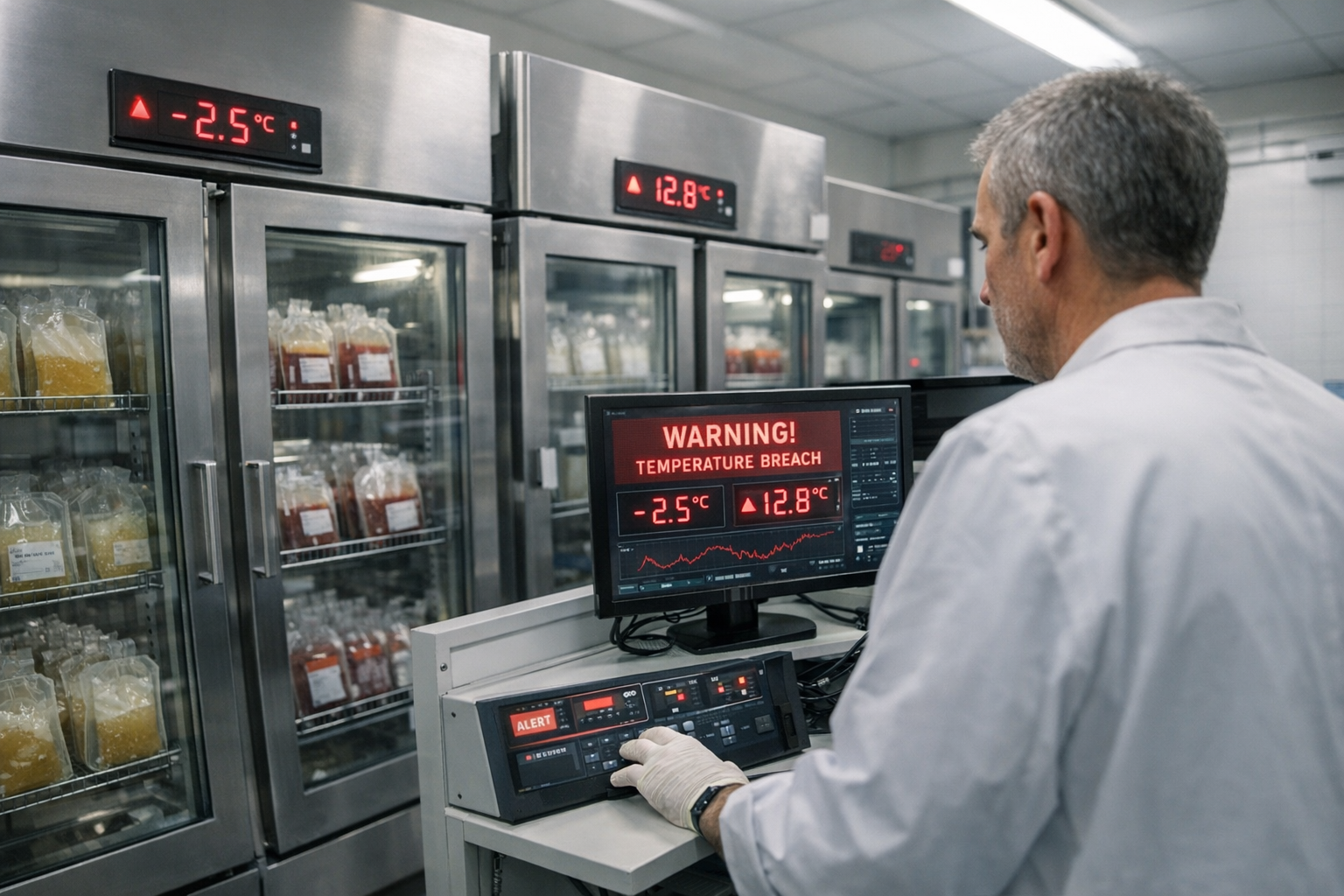
A cyberattack on France’s national blood service has pushed a fast-moving European hacking campaign into more sensitive territory, after attackers altered refrigeration settings at facilities storing plasma and other vital blood products.
The French blood service, known as EFS, said hackers on Monday changed temperature and defrost thresholds at three cold-storage sites to “very high levels” through systems supplied by a refrigeration equipment vendor. Alarm and monitoring systems alerted technicians in time to prevent spoilage, EFS said, and no blood products or samples were lost. Blood collection and distribution were not interrupted.
Still, the episode marks a sharp escalation in a wave of attacks that had already disrupted supermarket refrigeration and food retail operations across Europe. By reaching blood-bank cold storage, the campaign has taken on a clearer public-health dimension, raising concerns that industrial control systems once viewed as mundane back-office technology can become points of acute vulnerability.
French health authorities and the national cybersecurity agency, ANSSI, are investigating.
From retail disruption to health infrastructure
Until now, the recent attacks had been seen largely as a threat to food supply chains and retail operations. In France and elsewhere in Europe, hackers have been exploiting connected refrigeration and freezer systems, tampering with temperatures and forcing companies into costly emergency responses.
The broader campaign resurfaced across Europe on Nov. 2, after an earlier wave in France in mid-October. On Oct. 12, France’s CERT-FR, the national computer emergency response team, warned that internet-exposed refrigeration controllers had been compromised, specifically identifying Danfoss AK-SM and AK-SC systems and Copeland-Dixell xweb controllers.
Those systems are widely used to manage temperatures in commercial cold chains, from supermarkets to warehouses. Security officials have warned that poor network segmentation and direct internet exposure can leave such devices unusually susceptible to intrusion.
The attack on EFS appears to be the first publicly confirmed case in this campaign involving blood-storage infrastructure. Even though safeguards worked this time, the incident is likely to heighten alarm among hospitals, laboratories and pharmaceutical operators that rely on tightly controlled refrigeration to protect medical products and biological materials.
A widening European response
The European Commission moved quickly this week to frame the issue as more than a series of isolated national incidents. On Nov. 3, it convened coordination meetings with ENISA, the European Union cybersecurity agency, Europol and member-state authorities, according to officials familiar with the discussions.
That response reflects growing concern that attacks on connected cooling systems could ripple across borders and sectors, affecting food, health care and logistics at once. It also underscores how Europe’s cyber defenses are being tested not only by attacks on data and communications networks, but by intrusions into operational technology that governs physical processes.
The financial stakes have already become clearer in the retail sector. Ahold Delhaize, the Dutch-Belgian supermarket group, has said the earlier refrigeration attacks could reduce fourth-quarter sales by as much as €250 million, with an impact on operating income of up to €100 million.
Those figures have helped turn what might once have seemed a niche industrial cybersecurity problem into a broader economic and political concern.
Questions without answers
Much remains unknown. French authorities have not said who was behind the blood-bank intrusion, and European officials have stressed that attribution rests with national investigators. No government has publicly linked the campaign to a state actor, criminal group or individual hackers.
It is also unclear whether the attack on the blood-service facilities relied on the same access routes or vulnerabilities seen in the supermarket incidents, or whether health-sector operators face distinct weaknesses in the systems used by third-party refrigeration providers.
Another open question is scale. Officials still do not know how many health-care or cold-chain operators may be exposed across Europe, or the full cost of the damage already caused.
For now, the French blood-bank attack stands as a warning that the region’s cyber vulnerabilities extend deep into the physical systems that sustain everyday life — and, increasingly, emergency care. What began as a disruptive assault on store freezers now appears capable of touching infrastructure where a failed alarm or a delayed intervention could carry far more serious consequences.
Sources
Further reading and reporting used to add context:
- Cyberattack on French blood banks thwarted before damage, authorities say | AP News
- https://apnews.com/article/b6abfab3f5cdd65c19476b9032eb7a9d
- https://apnews.com/article/a8ea5b30d67da47957769f29101fe686
- https://www.axios.com/2026/11/02/europe-supermarket-fridges-attacks-food
- https://www.itpro.com/security/cyber-attacks/a-freezer-should-never-accept-an-instruction-to-heat-to-50-c-no-matter-who-sends-it-more-european-supermarkets-hit-by-suspected-cyber-attack
- https://www.techradar.com/tech/supermarket-freezers-across-europe-hit-by-fresh-cold-war-cyberattack-temperatures-raised-to-50c-forcing-grocers-to-throw-away-food
- https://www.theguardian.com/technology/2026/nov/04/france-national-blood-service-hack-cyber-attack-europe
- https://therecord.media/france-cyberattack-blood-refrigeration
- https://www.internazionale.it/ultime-notizie-reuters/2026/11/04/new-cyberattack-targets-french-blood-banks-health-ministry-says
- https://www.euronews.com/2026/11/04/cyberattack-hits-french-blood-banks-but-no-samples-compromised-officials-say
- https://www.investing.com/news/stock-market-news/european-supermarkets-rush-to-patch-vulnerabilities-after-regionwide-fridge-hack-4995896
- https://next.ink/briefs/le-brief-du-4-novembre-2026/
- https://www.itpro.com/security/cyber-attacks/french-blood-service-hit-by-new-cyber-attack-threatening-to-turn-stocks-into-black-pudding
- https://live.euronext.com/en/financial-news/new-cyberattack-supermarket-fridges-sweeps-across-europe
- https://www.lemonde.fr/pixels/article/2026/11/04/des-frigos-de-l-etablissement-francais-du-sang-a-leur-tour-victimes-d-une-cyberattaque_6806228_4408996.html
- https://www.lemonde.fr/en/cybersecurity/
- https://knews.kathimerini.com.cy/en/news/after-supermarket-freezer-hacks-france-s-blood-storage-systems-are-targeted
- https://www.euronews.com/2026/11/03/italy-holds-emergency-talks-as-supermarket-fridge-attacks-spread-across-europe
- https://2eu.brussels/en/news/european-commission-coordinates-response-to-cyberattacks-disrupting-supermarket-refrigeration-across-europe
- https://www.krisinformation.se/en/latest/news/cyberattacks-on-freezing-and-refrigeration-systems/
- Audiovisual Service – EC Midday press briefing of 03/11/2026
- https://www.cybersecuritydive.com/news/european-authorities-probe-attacks-grocery-refrigerators/873598/
- https://567politics.com/news/europe-supermarket-refrigeration-cyberattacks-second-wave-november-2026
- https://therecord.media/british-businesses-caught-in-europe-wide-supermarket-fridge-attacks
- https://euagenda.eu/news/945566
- https://therecord.media/cyberattack-grocery-freezers-europe
- https://www.ansa.it/english/newswire/english_service/2026/11/03/ansasupermarket-fridge-attacks-no-cause-for-alarm-govt_b94fe019-4fc9-4e2a-964a-224c11495fb9.html
- https://www.newsminimalist.com/articles/eu-urges-caution-on-russia-cyberattack-claims-0fcd234b
- https://www.consilium.europa.eu/en/press/press-releases/2025/05/12/cyber-attacks-council-extends-sanctions-and-legal-framework/pdf/
- https://ec.europa.eu/commission/presscorner/api/files/document/print/en/ip_26_748/IP_26_748_EN.pdf
- https://www.enisa.europa.eu/sites/default/files/2026-01/ENISA%20Threat%20Landscape%202025_v1.2.pdf
- https://www.europarl.europa.eu/RegData/etudes/ATAG/2026/785699/EPRS_ATA%282026%29785699_EN.pdf
- https://www.cert.cyber.gouv.fr/alerte/CERTFR-2026-ALE-012/
- https://pwn.watch/t/cert-fr
- https://teapawt.net/ANSSI_FR/status/2110004485565428018
- https://safeguard.sh/resources/blog/french-supermarkets-refrigeration-controllers-danfoss-cert-fr-alert
- https://tsnmedia.org/france-supermarkets-danfoss-refrigeration-cyberattack/
- https://www.redtigersecurity.com/advisory/certfr-refrigeration-controllers-campaign
- https://www.pk-sharma.com/briefing/french-supermarkets-refrigeration-attack-danfoss-says-most-units-end-of-life-no-link-to-claroty-flaws
- https://db.gcve.eu/vuln/CERTFR-2026-ALE-012
- https://marfik.fr/en/news/supervision-froid-compromise/
- https://ctipilot.ch/entities/incident%3Adanfoss-ak-sm-ak-sc-french-supermarket-refrigeration-attack-2026-10/
- https://intel.threadlinqs.com/threat/TL-2026-5186
- https://www.oktsec.com/radar/refrigeration-controller-attacks-europe-2026
- https://www.reddit.com/r/u_Deception_Check/comments/1x5cryb/certfr_expands_refrigeration_alert_what_to_check/
- https://webapps.copeland.com/dixell/Content/Pages/SystemSoftwareUpdate/XWEB-PRO/Security%20update%20%20XWEB-PRO%20-%20Product_Bulletin_February_2026.pdf
- https://en.wikipedia.org/wiki/2026_French_supermarket_refrigerator_hack
- https://assets.danfoss.com/documents/latest/535265/AO540953778522en-010101.pdf
- https://device.report/m/58d0c220c6da20d73bbbbf370602f029e3b8f0872e4abc0d28b9451ecb9df83f.pdf
- https://www.copeland.com/documents/026-4376-connect-release-notes-1-5-7f01-en-8981000.pdf
- https://www.marsdelivers.com/wps/wcm/connect/c2e7c0bc-d62e-4b84-87ba-cb863361c4cc/MARS-Danfoss_2020%2BSupermarket%2BCatalog_FINAL.pdf?CACHEID=ROOTWORKSPACE-c2e7c0bc-d62e-4b84-87ba-cb863361c4cc-nc6ksy4&CONVERT_TO=url&MOD=AJPERES
- https://jslink-prod.marsdelivers.com/images/danfoss/Supermarket_catalog_17.pdf
- Incident de sécurité ciblant les contrôleurs à distance des installations de réfrigération – CERT-FR