
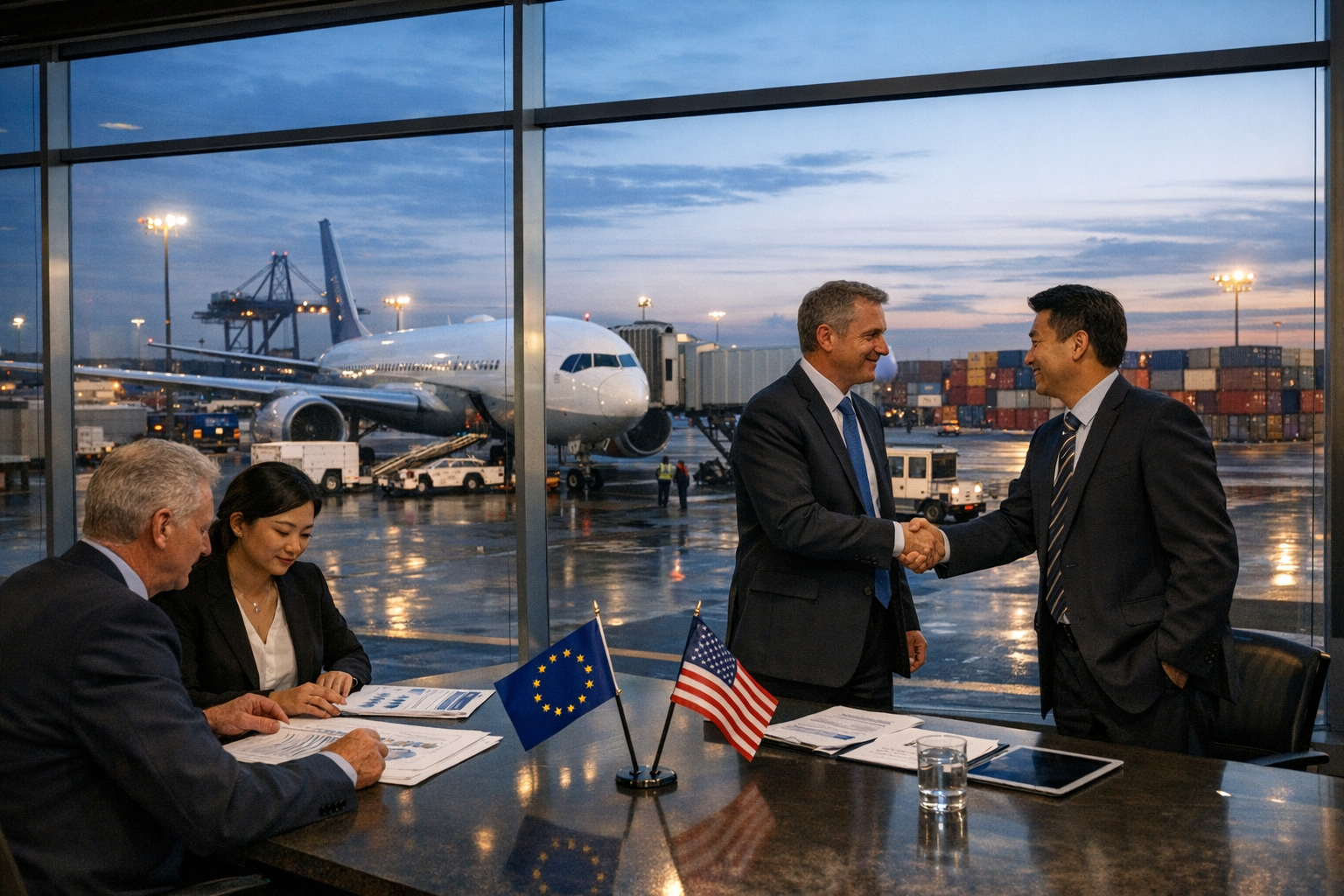
Trade channels begin to reopen on two fronts
The European Union moved on Wednesday to put into effect a long-delayed trade agreement with the United States, while China publicly confirmed a major purchase of Boeing aircraft and cast aviation as a promising area for cooperation with Washington — twin developments that suggest some of the world’s most consequential trade relationships are beginning to stir after years of tariff threats and geopolitical strain.
In Brussels, negotiators from the European Parliament and the bloc’s member states reached a provisional deal to implement the tariff provisions of the EU-U.S. accord struck last August. The agreement would cut or eliminate EU import duties on a range of American goods, clearing a major obstacle that had kept the deal in limbo for months.
The breakthrough is not yet the final legal step. Technical work and formal adoption still lie ahead. But European officials signaled that the path is now clear for the measures to enter into force in time to head off the latest threat of higher U.S. tariffs.
At nearly the same moment, Beijing confirmed that it would buy 200 Boeing planes, the first major Chinese order for the American manufacturer in almost a decade. Chinese officials also said the United States would ensure the supply of engines and spare parts, underscoring the unusually practical nature of the arrangement and pointing to aviation as a rare area where the two sides can still produce tangible commercial results.
Taken together, the moves amount to a notable shift in tone. They do not erase deep disputes over industrial policy, national security or strategic competition. But they suggest that even in an era of more fragmented global commerce, governments are still willing to carve out deals in sectors where the economic stakes are too high to ignore.
Europe tries to avert a tariff clash
For the European Union, the urgency is clear: avoid a fresh tariff escalation with Washington.
The EU-U.S. trade agreement was reached on Aug. 21, 2025, but ratification inside the bloc stalled as lawmakers objected to pressure from President Donald Trump, whose tariff threats and broader confrontations with European allies had hardened political resistance. The implementing legislation had become entangled in that backlash, leaving businesses uncertain whether the accord would ever take effect.
Wednesday’s provisional deal represents an effort to break that impasse. Under the package, the European Union would remove duties on most U.S. goods covered by the agreement, while preserving safeguards intended to reassure skeptical lawmakers. The European Commission would retain the authority to suspend concessions if Washington failed to honor the arrangement or otherwise disrupted trade relations. The regime would also expire at the end of 2029 unless renewed.
Those provisions reflect the uneasy balance at the heart of the deal. European governments want to keep access to the American market and avoid being hit by new tariffs. But they have also been reluctant to appear as though they are yielding unconditionally to White House pressure.
That tension has defined transatlantic trade relations for years. Since Trump’s first term, European officials have had to navigate a Washington that has been more willing to use tariffs as leverage not only against rivals but also against longstanding allies. The latest EU step suggests that, for now, Brussels has decided that reducing immediate economic risk outweighs the political costs of moving ahead.
Boeing order signals selective thaw with Beijing
The China-Boeing announcement carries its own symbolism.
Boeing had been largely shut out of major Chinese orders for years, a casualty of worsening U.S.-China relations, regulatory disputes and broader commercial mistrust. China’s confirmation of a 200-plane purchase therefore stands out not only as a boost for Boeing, but also as evidence that politically sensitive sectors can still yield agreements when both governments see a practical benefit.
The aircraft order follows talks between Mr. Trump and President Xi Jinping and appears to fit within a broader effort to stabilize commercial ties without resolving the deeper rivalry between the two countries. Beijing also said it wanted to extend the tariff-truce framework reached in Kuala Lumpur last year, another indication that both sides are at least testing whether selective détente is possible.
Aviation is a natural place to start. China needs aircraft to serve a vast and growing travel market. Boeing needs access to one of the world’s most important buyers. And because commercial aircraft depend on long production cycles, maintenance networks and certified components, any deal that includes commitments on engines and spare parts signals a higher level of operational coordination than a simple headline order.
Still, many details remain unclear, including which aircraft models are involved, when they would be delivered and how durable the broader thaw may prove to be.
Why this matters now
The significance of the day’s developments lies less in any single tariff cut or aircraft sale than in the message they send about the current phase of global trade diplomacy.
For much of the past decade, the dominant story was one of breakdown: tariff wars, export controls, sanctions and industrial subsidies reshaping supply chains around political lines. That dynamic has hardly disappeared. Europe remains wary of American protectionism. Washington and Beijing continue to clash over technology, security and influence. And neither of Wednesday’s moves guarantees lasting stability.
But both developments show that governments are still searching for narrower channels of cooperation even as strategic mistrust persists.
For Europe, implementing the U.S. deal may lower the immediate risk of punitive tariffs that could hit exporters already facing weak growth and industrial anxiety at home. For the United States and China, the Boeing order offers a visible demonstration that commercial ties are not frozen, even in a relationship defined increasingly by rivalry.
The open question is whether these are isolated transactions or the start of something broader. The EU agreement still requires final approval, and it is not certain that Washington will refrain from new tariff threats once Europe has acted. The China-Boeing arrangement, meanwhile, could remain a limited exception rather than a template for wider normalization.
For now, though, after years in which trade policy was dominated by retaliation and deadlock, the movement itself is notable. On both sides of the Atlantic and across the Pacific, the world’s largest economies are showing that even strained relationships can still make room for deals.
Sources
Further reading and reporting used to add context:
- Boeing secures a 200-plane order from China during Trump-Xi summit | AP News
- https://www.thedailybeast.com/trump-gives-embarrassingly-vague-answer-about-xi-meeting/
- https://taxation-customs.ec.europa.eu/news/provisional-application-eu-mercosur-interim-trade-agreement-begins-1-may-2026-2026-04-24_en
- EU paves way to finalise US trade deal and avoid Trump tariff hike By Reuters
- https://www.opb.org/article/2026/05/16/trump-and-boeing-say-china-agreed-to-buy-200-aircraft-reopening-a-key-market-for-the-us-planemaker/
- EU-US trade: Council and Parliament strike a deal to implement the tariff elements of the Joint Statement – Consilium
- https://www.scmp.com/news/china/diplomacy/article/3353826/china-confirms-deal-buy-us-aircraft-and-engines-after-donald-trumps-visit?module=inline&pgtype=article
- https://www.bloomberg.com/news/articles/2026-05-14/boeing-wins-200-jet-plane-order-from-china-trump-says
- China says it will buy 200 Boeing jets, seek extension of US tariff truce By Reuters
- https://www.globalbankingandfinance.com/eu-strikes-provisional-agreement-finalize-us-trade-deal/
- https://www.theguardian.com/world/2026/may/20/eu-european-union-to-implement-us-trade-deal
- https://www.washingtonpost.com/business/2026/05/15/trump-china-summit-boeing/7e490a68-505f-11f1-97e7-22c6c29ff0d8_story.html
- https://english.news.cn/20260520/0b7674584fe941469d57eabfe75d4785/c.html
- https://www.investing.com/news/stock-market-news/china-has-agreedto-buy-200-boeing-jets-trump-says-4689429
- https://www.consilium.europa.eu/en/press/press-releases/2025/11/28/eu-us-trade-relations-council-moves-forward-in-implementing-the-tariff-elements-of-the-joint-statement/pdf/
- https://www.europarl.europa.eu/legislative-train/carriage/implementation-of-certain-tariff-aspects-of-the-2025-eu-us-framework-agreement/report?sid=9901
- https://www.reddit.com/r/boeing/comments/1td4rm5/china_has_agreed_to_buy_200_boeing_jets_trump_says/
- https://en.wikipedia.org/wiki/EU%E2%80%93Mercosur_Partnership_Agreement