
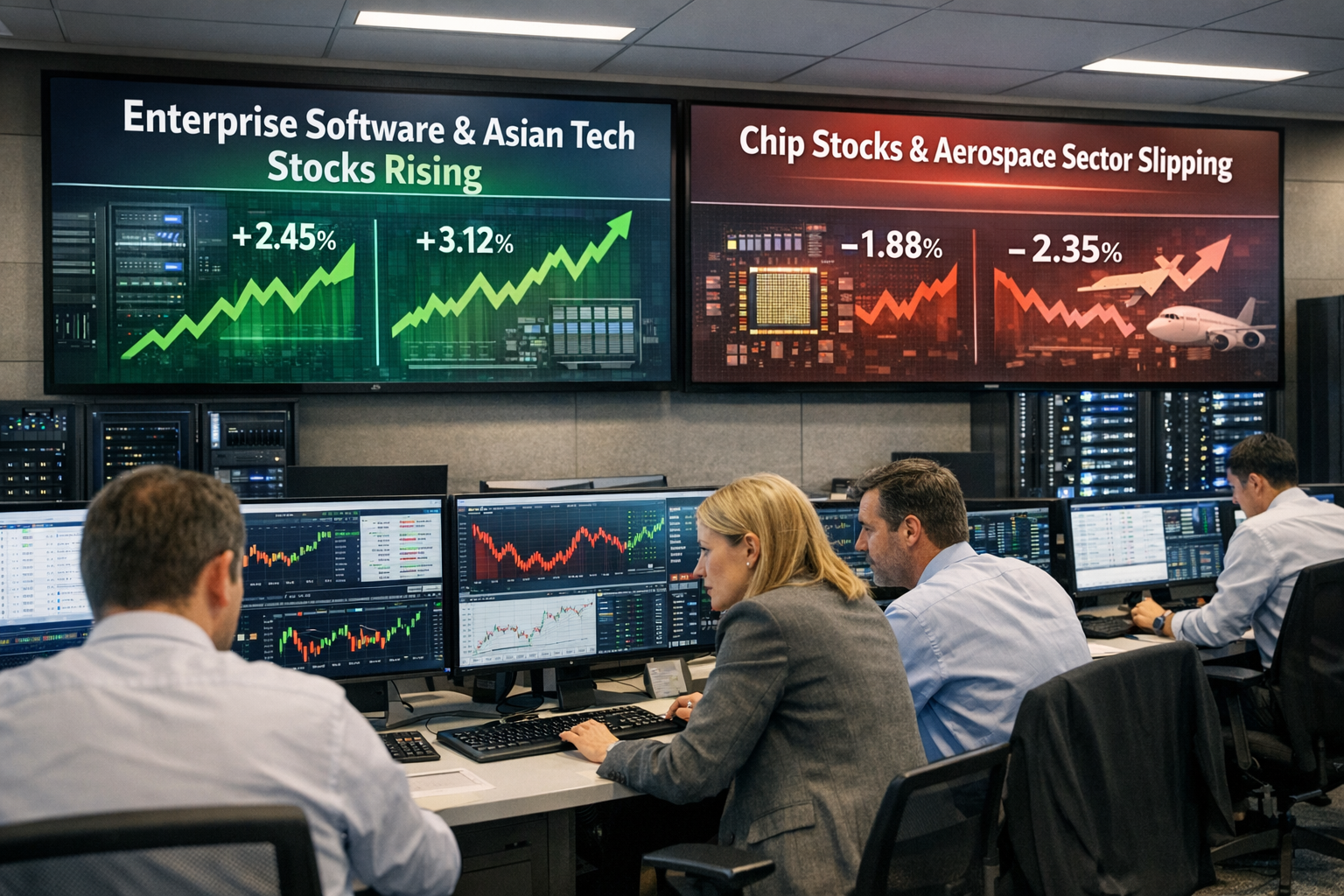
The artificial-intelligence trade is entering a more discriminating phase.
A burst of earnings and market reactions this week showed that investors are no longer content to reward companies simply for being adjacent to the technology that has electrified global markets. Instead, they are drawing sharper lines between businesses that can already translate AI demand into revenue and those that are still asking shareholders to tolerate heavier spending, thinner margins or a longer wait for payoff.
That divide was on vivid display across the United States and Asia. Palantir Technologies soared after delivering results that investors read as proof that AI enthusiasm can be turned into immediate business gains. SoftBank Group, one of Asia’s most closely watched AI proxies, surged in Tokyo as the rally spread beyond American megacaps. But Advanced Micro Devices fell even after posting strong growth, and SpaceX dropped after investors balked at a jump in AI-related spending.
A market that wants proof
Palantir offered perhaps the clearest example of what investors are rewarding now. Shares jumped roughly 29 percent after the company reported what its chief executive, Alex Karp, called an “otherworldly” quarter. Revenue rose 93 percent from a year earlier, and the company lifted its outlook for 2026, reinforcing a narrative that it is converting intense interest in enterprise AI into rapidly expanding sales.
Mr. Karp, in characteristically combative terms, said customers had “declined to become vassal states of the language labs,” casting Palantir as an alternative to companies building large, general-purpose AI models. Investors appeared to embrace that positioning, seeing in Palantir a company with a clearer path to monetization at a moment when many businesses are still trying to prove AI can be more than an expensive promise.
The reaction underscored a broader shift in sentiment that has been building through 2026. For much of the AI boom, markets often moved in broad waves, lifting nearly any company tied to chips, cloud computing, data centers or software. But as valuations stretched and capital spending climbed, investors began asking more pointed questions: Which companies are truly generating profits from AI? Which are simply spending aggressively in hopes of eventually doing so?
Strong numbers, insufficient comfort
AMD’s results showed how high the bar has become. The chipmaker reported a 50 percent rise in revenue, with data-center sales more than doubling from a year earlier. By most traditional measures, those figures would suggest a company firing on all cylinders, particularly in one of the hottest segments of the market.
Yet the stock fell.
The decline reflected a familiar dynamic in this stage of the AI cycle: strong growth is not always enough when expectations have already surged ahead. Investors have increasingly demanded signs not only that companies are benefiting from AI demand, but also that they can do so at a pace that justifies lofty valuations and relentless spending on compute infrastructure.
AMD is central to the physical buildout of AI, supplying chips that compete for a share of the booming data-center market. But that strategic importance has also left it vulnerable to disappointment whenever results, guidance or margins fail to clear an elevated hurdle.
SpaceX faced a different version of the same problem. Its shares slid 10 percent after the company’s first results as a public company showed a sharp increase in AI-related spending, unsettling investors who were looking for reassurance that new investments would not overwhelm near-term financial discipline. Elon Musk sought to strike an optimistic tone, saying SpaceX would reach $1 trillion in annual revenue in 2030, a year earlier than a prior forecast.
The promise of future scale, however, did not offset concern about current costs. In the present market, investors appear more willing to punish companies that ask them to wait for returns, especially when AI spending is accelerating across the corporate landscape and financing those bets is becoming a larger part of the investment debate.
The AI trade spreads in Asia
If Palantir represented the market’s appetite for immediate AI revenue, SoftBank highlighted how the trade is broadening geographically.
Shares in the Japanese conglomerate climbed about 13 percent as technology stocks across Asia followed Wall Street’s AI rally. The move added to evidence that enthusiasm once concentrated in a handful of American giants is now reshaping markets in Japan, South Korea and elsewhere in the region.
SoftBank has become a particularly potent stand-in for AI optimism. Its exposure runs through Arm, the chip designer whose architecture underpins much of modern computing, as well as investments linked to OpenAI and a wider push into data centers and “neocloud” infrastructure aimed at serving AI demand. For investors seeking ways to play the expansion of AI ecosystems beyond the dominant U.S. platforms, SoftBank has emerged as a favored proxy.
That enthusiasm has at times been intense enough to transform regional benchmarks and fuel sharp volatility. In recent months, Asian tech shares have swung as investors weighed whether AI-driven earnings can continue to justify a global capital-spending boom. SoftBank’s jump suggested that, for now, the answer from many traders remains yes — or at least that momentum is still powerful enough to carry the rally further.
A new earnings-season test
What has changed is not the market’s fascination with AI, but its tolerance for ambiguity.
Earlier phases of the boom often revolved around broad arguments over hype versus reality. This earnings season is producing a more nuanced test. Companies are being judged less on whether they mention AI and more on whether they can show what it is doing for revenue, margins and cash flow right now.
Palantir passed that test decisively. AMD, despite robust growth, showed how punishing the market can be when the result feels less spectacular than what investors had already priced in. SpaceX illustrated another fault line: spending tied to AI may excite investors only until it begins to threaten profitability or increase uncertainty around timing of returns.
The stakes are high because AI capital expenditure is no longer an abstract future bet. Across the technology sector, companies are pouring money into chips, servers, data centers, software and energy-hungry infrastructure required to train and run advanced models. That buildout has helped drive records in equity markets, but it has also raised pressure on executives to demonstrate that the spending will produce more than revenue growth alone.
What investors are watching next
The next question is whether this sharper sorting continues.
For Palantir, investors will want to know whether near-vertical growth can be sustained after such a dramatic move in the stock. For AMD, the challenge is to keep expanding AI-related sales fast enough to satisfy a market that has already rerated the company as a major beneficiary of the buildout. For SpaceX, the focus is likely to remain on how quickly heavy AI spending can translate into returns. And for SoftBank, skeptics will ask whether the rally reflects durable earnings power or another momentum-driven chapter in a market prone to sudden reversals.
For now, one lesson is becoming clear: in 2026, AI remains the dominant force in technology investing, but not all AI stories are treated equally. The market is still willing to reward ambition. It is simply demanding more evidence.
Sources
Further reading and reporting used to add context:
- https://www.axios.com/2026/08/04/spacex-earnings-elon-musk
- https://www.axios.com/newsletters/axios-closer-f8186890-7ddf-4084-b60d-d84a9e794345
- https://apnews.com/article/fbbe6128d618509e33d45a493c2615b1
- https://apnews.com/article/3b7b66a3e522e51d75caebc40af7e09e
- https://www.investing.com/news/stock-market-news/musk-says-spacex-could-bring-1-trillion-in-revenue-by-2030-4741195
- https://www.reddit.com/r/stocks/comments/1vfmfwe/amds_revenue_climbs_50_and_data_center_sales/
- https://www.amd.com/en/newsroom/press-releases/2026-5-5-amd-reports-first-quarter-2026-financial-results.html
- https://www.investing.com/news/stock-market-news/us-tech-megacaps-slide-as-spacex-extends-slump-ai-expense-concerns-grow-4753407
- https://www.cnbc.com/2025/08/20/palantir-stock-selloff-ai.html?msockid=142e1e4b0e376e5a31e008040f706f03
- https://www.investing.com/news/stock-market-news/asias-tech-giants-give-ai-bull-run-a-new-centre-of-gravity-4666527
- https://www.reddit.com/r/wallstreetbets/comments/1vfn053/amds_revenue_climbs_50_and_data_center_sales/
- https://www.investing.com/news/stock-market-news/asia-stocks-rise-on-ai-enthusiasm-focus-on-trumpxi-summit-4687031
- https://www.investing.com/news/stock-market-news/how-korean-stocks-turned-from-trusty-bellwether-to-ai-frenzy-4799743
- https://ir.amd.com/news-events/press-releases/detail/1289/amd-to-report-fiscal-second-quarter-2026-financial-results
- https://group.softbank/en/news/press
- https://ir.amd.com/
- https://group.softbank/en/news/press/20260702
- https://ir.amd.com/financial-information/sec-filings/content/0000002488-26-000072/q12026991.htm
- https://ir.amd.com/news-events/ir-calendar
- https://group.softbank/news/press
- https://group.softbank/en/ir
- https://group.softbank/en/news/press/20260227
- https://group.softbank/en/news/webcast/20260616
- https://ir.amd.com/financial-information/sec-filings/content/0000002488-26-000076/amd-20260328.htm
- https://group.softbank/en/news/info?category%5Bwarning%5D=warning&year=2025
- https://group.softbank/en/media/Project/sbg/sbg/pdf/ir/presentations/2025/investor-presentation_q2fy2025_01_en.pdf
- https://group.softbank/media/Project/sbg/sbg/pdf/ir/presentations/2025/earnings-presentation_q4fy2025_01_en.pdf
- https://ir.amd.com/sec-filings/content/0000002488-24-000121/0000002488-24-000121.pdf
- https://ir.amd.com/sec-filings/content/0000002488-25-000009/0000002488-25-000009.pdf
- https://www.gulf-times.com/pdf/2026/05/22/business-20260522-1.pdf?ts=003725
- https://group.softbank/media/Project/sbg/sbg/pdf/ir/financials/annual_reports/annual-report_fy2025_02_en.pdf
- https://www.reddit.com/r/wallstreetbets/comments/1vbb95o/sk_hynix_and_samsung_shares_surge_over_20_as_ai/
- https://www.reddit.com/r/technology/comments/1tzx55d/asia_tech_stocks_extend_selloff_with_softbank/
- https://www.reddit.com/r/EverHint/comments/1vfx937/stock_market_news_august_04_2026_evening_update/
- https://www.reddit.com/r/EverHint/comments/1ufwqxr/stock_market_news_june_25_2026_evening_update/
- https://www.reddit.com/r/Mag7shares/comments/1v9m1p0/asian_technology_stocks_extend_selloff_with/
- https://www.reddit.com/r/RWATimes/comments/1vbeaba/asia_stocks_surge_yen_in_the_spotlight_after/
- https://www.palantir.com/q2-2025-letter/en/
- https://www.sec.gov/Archives/edgar/data/1321655/000132165525000105/a2025q2ex991pressrelease.htm
- https://www.broadcom.com/company/news/financial-releases/64371
- https://markets.ft.markitdigital.com/data/announce/detail?dockey=600-202607131605BIZWIRE_USPRX____20260713_BW475194-1
- https://investor.hp.com/news-events/news/news-details/2026/HP-Inc–Reports-Fiscal-2026-Second-Quarter-Results/default.aspx
- https://www.sec.gov/Archives/edgar/data/1321655/000132165526000004/a2025q4ex991earningsrelease.htm
- https://www.paloaltonetworks.com/company/press/2026/palo-alto-networks-reports-fiscal-second-quarter-2026-financial-results
- https://investor.ptc.com/resources/news/news-details/2026/PTC-ANNOUNCES-SECOND-FISCAL-QUARTER-2026-RESULTS/default.aspx
- https://www.microsoft.com/en-us/Investor/earnings/FY-2026-Q2/press-release-webcast
- https://paloaltonetworks.gcs-web.com/news-releases/news-release-details/palo-alto-networks-reports-fiscal-second-quarter-2026-financial
- https://www.sec.gov/Archives/edgar/data/1321655/000132165526000026/a2026q1ex991pressrelease.htm
- https://investors.palantir.com/events.html
- https://www.reddit.com/r/newswall/comments/1vfm2aw/palantir_reports_93_percent_secondquarter_revenue/
- https://www.reddit.com/r/Palantir_Investors/comments/1vft355/cnbc_reports_obscene_palantir_profits_expanding/
- https://investors.palantir.com/files/2026%20Q1%20PLTR%2010-Q.pdf
- https://www.reddit.com/r/dotaddaknowledge/comments/1vf7g6i/pltr/
- https://www.reddit.com/r/PLTR/comments/1ve60rq/daily_thread_monday_discussion_lets_talk_about/
- https://www.reddit.com/r/wallstreetbets/comments/1veow56/palantir_raises_outlook_on_blowout_q2_numbers_us/
- https://www.stocktitan.net/news/PLTR/palantir-announces-date-of-second-quarter-2026-earnings-release-and-pb0p9gl5pf2d.html
- https://www.stocktitan.net/news/PLTR/
- https://www.stocktitan.net/overview/PLTR/
- https://www.stocktitan.net/sec-filings/PRGS/8-k-progress-software-corp-ma-reports-material-event-4008c808ee1d.html
- https://palatin.com/press_releases/palatin-reports-second-quarter-fiscal-year-2026-financial-results-and-provides-corporate-update/
- https://stocktwits.com/news-articles/markets/equity/pltr-q1-revenue-jump-quadrupled-profits-but-valuation-concerns-persist/cZQudVUReJA
- https://www.stocktitan.net/sec-filings/PLTR/8-k-palantir-technologies-inc-reports-material-event-e4ff3e917756.html
- https://www.stocktitan.net/news/TTAN/service-titan-announces-fiscal-second-quarter-financial-z2gcxk6s8gzg.html
- https://www.stocktitan.net/news/PLTR/palantir-reports-q2-2025-u-s-comm-revenue-growth-of-93-y-y-and-fc3tzd7xywbe.html
- https://www.reddit.com/r/stocks/comments/1veomq6/palantir_posts_blowout_q2_numbers_with_us/
- https://www.reddit.com/r/StockMarket/comments/1vep41k/palantir_earning_exploded_to_150/
- https://www.reddit.com/r/StockMarket/comments/1ve9d7j/palantir_earnings_preview_why_81_revenue_growth/
- https://www.reddit.com/r/Palantir_Investors/comments/1vf1tsh/pltr_update_earnings_beast_overnight_ripping/
- https://www.reddit.com/r/u_insights-center/comments/1veywf6/pltr_up_14_today_after_crushing_q2_earnings_heres/
- https://www.kiplinger.com/investing/stocks/17494/next-week-earnings-calendar-stocks
- https://www.amd.com/en/newsroom/press-releases/2026-7-8-amd-to-report-fiscal-second-quarter-2026-financial.html
- https://www.amd.com/en/newsroom/press-releases/2025-8-5-amd-reports-second-quarter-2025-financial-results.html
- https://ir.amd.com/financial-information/financial-results
- https://ir.amd.com/news-events/press-releases
- https://ir.amd.com/news-events/ir-calendar/detail/20260804-amd-fiscal-second-quarter-2026-financial-results
- https://ir.amd.com/financial-information/sec-filings/content/0000002488-26-000014/q42025991.htm
- https://ir.amd.com/news-events/press-releases/detail/122/amd-reports-second-quarter-results
- https://ir.amd.com/financial-information/sec-filings/content/0000002488-26-000072/attachments/AMD%20Q1%2726%20Earnings%20Slides%20Final.pdf
- https://investor.analog.com/news-releases/news-release-details/analog-devices-reports-record-fiscal-second-quarter-2026
- https://investors.delltechnologies.com/news-releases/news-release-details/dell-technologies-delivers-second-quarter-fiscal-2026-financial
- https://ir.amd.com/financial-information/sec-filings/content/0000002488-25-000163/attachments/AMD%20Q3%2725%20Earnings%20Slides%20Final.pdf
- https://ir.amd.com/financial-information/sec-filings/content/0000002488-25-000106/0000002488-25-000106.pdf
- https://www.reddit.com/r/AMD_Stock/comments/1vfsfsn/amd_reports_second_quarter_2026_financial_results/
- https://ir.amd.com/financial-information/sec-filings/content/0000002488-25-000009/0000002488-25-000009.pdf
- https://ir.amd.com/financial-information/sec-filings/content/0000002488-25-000106/attachments/AMD%20Q2%2725%20Earnings%20Slides%20FINAL%202.pdf
- https://ir.amd.com/financial-information/sec-filings/content/0001193125-25-067185/0001193125-25-067185.pdf
- https://www.sec.gov/Archives/edgar/data/2488/000000248826000115/amd-20260626.htm
- https://www.sec.gov/Archives/edgar/data/2488/000000248826000045/0000002488-26-000045-index.htm
- https://www.sec.gov/Archives/edgar/data/2488/0000002488-26-000014-index.html
- https://www.sec.gov/Archives/edgar/data/1280263/000119312525191300/d103497d8k.htm
- https://www.sec.gov/Archives/edgar/data/1062579/000119312526222301/d143858dex991.htm
- https://www.sec.gov/Archives/edgar/data/1596532/000159653226000074/ex991q126-earningsrelease.htm
- https://www.sec.gov/Archives/edgar/data/2488/000119312526226746/0001193125-26-226746-index.htm
- https://www.sec.gov/Archives/edgar/data/2488/000000248826000002/0000002488-26-000002-index.htm
- https://www.sec.gov/Archives/edgar/data/1327688/000132768825000005/ooma-20250826.htm
- https://www.sec.gov/edgar/browse/index.html?cik=2488
- https://www.sec.gov/Archives/edgar/data/2488/000000248826000045/R1.htm
- https://www.sec.gov/Archives/edgar/data/2488/000000248826000072/q12026991.htm
- https://www.sec.gov/Archives/edgar/data/2488/000119312526129106/d46357dars.pdf
- https://www.sec.gov/Archives/edgar/data/83246/000110465921122081/tm2128535d61_424b2.pdf
- https://www.sec.gov/Archives/edgar/data/0000002488/000119312524076535/d648557dars.pdf
- https://www.investing.com/news/economy-news/instant-view-tech-stocks-dive-as-fed-bets-rattle-ai-rally-4729731
- https://www.investing.com/news/stock-market-news/softbank-shares-surge-13-lead-asia-tech-rally-on-nvidia-cheer-4459284
- https://au.investing.com/news/economy-news/asia-markets-brace-for-selling-after-tech-rout-hits-wall-street-4474915
- https://www.marketscreener.com/news/asian-stocks-surge-as-investors-focus-more-on-ai-than-middle-east-attacks-ce7f5ededf89f122
- https://ph.investing.com/news/stock-market-news/softbank-shares-surge-13-lead-asia-tech-rally-on-nvidia-cheer-2192539
- https://uk.investing.com/news/stock-market-news/asia-chip-stocks-slump-as-ai-rally-loses-steam-japan-skorea-worst-hit-4716694
- https://au.investing.com/news/stock-market-news/samsung-sk-hynix-slide-amid-nvidia-financing-worries-china-competition-4555278
- https://www.investing.com/news/stock-market-news/ai-anxiety-sparks-tech-rout-broad-selloff-in-asian-markets-4815405
- https://au.investing.com/news/stock-market-news/chip-stock-pullback-sparks-worries-about-ai-rally-strength-leveraged-trades-4539723
- https://baiphil.org/wp-content/uploads/2026/05/20260508_BMW.pdf
- US stocks hit records as profits keep piling up for Palantir and others, while oil prices ease
- Asia’s tech giants give AI bull run a new centre of gravity By Reuters
- SpaceX posts loss in first report as a public company but less than expected