
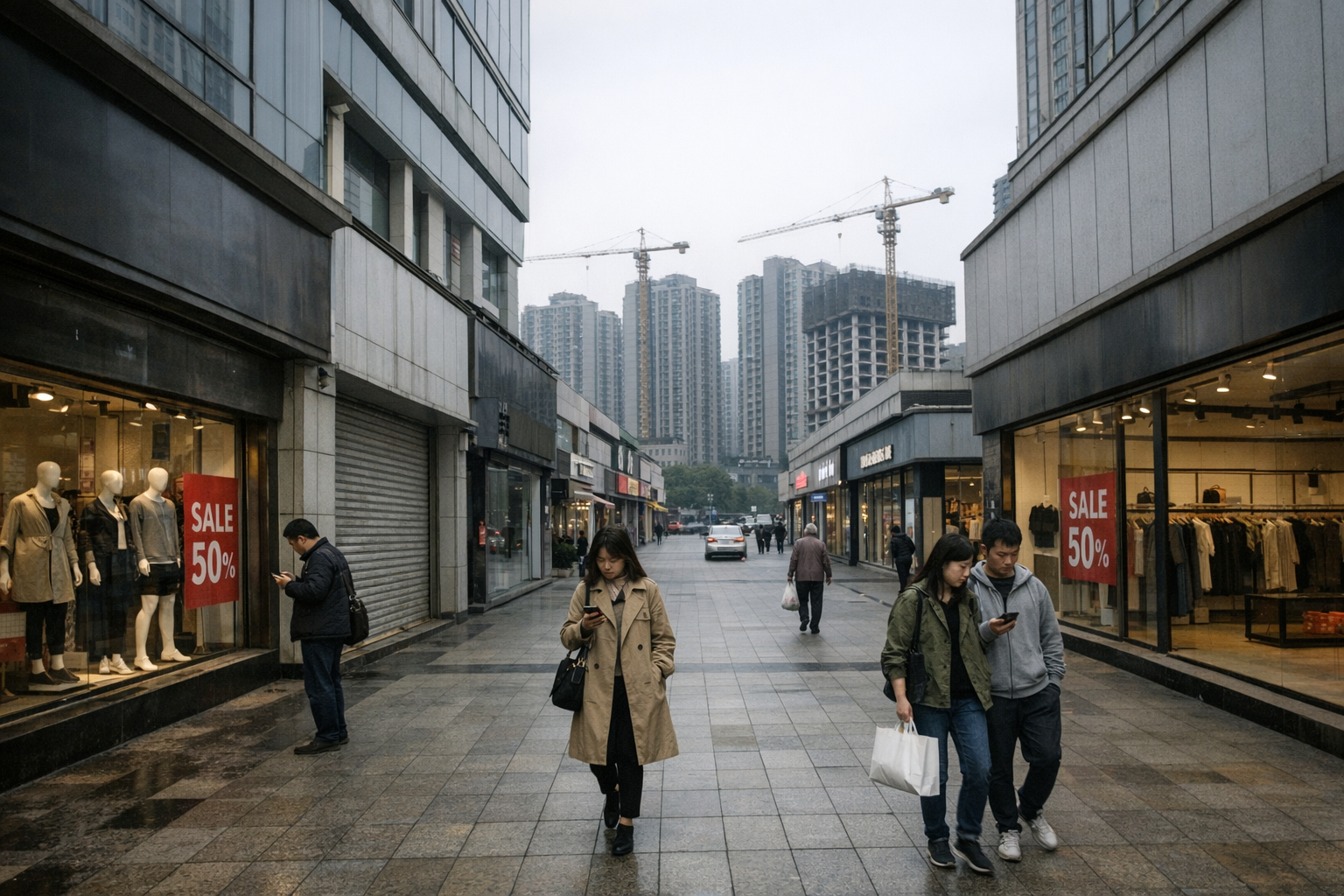
China’s domestic slowdown comes into sharper view
Fresh economic data from China suggest that the country’s slowdown is deepening at home, even as policymakers move on another sensitive front: reassuring wealthy families unnerved by new tax rules on offshore trusts.
The twin developments, unfolding days apart, point to a more pressured domestic picture than the one implied by recent attention to resilient exports and pockets of strength in advanced manufacturing. Consumption remains weak, investment is deteriorating and factory activity has slipped back into contraction, underscoring the challenge facing Beijing as it tries to stabilize growth without unleashing the kind of broad stimulus it has long sought to avoid.
Official figures released in mid-July showed that China’s economy grew 4.3 percent in the second quarter from a year earlier, a deceleration that reflected soft household spending and a prolonged downturn in property-related activity. Retail sales in June rose just 1.0 percent, a subdued pace for an economy that policymakers have repeatedly said they want to rebalance toward consumption. Fixed-asset investment fell 5.7 percent in the first half of the year, deepening a slump in a category that has long been central to China’s growth model.
By the end of July, another gauge reinforced the message. China’s official manufacturing purchasing managers’ index slipped back below the 50 mark that separates expansion from contraction, signaling that demand remained weak going into the new month.
Taken together, the numbers suggest that the world’s second-largest economy is still wrestling with a difficult imbalance: selected export industries and technology manufacturing have held up relatively well, but households and private-sector investors remain cautious. The property slump, which has dragged on far longer than many officials initially expected, continues to weigh on confidence, local government finances and broader spending.
A recovery that remains uneven
The weakness did not emerge suddenly. Earlier data had already shown retail sales falling in May for the first time in more than three years, while investment indicators were deteriorating further. Economists have increasingly described the economy as split between relatively strong supply in manufacturing and much softer demand at home.
That mismatch has become one of the defining features of China’s post-pandemic slowdown. Factories in favored sectors have continued to expand capacity, helped by policy support and overseas demand, but Chinese consumers have remained restrained, reflecting uncertainty about jobs, incomes and housing values. Businesses, meanwhile, have been reluctant to commit to new investment in the face of weak demand and a still-fragile private-sector mood.
The result is an economy in which headline growth is increasingly difficult to sustain without stronger domestic momentum. That raises pressure on Beijing to do more, particularly as leaders have emphasized the need to boost consumption but have so far been measured in rolling out large-scale household support.
Beijing moves to calm wealthy taxpayers
At the same time, authorities have been trying to contain another source of anxiety: confusion over new tax rules covering offshore trusts, a common vehicle used by wealthy Chinese families in places such as Hong Kong and other financial centers.
The rules, introduced on July 24, subjected assets transferred into offshore trusts, and income generated there, to individual income-tax treatment. They also gave taxpayers a 90-day grace period to settle unpaid tax tied to trusts dating back to January 2023 without incurring late-payment penalties.
But the rollout quickly stirred uncertainty among high-net-worth families and advisers, particularly over how the measures would apply in practice. In response, Beijing moved within days to clarify ambiguities, according to reports, in an apparent effort to improve compliance and shore up revenue collection without provoking unnecessary financial disruption.
The episode highlights a delicate balancing act. Chinese authorities are seeking to tighten tax enforcement and close gray areas in offshore wealth arrangements, even as they try to avoid sending a destabilizing signal to affluent households at a time when confidence is already fragile. For a leadership trying to revive domestic demand, unnerving wealthy consumers and investors would carry risks of its own.
Why the two developments intersect
On the surface, weak retail sales and offshore trust taxation concern very different parts of the economy. But together they illuminate the same underlying problem: the pressure point in China remains domestic.
For policymakers, that means the challenge is not simply producing enough goods or maintaining export competitiveness. It is persuading households to spend, businesses to invest and wealthier families to keep assets and economic activity within a system that is becoming more tightly regulated.
The trust-tax clarification also comes at a politically and economically sensitive moment. With growth slowing and local governments under strain, tax enforcement can help raise revenue and demonstrate policy discipline. Yet if rules are perceived as abrupt or unclear, they can deepen caution among exactly the social groups that Beijing would prefer to keep stable.
Whether the clarifications are enough to calm wealthy taxpayers remains uncertain. They may steady expectations, but they could also accelerate efforts to restructure offshore holdings. Much will depend on how authorities implement the rules in the coming months and whether families conclude that the compliance burden is manageable.
Pressure for more policy support
The broader question now is how Beijing responds to the weakening data. Analysts have been debating whether the government will introduce more forceful support measures and, if so, whether those steps will focus on consumption rather than the more familiar playbook of infrastructure and industrial backing.
That distinction matters. More supply-side support could bolster favored sectors but do little to address the shortfall in household demand. Measures aimed at raising incomes, improving social protections or relieving strains from the property downturn would speak more directly to the causes of weak spending, though such policies can be more politically and fiscally difficult.
Another uncertainty is how long exports can keep cushioning the broader slowdown. Overseas demand and competitiveness in some manufacturing categories have offered China important support, but that buffer may not be enough if domestic consumption and investment continue to sag.
For now, the latest data and the swift tax-policy clarifications tell a similar story. China’s leadership is managing an economy that looks sturdier in a few headline sectors than it does underneath, where confidence remains weak and the need for stability is growing more urgent.
Sources
Further reading and reporting used to add context:
- https://www.investing.com/news/economy-news/chinas-factory-activity-expected-to-have-stalled-in-july-4822418
- https://www.investing.com/news/economy-news/chinas-may-retail-sales-fall-for-first-time-in-over-three-years-4743743
- https://www.investing.com/news/economy-news/chinas-q2-gdp-growth-slows-to-43-yy-misses-market-forecast-4792122
- https://www.investing.com/news/economy-news/chinas-q2-growth-set-to-lose-steam-stimulus-to-remain-calibrated-4791821
- https://english.scio.gov.cn/pressroom/2026-07/27/content_118619159.html
- https://www.investing.com/news/economic-indicators/china%27s-economic-activity-slows-in-july-as-reforms-begin-to-bite-419933
- https://www.investing.com/news/economy-news/chinas-secondquarter-economic-growth-misses-market-forecast-4792126
- https://www.marketscreener.com/news/china-s-growth-slides-as-fears-grow-over-unbalanced-economy-ce7f5eddd189f42c
- https://economictimes.indiatimes.com/news/international/world-news/chinas-q2-gdp-growth-cools-to-3-1/2-year-low-structural-imbalances-complicate-policy/articleshow/132405889.cms
- https://www.investing.com/news/economic-indicators/china-july-industrial-output-up-64-retail-sales-miss-forecasts-2590295
- https://www.investing.com/news/economy-news/chinas-premier-urges-objective-understanding-of-the-economy-4788246
- https://economictimes.indiatimes.com/markets/stocks/news/rekha-jhunjhunwala-sells-over-7-crore-star-health-shares-in-q1-details-here/articleshow/132577312.cms
- https://www.reddit.com/r/TorontoRealEstate/comments/1vekyf1/china_to_tax_offshore_trusts_as_beijing_targets/
- https://www.reddit.com/r/Economics/comments/1vg8nvw/chinas_superrich_in_shock_and_hunting_for_cash_as/
- https://think.ing.com/downloads/pdf/article/chinas-july-activity-data-slump-shows-stimulus-is-still-needed
- https://www.reddit.com/r/Economics/comments/1voaaqp/us_retail_sales_post_first_decline_in_nine_months/
- https://www.reddit.com/r/Dynamic_Pricing/comments/1vfutd9/chinas_superrich_in_shock_and_hunting_for_cash_as/
- https://www.reddit.com/r/worldnews/comments/1vh01y4/chinas_superrich_in_shock_and_hunting_for_cash_as/
- https://www.zonebourse.com/actualite-bourse/la-chine-va-taxer-les-trusts-offshore-pekin-cible-la-fortune-de-ses-ressortissants-a-l-etranger-ce7f51dfda8dff27
- https://m.economictimes.com/markets/stocks/news/china-imposes-20-tax-on-offshore-trusts-targeting-wealth-abroad/amp_articleshow/132577312.cms
- https://in.marketscreener.com/news/china-to-tax-offshore-trusts-as-beijing-targets-overseas-wealth-ce7f51dfda8dff27
- https://www.scmp.com/business/china-business/article/3361907/china-cracks-down-offshore-trusts-new-tax-rules-wealthy
- https://www.investing.com/news/economy-news/chinas-factory-activity-unexpectedly-shrinks-in-july-4826670
- https://www.scmp.com/business/china-business/article/3361907/china-cracks-down-offshore-trusts-new-tax-rules-wealthy?module=most_popular&pgtype=section
- https://www.reddit.com/r/worldinsights/comments/1ukhuxj/chinas_economy_is_cooling_and_the_problem_reaches/
- https://www.reddit.com/r/AusFinance/comments/1vgh6fz/chinas_superrich_in_shock_and_hunting_for_cash_as/
- https://www.arabtimesonline.com/arabtimes/uploads/images/2026/07/19/135527.pdf
- https://www.reddit.com/r/China/comments/1v013qo/q2_gdp_at_43_vs_record_june_exports_which_number/
- https://www.reddit.com/r/ausmoney/comments/1vh88i5/chinas_superrich_in_shock_and_hunting_for_cash_as/
- https://www.lemonde.fr/en/economy/article/2026/08/15/china-targets-its-ultra-wealthy-living-abroad-in-tax-bid_6756550_19.html
- https://www.reddit.com/r/RWATimes/comments/1vfvaor/chinas_superrich_in_shock_and_hunting_for_cash_as/
- https://www.reddit.com/r/AusPropertyChat/comments/1vgnqpv/china_targets_offshore_trusts_with_new_tax_rules/
- https://apnews.com/article/65f886fe432f007e02871bf484b28656
- https://thedocs.worldbank.org/en/doc/0cb2fc6dd88d4db3816dc0433b5cb49b-0070012026/original/CEU-July-2026-EN.pdf
- https://www.reddit.com/r/China/comments/1vfxa68/china_launches_global_tax_hunt_going_back_decades/
- https://qnbvaward.com/sites/qnb/qnbfs/document/en/arDMR15September2024
- https://www.stats.gov.cn/english/PressRelease/index.html
- https://www.stats.gov.cn/english/PressRelease/202602/t20260228_1962661.html
- https://www.stats.gov.cn/english/PressRelease/202607/t20260717_1964160.html
- https://www.stats.gov.cn/sj/zxfb/202308/t20230815_1941957.html
- https://www.stats.gov.cn/sj/zxfbhjd/202509/t20250915_1961181.html
- https://www.stats.gov.cn/english/PressRelease/ReleaseCalendar/202512/t20251226_1962154.html
- https://www.stats.gov.cn/english/NewsEvents/200908/t20090811_26214.html
- https://www.stats.gov.cn/english/PressRelease/202509/t20250915_1961179.html?outputType=chromeless
- https://english.www.gov.cn/archive/statistics/202607/15/content_WS6a572b59c6d00ca5f9a0c34d.html
- https://www.stats.gov.cn/english/PressRelease/202607/t20260717_1964156.html
- https://www.stats.gov.cn/sj/?eqid=a3af5207001569c400000004646e29c6
- https://www.stats.gov.cn/english/PressRelease/202606/t20260617_1963965.html
- https://gia.info.gov.hk/general/202509/15/P2025091200738_510568_1_1757920565422.pdf
- https://www.stats.gov.cn/english/PressRelease/202002/P020200228518430909972.pdf
- https://www1.hkexnews.hk/listedco/listconews/sehk/2026/0127/2026012700635.pdf
- https://www.youtube.com/watch?v=IHEHFo7POgo
- https://www.stats.gov.cn/sj/ndsj/2024/html/zbe10.pdf
- https://apnews.com/article/a9a5016ca01d4f65e0491ff5327c0a11
- https://apnews.com/article/95136222f87d5a1e62918f41efab00be
- https://apnews.com/article/c50a9f1640e6e311cc6d4ef82c5720b9
- https://apnews.com/article/3e2bc5807d7396b8e6c5f599941cb2a9
- https://www.investing.com/news/economy-news/chinas-july-factory-output-retail-sales-growth-miss-forecasts-4194478
- https://www.uscc.gov/trade-bulletins/china-bulletin-july-23-2026
- https://kreab.com/beijing/insight/weekly-china-insight-17-july-2026/
- https://ca.investing.com/news/economic-indicators/china-industrial-output-growth-slows-in-july-retail-sales-miss-forecast-4161375?ampMode=1
- https://www.cmegroup.com/education/events/econoday/643261
- https://www.investing.com/news/economic-indicators/china-industrial-production-retail-sales-grow-less-than-expected-in-august-4237872
- https://www.ashmoregroup.com/en-co-aiac/document/weekly-18aug25
- https://news.bloomberglaw.com/tariff-news/chinas-economy-slows-sharply-in-ominous-sign-for-outlook-2
- https://news.bloomberglaw.com/capital-markets/china-crackdown-rattles-the-rich-in-worlds-top-offshore-hub
- https://kpmg.com/cn/en/insights/2026/07/china-tax-alert-05.html
- https://uk.finance.yahoo.com/news/china-targets-offshore-trusts-tax-101736326.html/
- https://businessmirror.com.ph/2026/06/16/chinese-economy-stalls-with-investment-consumption-in-big-slump/
- https://www.bloomberglinea.com/economia/la-economia-de-china-se-desacelera-drasticamente-por-la-guerra-comercial/?outputType=amp
- https://news.bloombergtax.com/financial-accounting/trump-xi-summit-to-take-stock-of-china-commitments-greer-says
- https://bloomberg.com/authors/AXphfg_S0-A/juliana-liu
- https://www.conyers.com/publications/view/prc-individual-income-tax-on-offshore-trusts-considerations-for-offshore-trust-structures/
- https://gmsc.gomarkets.mu/en-eu/articles/asia-pacific-market-outlook-august-2026
- https://www.deloitte.com/content/dam/assets-zone1/southeast-asia/en/docs/services/tax/2026/sea-tax-asia-pacific-financial-services-tax-conference-2026-china-update.pdf
- https://www.reddit.com/r/antimisdisinfoproject/comments/1mrjhma
- https://www.gulf-times.com/pdf/2025/08/08/business-20250808-1.pdf?ts=002040
- https://www.scmp.com/economy/economic-indicators/article/3325524/chinas-economy-under-strain-august-retail-sales-industrial-output-miss-forecasts?module=latest&pgtype=homepage
- https://think.ing.com/articles/chinas-july-activity-data-slump-shows-stimulus-is-still-needed/
- https://www.channelnewsasia.com/business/chinas-july-factory-output-retail-sales-growth-slump-in-blow-economic-momentum-5295786
- https://www.scmp.com/economy/economic-indicators/article/3321925/chinas-economy-shows-signs-strain-retail-sales-industrial-output-lose-momentum
- https://www.cmegroup.com/education/events/econoday/643260
- https://www.dbs.com/content/article/pdf/AIO/092025/250916_insights_china.pdf
- https://www.reddit.com/r/China/comments/1u746fe/china_retail_sales_sink_for_first_time_since_covid/
- https://www.reddit.com/r/neoliberal/comments/1mqoezo
- https://www.reddit.com/r/China/comments/1vb6ky1/inside_chinas_twospeed_economy_why_goods/
- https://www.reddit.com/r/ChinaStocks/comments/1mt9d8y
- https://www.lapost.com/category/economy?page=157
- https://www.cajatinminocha.com/resource/Updates/Our_Updates_2022.aspx
- https://www.podcasts-online.org/ac-breeze-yong-ying-wen-liao-xin-zhi-xin-ling-yu-le-1643361652
- https://www.brecorder.com/markets/mutual-funds/1926
- https://cs.trinity.edu/rjensen/Webjen/book13Q1.htm
- https://akdart.com/sports.html
- https://confederateyankee.mu.nu/archives/cat_politics.php
- China’s Q2 economic growth cools to 3-1/2-year low as imbalances worsen By Reuters
- China’s economic imbalance deepens as retail sales fall for first time in over three years By Reuters