
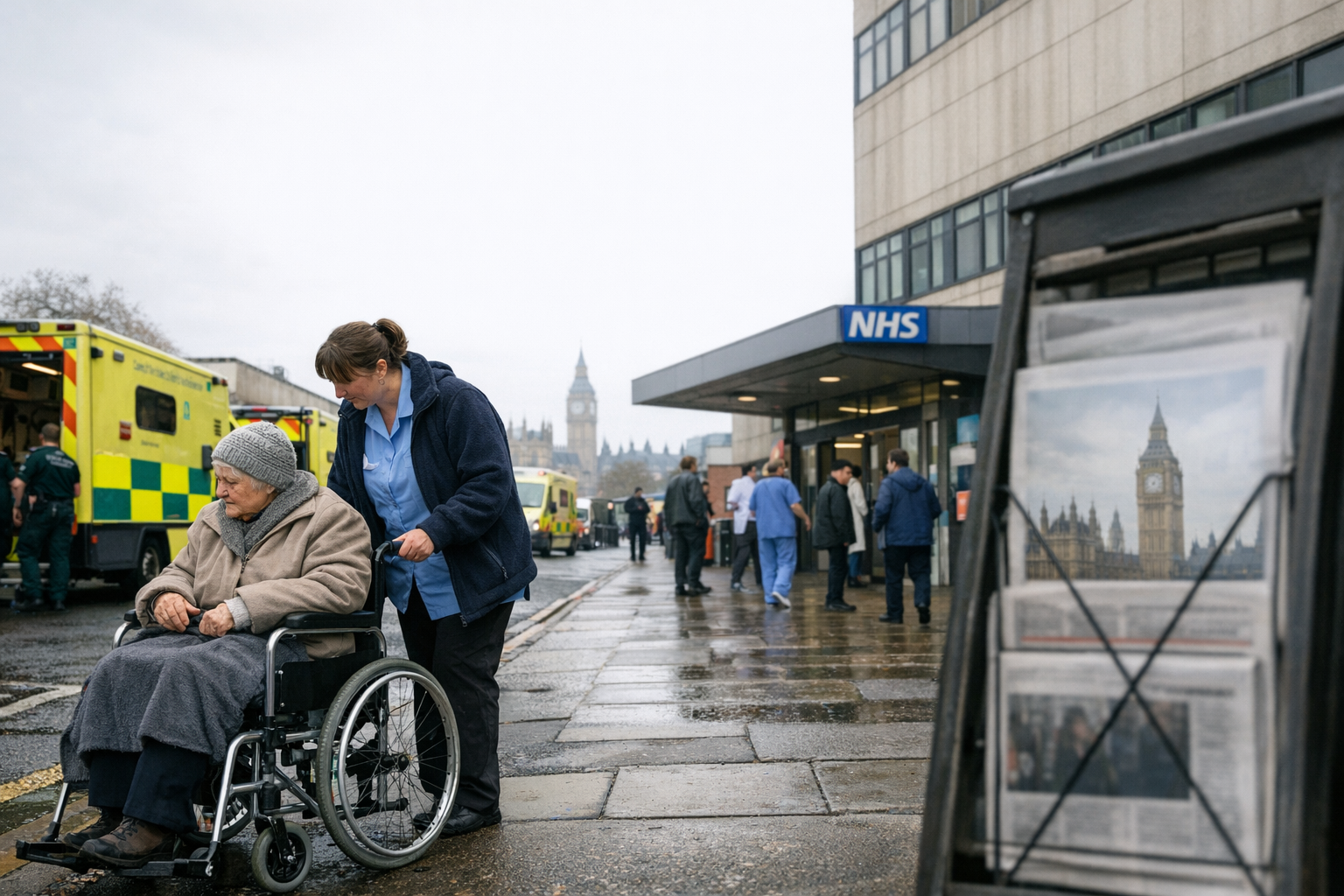
Prime Minister Andy Burnham has made clear that he intends to spend political capital early.
In his first major domestic policy push since entering Downing Street, Mr. Burnham has placed adult social-care reform near the top of his agenda, arguing that failure to act would deepen pressures on hospitals and leave England’s broader health system at risk. He has not yet set out a detailed timetable or funding plan, but allies say a speech later this week will begin to define what could become the first big test of his premiership.
The speed with which the issue has become politically fraught reflects a truth that has trapped successive governments: nearly everyone agrees England’s care system is failing, but agreement tends to dissolve when the conversation turns to who should pay.
Conservative and Reform U.K. figures have already signaled they will resist any overhaul financed through higher taxes or extra borrowing, trying to force an early confrontation over whether Mr. Burnham can reconcile an ambitious social policy with tight fiscal promises.
A long-delayed reckoning
Adult social care has for years occupied an uneasy place in British politics — plainly central to the lives of older and disabled people, but often discussed mainly through its knock-on effects on the National Health Service. England’s system is means-tested, fragmented and heavily dependent on local authorities, many of which have struggled under financial strain. Unlike the NHS, it is not a universal national service.
That structure has produced a familiar pattern: families facing high costs, councils rationing support, care providers under pressure and hospitals clogged with patients who are medically fit to leave but cannot do so safely because care is unavailable elsewhere.
Mr. Burnham has sought to frame the issue in both practical and moral terms. He has warned that the NHS cannot be stabilized if social care remains broken, but he has also suggested that the case for reform extends beyond hospital backlogs to basic questions of dignity, independence and fairness for older and disabled people.
Health policy experts have welcomed the elevation of the issue while cautioning against treating social care merely as an NHS release valve. Millions of people, they note, live with unmet care needs, and inadequate support can also keep unpaid carers and disabled adults out of work and community life, with broader economic consequences.
Pressure from the clock
The timing matters. An independent commission led by Baroness Casey, launched in April 2025, is already examining the future of adult social care. But lawmakers and campaigners have increasingly warned the government not to delay meaningful action until the end of the review process or the latter half of the parliament.
That concern stems from history. British governments of different stripes have repeatedly promised to fix social care, only to retreat amid rows over tax, property and intergenerational fairness. Proposals have often been caricatured as a “death tax” or collapsed under the weight of electoral caution.
Mr. Burnham appears to be signaling that he does not want his government to follow that pattern. Though he has declined to promise an immediate blueprint, he has said he wants substantial change within this parliament, a formulation intended to show urgency without locking himself into a deadline before funding and policy details are ready.
The funding question
That missing detail is the central one.
Mr. Burnham has committed himself to Labour’s existing fiscal rules and to manifesto constraints on major taxes, sharply limiting his room for maneuver. Any durable social-care settlement is likely to require new money, savings elsewhere or a politically painful reshaping of how property and wealth are taxed.
Among ideas circulating publicly are changes to council tax, long criticized as outdated and regressive because property bands in England have not been comprehensively revalued for decades. Another option discussed in policy circles is a proportional property tax that would replace council tax and stamp duty with an annual levy based on current home values. A land-value tax has also been floated by some advocates.
None of those options is politically simple. Property taxes can quickly trigger resistance from homeowners, and ministers know that social-care debates in Britain have often foundered once they become entangled with fears over housing wealth and inheritance.
That is why the opposition has moved quickly to define the battle lines. By demanding that Mr. Burnham rule out tax rises or more borrowing, his critics are seeking to turn social-care reform into a broader referendum on Labour’s economic credibility and appetite for state expansion.
More than an NHS policy
Mr. Burnham has long favored a more NHS-like approach to care, including the idea of a National Care Service. Whether his government now moves in that direction — and how far — will help determine whether this week’s rhetoric becomes a historic shift or another chapter in a long cycle of review and delay.
The stakes are larger than one policy dispute. Britain is aging, local government finances remain stretched, and the boundary between health care and social care has become one of the most glaring fault lines in the welfare state. A failure to address it would not simply prolong hardship for families already struggling to secure support; it would also leave hospitals carrying burdens they are poorly designed to bear.
For Mr. Burnham, the issue now poses an immediate question about the kind of prime minister he intends to be. He has promised to confront “big and difficult issues.” Social care, costly and emotionally charged and entangled with tax politics almost from the start, may be the first proof of whether he means it.
Sources
Further reading and reporting used to add context:
- https://apnews.com/article/438eef6399ef4247e9259e39b3b92097
- UK social care reform by Andy Burnham | The Straits Times
- Explainer-How UK PM Burnham’s government might raise taxes By Reuters
- https://parliamentnews.co.uk/nhs-social-care-reform-burnham-bbc-interview/
- https://www.investing.com/news/economy-news/new-uk-leader-burnham-says-he-will-never-take-risks-with-economy-4801340
- https://www.breakingviews.com/columns/breaking-view/burnham-nomics-offers-relief-over-reform-2026-07-21/
- https://www.investing.com/news/stock-market-news/andy-burnham-to-become-prime-minister-pledging-to-rewire-britain-4800029
- https://www.juiceliverpool.co.uk/news/uk-news/70771/andy-burnham-tells-bbc-nhs-will-collapse-without-social-care-reform
- https://www.internazionale.it/ultime-notizie-reuters/2026/07/20/factbox-what-is-new-labour-leader-andy-burnham-s-policy-approach-for-britain
- https://currently.att.yahoo.com/att/nhs-collapse-without-social-care-050024519.html
- https://www.fidelity.com/news/article/default/202607191901RTRSNEWSCOMBINED_L8N43L03M_1
- https://ca.marketscreener.com/news/uk-s-new-pm-burnham-promises-to-use-political-capital-to-tackle-social-care-ce7f51dbda8bf326
- https://www.lse.co.uk/news/uks-burnham-drops-digital-id-scheme-to-prioritise-cost-of-living-say-allies-c04cu45q2fn7bng.html
- https://www.reddit.com/r/ukpolitics/comments/1v7tbwd/andy_burnham_tells_bbc_nhs_will_collapse_without/
- https://www.reddit.com/r/Socialworkuk/comments/1v7tyel/andy_burnham_tells_bbc_nhs_will_collapse_without/
- https://www.reddit.com/r/unitedkingdom/comments/1v7sckt/andy_burnham_tells_bbc_nhs_will_collapse_without/
- https://www.reddit.com/r/BreakingUKNews/comments/1v7hpo8/badenoch_says_pm_must_rule_out_tax_rises_to_fund/
- https://www.reddit.com/r/doctorsUK/comments/1v7siea/andy_burnham_tells_bbc_nhs_will_collapse_without/
- https://caseycommission.co.uk/
- https://committees.parliament.uk/work/9849/the-casey-commission/publications/
- https://committees.parliament.uk/work/9849/the-casey-commission/publications/reports-responses/
- https://www.localgov.co.uk/social-care
- https://publications.parliament.uk/pa/cm5902/cmselect/cmhealth/420/report.html
- https://committees.parliament.uk/committee/81/health-and-social-care-committee/news/214671/prime-minister-will-have-no-excuse-not-to-start-fixing-social-care-before-general-election-mps-say/
- https://www.local.gov.uk/about/news/baroness-casey-announces-public-big-conversation-adult-social-care-lga-response
- https://committees.parliament.uk/oralevidence/17831/html/
- https://caseycommission.co.uk/wp-content/uploads/2026/07/Baroness-Caseys-speech-to-the-LGA-.pdf
- https://committees.parliament.uk/oralevidence/17831/pdf/
- https://northumberland.moderngov.co.uk/documents/g4518/Public%20reports%20pack%2007th-Jul-2026%2013.00%20Health%20and%20Wellbeing%20OSC.pdf?T=10
- https://www.cspa.co.uk/news/social-care-reform-what-the-casey-review-signals/
- https://committees.parliament.uk/event/27614
- https://committees.parliament.uk/publications/53980/documents/300918/default/
- https://www.gov.uk/government/publications/independent-commission-into-adult-social-care-terms-of-reference-easy-read
- https://caseycommission.co.uk/2026/06/june-2026-newsletter-parliamentary-evidence-and-government-response/
- https://www.reddit.com/r/uknews/comments/1uzu3mr/burnham_will_fasttrack_fixing_the_care_crisis_and/
- https://www.reddit.com/r/ukpolitics/comments/1uzu280/burnham_will_fasttrack_fixing_the_care_crisis_and/
- https://www.careengland.org.uk/wp-content/uploads/2025/07/indpendent.pdf
- https://ealing.moderngov.co.uk/documents/g6819/Public%20reports%20pack%20Thursday%2011-Jun-2026%2019.00%20Health%20and%20Adult%20Social%20Services%20Scrutiny%20Panel.pdf?T=10
- https://en.wikipedia.org/wiki/Louise_Casey%2C_Baroness_Casey_of_Blackstock
- https://en.wikipedia.org/wiki/National_Care_Service
- https://arxiv.org/abs/2411.01815
- https://arxiv.org/abs/2605.05651
- https://arxiv.org/abs/2007.11789
- https://arxiv.org/abs/2104.06299
- https://reformparty.uk/news/robert-jenrick-no-one-voted-for-burnham-s-38-billion-tax-raid
- https://www.reformparty.uk/news/andy-burnham-has-no-mandate-and-no-plan
- https://www.reformparty.uk/news/nigel-farage-burnham-s-government-will-not-just-be-more-of-the-same-it-will-be-worse-than-before
- https://reformparty.uk/index.php/news/zia-yusuf-burnham-will-save-you-just-enough-to-buy-some-celery
- https://www.gov.uk/government/publications/local-government-finance-policy-statement-2026-27-to-2028-29/local-government-finance-policy-statement-2026-27-to-2028-29
- https://www.reformparty.uk/news
- https://www.theguardian.com/society/social-care
- https://news.sky.com/story/new-taxes-inside-burnhams-plan-for-social-care-13562139
- https://archive.ph/42WAp
- Burnham to tackle 'neglected' issues of social care, youth unemployment and devolution | ITV News
- https://www.reddit.com/r/reformuk/comments/1v78n1p/robert_jenrick_reform_will_fight_burnhams/
- https://www.reddit.com/r/ukpolitics/comments/1v7cquf/burnham_actively_looking_to_scrap_council_tax_and/
- https://doncaster.moderngov.co.uk/documents/s51106/Draft%20Budget%20Motion%20Reform%20230226%20Revised_260223_113001.pdf
- https://hansard.parliament.uk/pdf/Commons/2026-06-18
- https://www.reddit.com/r/ukpolitics/comments/1v3825v/burnham_hints_at_tax_rises_to_pay_for_social_care/
- https://www.reddit.com/r/LabourUK/comments/1v7slub/andy_burnham_to_make_it_harder_for_people_to/
- https://www.reddit.com/r/ukpolitics/comments/1uw8s9o/allow_councils_to_put_up_council_tax_by_as_much/
- https://www.reddit.com/r/unitedkingdom/comments/1v7e8nu/burnham_actively_looking_to_scrap_council_tax_and/
- https://www.reddit.com/r/ukpolitics/comments/1v6lkuq/andy_burnham_to_address_social_care_youth/