
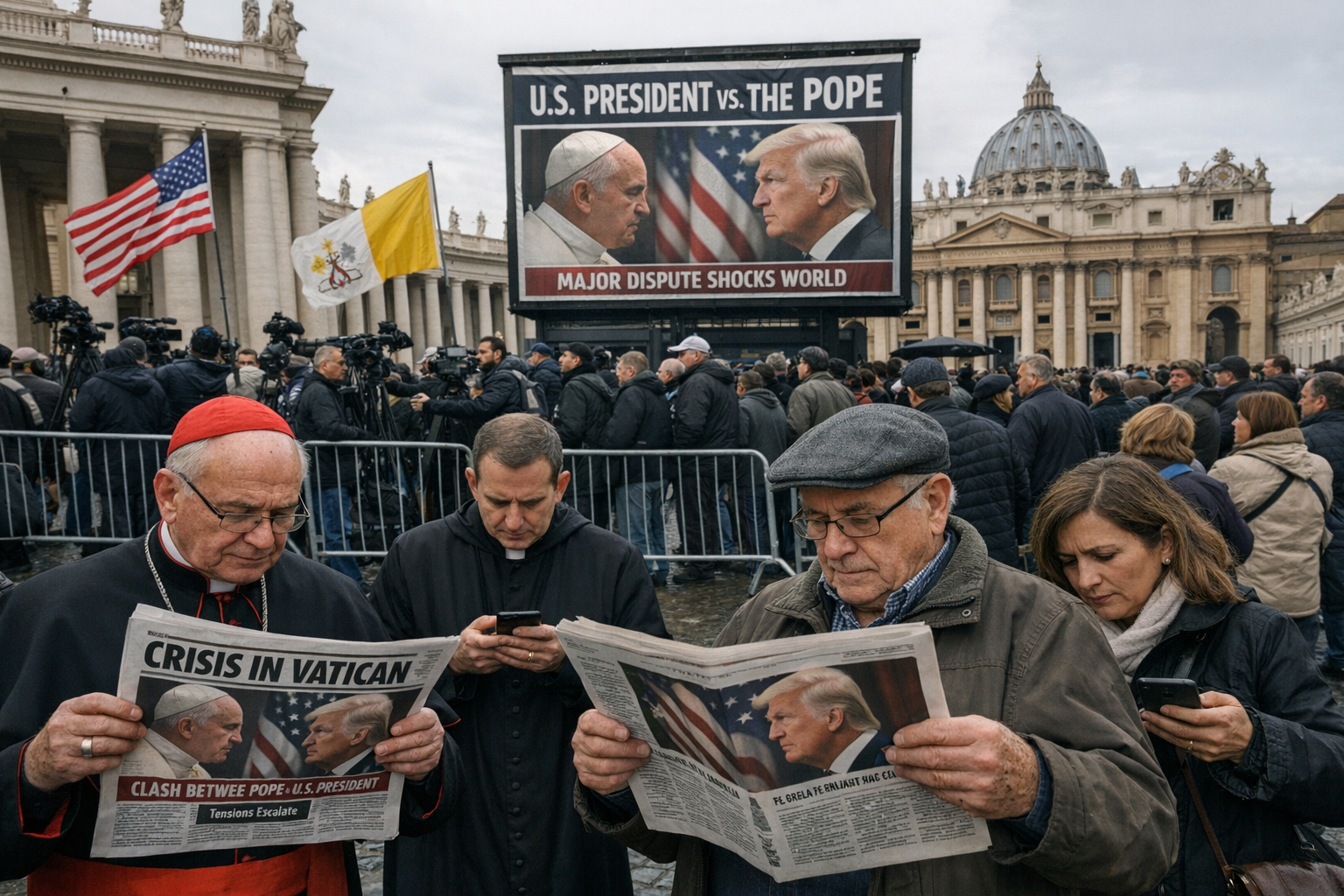
A clash with the pope spills beyond the Vatican
What began as a dispute over war has widened into a test of President Trump’s political reach — from the pews of American Catholic churches to the fragile alliances of Europe’s nationalist right.
In recent days, Trump’s escalating attacks on Pope Leo XIV have reverberated far beyond the Vatican after the pope sharply criticized the American-Israeli war on Iran and urged leaders to reject what he described as the destructive logic of military escalation. Trump, rejecting calls to soften his response, accused Leo of political meddling and has shown little interest in backing down.
The confrontation has now spread into allied politics. Prime Minister Giorgia Meloni of Italy, long regarded as one of Trump’s closest partners in Europe, called his remarks about the pope “unacceptable,” drawing a public rebuke from the president and exposing strains in a relationship once held up as evidence of a durable transatlantic populist axis.
At home, the feud has unsettled American Catholics, a politically diverse and often divided bloc that helped return Trump to office in 2024. Because Leo is the first American-born pope, the dispute carries a particularly intimate charge in the United States, where arguments over faith, nationalism and presidential power already run deep.
From Iran to a wider rupture
The roots of the clash lie in the war with Iran, which has become one of the most politically perilous episodes of Trump’s second term. Since March, Leo has increasingly used his public appearances to warn against the conflict. On April 7 and again on April 11, he condemned threats against the Iranian people, attacks on civilian infrastructure and what he called a “delusion of omnipotence” driving the march to war.
Those appeals placed the Vatican in direct moral opposition to a military campaign championed by Trump and defended by his allies. The president answered by portraying the pope as an unelected actor intruding into affairs of state. But for many Catholics, and for some of America’s European partners, Trump’s language crossed a line.
The dispute matters in part because Catholic voters have often proved movable in American politics, resistant to clean partisan sorting. Trump won a majority of Catholic voters in 2024, but his coalition included both conservative churchgoers deeply suspicious of Pope Francis-era liberalism and more moderate or immigrant-rooted Catholics who respond strongly to papal appeals on war, poverty and refugees. Leo’s emergence has sharpened those fault lines rather than resolved them.
Fresh reporting from the United States suggests the argument is now filtering into parish life and private devotion. In Bible study groups and church communities, Catholics who might once have tried to keep politics outside religious spaces are now confronting the spectacle of a president denouncing the head of their church. Some see Trump’s attack as an affront to the faith itself; others argue that Leo, by speaking so directly about Iran, has entered the political arena and should expect a political response.
A difficult moment for Trump
The timing is awkward for a White House already facing pressure on multiple fronts. The Iran conflict has opened fissures within Trump’s own base, including among voters who backed him on promises to avoid new wars and to focus instead on prices at home. The pope’s criticism has added a moral dimension to those frustrations, particularly among Christians disturbed by the human cost of the conflict and by Trump’s willingness to strike at a global religious leader.
In that sense, the quarrel with Leo is not an isolated controversy but part of a broader question hanging over Trump’s presidency: whether the political instincts that sustained him for years still work when they collide with war fatigue, inflation and religious disquiet all at once.
His refusal to retreat may energize some loyalists who view the Vatican with suspicion. Yet it also risks alienating Catholics who do not agree with every papal statement but recoil at the spectacle of an American president publicly feuding with the pope, especially an American pope speaking in the language of peace.
Meloni’s balancing act
In Italy, the dispute has become entwined with a separate political drama. Meloni has been under pressure after a failed referendum on judicial overhaul punctured, at least temporarily, the image of steady control that had made her one of Europe’s most formidable conservative leaders. The fallout contributed to government turmoil and opened space for rivals, including the rising progressive mayor of Genoa, Silvia Salis, who is increasingly being discussed as a fresh face on the left.
Against that backdrop, Meloni’s criticism of Trump appeared to be both a moral and political calculation. Italy, heavily exposed to regional instability and energy shocks, has little appetite for prolonged conflict in the Middle East. And for a prime minister already trying to steady herself at home, silence in the face of an attack on the pope — who holds singular influence in Italian public life — may have been politically untenable.
Trump’s sharp response underscored the limits of ideological affinity. For years, Meloni and Trump were seen as natural partners: nationalist, culturally conservative, skeptical of liberal internationalism. But the Iran war has strained that alignment, revealing that common rhetoric does not always survive the pressures of governing, particularly when domestic audiences are anxious about conflict and economic fallout.
Catholics caught in the middle
The divide among American Catholics is especially consequential because the community has long mirrored the country’s broader political fragmentation. White conservative Catholics have in recent years formed an important part of the Republican coalition, while Hispanic Catholics and many urban and suburban parishioners have often responded more favorably to papal emphases on peace and social justice.
Leo’s identity complicates the picture further. As the first pope born in the United States, he is harder for American conservatives to dismiss as a distant European cleric speaking from unfamiliar political assumptions. His criticism lands closer to home, and Trump’s response does too.
Some conservative Catholic voices have defended the president or argued that the pope’s comments on Iran exceed the spiritual mission of the church. Others, including Catholics who may agree with Trump on abortion or religious liberty, have expressed discomfort with the intensity and tone of his attacks. The result is a conflict that cuts across the usual ideological categories and could, if it persists, become measurable in electoral politics before the midterm campaigns fully take shape.
What comes next
Much now depends on whether either side seeks a way to lower the temperature. It remains unclear whether the White House and the Holy See will allow the conflict to remain a rhetorical spectacle or whether it will harden into a more serious diplomatic rupture. It is also uncertain whether conservative Catholic media figures and bishops in the United States will inflame the divide or try to contain it.
For Meloni, the question is different but related: whether distancing herself from Trump helps reassure an uneasy Italian electorate or simply highlights how much her once-vaunted international positioning has weakened.
What is already clear is that the fight has outgrown its starting point. A pope’s condemnation of war and a president’s retaliatory fury have become something larger — a struggle over the boundaries between faith and politics, over the durability of right-wing alliances, and over how much political cost Trump may yet pay for choosing confrontation in a moment of widening instability.
Sources
Further reading and reporting used to add context:
- https://www.thedailybeast.com/ex-catholic-hannity-ramps-up-maga-pile-on-of-trump-hating-pope/
- https://apnews.com/article/7309c5df6c7312b942e0510ea65502cb
- https://apnews.com/article/172094da97513b78a91cd5abc1bdbdc8
- https://theweek.com/religion/pope-leo-criticizes-iran-war-trump-vatican-white-house
- https://apnews.com/article/332059536d7c4d6071c8f5abb35d8c8d
- https://time.com/article/2026/04/13/trump-pope-leo-war-iran/
- https://www.washingtonpost.com/world/2026/04/07/pope-leo-denounce-trump-iran-threat/
- https://www.washingtonpost.com/world/2026/04/07/pope-leo-iran-trump-threat-unacceptable/b9a00da2-32b2-11f1-b85b-2cd751275c1d_story.html
- https://www.ansa.it/english/newswire/english_service/2026/04/14/meloni-reiterates-condemnation-of-trumps-attack-on-pope-leo-2_166c62ec-4b45-4e3b-9b4e-fa963e86c9af.html
- https://en.wikipedia.org/wiki/2026_Kharg_Island_attack
- https://www.thedailybeast.com/pope-leo-trashes-propaganda-after-denouncing-trumps-war/
- https://www.cbsnews.com/news/pope-leo-offers-latest-rebuke-iran-war/
- https://today.lorientlejour.com/article/1503499/after-calling-trumps-comments-on-pope-leo-unacceptable-the-us-leader-turns-on-italys-meloni.html
- https://www.al-monitor.com/originals/2026/03/pope-leo-urges-trump-find-ramp-end-iran-war
- https://www.yahoo.com/news/videos/italys-meloni-backs-pope-leo-143626149.html
- https://www.theguardian.com/world/2026/apr/16/giorgia-meloni-relations-donald-trump-italy
- https://www.euronews.com/2026/04/14/trump-refuses-to-apologise-after-clash-with-pope-leo-xiv-over-iran-war
- https://www.foxnews.com/world/trump-blasts-close-ally-meloni-says-shes-failing-us-iran/
- https://www.reutersconnect.com/item/pope-leo-urges-trump-to-find-off-ramp-to-end-iran-war/dGFnOnJldXRlcnMuY29tLDIwMjY6bmV3c21sX1ZBODkzMjMxMDMyMDI2UlAx
- https://en.wikipedia.org/wiki/Naval_blockade_of_Iran
- https://en.wikipedia.org/wiki/2026_United_States%E2%80%93Holy_See_rift
- https://apnews.com/article/ccf9458e288db4355f359ddf56668caf
- https://www.thedailybeast.com/johnson-says-pope-was-asking-for-trouble-after-trump-attacks/
- https://time.com/article/2026/04/13/pope-leo-trump-attack-catholics/
- https://www.inquirer.com/politics/philadelphia/trump-pope-leo-post-truth-social-catholic-reactions-philadelphia-20260413.html
- https://www.washingtonpost.com/world/2026/04/13/pope-leo-president-trump-feud/
- https://www.wsls.com/news/politics/2026/04/13/trump-lambasts-pope-leo-xiv-extending-feud-over-iran-war-with-first-american-pontiff/
- https://www.washingtonpost.com/politics/2026/04/13/pope-leo-donald-trump-us-catholic-evangelicals/abc690e6-3769-11f1-90c4-9772c7fabc03_story.html
- https://www.washingtonpost.com/world/2026/04/13/pope-leo-president-trump-feud//
- https://www.salon.com/2026/04/14/catholics-warn-of-serious-juncture-as-trump-targets-pope-leo-xiv/
- https://www.timesunion.com/news/politics/article/many-us-catholics-are-dismayed-by-trump-s-22204245.php
- https://www.kpbs.org/news/politics/2026/04/12/trump-lambasts-pope-leo-xiv-extending-feud-over-iran-war-with-american-pontiff
- https://time.com/article/2026/04/13/pope-leo-trump-attack-catholics//
- https://www.sfchronicle.com/news/article/trump-lambasts-pope-leo-xiv-extending-feud-over-22202831.php
- https://en.wikipedia.org/wiki/Draft%3ATrump-Pope_Leo_XIV_conflict
- https://apnews.com/article/02f6b4554ea4b83af02af15987ae1f2d
- https://theweek.com/religion/trump-attacks-pope-leo-war-criticism
- https://www.axios.com/2026/04/13/trump-pope-leo-weak-terrible
- https://www.cbsnews.com/news/trump-pope-leo-feud-politics/
- https://www.ansa.it/amp/english/newswire/english_service/2026/04/14/ansatrump-hits-back-as-meloni-reiterates-condemnation-of-attack-on-pope_59ffb4de-49c9-430c-9daf-6fc7c614c593.html
- https://www.yahoo.com/news/videos/trump-refuses-apologize-feud-pope-211151207.html
- https://www.newsmax.com/newsfront/donald-trump-meloni-pope-leo/2026/04/14/id/1252890/
- https://www.independent.co.uk/news/world/americas/us-politics/vatican-meeting-pope-leo-trump-b2955376.html
- https://www.forbes.com/sites/zacharyfolk/2026/04/14/trump-blasts-italys-meloni-a-rare-european-ally-after-she-defends-pope/
- https://es.wikipedia.org/wiki/Conflicto_diplom%C3%A1tico_entre_Estados_Unidos_y_la_Santa_Sede_de_2026
- https://www.reddit.com/r/newsPH/comments/1skj1oe/trumps_comments_on_pope_leo_are_unacceptable_says/
- https://www.vaticannews.va/en/pope/news/2026-04/pope-leo-xiv-appeal-to-journalists-castel-gandolfo-7-april-2026.html
- https://www.vaticannews.va/en/vatican-city/news/2026-04/pope-leo-s-appeal-to-the-silent-majority-that-chooses-peace.html
- https://www.vaticannews.va/en/pope/news/2025-06/pope-leo-xiv-angelus-appeal-peace-middle-east-iran.html
- https://www.vaticannews.va/en/pope/news/2026-04/popes-prayer-vigil-peace-accompanied-by-light-from-lamp-assisi.html
- https://www.vaticannews.va/en/pope/news/2026-03/pope-leo-angelus-iran-lebanon-weapons-silent-peace.html
- https://www.vaticannews.va/en/pope/news/2026-03/pope-we-cant-be-silent-in-face-of-suffering-of-many-innocents.html
- https://www.vaticannews.va/en/church/news/2026-03/javier-cercas-leo-xiv-balanced-view-artificial-intelligence.html
- https://www.vaticannews.va/en/pope/news/2025-06/pope-leo-xiv-echoes-the-cry-of-francis-war-is-always-a-defeat.html
- https://www.vaticannews.va/en/pope/news/2026-02/pope-leo-xiv-general-audience-catechesis-word-of-god-dei-verbum.html
- https://www.vaticannews.va/en/pope/news/2025-11/six-months-with-pope-leo-xiv-a-united-and-open-church.html
- https://www.vaticannews.va/en/pope/news/2026-01/pope-leo-holocaust-memorial-middle-east-peace.html
- https://www.vaticannews.va/en/pope/news/2025-10/pope-leo-xiv-peace-meeting-rome-colosseum-sant-egidio.html
- https://press.vatican.va/content/salastampa/it/bollettino/pubblico/2025/12/18/0998.pdf
- https://www.vatican.va/content/leo-xiv/en/audiences/2025/documents/20250625-udienza-generale.pdf
- https://press.vatican.va/content/salastampa/en/bollettino/pubblico/2023/11/29/231129b.pdf
- https://www.vaticannews.va/content/dam/vaticannews/meditazioni/casa-pontificia/doc/LENT-2026—1.-Conversion.pdf
- https://www.vatican.va/content/leo-xiv/ar/speeches/2026/january/documents/20260119-finlandia.pdf
- https://media.vaticannews.va/media/osservatoreromano/pdf/ing/2021/01/ING_2021_001_0101.pdf
- Pope Leo XIV denounces the 'delusion of omnipotence' he says fuels the US-Israeli war in Iran
- Pope Leo says he does not fear Trump, as he pushes back in feud over Iran war | KPBS Public Media
- Pope: The threat against the entire Iranian people is unacceptable – Vatican News
- Ex-Catholic Hannity Ramps Up MAGA Pile-On of 'Trump-Hating' Pope