
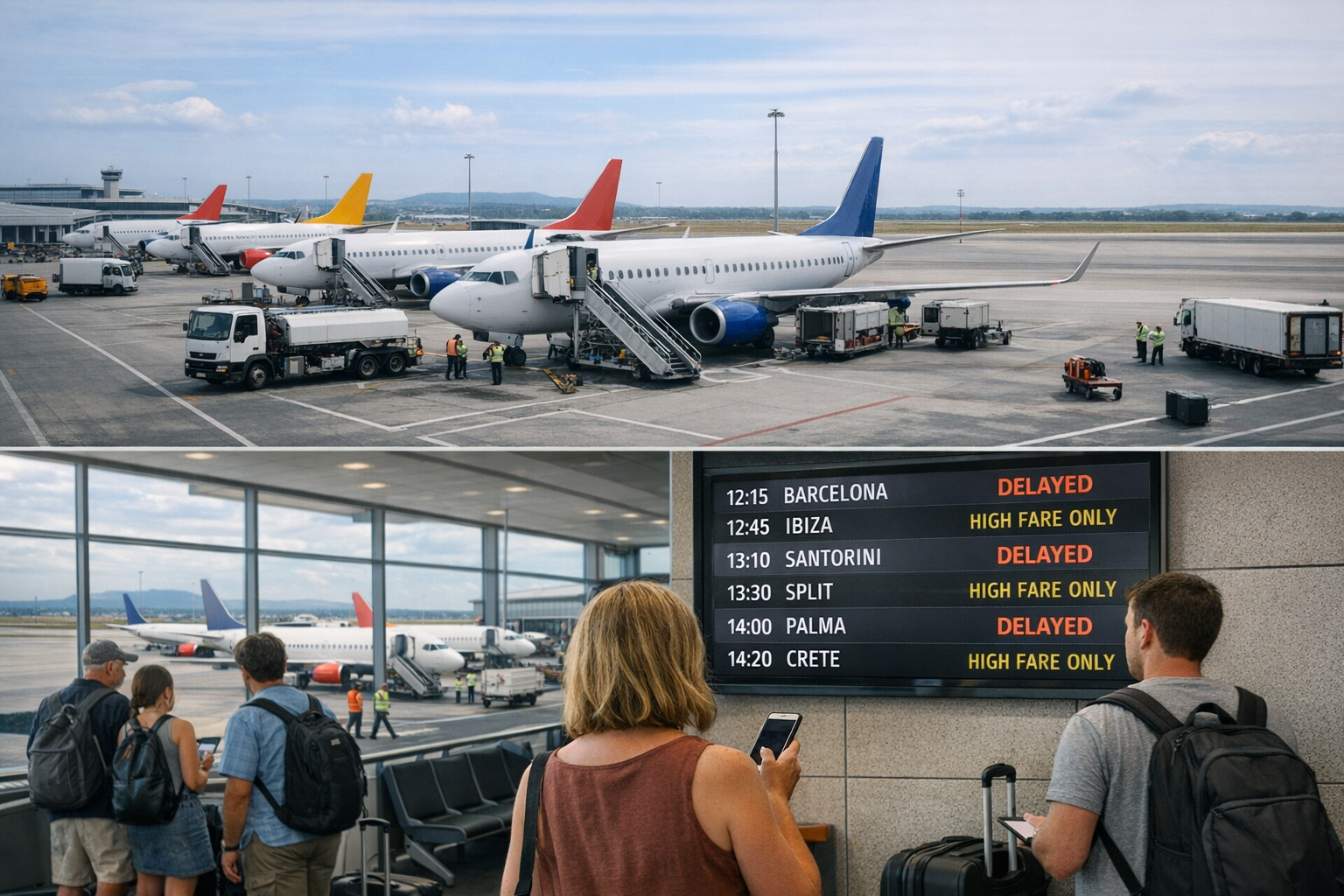
Europe’s Budget Airlines Brace for a Fuel Squeeze
Ryanair, Europe’s largest low-cost airline, said on Monday that it has drawn up plans for an aviation “armageddon” scenario if the jet-fuel squeeze deepens, even as it expressed growing confidence that its own operations will avoid major disruption this summer.
The warning captured the uneasy mood hanging over European aviation: the immediate fear of widespread cancellations has eased, but the industry is still confronting a potent mix of elevated fuel costs, geopolitical risk and increasingly fragile consumer demand. For airlines already operating on thin margins, executives say, the danger may be less a sudden collapse in supply than a prolonged period of expensive fuel that weaker carriers cannot withstand.
Neil Sorahan, Ryanair’s chief financial officer, said the airline had become more confident it would not face supply shocks in the coming months. But he cautioned that if current pressures persist, some smaller or less well-capitalized European airlines may struggle to survive.
That stark message comes as travelers are already adjusting their habits. Airlines say bookings are being made later, holidaymakers are gravitating toward shorter trips closer to home, and some are abandoning long-haul plans in favor of rail journeys or staycations. If fuel prices remain high, carriers have warned, fares for later travel this year could rise.
A Crisis That Has Shifted, Not Disappeared
The industry’s concern stems from the conflict in the Middle East, which escalated in late February and disrupted flows through the Strait of Hormuz, a critical artery for global energy supplies. Europe is particularly exposed: the International Air Transport Association has said that roughly a quarter to nearly a third of the region’s jet-fuel demand is tied to Persian Gulf supply.
Officials have repeatedly said there is no immediate shortage. But the risk has been serious enough that European regulators moved this month to support the careful use of Jet A fuel, rather than the Jet A-1 grade normally standard in Europe, in an effort to widen supply options.
Those steps have helped calm the most acute fears for the start of the summer travel season. Ryanair said it had seen suppliers grow more confident through the end of June. The airline has also insulated itself to some extent by hedging about 80 percent of its fuel needs through April 2027, limiting its exposure to sudden price spikes.
Still, hedging can only do so much. If high prices endure, the pain will spread across an industry already contending with rising labor and maintenance costs. And while large carriers may be able to pass on some of those costs or rely on premium cabins and loyalty revenue, budget airlines have fewer cushions.
Pressure on Weaker Carriers
Ryanair’s comments amounted to a warning that the current disruption could accelerate a shakeout in Europe’s crowded airline market.
That possibility has long hovered over the region’s aviation sector, where intense competition and fare-sensitive travelers leave little room for error. A sustained increase in fuel costs can quickly erode profitability, especially for smaller operators without the scale, balance sheet strength or fuel hedging that larger rivals enjoy.
In that sense, the current episode is testing more than supply chains. It is testing which business models can endure a prolonged period of geopolitical instability and volatile energy markets.
Ryanair, which has built its reputation on aggressively low fares and a disciplined cost base, has sought to project resilience. Yet even it has signaled that consumers should not expect the current environment to leave ticket prices untouched. The airline said passengers booking later in the year could face higher fares if fuel remains expensive.
Travelers Change Course
For consumers, the effect is already visible less in airport chaos than in subtler shifts in behavior.
Airlines say many passengers are waiting longer before committing to trips, reflecting both price sensitivity and uncertainty over where disruptions may spread. There has also been a discernible tilt toward shorter-haul destinations such as Spain, Portugal and Italy, while demand for more distant travel has softened.
That matters because long-haul flying is typically more fuel-intensive and more exposed to swings in energy costs. A broad move toward shorter routes may help some budget carriers fill planes in the near term, but it also signals a more cautious European traveler — one who may be willing to holiday, but not at any price.
Some of that hesitancy has already forced airlines to respond. Even as it warned of future fare increases, Ryanair had recently been discounting some later-summer seats to stimulate demand, a sign that the market is being shaped by two competing forces at once: higher airline costs and more reluctant consumers.
What Comes Next
The key question now is whether the improvement in near-term supply conditions lasts beyond early summer. Airlines and suppliers may have gained some confidence for the weeks ahead, but European officials have not ruled out longer-term strain if the conflict drags on.
If that happens, the consequences are likely to be uneven. Larger carriers with hedging programs and stronger finances may absorb the shock, at least for a time. Smaller rivals may be forced to cut capacity, raise fares more sharply or seek consolidation. For travelers, that could mean fewer choices and more expensive tickets later in the year, even if the worst-case scenario of mass cancellations never arrives.
For now, the industry is operating in a tense middle ground: not in crisis, but not yet clear of danger. Ryanair’s message was that it expects to get through the summer. Its warning was that not everyone else will.
Sources
Further reading and reporting used to add context:
- https://www.theguardian.com/business/2026/may/18/ryanair-jet-fuel-shortage-fare-rises-book-flights-higher-prices
- https://www.bloomberg.com/news/articles/2026-05-18/ryanair-warns-of-rising-costs-on-higher-fuel-prices-crew-wages?srnd=phx-industries
- https://www.theguardian.com/business/ryanair
- https://www.theguardian.com/travel/flights
- https://www.lemonde.fr/en/economy/article/2026/05/14/air-travel-faces-unprecedented-crisis-as-flights-are-canceled-and-ticket-prices-rise_6753437_19.html
- https://www.jpost.com/travel/article-894462
- https://www.insidermonkey.com/blog/the-ceo-of-ryanair-holdings-plc-ryaay-claims-there-is-less-chance-of-a-jet-fuel-crisis-in-europe-1758930/?amp=1
- https://www.cnbc.com/2025/05/22/summer-travel-demand-is-soaring-but-airlines-are-short-on-planes.html
- https://www.newsquawk.com/headlines/ryanair-rya-id-ceo-says-close-in-booking-in-may-and-april-are-very-strong-and-stronger-than-what-the-co-expected-28-04-2026
- https://uk.marketscreener.com/news/ryanair-profits-may-come-under-a-bit-of-pressure-if-oil-prices-stay-high-ceo-says-ce7f5bddde8df527
- https://www.globalbankingandfinance.com/ryanair-boss-risk-jet-fuel-shortage-europe-receding/
- https://ts2.tech/en/ryanairs-summer-fare-warning-just-put-europes-cheap-flights-on-notice/
- https://www.lse.co.uk/news/ryanair-boss-does-not-expect-jet-fuel-disruption-in-europe-this-summer–rale41qnaec073k.html
- https://www.reddit.com/r/GUARDIANauto/comments/1tggg0b/world_ryanair_confident_it_will_avoid_jet_fuel/
- https://www.reddit.com/r/AutoNewspaper/comments/1tgdkcl/world_ryanair_has_plans_for_armageddon_scenario/
- https://www.reddit.com/r/AutoNewspaper/comments/1tggnmh/world_ryanair_confident_it_will_avoid_jet_fuel/
- https://apnews.com/article/c9518120fb1a746046fe003fcdd82036
- https://www.easa.europa.eu/en/newsroom-and-events/news/easa-issues-sib-safe-usage-jet-aviation-fuel-europe
- https://logistics.maritimeprofessional.com/passenger-transportation-services/2026/04/28/ryanair-boss-risk-of-jet-fuel-shortages-in-europe-is-receding
- https://www.easa.europa.eu/en/newsroom-and-events
- https://www.marketscreener.com/news/ryanair-boss-says-risk-of-jet-fuel-shortage-in-europe-receding-ce7f59d2da8bf526
- https://www.marketscreener.com/news/eu-agency-urges-caution-with-jet-fuel-switch-amid-supply-crunch-fears-ce7f5bdbd88cf02c
- https://uk.investing.com/news/company-news/ryanair-ceo-says-jet-fuel-shortage-risk-in-europe-receding-93CH-4634028
- https://www.lse.co.uk/news/ryanair-boss-says-risk-of-jet-fuel-shortage-in-europe-receding-19uqkl8etg0m36q.html
- https://airguide.info/ryanair-sees-lower-fuel-risk-plans-fare-pressure/
- https://transport.ec.europa.eu/news-events/news/commission-publishes-guidance-support-eu-transport-sector-affected-middle-east-crisis-2026-05-08_en
- https://ad.easa.europa.eu/blob/EASA_SIB_2026_04.pdf/SIB_2026-04_1
- https://www.marketscreener.com/news/jet-fuel-crisis-what-crisis-european-airlines-downplay-fears-of-summer-shortage-ce7f5bddd988f625
- https://hcaa.gov.gr/en/hcaa-sian-01-2026-aviation-turbine-fuel-use-jet-grade-fuel-jet-1-environment
- https://www.iata.org/en/iata-repository/publications/economic-reports/middle-east-conflict-exposes-jet-fuel-supply-vulnerabilities/
- https://www.axios.com/2026/04/29/jet-fuel-airline-dealmaking
- https://en.wikipedia.org/wiki/2026_Iran_war
- https://en.wikipedia.org/wiki/2026_Iran_war_fuel_crisis
- https://www.teneo.com/app/uploads/2026/04/Aviation-Outlook-2026-Impact-of-the-Iran-Conflict-on-Passenger-Aviation-4.21.26.pdf
- https://fr.wikipedia.org/wiki/Crise_du_carburant_li%C3%A9e_%C3%A0_la_Guerre_d%27Iran_de_2026
- https://www.cnbc.com/2013/06/24/ryanair-ceo-were-europes-southwest-airlines.html
- https://www.cnbc.com/video/2025/05/19/ryanair-ceo-said-boeing-has-improved-significantly-oil-prices-are-a-tailwind.html
- https://www.cnbc.com/2025/01/27/ryanair-cuts-passenger-traffic-goal-again-on-boeing-delays.html
- https://www.cnbc.com/2022/05/16/boeing-management-needs-a-reboot-after-losing-its-way-ryanair-ceo-says.html
- https://www.cnbc.com/2016/11/07/trump-victory-would-be-chaotic-but-entertaining-ryanair-ceo-says.html
- https://www.cnbc.com/2023/05/22/ryanair-reports-bumper-profit-on-favorable-fuel-hedges-sees-major-industry-consolidation.html
- https://www.cnbc.com/2012/11/05/ryanair-could-benefit-from-spanish-bailout-ceo.html
- https://www.cnbc.com/2015/04/16/heres-why-ryanair-flights-may-get-even-cheaper-says-ceo-oleary.html
- https://www.cnbc.com/video/2021/05/17/ryanair-holdings-ceo-travel-rebound-boeing.html
- https://www.cnbc.com/2013/03/19/ryanair-ceo-calls-boeing-787-problems-regulatory-crap.html
- https://www.cnbc.com/2022/11/07/airlines-face-fragile-winter-ryanair-ceo-says-after-record-summer-profits.html
- https://www.cnbc.com/italy/
- https://fm.cnbc.com/applications/cnbc.com/resources/editorialfiles/2026/04/23/Toplines_260142_CNBC_AAES_Q1_2026_Topline.pdf
- https://fm.cnbc.com/applications/cnbc.com/resources/editorialfiles/2012/05/03/2226796_GPR_DELOITTE_Final%2520%282%29.pdf
- https://fm.cnbc.com/applications/cnbc.com/resources/editorialfiles/2020/05/26/05262020_Treasury%20Letter%20-%20airline%20COVID%20furloughs%20Final%20w%20signatures.pdf
- https://fm.cnbc.com/applications/cnbc.com/resources/editorialfiles/2012/05/03/2226803_Ask%20Warren%20-%20Complete%20Transcript%20-%202009-03-09.pdf
- https://fm.cnbc.com/applications/cnbc.com/resources/editorialfiles/2012/07/03/2012-02-27%20Ask%20Warren%20Transcript.pdf
- Ryanair ‘confident’ it will avoid jet fuel shortage but warns of future fare rises | Ryanair | The Guardian
- Jet fuel crisis, what crisis? European airlines downplay fears of summer shortage | MarketScreener
- Chart of the Week
- Ryanair boss says risk of jet fuel shortage in Europe receding | MarketScreener