
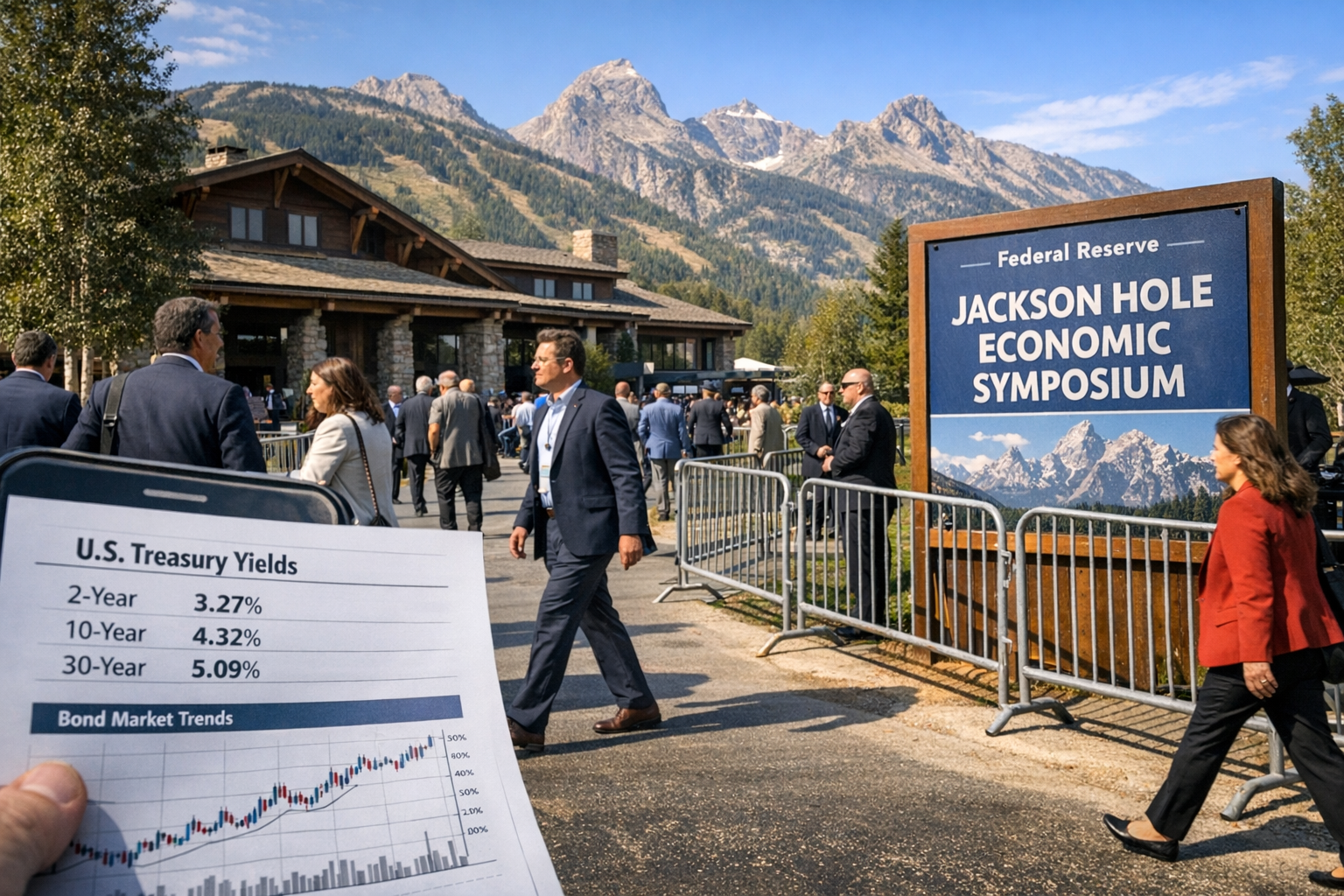
Bond jitters deepen as Treasury support falters before Jackson Hole
A fresh attempt by the Treasury Department to steady the government bond market is failing to calm investors, leaving Wall Street increasingly focused on a higher-stakes question: whether the Federal Reserve’s new chair can restore confidence that inflation will be contained.
Longer-dated Treasury yields, which influence everything from mortgage rates to corporate borrowing costs, climbed back toward multi-year highs days after Treasury announced a larger bond-buyback program meant to improve trading conditions in the market’s most stressed corners. The whiplash has sharpened concern that investors are no longer responding to technical fixes alone, but are instead demanding greater compensation for holding long-term U.S. debt amid rising inflation worries, heavy government borrowing and questions about policy credibility.
By Aug. 21, the benchmark 10-year Treasury yield had returned to about 4.70 percent and the 30-year yield was near 5.25 percent, close to levels last seen in 2007. The reversal came after an initial rally following the Treasury’s Aug. 19 announcement that it would double repurchases of bonds with maturities of 10 to 30 years to at least $4 billion per operation. Treasury Secretary Scott Bessent has since said the program could be expanded further.
The timing has only heightened the pressure on policymakers. Central bankers and investors are now heading into the Federal Reserve’s annual Jackson Hole symposium, scheduled for Aug. 27 to 29, where Chair Kevin Warsh is expected to offer one of his clearest public signals yet on how he intends to confront a renewed inflation threat.
A market looking past liquidity
Treasury’s stated aim in expanding buybacks was narrow: to provide liquidity support in longer-dated bonds, where demand to sell securities back to the government had been unusually strong. In ordinary circumstances, such operations can help smooth trading and ease distortions in specific parts of the market.
But the market’s quick loss of faith suggested a deeper unease.
Investors have spent much of this year repricing long-term U.S. debt as inflation reaccelerated, energy prices rose and geopolitical conflict threatened supply chains. At the same time, Washington’s fiscal outlook has darkened, with traders increasingly focused on the scale of future borrowing needed to finance tax and spending plans and refinance existing debt at higher rates.
That combination has created a harsher backdrop for any Treasury effort to stabilize the long end of the market. If bond investors believe inflation will remain stubborn or that deficits will require still more issuance, a buyback program measured in billions can appear small beside the larger tide of supply and macroeconomic risk.
The result is a market that seems less concerned with immediate trading frictions than with the possibility of a more lasting reset in what it costs the United States to borrow for decades at a time.
Why long-term yields matter
Rising yields on 10- and 30-year Treasuries do not stay confined to government debt. They feed directly into mortgage rates, borrowing costs for businesses, municipal finance and the federal government’s own interest bill. Higher long-term rates can also tighten financial conditions even if the Fed leaves short-term policy rates unchanged, slowing investment and weighing on interest-sensitive sectors of the economy.
That is one reason the recent move has drawn such scrutiny. For years, investors broadly assumed that inflation would drift back toward the Fed’s target and that long-term yields would remain contained, even as deficits widened. That assumption is now being tested.
The fading effect of the buyback announcement has also revived an old institutional concern: whether efforts by the Treasury to influence longer-dated yields risk blurring the boundary between debt management and monetary policy. The Treasury is responsible for financing the government; the Fed is responsible for price stability and broader monetary conditions. When markets grow suspicious that one arm of the government is trying to lean against yields while inflation remains unsettled, it can complicate both missions.
Warsh’s first major test
That is the backdrop confronting Mr. Warsh, who took office on May 22 and now faces his first Jackson Hole gathering as chair. The symposium often serves as a stage for major central-bank signals, and investors are expected to parse his remarks for evidence of how forcefully he intends to defend the Fed’s inflation-fighting credibility.
Recent Fed minutes showed that many policymakers believe rates may need to rise further if inflation stays elevated. But markets are still searching for clarity on whether Mr. Warsh will emphasize the risk of doing too little, too late — or whether he will leave room for a more cautious approach as financial strains build.
That distinction matters. A forceful anti-inflation message could reassure bond investors that the Fed will not tolerate a sustained drift upward in prices, even at the cost of slower growth. A more ambiguous message, by contrast, could deepen the sense that investors must protect themselves against both inflation and heavier future issuance by demanding still higher long-term yields.
A broader repricing, or a temporary rupture?
For now, the central question hanging over the Treasury market is whether the recent surge in yields reflects a temporary dislocation that can be eased with targeted support — or the beginning of a more durable repricing of U.S. sovereign debt.
If it is the former, a larger buyback program and a clear Fed message may help steady the market. If it is the latter, policymakers are confronting something more consequential: a bond market that is insisting on a higher premium to finance America’s debts in an era of stickier inflation, bigger deficits and more uncertain policy.
Jackson Hole is unlikely to settle that debate on its own. But with the Treasury’s latest intervention losing force almost as soon as it was announced, the burden now falls more squarely on the Fed — and on Mr. Warsh in particular — to persuade markets that the United States still has both the will and the tools to keep inflation, and borrowing costs, from moving higher still.
Sources
Further reading and reporting used to add context:
- https://apnews.com/article/8ab800029c559c5e751058ac1a8ef932
- https://apnews.com/article/ad0783da9f5c491ba6793ef801a9a11e
- https://apnews.com/article/c6e148f8235a98245adf04b2d4bdd8d1
- https://www.axios.com/2026/08/17/treasury-yields-warsh-bonds
- https://www.axios.com/2026/08/21/dollar-debasement-treasury-bonds
- https://www.kiplinger.com/investing/economy/this-weeks-economic-calendar
- https://apnews.com/article/bd0cead63ff1b7f2e99d4c8cce0a28d3
- https://www.theguardian.com/business/2026/aug/24/fed-chair-kevin-warsh-faces-critical-test-jackson-hole-inflation-fears-mount
- https://www–reuters–com.flex00000.online/world/us-treasury-double-sizes-some-debt-buyback-operations-least-4-billion-2026-08-19/
- https://www.investing.com/news/economy-news/treasury-buyback-renews-dollardebasement-fears-4870832
- https://www.kitco.com/news/off-the-wire/2026-08-20/treasurys-bessent-says-upsized-bond-buybacks-could-increase-further
- https://www.investing.com/news/economy-news/treasurys-upsized-buybacks-may-complicate-feds-monetary-policy-work-4868681
- https://www–reuters–com.flex00000.online/legal/transactional/view-us-treasury-will-double-some-bond-buy-backs-2026-08-19/
- https://www.thefiscaltimes.com/2026/08/20/Bessent-Promises-New-Fiscal-Plan-His-Bond-Market-Intervention-Fizzles
- https://news.linxi.com.au/news/us-treasury-yields-rise-as-bessent-bond-buyback-momentum-stalls
- https://www.realclearpolitics.com/video/2026/08/21/bessent_on_debt_theres_nothing_agic_about_the_40_trillion_number_we_can_grow_our_way_out.html
- https://finance.yahoo.com/economy/policy/articles/bonds-bounce-us-buybacks-relief-040238251.html
- https://www.investing.com/news/economy-news/trump-says-he-did-not-direct-bessent-to-intervene-in-bond-market-4872224
- https://www.federalreserve.gov/newsevents/pressreleases/other20260522a.htm
- https://www.federalreserve.gov/aboutthefed/bios/board/warsh.htm
- https://www.kansascityfed.org/research/jackson-hole-economic-symposium/
- https://www.kansascityfed.org/research/jackson-hole-economic-symposium/about-jackson-hole-economic-symposium/?chain_id=Name1K9-3FXPhg.1kjmmo0&global_content=%7B%22promote_id%22%3A13766%2C%22sub_promote_id%22%3A14%2C%22f%22%3A%22www.futunn.com%2Fen%2Flearn%2Fdetail-insights-for-aug-2023-why-is-the-upcoming-jackson-hole-economic-symposium-important-88969-230965011%22%7D
- https://www.federalreserve.gov/newsevents/pressreleases/other20260515a.htm
- https://www.atlantafed.org/news-and-events/2026/05/22/warsh-sworn-in-as-new-fed-chairman
- https://www.kansascityfed.org/pdf/general/generalpage/15592/
- https://www.govinfo.gov/app/details/DCPD-202600361/related
- https://www.federalreserve.gov/?source=post_internal_links———0—————————-
- https://www.whitehouse.gov/gallery/federal-reserve-chair-kevin-warsh-is-sworn-in-in-the-east-room-of-the-white-house/
- https://www.youtube.com/watch?v=ka4cWjUL_gc
- https://www.whitehouse.gov/videos/kevin-warsh-has-been-sworn-in-as-the-17th-chairman-of-the-federal-reserve/
- https://www.kansascityfed.org/documents/11142/ten_summer2025.pdf
- https://www.kansascityfed.org/newsroom/2025-news-releases/kansas-city-fed-to-host-annual-jackson-hole-economic-policy-symposium-2025/
- https://www.presidency.ucsb.edu/documents/remarks-swearing-ceremony-for-kevin-m-warsh-chairman-the-federal-reserve-system-board
- https://www.youtube.com/watch?v=2NyUb2Ko7M8
- https://www.federalreserve.gov/foia/files/chair-powell-calendar-082025.pdf
- https://www.kansascityfed.org/pdf/article/articlepage/16040/
- https://www.federalreserve.gov/mediacenter/files/FOMCpresconf20260429.pdf
- https://www.govinfo.gov/content/pkg/CREC-2026-04-30/pdf/CREC-2026-04-30.pdf
- https://apnews.com/article/d87285399582840f585bc4e24dd4f10f
- https://www.reddit.com/r/law/comments/1tkys88/kevin_warsh_has_officially_been_sworn_in_as_chair/
- https://www.reddit.com/r/MarketPulseReport/comments/1tkunmm/kevin_warsh_federal_reserve_chair_swearingin/
- https://apnews.com/article/b665712fa5d40d3fcea53d80d0a79c64
- https://apnews.com/article/448828f7cc01932cc234ff47dd80be27
- https://www.kiplinger.com/investing/stocks/dow-hits-new-high-as-warsh-takes-fed-oath-stock-market-today
- https://apnews.com/article/95ccceb935f5c6ebc3b6a4528fd3cbcb
- https://www.axios.com/2026/05/13/warsh-fed-senate-trump
- https://www.reddit.com/r/RWATimes/comments/1tl1c2d/kevin_warsh_begins_fed_chair_role_amid_soaring/
- https://apnews.com/article/1dcf7c9c3cc490b82b2632302628c46b
- https://apnews.com/article/0030d04832b89b564b743b34ab2cd8de
- https://www.axios.com/2026/08/21/treasury-yields-bessent-market
- https://www.axios.com/2026/08/19/rates-treasury-borrowing-bessent
- https://theweek.com/business/economy/why-are-bond-markets-getting-hammered
- https://www.cbsnews.com/news/bond-sell-off-treasury-yields-borrowing-costs/
- https://www.investing.com/news/forex-news/dollar-wobbles-as-investors-balk-at-us-treasurys-rescue-efforts-4870745
- https://www.kitco.com/news/off-the-wire/2026-08-20/us-treasury-buyback-briefly-eases-bond-rout-debt-worries-persist
- https://www.local10.com/business/2026/08/20/why-treasury-secretary-bessents-moves-to-calm-the-bond-market-havent-worked-so-far/
- https://ca.finance.yahoo.com/news/why-treasury-secretary-bessents-moves-193833400.html
- https://www.local10.com/business/2026/08/20/higher-yields-in-the-bond-market-and-a-drop-for-walmart-drag-us-stocks-lower/
- https://www.investing.com/news/stock-market-news/bonds-bounce-on-us-buybacks-but-relief-may-be-brief-4868662
- US Treasury Secretary Bessent doubles US long-bond buybacks in the face of surging yields | Reuters
- Treasury’s upsized buybacks may complicate Fed’s monetary policy work By Reuters
- Treasury buyback renews dollar-debasement fears By Reuters