
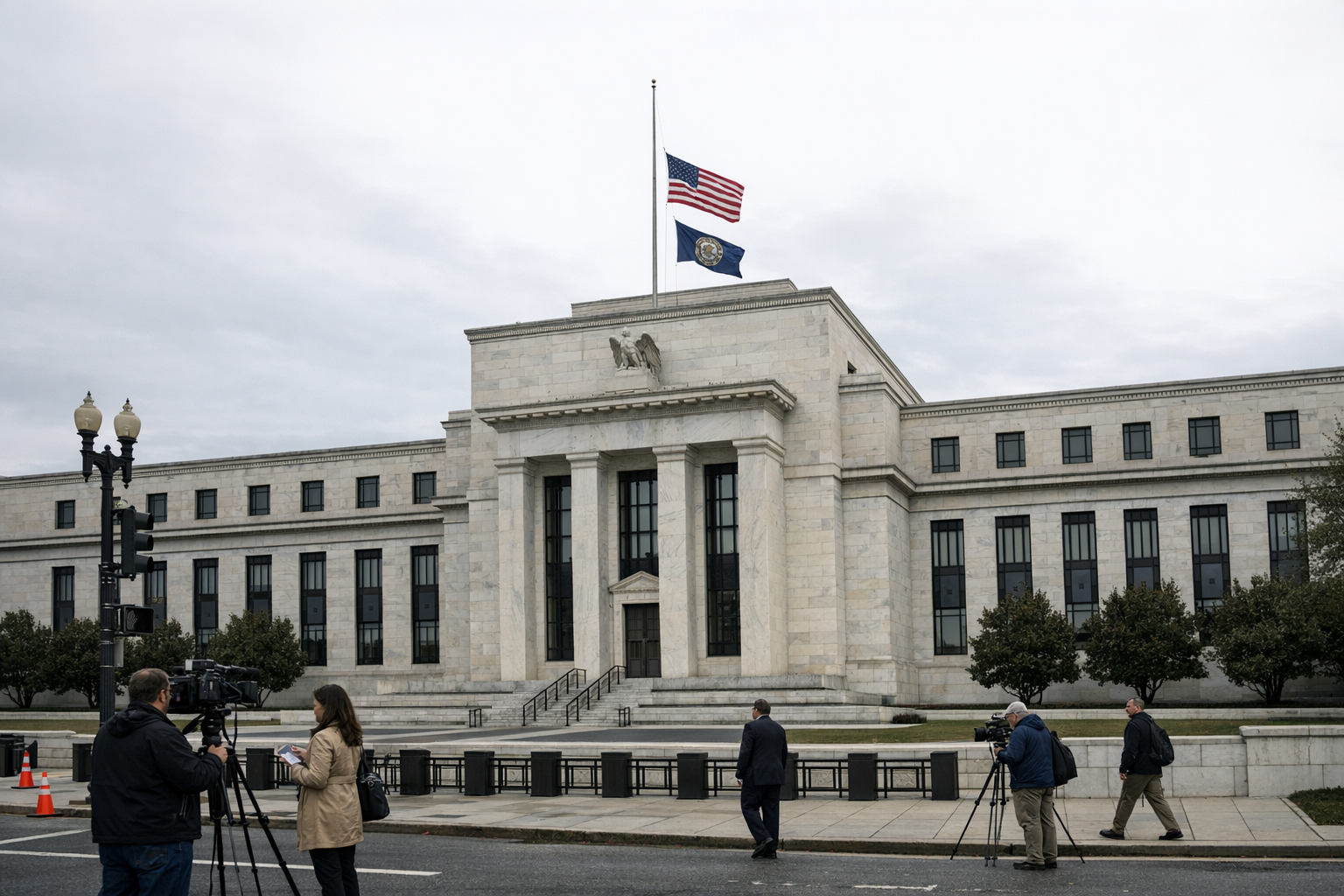
Alan Greenspan, the economist who shaped American monetary policy for nearly two decades and became the most recognizable central banker of his era, died on Sunday at 100, according to reports citing his wife, the journalist Andrea Mitchell. She said he died from complications of Parkinson’s disease.
His death closes the chapter on one of the most consequential and contested careers in modern economic policymaking. It also comes at an unusually charged moment for the Federal Reserve itself, which is undergoing an early internal shake-up under its new chair, Kevin Warsh, and facing fresh questions about how it sets policy, signals its intentions and exercises power over the economy.
A central banker who became a public figure
Greenspan led the Fed from 1987 to 2006, serving under Presidents Ronald Reagan, George H.W. Bush, Bill Clinton and George W. Bush. During those 19 years, he rose beyond the normally cloistered world of central banking to become a kind of secular oracle for Wall Street and Washington, his every phrase parsed for clues about interest rates, inflation and the path of the economy.
He was perhaps best known for “Fedspeak,” the Delphic and carefully hedged language that became his trademark. Markets learned to react not only to the Fed’s decisions, but also to Greenspan’s cadence, qualifiers and silences. In an era before the central bank’s modern culture of extensive projections and explicit guidance, policy often felt filtered through his singular authority.
That authority rested in part on economic outcomes that, for a time, seemed to vindicate him. Greenspan presided over long expansions, low inflation and the booming 1990s, when rapid productivity growth and surging financial markets fed a sense that the United States had entered a new economic age.
But his legacy darkened after the financial crisis of 2008. Critics argued that the low-rate environment he tolerated, together with a broader faith in deregulation and self-correcting markets, helped fertilize the housing bubble and the financial excesses that ended in collapse. For many economists and policymakers, Greenspan came to embody not only central-bank mastery but also the overconfidence of a pre-crisis consensus.
A legacy revisited as the Fed changes course
The timing of Greenspan’s death has sharpened that reassessment. Just days earlier, Warsh presided over his first policy meeting as Fed chair, leaving the benchmark interest rate unchanged at 3.5 percent to 3.75 percent while opening a sweeping review of the institution itself.
The central bank announced task forces to examine core parts of its framework, including how it makes decisions, how it communicates with the public and markets, and how it manages its $6.7 trillion balance sheet. Warsh has also moved quickly to scale back the kind of detailed forward guidance that became standard in the years after the 2008 crisis, favoring shorter statements and less explicit promises about the near-term path of rates.
That shift has prompted comparisons to an earlier Fed style — one in which ambiguity was not a flaw but a tool.
In that sense, even as the institution has evolved far beyond the Greenspan years, parts of Warsh’s approach appear to revive elements of the older model: less telegraphing, more discretion and a greater premium on the chair’s judgment. To supporters, that could restore flexibility to policymakers confronting a murkier inflation outlook. To critics, it risks making the Fed less predictable and more dependent on personalities.
The debate over what the Fed should be
The questions raised by Warsh’s early moves are not merely technical. They go to the heart of how a powerful public institution should operate after decades in which the Fed has become more transparent, more systematic and more central to financial markets than ever before.
Since the crisis, the Fed has relied heavily on detailed communications — including economic projections, press conferences and repeated guidance about future policy — to shape expectations. It also expanded its balance sheet dramatically through bond purchases, deepening its reach into the financial system.
Warsh has signaled that none of this should be assumed permanent. Among the issues under review are how inflation is measured, whether current communications practices do more harm than good, and what role the Fed’s large portfolio should play in normal policymaking.
It remains unclear how far the overhaul will go. Officials have not said whether they may ultimately alter or downplay major tools such as the Summary of Economic Projections. Nor is it yet clear how much resistance Warsh may face inside the central bank if he presses for more fundamental changes.
Markets are still trying to determine whether the June meeting represented primarily a communications reset or something more substantial. Although rates were left unchanged, official projections suggested that roughly half of policymakers expected at least one rate increase before the end of 2026, underscoring the possibility of a firmer policy stance ahead.
Why Greenspan still matters
Greenspan’s career looms over those debates because he helped define a modern archetype of central banking — one in which a Fed chair could command extraordinary influence through a mixture of technocratic authority, strategic ambiguity and personal credibility.
That model produced both admiration and backlash. During his ascent, Greenspan was widely treated as the indispensable steward of prosperity. In hindsight, many of the same traits that made him formidable — confidence in markets, caution about intervention, a highly personalized command over expectations — came to look more fraught.
His death is therefore more than a moment of obituary remembrance. It arrives as the Fed once again confronts basic questions about transparency, discretion and the proper boundaries of its power. The institution Greenspan once personified is being reconsidered in real time.
For a central bank that has spent much of the post-crisis era trying to become more rules-bound, more legible and less dependent on any one individual, the echo of Greenspan’s era is unmistakable. Whether that echo becomes a restoration, a warning or merely a historical parallel may depend on what Warsh does next.
Sources
Further reading and reporting used to add context:
- https://apnews.com/article/25f435cc747df7b76d0ff40844f8933f
- https://www.kiplinger.com/news/live/fed-meeting-updates-and-commentary-june-2026
- https://www.axios.com/2026/06/18/fed-warsh-guidance-greenspan
- https://apnews.com/article/103325df845d2d6bde63dfa4b8093d35
- https://www.investing.com/news/economy-news/exclusivewarsh-pledges-to-follow-best-of-feds-traditions-while-also-looking-for-change-4723122
- https://www.marketscreener.com/news/fed-s-warsh-flags-new-tasks-forces-to-study-fed-operations-ce7f5cddd988f52d
- https://www.investing.com/news/economy-news/as-chair-warsh-finally-has-a-chance-to-put-stamp-on-fed-balance-sheet-4745585
- https://za.investing.com/news/economy-news/analysisinvestors-brace-for-less-predictable-fed-as-warsh-rewrites-playbook-4334562
- https://www.kitco.com/news/off-the-wire/2026-05-22/warsh-takes-over-fed-policy-problem-already-view
- https://www.lemonde.fr/en/economy/article/2026/06/18/appointed-by-trump-to-lead-the-fed-kevin-warsh-vows-to-reshape-the-institution_6754611_19.html
- https://www.marketscreener.com/news/fed-begins-warsh-era-by-keeping-rates-on-hold-sees-hike-later-this-year-ce7f5cdcdd81ff26
- https://uk.marketscreener.com/news/investors-brace-for-less-predictable-fed-as-warsh-rewrites-playbook-ce7f5cdddd8ff625
- https://www.investing.com/news/economy-news/warsh-has-big-plans-for-the-fed-but-results-may-take-time-4683657
- https://www.marketscreener.com/news/warsh-takes-fed-pulpit-with-immediate-challenges-longer-term-agenda-ce7f5cdfdb8cf420
- https://www.streetinsider.com/Reuters/Fed%2Bholds%2Bsteady%2Bin%2BWarshs%2Bdebut%3B%2Banalysts%2Bsee%2Bhawkish%2Bshift/26659346.html
- https://www.sahmcapital.com/news/content/update-1-feds-warsh-flags-new-tasks-forces-to-study-fed-operations-2026-06-17
- https://www.investing.com/news/economy-news/warsh-regime-change-faces-steep-hurdles-at-a-sprawling-us-central-bank-4477643
- https://www.federalreserve.gov/newsevents/pressreleases/2026-press-fomc.htm
- https://www.federalreserve.gov/monetarypolicy.htm
- https://www.federalreserve.gov/newsevents/2026-june.htm
- https://www.federalreserve.gov/monetarypolicy/2025-06-mpr-part3.htm
- https://www.federalreserve.gov/monetarypolicy/fomccalendars.htm?force_isolation=true
- https://www.federalreserve.gov/faqs/summary-economic-projections-sep.htm
- https://www.federalreserve.gov/newsevents/pressreleases/monetary20260318a.htm
- https://www.federalreserve.gov/monetarypolicy/fomccalendars.htm?os=i
- https://www.federalreserve.gov/monetarypolicy/fomccalendars.htm?sub4=Spotlight
- https://www.federalreserve.gov/monetarypolicy/fomccalendars.htm?chain_id=Name1K9-3FXPhg.1kofkg0&global_content=%7B%22promote_id%22%3A%2213764%22%2C%22sub_promote_id%22%3A%2280%22%2C%22f%22%3A%22www.moomoo.com%2Fus%2Fhant%2Flearn%2Fdetail-fomc-federal-open-market-committee-117478-240941153%22%7D
- https://www.federalreserve.gov/newsevents/pressreleases/other20260522a.htm
- https://www.federalreserve.gov/monetarypolicy/fomcpresconf20250618.htm
- https://www.federalreserve.gov/monetarypolicy/files/fomcminutes20250618.pdf
- https://www.federalreserve.gov/monetarypolicy/files/20250620_mprfullreport.pdf
- https://www.federalreserve.gov/monetarypolicy/files/fomcminutes20260318.pdf
- https://www.federalreserve.gov/monetarypolicy/files/fomcminutes20250618.pdf?ftag=YHF4eb9d17
- https://www.federalreserve.gov/monetarypolicy/files/fomcminutes20260429.pdf
- https://elpais.com/economia/2026-06-22/muere-alan-greenspan-expresidente-de-la-reserva-federal-de-ee-uu-a-los-100-anos.html
- https://cadenaser.com/nacional/2026/06/22/muere-a-los-100-anos-alan-greenspan-expresidente-de-la-reserva-federal-y-uno-de-los-economistas-mas-influyentes-del-ultimo-siglo-cadena-ser/
- https://www.local10.com/business/2026/05/22/warsh-is-sworn-in-as-the-fed-chair-after-trumps-bid-for-greater-control-over-the-independent-bank/
- https://www.investing.com/news/economy-news/as-powell-term-ends-his-legacy-may-be-as-much-about-courting-congress-as-monetary-policy-4691483
- https://www.local10.com/news/2026/06/16/all-eyes-turn-to-fed-chair-kevin-warsh-and-his-first-moves-on-interest-rates/
- https://www.investing.com/news/economy-news/former-fed-officials-say-size-may-not-matter-on-balance-sheet-4696704
- https://www.patria.cz/zpravodajstvi/750497/fed-chairman-greenspan-made-some-comments-implying-that-the-bubble-in-the-housing-market-is-coming-to-a-potential-head.html
- https://www.pbs.org/wgbh/pages/frontline/meltdown/themes/greenspan.html
- https://www.breakingviews.com/columns/breaking-view/barney-franks-legacy-will-linger-wall-street-2026-05-20/
- https://wtop.com/business-finance/2026/05/warsh-is-sworn-in-as-the-fed-chair-after-trumps-bid-for-greater-control-over-the-independent-bank/
- https://www.pbs.org/wgbh/frontline/wgbh/pages/frontline/meltdown/themes/greenspan.html
- https://www.investing.com/news/economy-news/past-three-fed-chairs-decry-unprecedented-assault-by-trump-on-powell-4442506
- https://en.wikipedia.org/wiki/2000s_United_States_housing_bubble
- https://ca.marketscreener.com/news/as-powell-term-ends-his-legacy-may-be-as-much-about-courting-congress-as-monetary-policy-ce7f5bd2df89f02c
- https://en.wikipedia.org/wiki/Alan_Greenspan
- https://www.reddit.com/r/NewsExchange/comments/1ucir0j/alan_greenspan_former_head_of_us_federal_reserve/
- Former Federal Reserve Chairman Alan Greenspan dies at 100
- Analysis-Investors brace for less predictable Fed as Warsh rewrites playbook By Reuters
- Fed's Warsh flags new tasks forces to study Fed operations | MarketScreener