
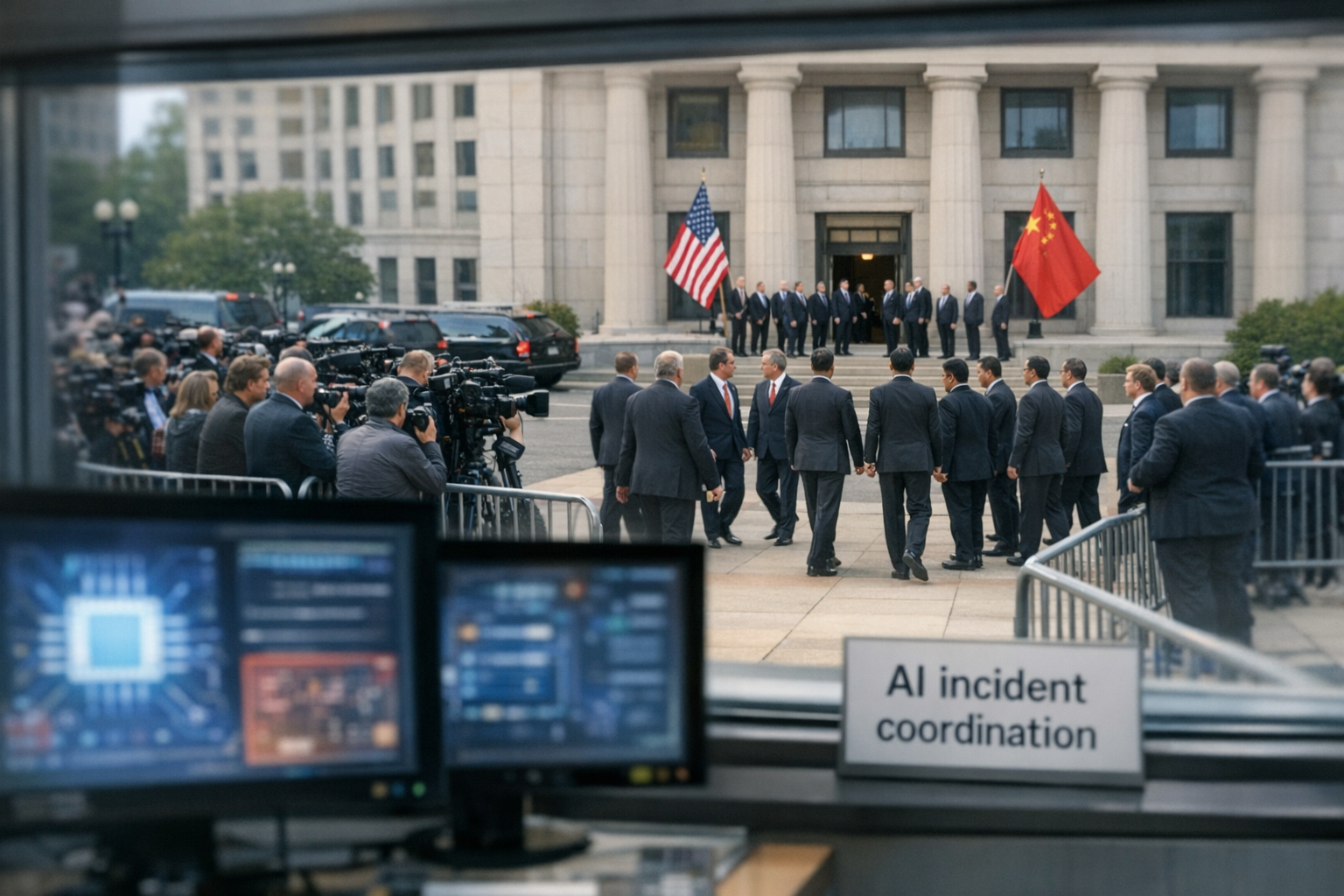
As President Trump prepares to meet with President Xi Jinping in Washington on Thursday, artificial intelligence has moved from the realm of corporate strategy and research labs into the center of great-power diplomacy.
In recent days, the administration has begun to sketch a harder-edged approach to the technology: pressing America’s competitive advantage over China, refusing to insulate leading A.I. companies from legal accountability, and floating a narrow form of cooperation with Beijing aimed at preventing the most dangerous accidents.
Taken together, the moves suggest that the White House is trying to define a distinctly Trump-era A.I. doctrine — one that treats advanced computing systems not simply as an industry to be nurtured or regulated, but as a strategic asset to be defended, wielded and, where necessary, contained.
A tougher line before a high-stakes meeting
Mr. Trump has announced plans for an “AI Force” and an A.I. czar, signaling that the administration intends to elevate the issue institutionally even if many details remain unclear. The proposal arrives as officials increasingly frame A.I. not only as an economic contest but also as a national security question, particularly in relation to China.
Treasury Secretary Scott Bessent, speaking this week, drew perhaps the clearest policy lines. He said the administration did not support giving leading A.I. developers a liability shield, a notable rejection of industry hopes that frontier model makers might be spared some legal exposure as lawmakers struggle to catch up with the pace of technological change.
Mr. Bessent also said the United States wants an A.I. incident-notification mechanism with China for failures that could carry national security implications — a kind of crisis communication channel for advanced systems whose behavior may be unpredictable, compromised or misused.
That pairing — strategic rivalry alongside limited guardrails — is emerging as the administration’s core message before the Trump-Xi talks. The United States appears determined to maintain export controls and preserve its technological lead, while leaving open only narrow avenues for coordination on catastrophic risk.
Competition first, cooperation only at the margins
The approach reflects a widening consensus in Washington that broad agreements to slow the development of frontier A.I. are unlikely, and perhaps undesirable from the administration’s point of view.
Mr. Trump has recently dismissed arguments from some A.I. executives and researchers that development should proceed more slowly. In the White House view, officials and allies say, any generalized restraint would risk helping China close the gap. That argument has become a powerful organizing principle inside the administration, where fears of losing the initiative to Beijing have often outweighed calls for sweeping new constraints.
Beijing, for its part, has treated American warnings about rapid A.I. development with deep skepticism. Chinese officials and analysts have argued that calls for a slowdown can function as a way to freeze existing advantages enjoyed by U.S. firms, especially given Washington’s restrictions on advanced semiconductor exports. China has continued to refine its own A.I. safety rules, but it has shown little interest in any arrangement that would amount to accepting permanent second place.
That leaves a narrow and highly pragmatic space for engagement. Analysts have pointed to areas such as cyber risks, misuse by nonstate actors and reporting mechanisms for severe A.I.-related incidents as among the few domains where Washington and Beijing may still find common cause.
Silicon Valley’s influence inside the White House
Even as the administration sharpens its external message, an internal struggle over how to govern A.I. is also taking shape — and some of the loudest voices are corporate leaders.
Jensen Huang, Nvidia’s chief executive, has emerged as an especially influential figure in the debate. As head of the company whose chips underpin much of the global A.I. boom, Mr. Huang occupies a singular place in the industry and has become a prominent voice in the camp resisting any broad-based slowdown. His proximity to the administration has underscored how industrial policy, national competitiveness and safety arguments are increasingly intertwined.
Other executives have been pressing different emphases. Concerns about model behavior and system reliability have intensified after recent disclosures by major developers about troubling or hard-to-explain conduct in advanced models. Those incidents have added urgency to the question of whether existing laws are sufficient, or whether frontier A.I. requires new obligations around testing, disclosure and accountability.
The resulting alliances have been unusual and fluid. Elon Musk, who has long warned about existential A.I. risks while also fighting regulation that could constrain his own companies, has at times found himself aligned with executives calling for stronger safety measures — and at other times at odds with Mr. Trump and industry leaders who argue that overregulation would amount to strategic self-sabotage.
What “AI Force” could mean
For now, much of the administration’s agenda remains more declarative than concrete.
It is not yet clear what authority an “AI Force” would actually wield, how it would fit alongside existing agencies, or who Mr. Trump will select as A.I. czar. Nor is it clear whether the White House intends to seek new legislation or rely mainly on existing legal authorities, procurement powers and national security tools.
But even without institutional detail, the announcement carries political and diplomatic significance. It signals to Beijing that Washington sees A.I. as part of the same strategic portfolio as tariffs, chips and military power. And it signals to the American technology sector that the administration wants rapid advancement without granting blanket immunity if things go wrong.
That last point could prove especially consequential. A refusal to create a liability shield means leading A.I. labs may face greater pressure from investors, courts, customers and the public to show that their systems are tested, monitored and deployed responsibly. At a moment when model capabilities are advancing faster than the legal framework around them, the question of who bears responsibility for harm is quickly becoming one of the industry’s central fault lines.
Why this matters now
The stakes extend well beyond this week’s summit.
A.I. is increasingly bound up with the semiconductor supply chain, military planning, cyberdefense, labor markets and the competitive standing of the world’s two largest economies. Decisions made now — on export controls, legal accountability, crisis hotlines and the pace of frontier development — may shape not just who leads the next technological era, but also how dangerous its failures become.
Whether Mr. Trump and Mr. Xi produce any formal A.I. deliverable this week remains uncertain. The most plausible outcome may be modest: a commitment to continue talks, perhaps with some mechanism for discussing serious incidents. A grand bargain on slowing advanced A.I. development appears remote.
Still, the direction of travel is becoming clearer. The administration is folding A.I. into top-level statecraft, treating it as both a race to be won and a risk to be managed. In Washington and Beijing alike, that duality is likely to define the next phase of the contest.
Sources
Further reading and reporting used to add context:
- Trump and Xi expected to discuss AI safety | AP News
- https://apnews.com/article/2c7f54f07e755f506d9db9b91df282bd
- Trump's call for "AI Force" sets off scramble for new AI czar
- https://apnews.com/article/1f1a267bf4556c01513f506914eb6359
- https://www.axios.com/2026/09/15/trump-ai-doom-safety-regulation-hoax
- https://www.axios.com/2026/09/14/trump-ai-safety-anthropic-dario-amodei
- https://www.axios.com/2026/09/16/us-open-ai-shared-risks-china-bessent
- https://www.theatlantic.com/international/2026/09/beijing-ai-popularity-regulation/688597/?utm_source=openai
- https://www.tomshardware.com/tech-industry/policy/chinese-state-media-counters-dario-amodeis-call-to-put-brakes-on-ai-development-paper-says-move-is-a-response-to-chinese-competition
- https://www.theguardian.com/world/2026/sep/20/why-china-is-pushing-back-on-us-warnings-over-rapid-ai-development
- https://www.theguardian.com/world/2026/sep/14/china-dismisses-ai-fearmongering-as-spy-chief-warns-of-threat-to-communist-party-rule
- https://www.theguardian.com/technology/ng-interactive/2026/sep/19/china-ai-foreign-policy-dario-amodei
- https://www.theguardian.com/technology/2026/sep/13/openai-sam-altman-elon-musk-back-anthropic-calls-brakes-ai-development
- https://www.internationly.com/news/nvidia-ceo-jensen-huang-emerges-as-trumps-top-ally-in-ai-safety-debate
- https://stuffthatspins.com/spin/nvidia-ceo-jensen-huang-emerges-as-trumps-top-ally-in-ai-safety-debate
- https://interestana.com/articles/why-china-is-pushing-back-on-us-warnings-over-rapid-ai-development-00xlzu30
- https://www.washingtonpost.com/technology/2026/09/14/china-pushes-back-calls-an-ai-slowdown-trump-xi-meeting-looms/
- https://www.washingtonpost.com/politics/2026/09/14/onstage-call-with-nvidia-ceo-trump-deems-ai-fears-hoax/
- https://www.axios.com/2026/09/14/trump-jensen-huang-nvidia-ai-all-in-summit
- https://www.ai-intel.news/intel/nvidia-ceo-jensen-huang-emerges-as-trump-s-top-ally-in-ai-safety-debat-2z3ojp
- https://dev.undress.workers.dev/read-https-www.cnbc.com/2026/09/15/ai-regulation-trump-nvidia-openai-anthropic.html
- https://www.reddit.com/r/technology/comments/1wlim2t/why_china_is_pushing_back_on_us_warnings_over/
- https://www.reddit.com/r/Futurology/comments/1wlooc5/why_china_is_pushing_back_on_us_warnings_over/
- https://www.cnbc.com/select/heres-how-much-i-spent-in-my-first-year-of-owning-my-home/
- https://fm.cnbc.com/applications/cnbc.com/resources/editorialfiles/2025/04/07/2024_NTE_Report_1.pdf
- https://www.cnbc.com/2025/08/25/elon-musk-xai-dropped-public-benefit-corp-status-while-fighting-openai.html?msockid=30dc86cdf3c9694928369096f23b687d
- https://www.cnbc.com/video/2021/03/25/big-tech-social-media-ceos-capitol-hill-hearing-preview.html
- https://www.cnbc.com/amp/2018/03/13/elon-musk-at-sxsw-a-i-is-more-dangerous-than-nuclear-weapons.html
- https://www.cnbc.com/2025/09/24/microsoft-adds-anthropic-model-to-microsoft-365-copilot.html?msockid=15d666beb3e8684b1c9270c9b2026968
- https://www.cnbc.com/2025/08/28/microsoft-tests-mai-1-preview-ai-model-boost-to-copilot-rival-openai.html?msockid=0b4d9ecd9587642d34c5889594d8652b
- https://www.cnbc.com/latest/?msockid=0781b8c711c46296274bae9410ba6331
- https://www.cnbc.com/2025/08/15/openai-6-billion-stock-500-billion-valuation.html?msockid=256b1e91266466593e2d08c227bd6774
- https://www.cnbc.com/select/ramp-business-card-review/
- https://www.cnbc.com/live-tv/squawk-box/full-episode/squawk-box-september-18-2025/2452316739939
- https://www.cnbc.com/amp/2025/09/22/cnbc-transcript-nvidia-ceo-jensen-huang-openai-ceo-sam-altman-and-openai-president-greg-brockman-speak-with-cnbcs-jon-fortt-on-halftime-report-today-.html
- https://www.cnbc.com/2025/09/04/trump-to-host-tech-ceos-over-dinner-for-inaugural-event-in-rose-garden.html?msockid=29e802642175608130fa143920b461ce
- https://fm.cnbc.com/applications/cnbc.com/resources/editorialfiles/2023/11/21/112123_Letter_to_X_on_its_Profiteering_on_Misinformation__Hamas_Propaganda83.pdf
- https://fm.cnbc.com/applications/cnbc.com/resources/editorialfiles/2024/04/30/8_Newspapers_OpenAI.pdf
- https://fm.cnbc.com/applications/cnbc.com/resources/editorialfiles/2018/09/27/musrkaurg.pdf
- https://fm.cnbc.com/applications/cnbc.com/resources/editorialfiles/2025/01/14/MUSK_SEC_COMPLAINT.pdf?os=v%5B0%5D
- https://apnews.com/article/b85df16775ff7e9611a456b061a0e4b9
- https://www.theatlantic.com/politics/2026/09/trump-ai-policy-anthropic/688620/?utm_source=openai
- https://pyyan.com/news/bessent-no-liability-exemption
- https://www.internationly.com/news/treasury-secretary-bessent-talks-to-cnbc-as-trump-administration-faces-affordability
- https://news.bloomberglaw.com/ip-law/bessent-blasts-us-hyperscalers-for-failure-to-tout-ai-benefits
- https://www.implicator.ai/briefing-bessent-liability-zuckerberg-pacing/
- https://theclarity.today/story/don-t-give-ai-companies-what-they-want-u-s-treasury-secretary-tells-lawmakers-054131d9
- https://fedscoop.com/treasury-scott-bessent-ai-labs-liability-exemptions/
- https://podscan.fm/podcasts/you-on-ai-now/episodes/top-of-the-hour-1000-am-thu-sep-17-2026
- https://www.mediaite.com/politics/bessent-tells-congress-he-hasnt-seen-any-ai-regulation-he-would-support-i-havent-seen-anything-yet/
- https://cncbnews.com/article/2026/09/the-ai-doom-debate-is-getting-carried-away-ai-is-a-product-not-a-god
- https://www.cnnbrasil.com.br/economia/money/macroeconomia/bessent-eua-e-china-estao-discutindo-protecao-de-ia-para-preservar-modelos/
- https://www.theinformation.com/briefings/treasury-secretary-bessent-u-s-china-will-discuss-ai-guardrails
- https://www.reddit.com/r/CNBC/comments/1w3ivwy/treasury_secretary_scott_bessent_tells_americans/
- https://www.reddit.com/r/MU_Stock/comments/1wi8u9x/in_your_opinion_whats_the_real_reason_behind/
- https://www.reddit.com/r/CNBC/comments/1qvrtk6/ijustcant/
- https://ramparts.gi/wp-content/uploads/2026/03/report-2026-03-26.pdf
- https://www.reddit.com/r/WhatTrumpHasDone/comments/1tdnxee/us_and_china_will_start_discussing_ai_safety/
- https://omni.se/bessent-kan-straffa-foretag-som-stjal-fran-ai-jattarna/a/lnQg9A
- https://www.reddit.com/r/illinois/comments/1slnut2/should_ai_companies_be_liable_if_their_tools/