
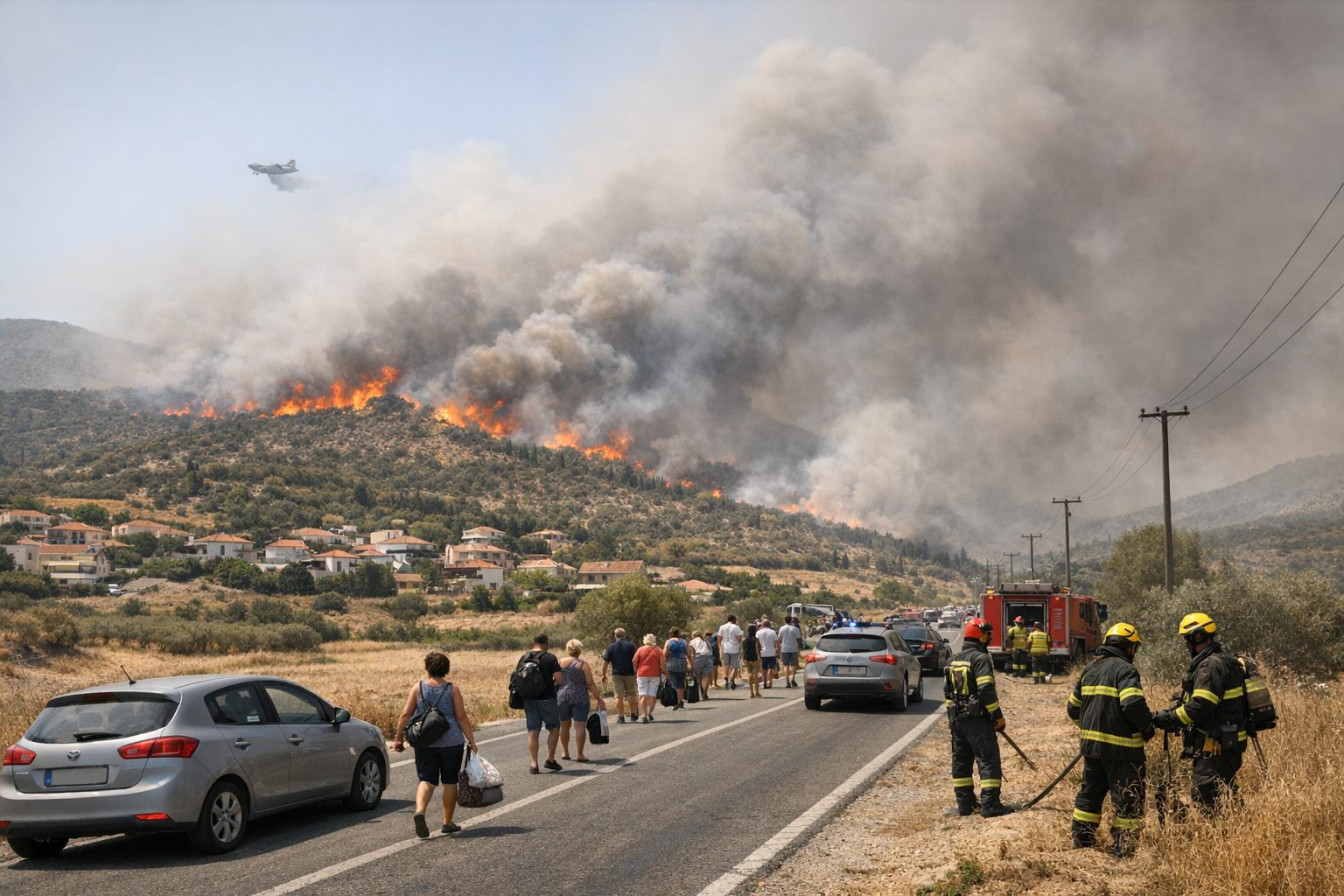
A Fire Emergency Spreads Across France and Spain
Wildfires raging across southwestern France and parts of Spain forced hundreds of thousands of people from their homes or into lockdown over the weekend and into Monday, stretching emergency services, disrupting local economies and prompting top-level political intervention as another burst of heat loomed.
In France, the gravest threat remained in Gironde, near Bordeaux, where a vast blaze had already driven the evacuation of roughly 220,000 people, according to authorities. In Spain, major fires around Ávila and areas near Madrid, as well as in the Valencia region, set off large evacuations and confinement orders, pushing the combined number of displaced people in the two countries to well above a quarter-million, with some estimates exceeding 300,000 when those told to remain inside their homes are included.
President Emmanuel Macron convened a crisis meeting on Monday as French firefighters, backed by military support and water-bombing aircraft, tried to prevent the fire from pushing deeper toward populated areas and critical infrastructure. In Spain, Prime Minister Pedro Sánchez visited the affected zone and said the country was confronting the effects of the climate crisis as national authorities mobilized what officials described as the country’s first wildfire national emergency.
The speed and scale of the fires have turned what is usually treated as a seasonal hazard into something more destabilizing: a test of how quickly modern European states can move people, protect transport corridors and sustain emergency operations when extreme weather pushes fire behavior beyond normal expectations.
Heat, Drought and Wind Create a Volatile Mix
Fire experts and meteorologists say the blazes are being fed by a combustible sequence that has become increasingly familiar across southern Europe. An unusually wet winter and spring allowed vegetation to grow thickly. Then months of scarce rainfall and repeated heat waves dried that growth into tinder. Strong winds have since accelerated the spread, carrying flames quickly across forests, scrubland and fields.
That combination has made the fires not only easier to ignite but harder to contain. Across western Europe, drought has left fine fuels — grass, pine needles, leaf litter and twigs — primed to burn rapidly. Officials note that most wildfires are still started by human activity, whether accidentally or deliberately, but weather conditions are determining how destructive those ignitions become.
Near Bordeaux, firefighters reported the formation of a pyrocumulonimbus, or “fire cloud,” a phenomenon in which intense heat from a wildfire drives towering smoke-filled storm clouds that can generate their own erratic winds and worsen already dangerous conditions on the ground. Such events can make a fire behave less like a conventional blaze and more like a self-sustaining weather system.
That has helped explain why crews in both countries have struggled to consolidate gains even after heavy deployments of personnel and aircraft. Winds that picked up over the weekend hindered containment efforts in France, and forecasters warned that another heat wave could deepen the crisis.
A Humanitarian and Economic Shock
The evacuations have emptied campsites, villages and neighborhoods and sent residents scrambling for temporary shelter. Roads have been closed, local services disrupted and holiday travel unsettled at the height of summer, when tourism is critical to many communities in southwestern France and coastal and inland Spain.
French officials have described the fire’s impact on the economy as a shock to the region, with threats extending beyond homes to farmland, businesses and transport links. In both countries, the danger is not confined to forests. Fires have moved through mixed landscapes where woodland, agriculture and housing sit close together, raising the prospect of longer-term damage to vineyards, livestock areas and tourism-dependent towns.
The scale of the response reflects that broader threat. France has deployed large aerial resources and army support. Spain activated its national emergency apparatus as firefighters battled to protect communities in several regions at once.
A Severe Season, and a Warning
The current emergency comes after an already punishing start to the 2026 wildfire season. By July 24, France had recorded more than 50,000 hectares burned, and Spain had logged far more large fires than is typical for this point in the year. Officials and researchers are still trying to determine whether this wave represents an extreme but temporary surge or evidence that western Europe is settling into a more dangerous summer pattern.
What is clear is that the fires have sharpened a broader political and scientific debate. Leaders in both countries have linked the disaster to intensifying climate risks, arguing that hotter, drier and more volatile summers are making old firefighting assumptions obsolete.
For now, the immediate question is whether crews can hold the line. Forecast heat and wind could allow contained edges to flare again, especially near Bordeaux and in central Spain, where fires have already shown they can shift quickly and threaten populated areas with little warning. The evacuation totals may also continue to change as officials distinguish between those ordered to flee and those told to shelter in place.
But even before the last hotspots are extinguished, the message from this week’s fires is already stark: in parts of Europe, wildfire is no longer a remote rural threat. It is becoming a mass-displacement event, an economic emergency and a measure of how prepared governments are for a harsher climate.
Sources
Further reading and reporting used to add context:
- https://apnews.com/article/01d41aae7a3c835b270306288023f8e3
- https://apnews.com/article/54c3d375fa1cca8399ea2645a8e119b0
- https://apnews.com/article/93678a31ff53fc46564b6dfd9934eae1
- https://apnews.com/article/28b44eff7d7d8e435175bcb546440ed0
- https://www.washingtonpost.com/world/2026/07/27/europe-wildfires-france-spain-bordeaux/7c7785b2-8984-11f1-8912-d71e69d679d7_story.html
- https://www.investing.com/news/world-news/tens-of-thousands-flee-fires-in-france-blazes-merge-outside-madrid-4812480
- https://www.itv.com/news/2026-07-27/wildfires-france-spain-heatwave-evacuate
- https://www.theguardian.com/world/live/2026/jul/26/europe-wildfires-spain-france-bordeaux-madrid-evacuations?page=with%3Ablock-6a660e998f088134984cc711
- https://es.marketscreener.com/noticias/espa-a-declara-el-estado-de-emergencia-nacional-por-los-incendios-cerca-de-madrid-y-en-vila-ce7f51dfdb88f225
- https://ca.marketscreener.com/news/wildfires-threaten-bordeaux-as-france-spain-battle-blazes-ce7f51dcd888f426
- https://www.theguardian.com/world/2026/jul/25/wildfires-force-250000-people-to-evacuate-in-france-and-spain
- https://www.theguardian.com/world/2026/jul/13/france-fires-wildfires-fointaineblue-forest-paris
- https://knews.kathimerini.com.cy/en/news/macron-calls-emergency-meeting-as-wildfires-tear-across-france-and-spain
- https://www.theguardian.com/world/2026/jul/07/record-wildfires-europe-failure-to-adapt-mounting-cost-climate-crisis
- https://ca.marketscreener.com/news/wildfires-force-evacuations-outside-bordeaux-as-wind-stokes-spanish-blazes-ce7f51dcd98df326
- https://www.theguardian.com/world/2026/jul/23/people-evacuated-intense-wildfire-saumos-france
- https://www.reddit.com/r/collapse/comments/1v7qe4s/wildfires_in_france_drive_250000_people_from/
- https://www.reddit.com/r/worldnews/comments/1v7vpb5/spain_and_france_wildfires_force_more_than_300000/
- https://www.lamoncloa.gob.es/presidente/agenda/Paginas/agenda.aspx?d=20260726
- https://www.gendarmerie.interieur.gouv.fr/gendinfo/actualites/2026/nouvelle-aquitaine-engagement-majeur-de-la-gendarmerie-nationale-sur-le-front-des-incendies-en-gironde-et-dans-les-landes
- https://mapping.emergency.copernicus.eu/news/wildfire-in-andalusia-spain-emsr892/
- https://atmosphere.copernicus.eu/lowest-global-biomass-burning-emissions-record-during-first-half-2026
- https://www.interieur.gouv.fr/actualites/actualites-du-ministere/sur-terre-et-dans-airs-combattre-feu-sur-tous-fronts
- https://emergency.copernicus.eu/news/?page=&page=1
- https://climate.copernicus.eu/esotc/2025/wildfires
- https://forest-fire.emergency.copernicus.eu/effis/reports-and-publications/annual-fire-reports/08-forest-fires-in-southern-europe-2000.pdf
- https://www.gendarmerie.interieur.gouv.fr/gendinfo/actualites/2026/incendies-en-gironde-deux-sapeurs-pompiers-sont-decedes-dans-l-exercice-de-leur-mission
- https://emergency.copernicus.eu/news/tags/on-demand-mapping/
- https://climate.copernicus.eu/esotc/2023/wildfires
- https://www.lamoncloa.gob.es/presidente/actividades/paginas/index.aspx?mode=Light
- https://www.lamoncloa.gob.es/presidente/intervenciones/Paginas/2026/20260725-sanchez-visita-incendios-madrid-cenicient.aspx
- https://www.theguardian.com/world/live/2026/jul/26/europe-wildfires-spain-france-bordeaux-madrid-evacuations?page=with%3Ablock-6a65b5278f08990d2f69eb82
- https://www.theguardian.com/world/2026/jul/24/france-evacuation-cap-ferret-peninsula-wildfire
- https://atmosphere.copernicus.eu/cams-tracks-extreme-july-wildfire-activity-both-sides-atlantic
- https://climate.copernicus.eu/esotc/2022/wildfires
- https://atmosphere.copernicus.eu/copernicus-north-america-and-europe-experience-large-wildfires-june-and-july
- https://climate.copernicus.eu/sites/default/files/custom-uploads/ESOTC-2025/ESOTC-2025-report.pdf
- https://api2.effis.emergency.copernicus.eu/api/effis/seasonaltrend/pdf/EU/2026/CO2
- https://forest-fire.emergency.copernicus.eu/effis/reports-and-publications/annual-fire-reports/Forest_fires_in_Europe_Middle_east_and_North_Africa_2015_final_pdf_JkX4Yl3.pdf
- https://atmosphere.copernicus.eu/sites/default/files/custom-uploads/CAMS-9thPUW/10%20-%20QAR_IAR_AAR_PUW-2026_Tsyro_Hamer.pdf
- https://data.effis.emergency.copernicus.eu/effis/reports-and-publications/annual-fire-reports/FireReport2012_Final_2pdf_2_qyaUkXu.pdf
- Macron holds crisis meeting as monster wildfires drive 250,000 from their homes
- Tens of thousands flee fires in France, blazes merge outside Madrid By Reuters
- Europe wildfires: more than 300,000 flee homes and holiday accommodation in France and Spain as fires rage | Wildfires | The Guardian