
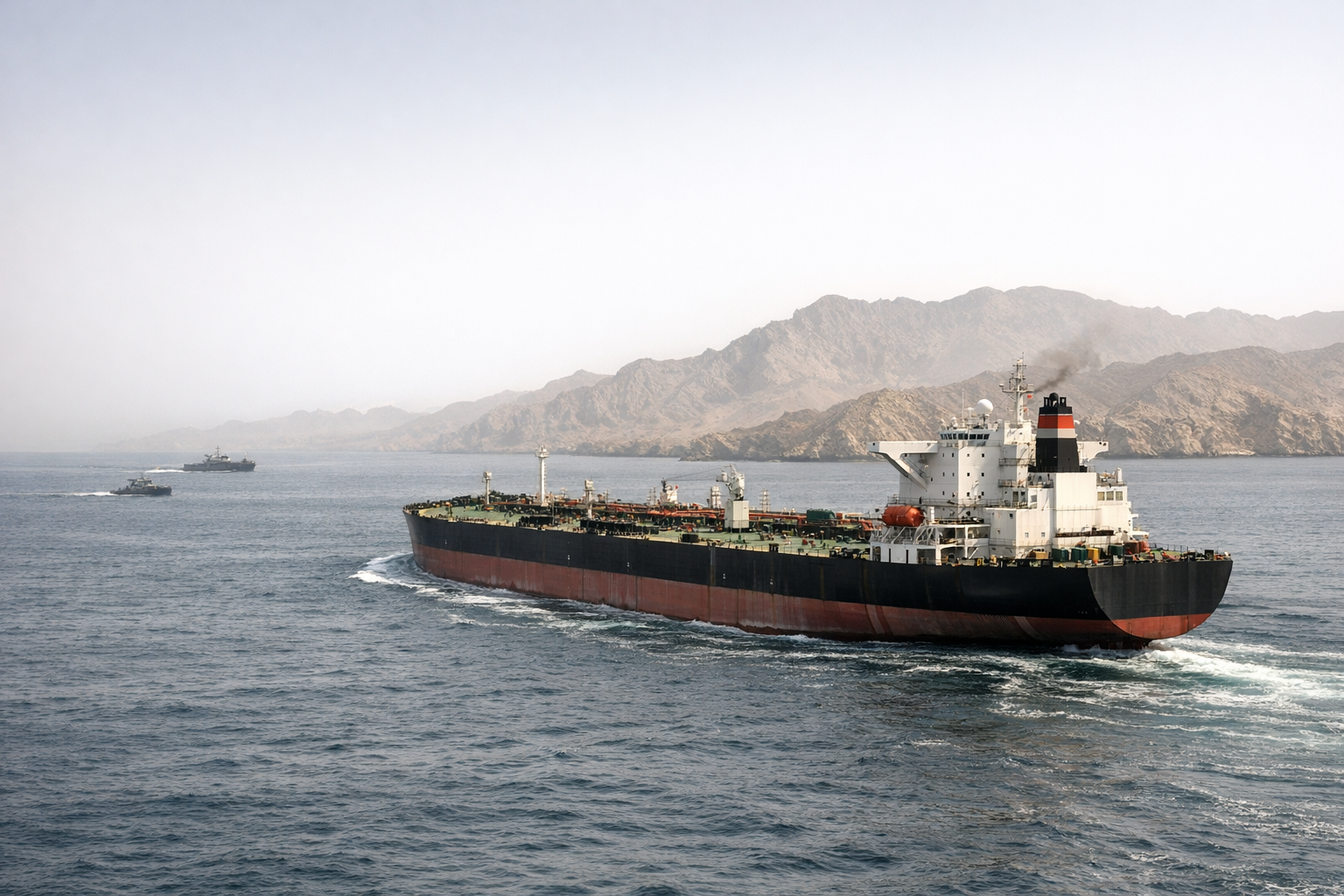
Hopes for Hormuz Breakthrough Recede as Iran Hardens Stance
A fragile diplomatic opening around the Strait of Hormuz appeared to fray on Wednesday as Iran’s lead negotiator dismissed talks with the United States as “theater diplomacy” and reports emerged of an Iranian draft plan that would bar American and Israeli vessels from the narrow waterway, one of the world’s most vital oil corridors.
The shift rattled energy markets and cast fresh doubt on negotiations that only days earlier had been described by mediators and outside officials as nearing a limited agreement to ease traffic through the strait. Oil prices climbed on renewed concern that even selective restrictions on passage could disrupt global supplies, raise shipping and insurance costs, and deepen uncertainty for major crude importers in Asia.
The latest turn suggested that what had briefly looked like a technical effort to restore safer maritime passage was again becoming a test of political leverage and military risk.
The Strait of Hormuz, which links the Persian Gulf to the Gulf of Oman and the Arabian Sea, carries roughly a fifth of the world’s traded oil and gas under normal conditions. Any threat to its operation reverberates well beyond the Gulf, affecting tanker rates, refinery planning and inflation expectations from Beijing to Brussels.
From Technical Talks to Strategic Pressure
Only earlier this week, officials had pointed to progress in Oman-mediated discussions over shipping coordinates and transit arrangements, raising hopes that Tehran might permit a more orderly reopening after months of disruption. Since the U.S.-Israeli attacks on Iran on Feb. 28, Tehran has treated access through Hormuz as a core bargaining chip, periodically constraining traffic and resisting a return to prewar navigation rules.
That posture had already made commercial shipping hazardous. Vessel traffic recovered somewhat in the week from July 27 to Aug. 2, according to reported shipping data, rising to 84 transits from 45 the previous week. But the increase came despite continued reports of attacks, near misses and warnings linked to Iran-aligned forces, underscoring how tentative any recovery remained.
Now, with Tehran publicly scornful of Washington’s approach and reportedly considering restrictions aimed specifically at U.S. and Israeli shipping, the possibility of a broader reopening appears more remote.
American officials have suggested in recent days that an agreement with Iran was within reach. But the latest statements from Tehran, coupled with market reaction to the reported draft plan, have reinforced the view among traders and diplomats that any deal is unlikely soon.
Oil Market Reacts to Risk of Selective Closure
Energy traders have long feared not only a full closure of Hormuz — an extreme scenario with global economic consequences — but also a murkier reality in which access remains technically open while certain vessels face delays, inspections, threats or exclusion.
That kind of selective pressure can be enough to drive up prices. Tanker owners may demand higher premiums, insurers may reprice war-risk coverage, and refiners may scramble for alternative cargoes. Even if the volume of oil physically moving through the strait does not collapse, the added cost and uncertainty can tighten markets.
The reported Iranian proposal to exclude U.S. and Israeli vessels struck at precisely that vulnerability. It remained unclear whether the draft represented a negotiating tactic, a serious policy under internal review, or a precursor to formal enforcement. It was also unclear how Iran would implement such a ban in practice without risking direct confrontation with the United States and its allies.
Still, markets reacted to the possibility that the threat itself could reshape shipping patterns.
China and Other Asian Buyers Face Renewed Exposure
The deterioration matters especially for Asia, which relies heavily on Gulf crude. China’s oil imports showed some improvement in July after earlier weakness, but analysts have warned that any recovery could prove short-lived if Hormuz remains unstable and Chinese demand stays soft.
For Beijing, the issue is not simply price. Sustained insecurity in Hormuz could complicate refinery purchasing decisions, force a shift toward costlier or longer-haul supplies, and add another layer of uncertainty to an economy already facing uneven demand. Other Asian importers, including India, Japan and South Korea, are similarly exposed to turbulence in Gulf shipping lanes.
Because so much of the world’s seaborne crude passes through the strait, disruptions there can quickly spread through freight networks and global fuel markets. A prolonged standoff would not need to become a formal blockade to inflict economic pain.
Oman’s Mediation Faces a Harder Test
Oman has long played the role of quiet intermediary between Iran and the West, and its efforts had briefly offered one of the few signs that the Gulf crisis might ease without a new military escalation. The technical nature of the talks — focused on routes, coordinates and passage arrangements — had raised hopes that both sides might separate commercial shipping from broader political grievances.
The latest rhetoric from Tehran makes that harder.
If Iran insists on terms that imply a right to selectively control passage, Washington would face pressure to reject any arrangement seen as legitimizing such authority. If the United States refuses, Oman’s room to salvage a compromise narrows further. And if Tehran moves from signaling to enforcement, the risk of a broader regional confrontation would rise sharply.
For now, the central question is whether Iran’s draft restrictions are meant to strengthen its hand at the negotiating table or to mark a genuine escalation. But even before that is answered, the message to markets and governments is already clear: the brief optimism around Hormuz has given way once again to the politics of coercion, and the cost of that reversal is being felt far beyond the Gulf.
Sources
Further reading and reporting used to add context:
- https://apnews.com/article/07074f3374339a34bc539f56d7d6287a
- https://apnews.com/article/ff5f13230ab92b5ae3022f45b2585444
- https://apnews.com/article/6587f90f2ab5beec373ce5fabf637541
- https://apnews.com/article/814164417aa284dc8a6d34ac22ea1a8e
- https://www.axios.com/newsletters/axios-am-c28a0dcf-07c5-4caa-b46b-da0e202609d6
- https://www.axios.com/2026/08/05/us-iran-strait-of-hormuz-deal-nears
- https://www.thedailybeast.com/iran-immediately-calls-bs-on-trumps-war-talks-vow/
- https://www.theguardian.com/world/2026/jun/29/oman-safe-reopening-strait-hormuz-iran-us-middle-east
- https://www.theguardian.com/world/2026/jun/25/un-backed-plan-ships-trapped-strait-of-hormuz-rejected-iran
- https://www.theguardian.com/world/2026/may/15/iran-oman-coordinating-management-strait-of-hormuz-tolls-ships
- https://www.theguardian.com/world/2026/jun/30/us-iran-talks-6bn-iranian-assets-restart
- https://www.theguardian.com/world/2026/jun/04/oman-resists-us-pressure-to-break-ties-with-iran-over-strait-of-hormuz
- https://www.theguardian.com/world/oman
- https://www.theguardian.com/world/2026/apr/08/us-iran-ceasefire-mass-exodus-ships-strait-hormuz-analysts
- https://www.sahmcapital.com/news/content/oil-tanker-traffic-through-hormuz-at-near-standstill-as-attacks-strain-iran-truce-2026-07-09
- https://www.nbcbayarea.com/news/national-international/trump-says-he-wont-rush-into-a-deal-with-iran/4089385/
- https://www.investing.com/news/world-news/us-disputes-iranian-claims-about-closing-strait-of-hormuz-as-negotiators-head-to-switzerland-4751638
- https://netzender.com/cnbc-daily-open-trumps-iran-deal-is-days-away-yet-again
- https://fm.cnbc.com/applications/cnbc.com/resources/editorialfiles/2026/04/23/Toplines_260142_CNBC_AAES_Q1_2026_Topline.pdf
- https://www.cnbc.com/markets/?msockid=127660b9067f6adb24a576e707cf6b41
- https://www.cnbc.com/2025/06/13/iran-launches-100-drones-at-israel-in-response-to-missile-attack.html?s=09
- https://apnews.com/article/0220ceb7904e16c30869c8fe4cf2a3db
- https://apnews.com/article/3b92568b6f2eec283eb51d0327ee682a
- https://apnews.com/article/194ab3d3130bb44de445cf3d05954beb
- https://www.axios.com/2026/08/01/saudi-crown-prince-trump-iran-attacks
- https://www.thedailybeast.com/stumped-trump-faces-humiliating-defeat-on-world-stage/
- https://www.investing.com/news/commodities-news/explainerchinas-oil-imports-have-plunged-during-the-iran-war-how-much-will-they-recover-4797393
- https://www.investing.com/news/commodities-news/trump-says-the-us-will-control-strait-of-hormuz-and-get-paid-for-it-4788454
- https://au.investing.com/news/world-news/us-revoking-license-that-authorized-iranian-oil-sales-official-says-4521893
- https://live.euronext.com/en/financial-news/oil-gains-over-4-trump-says-us-reinstating-iran-naval-blockade
- https://www.investing.com/news/commodities-news/explainerwhat-does-a-us-naval-blockade-of-iran-mean-for-oil-flows-4609295
- https://www.sahmcapital.com/news/content/barclays-expects-higher-brent-prices-if-strait-of-hormuz-remains-disrupted-2026-06-09
- https://www.investing.com/news/commodities-news/analysishow-irans-golden-weapon-of-hormuz-became-a-bigger-priority-than-its-longdisputed-nuclear-programme-4782091
- https://live.euronext.com/en/financial-news/oil-rises-intensifying-us-iran-hostilities-and-threat-red-sea-closure
- https://www.investing.com/news/commodities-news/hormuz-reopening-to-release-wave-of-oil-supply-depress-prices-4749314
- https://www.investing.com/news/world-news/trump-urges-iran-to-sign-a-deal-and-discusses-prolonged-blockade-4646375
- https://ca.investing.com/news/commodities-news/oil-climbs-to-onemonth-high-as-us-iran-step-up-attacks-in-strait-of-hormuz-4732105
- https://www.wsj.com/public/resources/documents/UfCrup2QFf8arruFYBNx-WSJNewsPaper-4-9-2026.pdf
- https://oversightdemocrats.house.gov/imo/media/doc/2026-05-06garciaetaltotrumpreiranaffordability.pdf
- https://www.wsj.com/public/resources/documents/WGgvgCu3WqtBCiFwEopE-WSJNewsPaper-3-7-2026.pdf
- https://www.wsj.com/public/resources/documents/RetoKjQieUWQBdgWCpWw-WSJNewsPaper-3-12-2026.pdf?gaa_at=eafs&gaa_n=AWEtsqcktAfPr-FwfBo2YlwUmXWStcnH1eb-7bF3bkV6NrbtOaPSnAroiGja&gaa_sig=St2lHFeoJt_xGGGJEJnndNou1fYcj8tpwxjrBdBboB0YJC80BB8DzbMJ0C6QMKfnXXDPrUeHWvTw0WwTAj6otQ%3D%3D&gaa_ts=69d2f615
- https://www.reddit.com/r/politics/comments/1vhixk1/oil_prices_jump_after_iran_publishes_restrictive/
- https://www.energy.senate.gov/services/files/3003976B-8A3D-4F65-BC65-7CB3696C121F
- https://www.wsj.com/public/resources/documents/5srHb1YcEVGbTGraIBcP-WSJNewsPaper-3-17-2026.pdf
- https://www.investing.com/news/commodities-news/oil-climbs-to-onemonth-high-as-us-iran-step-up-attacks-in-strait-of-hormuz-4789642
- https://www.investing.com/news/commodities-news/oil-prices-rise-more-than-2-as-israel-moves-further-into-lebanon-4717951
- https://au.investing.com/news/commodities-news/us-oil-prices-jump-after-us-military-launches-strikes-against-iran-4522352
- https://uk.investing.com/news/commodities-news/oil-prices-rise-2-as-hostilities-worsen-in-the-middle-east-4771073
- https://www.investing.com/news/commodities-news/analysismideast-war-escalation-threatens-recovery-in-global-oil-refining-4804747
- https://www.investing.com/news/commodities-news/oil-rises-on-intensifying-usiran-hostilities-and-threat-of-red-sea-closure-4797340
- https://www.investing.com/news/commodities-news/oil-prices-settle-at-lowest-in-over-a-week-as-us-pauses-attacks-on-iran-4817880
- https://www.investing.com/news/commodities-news/instant-view-oil-surges-20-as-iran-war-fuels-supply-fears-4548664
- https://apnews.com/article/ecdbd96f2b46c70beb5926d8508f9c55
- https://apnews.com/article/fb81a68f999f4a7b0498ae71cbffe8e5
- https://www.reutersconnect.com/item/hormuz-traffic-nearly-halts-as-renewed-us-iran-strikes-rattle-energy-shipping/dGFnOnJldXRlcnMuY29tLDIwMjY6bmV3c21sX09XQU5BQ0FBVklERU8yMDI2MDcwOTQxOTMwMDc3
- https://www.reutersconnect.com/item/irans-chief-negotiator-says-talks-will-be-successful-if-lebanons-territorial-integrity-is-secured/dGFnOnJldXRlcnMuY29tLDIwMjY6bmV3c21sX1ZBMTQ0MTIyMDYyMDI2UlAx
- https://www.internazionale.it/ultime-notizie-reuters/2026/07/09/oil-tanker-traffic-through-hormuz-at-near-standstill-as-attacks-strain-iran-truce
- https://www.reutersconnect.com/item/vance-trump-asked-us-to-turn-over-a-new-leaf-in-ties-with-iranian-people/dGFnOnJldXRlcnMuY29tLDIwMjY6bmV3c21sX1ZBMTAyNTIxMDYyMDI2UlAx/dGFnOnJldXRlcnMuY29tLDIwMjY6bmV3c21sX0xWQTAwNzEwMjUyMTA2MjAyNlJQMQ
- https://www.reutersconnect.com/item/irans-policy-towards-the-us-is-commitment-for-commitment-says-chief-negotiator/dGFnOnJldXRlcnMuY29tLDIwMjY6bmV3c21sX1ZBMzcxNTE5MDQyMDI2UlAx
- https://www.sahmcapital.com/news/content/shipping-traffic-through-hormuz-at-virtual-standstill-despite-ceasefire-data-shows-2026-04-09
- https://www.investing.com/news/commodities-news/shipping-traffic-remains-at-virtual-standstill-through-hormuz-data-shows-4622861
- https://noticias.uol.com.br/ultimas-noticias/reuters/2026/07/10/principal-negociador-do-ira-diz-que-conflito-nao-terminara-com-a-rendicao-do-ira.htm?uol_app=uolnoticias
- https://www.investing.com/news/commodities-news/most-strait-of-hormuz-shipping-at-a-standstill-despite-latest-us-pledge-4655862
- https://www.fidelity.com/news/article/default/202606071222RTRSNEWSCOMBINED_KBN3S90FV-OUSWD_1
- https://www.reutersconnect.com/item/iranian-delegation-led-by-chief-negotiator-mohammad-baqer-qalibaf-and-foreign-minister-abbas-araqchi-lands-at-zurich-international-airport/dGFnOnJldXRlcnMuY29tLDIwMjY6bmV3c21sX1JDMlhYTEEzVVlUQQ
- https://www.fidelity.com/news/article/default/202606110309RTRSNEWSCOMBINED_KBN3SD0A6-OUSTP_1
- https://www.fidelity.com/news/article/default/202606142028RTRSNEWSCOMBINED_KBN3SG0S2-OUSWD_1
- https://www.fidelity.com/news/article/default/202606200641RTRSNEWSCOMBINED_KBN3SM03D-OUSWD_1
- https://www.fidelity.com/news/article/default/202606120106RTRSNEWSCOMBINED_KBN3SE0CO-OUSTP_1
- https://www.fidelity.com/news/article/default/202606251128RTRSNEWSCOMBINED_KBN3SR1DL-OUSTP_1
- https://www.fidelity.com/news/article/default/202607222332RTRSNEWSCOMBINED_L1N43P01A_1
- https://www.fidelity.com/news/article/default/202607272345RTRSNEWSCOMBINED_L1N43T12C_1
- https://www.fidelity.com/news/article/default/202607111921RTRSNEWSCOMBINED_KBN3T70LK-OUSWD_1
- https://www.fidelity.com/news/article/top-news/202607122334RTRSNEWSCOMBINED_KBN3T80MK-OUSBS_1
- https://www.fidelity.com/news/article/default/202607091213RTRSNEWSCOMBINED_L1N43A13S_1
- https://www.fidelity.com/news/article/default/202605142313RTRSNEWSCOMBINED_KBN3RL08Z-OUSWD_1
- https://www.fidelity.com/news/article/default/202605290527RTRSNEWSCOMBINED_KBN3RE1M1-OUSTP_1
- https://d2dr22b2lm4tvw.cloudfront.net/ar_adg/2026-03-31/front-page.pdf
- https://www.gulf-times.com/pdf/2026/05/10/main-20260510-1.pdf?ts=004857
- https://www.cus.com.cy/images/Newsletters%20PDF/2026/13/Attachment%201.pdf
- https://www.wsj.com/public/resources/documents/s0cNgmELRiY0bUeogOiD-WSJNewsPaper-3-25-2026.pdf?gaa_at=eafs&gaa_n=AWEtsqdHBAJ7audLjotvMNfm-4xXUgK82sI5nRHlzTRmuye8DjoE9zE5kjoR&gaa_sig=pd7gz_u8hOSw6wucXGWAZ6g37eailhuwSa1CPq3o4bj1a4qu5nbmk8sGKv25W_9JWjwMqTDZbaR-6iHOp3yfxg%3D%3D&gaa_ts=69cc6dc7
- https://en.wikipedia.org/wiki/2025%E2%80%932026_Iran%E2%80%93United_States_negotiations
- https://www.israelnationalnews.com/news/421912
- https://www.straitstimes.com/asia/south-asia/india-bars-seafarers-from-strait-of-hormuz-voyages-after-attacks
- https://www.chinadaily.com.cn/bizchina/2010-08/11/content_11135493.htm
- https://au.marketscreener.com/news/mideast-war-escalation-threatens-recovery-in-global-oil-refining-ce7f51d8d08cf224
- https://www.investing.com/news/commodities-news/analysisiran-war-energy-shock-sparks-global-push-to-reduce-fossil-fuel-dependence-4568732
- https://me.exante.eu/ar/press/market-updates/3160-paying-for-access-section-301-edition/
- https://www.rferl.org/a/iran-war-us-hormuz-oil-blockade-gulf-israel/33640284/lbl0lbi460363.html
- https://maritime-executive.com/article/china-begins-to-return-to-the-world-oil-market
- https://www.argusmedia.com/-/media/project/argusmedia/mainsite/english/images/downloadable-content/argus-tanker-freight-20240903.pdf
- https://www.reddit.com/r/worldnews/comments/1vharh1/oil_prices_jump_after_iran_publishes_restrictive/
- https://www.bis.org/publ/qtrpdf/r_qt1409.pdf
- https://www.investing.com/news/stock-market-news/factboxhow-usisraeli-war-on-iran-is-upending-global-business-4568788
- https://commodityintelligence.com/workflow/client/08dbf9b63c054038be29a0ba/view
- https://www.al-monitor.com/originals/2026/07/houthis-warn-shipping-companies-avoid-saudi-ports-email-shows
- https://www.reddit.com/r/oil/comments/1vencq3/removed/
- https://www.rferl.org/a/iran-war-us-hormuz-oil-blockade-gulf-israel/33640284/lbl0lbi454170.html
- https://imranghazi.com/mtba/downloads/News/2014/News%2022%20Aug%202014%20Email%20No%20191-2014.pdf
- https://www.reddit.com/r/wallstreetbetsHUZZAH/comments/1vf5z1k/daily_discussion_thread_august_04_2026/
- https://nsearchives.nseindia.com/corporate/ARSSBL_2024_08062026123243_Intimation_sd.pdf
- https://au.investing.com/news/commodities-news/oil-prices-rise-more-than-2-on-israel-strikes-on-lebanon-4474901
- https://www.investing.com/news/world-news/gulf-states-back-plan-to-let-iran-collect-voluntary-fees-to-use-hormuz-4816183
- https://www.fidelity.com/news/article/default/202605101808RTRSNEWSCOMBINED_KBN3RH0L2-OUSBS_1
- https://www.fidelity.com/news/article/default/202605101857RTRSNEWSCOMBINED_KBN3RH0M1-OUSBS_1
- https://www.investing.com/news/commodities-news/top-us-oil-trade-group-opposes-hormuz-tolls-after-gulfbacked-voluntary-fee-proposal-4818345
- https://www.investing.com/news/world-news/us-gulf-arab-nations-draft-new-un-resolution-on-strait-of-hormuz-4657080
- https://www.fidelity.com/news/article/top-news/202607071842RTRSNEWSCOMBINED_KBN3T32MM-OUSBS_1
- https://au.investing.com/news/commodities-news/russias-sechin-says-us-companies-benefit-from-strait-of-hormuz-closure-4474959
- https://institutional.fidelity.com/app/proxy/content?literatureURL=%2FRD_QAA_9130.PDF
- https://media.fidelity.com/assets/Fidelity.com_VMS/486/803/040926_ITM_Show-Notes.pdf
- https://institutional.fidelity.com/app/proxy/content?literatureURL=%2F9883196.PDF
- https://clearingcustody.fidelity.com/app/proxy/content?literatureURL=%2F9922560.PDF
- https://institutional.fidelity.com/app/proxy/content?literatureURL=%2F9922537.PDF
- https://institutional.fidelity.com/app/proxy/content?literatureURL=%2F9920585.PDF
- Possible Strait of Hormuz deal, a large attack in Yemen and other Mideast news
- A deal with Iran over the Strait of Hormuz may require a compromise from Trump
- Gulf states back plan to let Iran collect voluntary fees to use Hormuz By Reuters
- Iran and Oman make progress on a deal to reopen the Strait of Hormuz, officials say