
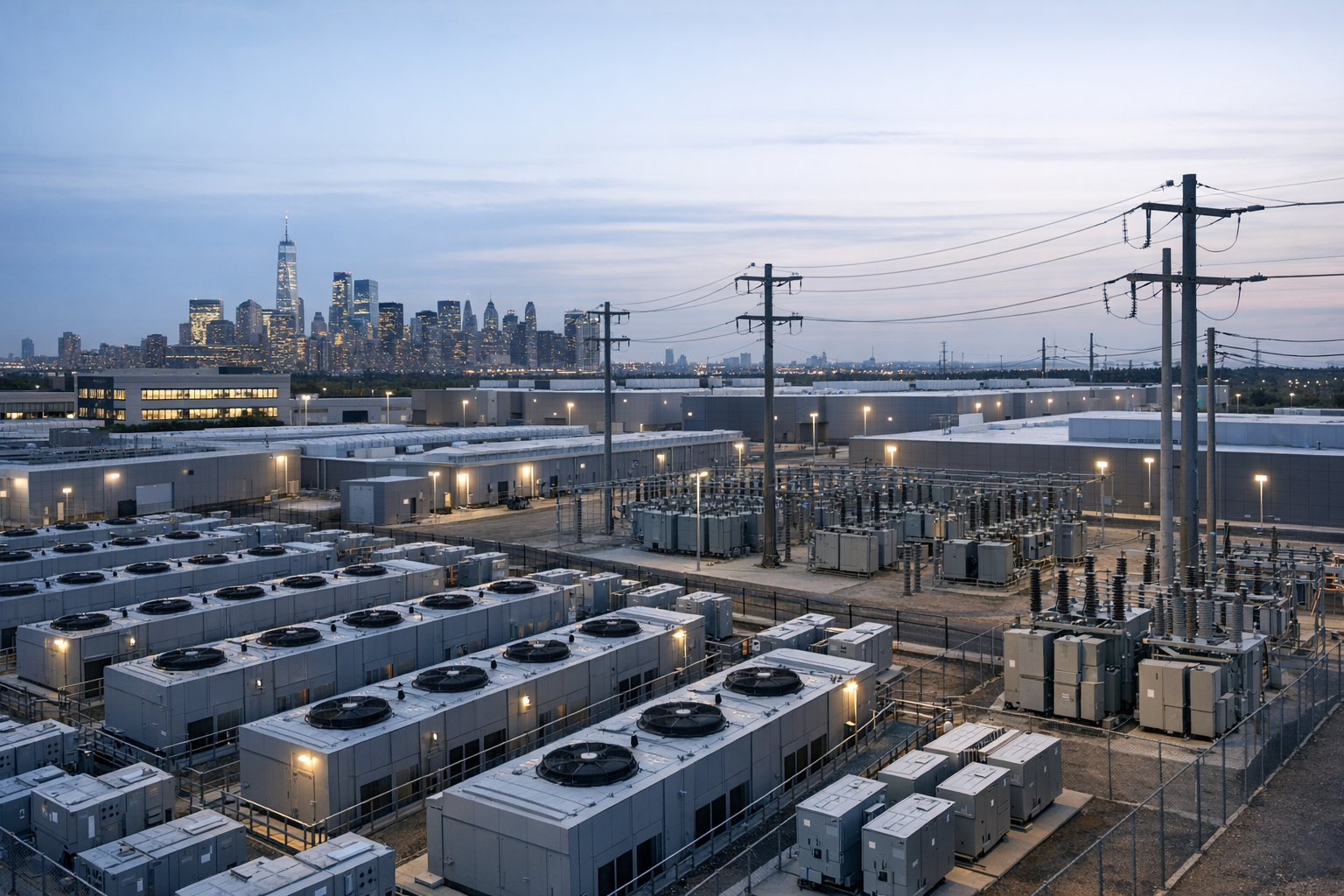
Wall Street Moves Closer to the Center of the A.I. Boom
For much of the past three years, the frenzy to build artificial intelligence has been underwritten by the largest technology companies on earth, whose balance sheets were strong enough to absorb the staggering cost of chips, data centers and electricity.
Now, a new phase is taking shape — one in which Wall Street is being asked to finance the boom more directly.
In recent days, a cluster of deals across the industry has underscored how quickly the economics of artificial intelligence are expanding beyond Silicon Valley’s richest companies. Nvidia said it was working with a roster of investment giants — Apollo, BlackRock, Blackstone, Brookfield, Goldman Sachs and KKR — to mobilize more than $500 billion over time for A.I. infrastructure. Intel upsized a stock sale to $20 billion at $95 a share. CoreWeave, the cloud-computing company built around renting access to Nvidia chips, reported another sharp jump in revenue even as investors continued to scrutinize its roughly $35 billion debt load. And Riot Platforms, better known as a Bitcoin miner, disclosed a 20-year data-center lease at its Rockdale, Texas, site that is expected to generate about $9.1 billion in initial contract revenue.
Taken together, the moves point to a broadening financial architecture behind A.I. — one that increasingly relies on public equity offerings, structured finance, long-term leases and private capital rather than the spending power of hyperscalers alone.
That matters because the race to secure computing power is becoming too large, and too power-hungry, to be funded in the old way.
A Capital-Intensive Race
The numbers involved in the A.I. build-out have become almost difficult to parse. Training and running advanced models requires vast clusters of graphics processors, specialized networking gear, new data-center campuses and, crucially, access to electricity in a grid environment that is already strained in many regions.
Nvidia’s latest financing push gives perhaps the clearest picture yet of how the industry sees the next step. The company has increasingly promoted the notion of “A.I. factories” — industrial-scale facilities designed to produce intelligence the way older plants produced steel or chemicals. But building those facilities requires financing mechanisms closer to those used in infrastructure, real estate and project finance than in traditional software investing.
The significance of Nvidia’s plan is not just its scale. It is that the company is effectively trying to connect demand for its chips with the deep pools of capital sitting in pension funds, private-credit firms and alternative asset managers. If that effort works, it could accelerate the deployment of data centers and computing capacity well beyond what even the largest technology companies would choose to finance on their own books.
It would also leave the A.I. boom more exposed to shifts in credit markets, investor confidence and the long-term economics of renting out compute.
Intel and CoreWeave Test Investor Appetite
The same tension is visible in Intel’s enlarged stock offering and in the market’s response to CoreWeave.
Intel’s $20 billion raise, priced at $95 a share, is one of the clearest signs that companies tied to the A.I. supply chain believe they can still tap investors for enormous sums, even as the costs of competing rise. For Intel, which has been under pressure to prove it can remain relevant in an A.I. market dominated by Nvidia, the offering is both a financing event and a strategic signal: the race is expensive, and falling behind may be even more costly.
CoreWeave offers a different, and in some ways more revealing, case. The company has become one of the emblematic businesses of the A.I. era by doing something simple and capital intensive: borrowing heavily to assemble large amounts of high-end computing capacity, then leasing that capacity to customers racing to build and deploy models.
Its revenue has been surging, a sign that demand for A.I. infrastructure remains strong. Yet investor fascination with the company has always carried a note of anxiety, because its growth model depends on immense upfront spending and debt. CoreWeave has previously outlined plans for $30 billion to $35 billion in capital expenditures in 2026 and has said it expects active power to more than double to about 1.7 gigawatts by year-end.
In other words, it is trying to industrialize cloud computing at a pace that resembles a utility build-out more than a typical software expansion. That can look brilliant when demand is rising and customers are signing long-term contracts. It can look precarious if pricing weakens, utilization slips or financing conditions tighten.
Bitcoin Miners Seek a Second Act
Riot’s agreement in Texas highlights another important shift: the scramble for A.I. capacity is creating an opening for companies that already control land, power access and industrial facilities, even if they were built for another digital boom.
Riot said the Rockdale lease covers 191 megawatts over 20 years and should produce roughly $9.1 billion in initial contract revenue. The company identified the customer only as a “leading frontier A.I. lab,” though market reports linked the deal to Anthropic. The filing left some crucial questions unanswered, including the tenant’s formal identity and the extent of any credit support, but the broad message was unmistakable.
Bitcoin miners, once valued mainly for their exposure to cryptocurrency prices, are increasingly trying to recast themselves as owners of power-rich infrastructure that can be repurposed for A.I. workloads. Rockdale, like other former mining sites, offers something suddenly scarce: the possibility of large-scale electricity access and existing industrial footprints in a market where power procurement and permitting can delay projects for years.
For Riot, the appeal is obvious. A long-dated computing lease can promise steadier and potentially more valuable cash flows than the volatile economics of mining Bitcoin. For the A.I. industry, the deal shows how the search for capacity is spilling into adjacent sectors and pulling in operators who can function less like tech companies than like landlords or utility-style service providers.
The Anthropic Effect
The deal also fits a broader pattern around Anthropic, one of the leading developers of frontier A.I. models, which has been locking up computing capacity through multiple channels. The company already has arrangements tied to Amazon for up to 5 gigawatts of capacity, and Reuters reported in June on another expansion backed by Broadcom and asset managers.
That behavior speaks to one of the defining features of the current market: leading model developers increasingly need to secure compute years in advance, often through complex partnerships rather than straightforward cloud purchases. As a result, their suppliers — whether cloud firms, chipmakers or repurposed miners — are beginning to finance against those long-term commitments.
In theory, that should make the system more efficient. Long-duration demand can support long-duration financing. In practice, it also creates a chain of dependencies that can become fragile if one link weakens.
The Risks Beneath the Optimism
For now, the market’s message is that investors still believe the hunger for A.I. computing will justify extraordinary spending. But the risks are becoming harder to ignore.
One question is whether demand for A.I. services, and the prices customers are willing to pay, will remain high enough to support this level of leverage and construction. Another is whether projects can actually be delivered on schedule, given bottlenecks in power, transmission, permits, labor and equipment. In Riot’s case, key economics depend on phased delivery beginning in late 2027 and continuing into 2028.
There are also concerns about how financing structures may reinforce one another. As Nvidia promotes ecosystems in which its chips, infrastructure partners and capital providers are increasingly intertwined, some investors have begun to ask whether the arrangements could create “circular” dynamics — in which enthusiasm for A.I. hardware helps finance capacity that, in turn, drives further hardware demand.
That does not mean the boom is illusory. It means the business is maturing into something closer to a full industrial system, with all the complexity that entails.
Why This Moment Matters
What is changing now is not simply the scale of spending, but who is being asked to bear it.
The first chapter of the generative A.I. era was dominated by giant technology companies writing giant checks. The next chapter appears likely to draw in a much wider cast: public shareholders buying new offerings, private-credit firms underwriting data-center fleets, infrastructure investors backing power-hungry campuses, and companies from the crypto world repositioning themselves to serve model makers.
That broader funding base could speed the build-out dramatically. It could also make the future of A.I. more contingent on the disciplines of capital markets — quarterly scrutiny, refinancing risk, contract enforcement and the unforgiving mathematics of debt.
The industry’s underlying promise remains vast. But as this week’s deals made clear, the contest is no longer just about inventing smarter models or faster chips. It is also about who can finance the physical machinery of artificial intelligence, and for how long.
Sources
Further reading and reporting used to add context:
- https://www.axios.com/2026/08/11/intel-stock-chips-ai
- https://www.kiplinger.com/investing/stocks/17494/next-week-earnings-calendar-stocks
- https://www.cnbc.com/amp/2025/08/20/intel-investors-equity-softbank-trump.html
- https://www.cnbc.com/2025/08/18/intel-is-getting-a-2-billion-investment-from-softbank.html?msockid=2069bd6db1756062376dab3cb0516121
- https://uk.finance.yahoo.com/news/coreweave-tops-revenue-estimates-ai-201014285.html/
- https://www.reddit.com/r/wallstreetbets/comments/1vltwx2/coreweave_stock_pops_12_as_revenue_doubles_on/
- https://www.cnbc.com/2025/03/03/amazon-backed-ai-firm-anthropic-valued-at-61point5-billion-after-latest-round.html?msockid=204b79c8ad91618631e36f80ac456038
- https://getcoai.com/news/coreweave-stock-drops-14-on-earnings-miss-despite-1-21b-revenue-beat/
- https://www.cnbc.com/2025/09/02/anthropic-raises-13-billion-at-18-billion-valuation.html?msockid=15b9bcd5a79d68bc1261aa88a616691a
- https://www.reddit.com/r/wallstreetbets/comments/1vl0z4e/nvidia_lines_up_500_billion_in_financing_as_ceo/
- https://www.axios.com/2026/07/22/nvidia-jensen-huang-china-open-source-ai
- https://www.latimes.com/business/story/2026-07-29/nvidias-750-billion-ai-bet-deepens-fears-of-circular-tech-bubble
- https://www.cnbc.com/2025/09/18/intel-nvidia-investment.html?msockid=1ac45fd82e3b6c2801f949b72fed6def
- https://www.reddit.com/r/wallstreetbets/comments/1vl38lj/anthropic_strikes_9_billion_cloud_deal_with_riot/
- https://www.techmeme.com/260206/p23
- https://techblog.comsoc.org/2026/02/07/nvidia-ceo-huang-ai-is-the-largest-infrastructure-buildout-in-human-history-and-ai-capex-will-generate-new-revenue-streams/
- https://www.spglobal.com/market-intelligence/en/news-insights/research/coreweaves-revenue-set-to-soar-as-demand-for-ai-infrastructure-booms
- https://www.reddit.com/r/technology/comments/1vl5ssn/nvidia_lines_up_500_billion_in_financing_as_ceo/
- https://www.reddit.com/r/siliconvalley/comments/1vkwphp/nvidia_taps_wall_street_for_500_billion_financing/
- https://www.riotplatforms.com/riot-announces-august-2025-production-and-operations-updates/
- https://www.riotplatforms.com/riot-announces-fee-simple-acquisition-of-land-and-first-data-center-lease-with-amd-at-the-rockdale-site/
- https://newsroom.intel.com/corporate/intel-and-trump-administration-reach-historic-agreement
- https://investor.nvidia.com/news/press-release-details/2026/NVIDIA-Sets-Conference-Call-for-Second-Quarter-Financial-Results/default.aspx
- https://www.riotplatforms.com/investors/
- https://www.riotplatforms.com/terrestrial-energy-and-riot-platforms-launch-collaboration-to-develop-nuclear-powered-large-scale-data-center-projects/
- https://www.riotplatforms.com/
- https://www.riotplatforms.com/riot-announces-august-2024-production-and-operations-updates/
- https://www.intc.com/filings-reports/all-sec-filings/content/0000050863-25-000129/intc-20250822.htm
- https://www.riotplatforms.com/category/press-releases/
- https://investor.nvidia.com/news/press-release-details/2025/NVIDIA-Announces-Upcoming-Event-for-Financial-Community/default.aspx
- https://www.riotplatforms.com/category/uncategorized/
- https://www.intc.com/filings-reports/all-sec-filings/content/0000050863-25-000126/0000050863-25-000126.pdf
- https://www.reddit.com/r/NVDA_Stock/comments/1vkzceo/jensenvidia_ai_factory_compute_is_becoming_an/
- https://nvidianews.nvidia.com/_gallery/download_pdf/688a88483d6332c9503dbf7e/
- https://s201.q4cdn.com/141608511/files/doc_financials/2026/q2/NVDA-Q2-2026-Earnings-Call-27-August-2025-5_00-PM-ET.pdf
- https://www.wsj.com/public/resources/documents/FsNONoe3i33z3pX6jQOY-WSJNewsPaper-2-27-2026.pdf?gaa_at=eafs&gaa_n=AWEtsqcz5zZMS8eB3LEX8IprbbfdY1jhzhkv2eEeIYIZzn6MH-APII_fsSei&gaa_sig=hpom_gFmY2DxKcv9pkIGRFdrzD42D-q30BN28U5UTishqsIZZYNRE6ncFMuCJGaAyLqgr5fLlrFFbuzEaXtmXw%3D%3D&gaa_ts=69ca9e9c
- https://www.intc.com/filings-reports/all-sec-filings/content/0000050863-25-000135/0000050863-25-000135.pdf
- https://www.reddit.com/r/irenstocks/comments/1vkzsp9/nvidia_ai_factory_compute_is_becoming_an/
- https://www.intc.com/filings-reports/annual-reports/content/0000050863-26-000011/0000050863-26-000011.pdf
- https://nvidianews.nvidia.com/news/nvidia-and-emerald-ai-join-leading-energy-companies-to-pioneer-flexible-ai-factories-as-grid-assets
- https://nvidianews.nvidia.com/news/dsx-infrastructure-ai-factory
- https://nvidianews.nvidia.com/news/latest?pStoreID=hp_education&page=17
- https://nvidianews.nvidia.com/news/naver-nvidia-and-brookfield-to-expand-koreas-national-ai-factory-infrastructure-buildout
- https://nvidianews.nvidia.com/news/nvidia-vera-rubin-platform?linkId=100000412790691&ncid=so-face-181339
- https://nvidianews.nvidia.com/news/nvidia-announces-financial-results-for-second-quarter-fiscal-2026
- https://nvidianews.nvidia.com/news/a-?page=1
- https://nvidianews.nvidia.com/news/nvidia-names-suzanne-nora-johnson-to-board-of-directors
- https://nvidianews.nvidia.com/news/nvidia-sets-conference-call-for-second-quarter-financial-results-6912330
- https://nvidianews.nvidia.com/_gallery/download_pdf/69c11da33d63324e40d61ab9/
- https://investor.nvidia.com/news/press-release-details/2026/NAVER-NVIDIA-and-Brookfield-to-Expand-Koreas-National-AI-Factory-Infrastructure-Buildout/default.aspx
- https://nvidianews.nvidia.com/_gallery/download_pdf/68b0c3973d63329aeaf4cb9a/
- https://nvidianews.nvidia.com/news/latest?c=21926&page=4
- https://nvidianews.nvidia.com/helper-search-news?ct=releases&page=1&q=blackwel
- https://nvidianews.nvidia.com/_gallery/download_pdf/69a6e9f23d633287de8fd1dd/
- https://nvidianews.nvidia.com/_gallery/download_pdf/682aaecb3d633282ef2e0fe5/
- https://nvidianews.nvidia.com/_gallery/download_pdf/665c69873d6332d086f2f3c7/
- https://nvidianews.nvidia.com/_gallery/download_pdf/65d4b0e13d633225dac0fe5f/
- https://www.axios.com/2026/08/11/nvidia-chip-securitization-wall-street
- https://www.axios.com/2026/08/10/nvidia-financing-ai-goldman-sachs-blackrock
- https://www.axios.com/newsletters/axios-closer-ba10bc69-9513-48e2-993f-9df13dd3246a
- https://www.cnbc.com/2025/08/29/cnbc-daily-open-main-street-and-wall-street-are-still-alive-and-kicking.html/
- https://www.sec.gov/Archives/edgar/data/0000312070/000095010326001845/dp241312_424b2-8348barc.htm
- https://news.bloomberglaw.com/california-brief/nvidia-tied-data-center-raises-4-59-billion-from-junk-bond-sale
- https://www.reddit.com/r/NBCauto/comments/1vlzkwg/world_cnbc_daily_open_big_tech_wants_to_tap_wall/
- https://news.bloomberglaw.com/texas-brief/sec-calls-for-clear-disclosure-about-ai-data-center-financing
- https://news.bloomberglaw.com/artificial-intelligence/nvidias-750-billion-in-deals-reignite-circular-ai-fears-1
- https://www.bloomberg.com/news/articles/2026-05-06/nvidia-buys-500-million-of-rights-for-stock-in-corning?srnd=phx-technology
- https://www.bloomberglinea.com/tecnologia/megaacuerdos-de-nvidia-reavivan-temores-por-el-financiamiento-circular-de-la-ia/
- https://www.bloomberg.com/news/articles/2025-08-11/trump-open-to-nvidia-selling-scaled-back-blackwell-chip-to-china
- https://www.bloomberg.com/news/videos/2026-05-13/bloomberg-tech-5-13-2026-video
- https://news.bloombergtax.com/daily-tax-report-international/distress-watch-data-center-debt-hits-a-wall-after-deal-rush
- https://www.sec.gov/Archives/edgar/data/1491252/0001214659-26-006075-index.htm
- https://guidances.org/en/article/6ac846ec-e1d5-4f7d-9c40-222f2bf6a9b1/nvidia-s-return-to-the-high-grade-bond-market-puts-ai-capex-under-a-new-05eff8fb
- https://www.sec.gov/Archives/edgar/data/83246/000110465923094194/tm2324280d1dps_424b2.pdf
- https://www.reddit.com/r/BetterOffline/comments/1vkvi8l/nvidia_teams_up_with_wall_street_asset_managers/
- https://www.reddit.com/r/MU_Stock/comments/1vktvb9/nvidia_to_team_with_wall_street_on_500_billion/
- https://www.reddit.com/r/BetterOffline/comments/1vlmi9p/us_sec_exempts_certain_data_center_bonds_from_key/
- https://www.reddit.com/r/NvidiaStock/comments/1vkvs1d/nvidia_partners_with_apollo_blackrock_blackstone/
- https://www.riotplatforms.com/riot-announces-second-quarter-2026-earnings-conference-call/
- https://www.riotplatforms.com/riot-platforms-reports-first-quarter-2026-financial-results-and-strategic-highlights/
- https://www.riotplatforms.com/riot-platforms-reports-second-quarter-2025-financial-results-current-operational-and-financial-highlights/
- https://www.riotplatforms.com/riot-platforms-reports-full-year-2025-financial-results-and-strategic-highlights/
- https://www.riotplatforms.com/riot-platforms-reports-second-quarter-2024-financial-results-current-operational-and-financial-highlights/
- https://www.riotplatforms.com/locations/rockdale/
- https://www.riotplatforms.com/riot-platforms-reports-second-quarter-2023-financial-results-current-operational-and-financial-highlights/
- https://www.riotplatforms.com/riot-platforms-reports-third-quarter-2025-financial-results-and-strategic-highlights/
- https://www.riotplatforms.com/riot-reports-second-quarter-2022-financial-results-current-operational-and-financial-highlights/
- https://www.morningstar.com/news/business-wire/20260727724365/coreweave-announces-date-of-second-quarter-2026-financial-results-and-conference-call
- https://investors.coreweave.com/news/news-details/2026/CoreWeave-Reports-Strong-First-Quarter-2026-Results/
- https://www.sec.gov/Archives/edgar/data/1769628/000176962826000220/crwv-20260507.htm
- https://investors.coreweave.com/news/news-details/2025/CoreWeave-Reports-Strong-Second-Quarter-2025-Results/default.aspx
- https://investors.coreweave.com/financials/quarterly-results/default.aspx
- https://www.sec.gov/Archives/edgar/data/1769628/000176962825000039/crwv-20250812.htm
- https://www.nasdaq.com/press-release/coreweave-announces-date-second-quarter-2026-financial-results-and-conference-call
- https://investors.coreweave.com/overview/default.aspx
- https://www.sec.gov/ixviewer/ix.html?doc=%2FArchives%2Fedgar%2Fdata%2F1769628%2F000176962826000220%2Fcrwv-20260507.htm
- https://markets.financialcontent.com/prnews/article/bizwire-2026-7-27-coreweave-announces-date-of-second-quarter-2026-financial-results-and-conference-call
- https://finance.yahoo.com/technology/ai/articles/coreweave-announces-date-second-quarter-200500527.html
- https://investor.crowncastle.com/news-releases/news-release-details/crown-castle-reports-second-quarter-2026-results-and-updates
- https://s205.q4cdn.com/133937190/files/doc_presentations/2026/Mar/02/March-2026-Investor-Presentation.pdf
- https://s205.q4cdn.com/133937190/files/doc_financials/2026/q1/Earnings-One-pager_Final.pdf
- https://www.reddit.com/r/CRWV/comments/1vlxj67/coreweave_q2_2026_strong_results_margin/
- https://investors.coreweave.com/files/doc_financials/2025/q3/Guidance.pdf
- https://s205.q4cdn.com/133937190/files/doc_financials/2025/q2/Q2-25-Earnings-Presentation.pdf
- https://www.sec.gov/Archives/edgar/data/1769628/000176962826000193/formars.pdf
- https://www.reddit.com/r/CRWV/comments/1v8cchx/coreweave_to_hold_its_second_quarter_2026/
- https://www.reddit.com/r/CRWV/comments/1vlsrgf/coreweave_q2_2026_earnings_results/
- https://www.reddit.com/r/stocks/comments/1vlsvg4/coreweave_edges_past_quarterly_revenue_estimates/
- https://www.reddit.com/r/CRWV/comments/1vlvmey/coreweave_outlook/
- https://www.reddit.com/r/CRWV/comments/1vlslbd/q2_earnings/
- https://www.itiger.com/news/2633179952
- https://finance.yahoo.com/markets/stocks/articles/coreweave-reports-strong-first-quarter-200700558.html
- https://www.businesswire.com/news/home/20260507558197/en/CoreWeave-Reports-Strong-First-Quarter-2026-Results
- https://ir.mccormick.com/node/33851/pdf
- https://www.sec.gov/Archives/edgar/data/1769628/000176962826000220/coreweave1q26earningspress.htm
- https://earnings-documents-prod.s3.amazonaws.com/fd42d73d-ed23-4e22-89d7-55c36c8d7b20/8-K.pdf?X-Amz-Algorithm=AWS4-HMAC-SHA256&X-Amz-Credential=ASIAWUJMVP6Y64O3GNVG%2F20260430%2Fus-east-1%2Fs3%2Faws4_request&X-Amz-Date=20260430T233505Z&X-Amz-Expires=900&X-Amz-Security-Token=IQoJb3JpZ2luX2VjEFAaCXVzLWVhc3QtMSJHMEUCIAydkAZ0ST0f9BqG1GItTpERRcd6JtPLcC%2F24I3AEJJrAiEAgRWEKBGms74skeefQp%2F0h%2FVJ92xtHCfWmKlQSjyjZ24q%2BwQIGRAEGgw0NTU4OTcwODc5MjEiDO%2FPMrp7YnfDg0N%2BfSrYBDT9q1EORwk2BNRHOHQy1GQ2hM4sF1cqSXkbJZcLi08ivLSTkIHH0IimJKWRTxTFmwIJu3iXY84vL%2Fq91OaxR56unZMKyMgcoOYhpt%2FyyDl8I0tXZoZngv3JWFr%2F2gZORSwxmnMARivW3nPSd%2FCk5cK42SJq%2BBq6fanLHBLHVGKIX2VhHVWM0LANy%2BjQ7G%2B7fGHYqhjf2L6DbmryuelxdnbbTjXaREBnlBHsHJz9aZAVaVpsoXWha4QcdIVU6G9qMOozhUIihiQqLB5iBKbcrjUoNGMs3sz7Ci7YYADkqxIdgQfMoP11%2F6d%2FZxU19wIIBvZBjMX%2F2uW8MTD3N539yRL2mJQVdNrQddT%2FR1nGHM9gNgJEq5ARArJjJCMyy3aJd7MAszYg19jNhBbTpeMl4eqGd%2FH5%2FaPlj7qwoNXZ3XPv19SstyIbDtZCtugGFKPk86AsuNV%2FTJaJ6UlxpAaAY%2F45Jw0nkXpi8fkkA1DJVPfRXQNfTXsrnM%2B8%2FFNzVltyWkEzXJtSXhkX44nDWvYWaNofEMJnoYRLKEJ20tZo27LOW9OFiAIdMDufEx37CXSnJ5mDxDy2wRRXchg5aRq53kpR4VMQIZuTNQJgGm%2BkrEZODZy%2BZkkjAM4N2cB7WTxiJ%2FT15WFfmWQfbcEdiz642ju03qQp9B9CisYQWp6oR1uQvU91hwVIKEArTSOyD%2FhKFkRqMK9gIWVCL8AryIf%2B9bi2OjjRG%2BAqXFgYX4tqu%2FHmIYY5ZWrxKDWIDQHFG%2BIF5YECJJ8iQDcdsYownTTzdQSfyof2a15qrzCpzs%2FPBjqYAYUIlcklugLD%2FGXkubgaygUoq0fduy9JgH0ZovMGxyo7ajGa6QPz8PnA4jwTuOJry2XsKfNZiLJdx6VGmFnalj9GDe7SxKYj10T7lElHJ3iGUxwgPyd0%2B7ZYuSlfuXYNrw1ZFVhBtW4XsztAP2cXQya%2BcoWQ2m0XWeUrmMsEuxs%2FOrIjlSW2K89ZnVGWCbnXbDCLFa5wmG9R&X-Amz-Signature=06e17160792489c70d7681863c74966122d68ae02bed73834b9540ef63bf46f2&X-Amz-SignedHeaders=host
- https://markets.financialcontent.com/stocks/quote/news?ChannelType=PRESSRELEASES&Symbol=NQ%3ACRWV
- https://docs.publicnow.com/viewDoc?filename=73196%2FEXT%2F37E3D053523A6B312ADEC3E6E307753136C38557_DCF380F338D35DE77E436D2CF194573ED687B775.PDF
- https://markets.financialcontent.com/worldnow.wgem/article/bizwire-2026-5-7-coreweave-reports-strong-first-quarter-2026-results
- https://pro.ceo.ca/%40businesswire/coreweave-reports-strong-first-quarter-2026-results
- https://markets.financialcontent.com/wss/quote/news?ChannelType=PRESSRELEASES&Symbol=537%3A2578433179
- https://last10k.com/sec-filings/crwv/0001769628-26-000220.htm
- https://cbonds.com/bonds/1899761/
- https://www.compassingai.com/radar/report/serenity/crwv/
- https://www.axios.com/2026/08/05/nvidias-ai-chips-financing
- https://www.investing.com/news/stock-market-news/nvidia-sk-group-unveil-500-billionplus-ai-data-centers-initiative-memory-partnership-4812652
- https://www.inc.com/reuters/nvidia-is-investing-100-billion-in-openai-as-ai-datacenter-competition-grows/91242894
- https://finance.yahoo.com/technology/ai/articles/nvidia-sk-group-unveil-500-235343258.html
- https://ca.marketscreener.com/news/nvidia-sk-group-unveil-500-billion-plus-ai-data-centers-initiative-memory-partnership-ce7f51dfd08df025
- https://www.sahmcapital.com/news/content/update-3-coreweave-slides-as-surging-capex-backlog-risks-overshadow-small-revenue-beat-2026-02-27
- https://in.marketscreener.com/news/nvidia-sk-group-unveil-500-billion-plus-ai-data-centers-initiative-memory-partnership-ce7f51dfd08df025
- https://finance.yahoo.com/technology/articles/nvidia-behind-50-billion-lease-041340807.html
- https://www.investing.com/news/stock-market-news/nvidia-in-talks-with-openai-to-guarantee-250-billion-financing-for-data-center-wsj-reports-4812926
- https://www.stockopedia.com/share-prices/nvidia-NSQ%3ANVDA/news/nvidia-sk-group-unveil-500-billion-plus-ai-data-centers-initiative-memory-partnership-019f9692-5c2d-780a-8f9b-f29b3cca56f2/
- https://finance.yahoo.com/technology/ai/articles/nvidia-talks-openai-guarantee-250-233930971.html
- https://currently.att.yahoo.com/att/nvidia-talks-guarantee-250-billion-004611074.html
- https://www.reddit.com/r/singularity/comments/1vkywi9/breaking_nvidia_partners_with_apollo_blackrock/
- https://www.investing.com/news/stock-market-news/factboxfrom-openai-to-nvidia-firms-channel-billions-into-ai-infrastructure-as-demand-booms-4605465
- https://www.reddit.com/r/NVDA_Stock/comments/1v5ysj4/nvidia_sk_group_unveil_500_billionplus_ai_data/
- https://www.anthropic.com/news/claude-sonnet-5?_rsc=304t7
- https://www.reddit.com/r/WallstreetWhales/comments/1vl38nd/breaking_anthropic_has_struck_a_91_billion_deal/
- https://www.anthropic.com/engineering/a-postmortem-of-three-recent-issues
- https://www.anthropic.com/news/anthropic-raises-30-billion-series-g-funding-380-billion-post-money-valuation?pubDate=20250818
- https://www.anthropic.com/news/anthropic-amazon-compute?pubDate=20260225
- https://www.reddit.com/r/IonicDigitalStock/comments/1vlhsp5/riot_up_11/
- https://www.anthropic.com/claude-corps/host
- https://www.reddit.com/r/wallstreetbets/comments/1vky8y2/riot_platforms_signs_91_billion_191_mw_ai_lease/
- https://www.fidelity.com/news/article/default/202605061308RTRSNEWSCOMBINED_L1N41J11O_1
- https://www.reddit.com/r/stockpicksdaily/comments/1vl421i/anthropic_strikes_9_billion_deal_with_cloud/
- https://www-cdn.anthropic.com/files/4zrzovbb/website/5678bc2f5978e5bcd4f1fe7c14b2c72284dcf9f8.pdf
- https://www.reddit.com/r/AMD_Stock/comments/1vl4exr/anthropic_strikes_9_billion_deal_with_cloud/
- https://www.investing.com/news/stock-market-news/apollo-blackstone-back-anthropics-35-billion-capacity-expansion-in-new-broadcom-tieup-4733588
- https://www.reddit.com/r/EverHint/comments/1vlmdxx/stock_market_news_august_11_2026_morning_update/
- https://www.anthropic.com/claude-corps/fellow
- https://www.anthropic.com/news/claude-sonnet-5?via=ailibricom
- https://www.reddit.com/r/Crypto_Currency_News/comments/1vlutt1/riots_91b_anthropic_deal_bitcoin_miners_are/
- https://www.anthropic.com/news/ust-claude
- https://www.reddit.com/r/CryptoMarkets/comments/1vlusei/riots_91b_anthropic_deal_bitcoin_miners_are/
- https://uk.marketscreener.com/news/anthropic-aims-to-nearly-triple-annualized-revenue-in-2026-sources-say-ce7d5adfda8af725
- https://www.anthropic.com/news/pwc-expanded-partnership?pubDate=20260417
- https://www.reddit.com/r/Wiseek/comments/1vl1zar/riot_anthropic_inks_9b_cloud_deal_with_riot/
- https://www.reddit.com/r/irenstocks/comments/1vlc7if/anthropic_deal_soon/
- https://www.reddit.com/r/EverHint/comments/1vl7pwh/stock_market_news_august_10_2026_evening_update/
- https://ceomorningbrief.theedgemalaysia.com/pdf/2026/20260226_CMB_1110/260226xr7i1j.pdf
- https://www.intc.com/filings-reports/all-sec-filings/content/0001193125-26-183128/0001193125-26-183128.pdf
- https://www.intc.com/filings-reports/all-sec-filings/content/0000050863-26-000061/proxy2026.htm
- https://www.intc.com/filings-reports/all-sec-filings/xbrl_doc_only/4231
- https://www.intc.com/news-events/press-releases/detail/629/intel-announces-senior-notes-offering
- https://www.intc.com/filings-reports/all-sec-filings?form_type=8-K
- https://www.sec.gov/Archives/edgar/data/1375365/000119312526267973/d41737d424b5.htm
- https://www.intc.com/news-events/press-releases/detail/1771/intel-announces-new-ai-innovations-at-computex-chip-to
- https://www.sec.gov/Archives/edgar/data/50863/000119312526197845/d143782dex51.htm
- https://www.intc.com/filings-reports/all-sec-filings/content/0001193125-20-224772/d17569d8k.htm
- https://www.intc.com/filings-reports/all-sec-filings/content/0001193125-26-179479/d271916d424b5.htm
- https://www.intc.com/filings-reports/all-sec-filings/content/0000050863-26-000118/intc-20260513.htm
- https://www.intc.com/filings-reports/all-sec-filings?form_type=8-K&year=
- https://www.intc.com/filings-reports/all-sec-filings/content/0000050863-26-000031/a01232026formex51skaddenop.htm
- https://www.intc.com/filings-reports/all-sec-filings/content/0000050863-26-000095/0000050863-26-000095.pdf
- https://www.sec.gov/Archives/edgar/data/50863/000005086326000066/intc_courtesy-pdfa.pdf
- https://www.intc.com/filings-reports/all-sec-filings/content/0000050863-26-000011/0000050863-26-000011.pdf
- https://www.intc.com/filings-reports/all-sec-filings/content/0000050863-26-000009/0000050863-26-000009.pdf
- https://www.sec.gov/Archives/edgar/data/1769628/000176962826000270/crwv-20260608.htm
- https://www.sec.gov/Archives/edgar/data/1769628/000176962826000220/0001769628-26-000220-index.htm
- https://www.sec.gov/Archives/edgar/data/1769628/000176962826000313/0001769628-26-000313-index.html
- https://www.sec.gov/Archives/edgar/data/1769628/000176962826000252/0001769628-26-000252-index.htm
- https://www.sec.gov/Archives/edgar/data/1769628/000176962826000094/0001769628-26-000094-index.html
- https://www.sec.gov/Archives/edgar/data/1769628/000176962826000236/0001769628-26-000236-index.htm
- https://www.sec.gov/Archives/edgar/data/1769628/000176962826000278/0001769628-26-000278-index.htm
- https://www.sec.gov/Archives/edgar/data/1769628/000176962826000164/crwv-20260409.htm
- https://www.sec.gov/Archives/edgar/data/1831096/000119312526037631/geg-ex99_1.htm
- https://www.sec.gov/Archives/edgar/data/1769628/000176962826000149/0001769628-26-000149-index.html
- https://www.sec.gov/Archives/edgar/data/820318/000119312526208972/d57080d8k.htm
- https://www.sec.gov/Archives/edgar/data/51253/000005125326000010/iff2025annualreport-final.pdf
- https://www.techmeme.com/260508/p11
- https://www.techreaderdaily.com/article/coreweave-revenue-doubles-to-2-billion-as-cost-fears-mount
- https://www.techmeme.com/260507/p47
- https://app.dealroom.co/news/feed/coreweave-revenue-doubles-as-backlog-swells-to-66-8b-despite-share-drop
- https://www.techmeme.com/260508/p10
- https://alatirok.com/neocloud-economics-2026/
- https://www.theinformation.com/articles/openai-sees-8-chatgpt-driving-consumer-subscribers-122-million-year
- https://www.techmeme.com/260508/h0520
- https://en.oninvest.com/article/coreweave-shares-plummet-revenue-doubles-but-rising-ai-chip-costs-hit-margins
- https://www.linkedin.com/posts/nnewstech_coreweave-revenue-doubles-as-ai-backlog-hits-activity-7458905723251630080-gsfu
- https://www.techmeme.com/260507/p44
- https://www.techmeme.com/260507/p40
- https://www.staff.ncl.ac.uk/davidgrundy/files/2025/04/Teaching-Case-Coreweave-IPO-and-Equity-Case-Discussion-Answers-for-Students.pdf
- https://www.reddit.com/r/NBIS_Stock/comments/1ioii7q
- https://assets.website-files.com/6859adcd17243179d182734f/691a4ac4e93a36b5173ddab1_dapipomuxix.pdf
- Nvidia and Wall Street partner on $500B AI financing
- Nvidia's AI revolution will be securitized
- Riot Platforms Reports Second Quarter 2026 Financial Results and Strategic Highlights | Riot Platforms