
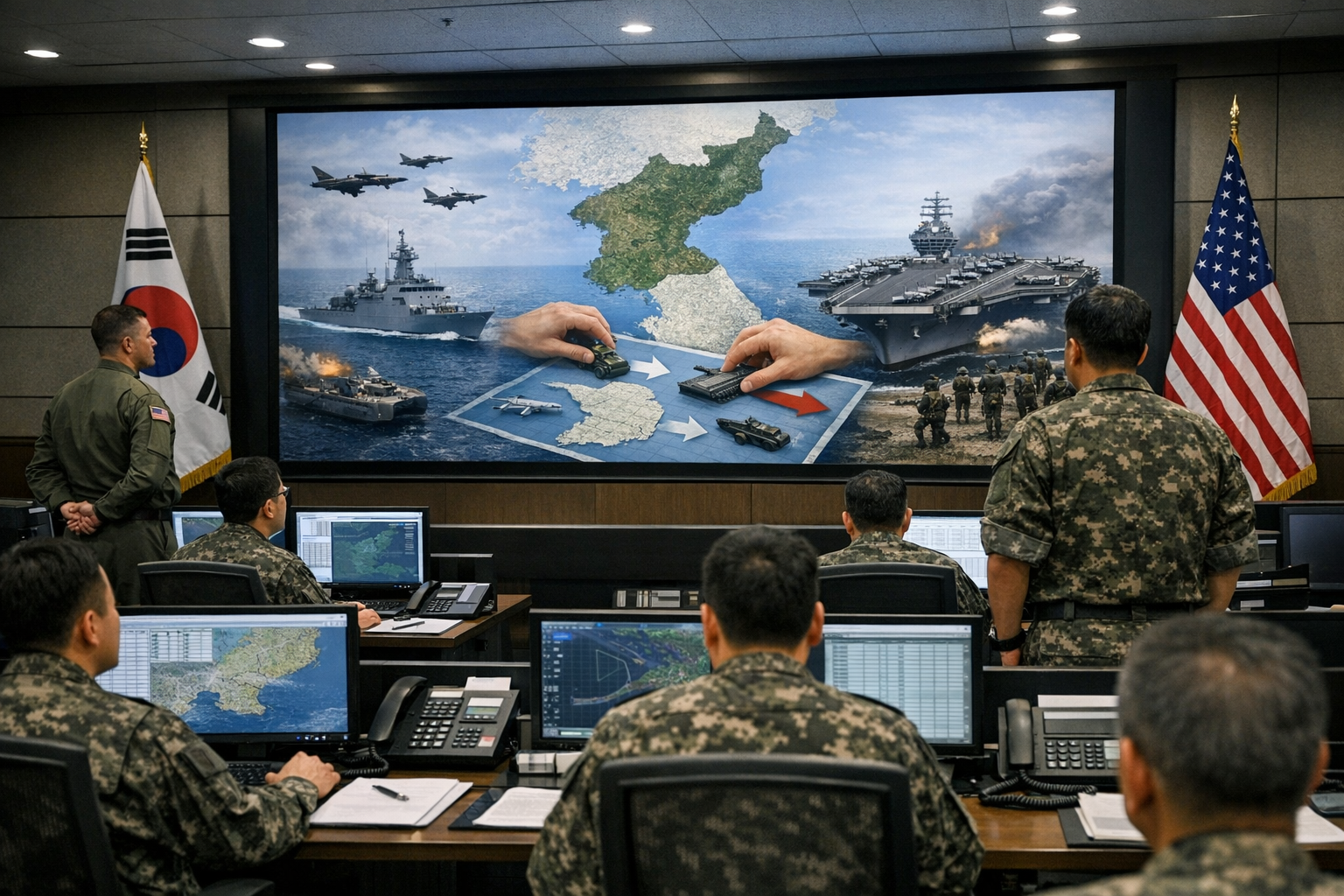
The United States and South Korea have cut short one of their most important annual military exercises, a move that has stirred unease in Seoul even as it appears to align, at least superficially, with the South Korean president’s long-stated preference for lowering tensions with the North.
South Korea’s military said the Ulchi Freedom Shield exercise, which began this week and had been scheduled to run through Aug. 27, would now end on Friday, about six days early, after a request from the American side. Some field training was also reduced. The decision followed President Trump’s order to scale back the drills as he seeks to reopen diplomacy with North Korea’s leader, Kim Jong-un.
Mr. Trump has said North Korea has been “unthreatening and respectful” and pointed to his “very good relationship” with Mr. Kim, reviving the personal diplomacy that defined his earlier approach to Pyongyang. The reduction in drills immediately recalled 2018, when Mr. Trump suspended major military exercises after his first summit with Mr. Kim, a decision that startled allies and critics who argued that Washington had conceded too much for too little in return.
A familiar diplomatic gamble
For decades, Ulchi Freedom Shield has been one of the central command-post exercises underpinning the U.S.-South Korea alliance. The drills are designed to test joint planning, command structures and crisis response in the event of a North Korean attack or other major contingency on the peninsula. Washington and Seoul describe them as defensive. North Korea has long denounced them as rehearsals for invasion.
That dispute is hardly new. What feels newly destabilizing in Seoul is the sense that a core element of deterrence is being adjusted abruptly, and once again at Washington’s initiative, in service of a possible opening to Pyongyang whose contours remain unclear.
There is no indication yet that the drill reduction has secured substantive talks. The North has repeatedly rebuffed outreach from Seoul, and past efforts at summit diplomacy produced striking images but limited durable progress on denuclearization or arms control. The latest move therefore raises a question that has haunted previous rounds of diplomacy: whether symbolic military concessions are being offered before any clear reciprocal step from Pyongyang.
Unease in Seoul
The retrenchment has exposed a deeper anxiety in South Korea about reliance on the United States at a moment when Mr. Trump’s foreign policy remains highly personalized and transactional.
President Lee Jae Myung, who has advocated dialogue with North Korea and a less confrontational posture, has nonetheless responded by warning South Koreans to prepare for a “worst-case scenario.” He has also renewed calls for greater military independence, including faster progress toward regaining wartime operational control of South Korean forces from the United States.
That position might seem contradictory only at first glance. Mr. Lee has long argued both for reducing tensions with Pyongyang and for building stronger homegrown defense capabilities. The current episode has reinforced the second half of that argument. For many in Seoul, the worry is not simply that exercises are being shortened, but that South Korea could once again find itself sidelined if Washington pursues direct leader-to-leader diplomacy with Mr. Kim and treats allied military posture as a bargaining chip.
The issue of wartime operational control, often known as OPCON, has hovered over alliance debates for years. In the event of war, command arrangements still place ultimate operational authority in a U.S.-led structure. Supporters of transferring that authority back to Seoul say South Korea, with its advanced military and economic weight, should not remain dependent on Washington for command in a national emergency. Critics warn that a rushed transition could complicate deterrence at a time when North Korea’s nuclear and missile capabilities are far more advanced than in the past.
Readiness and credibility
Military officials have emphasized that the alliance remains intact and that the exercises, though shortened, still contribute to preparedness. But defense analysts have long argued that these drills are valuable not simply as political signaling, but as practical mechanisms for ensuring interoperability between two militaries that would need to act in close coordination under extreme pressure.
That matters because North Korea is no longer merely a conventional artillery threat across the Demilitarized Zone. It has spent years expanding and refining its nuclear arsenal and missile programs, while deepening uncertainty about what kind of crisis might emerge and how quickly it could escalate. In that context, even a modest reduction in training can take on outsized symbolic significance.
For South Korea, the concern is as much about credibility as capability. The alliance has long depended on a shared understanding that military readiness should not be casually subordinated to diplomatic theater. By cutting a marquee exercise just as it began, Washington has unsettled that assumption.
What comes next
The central uncertainty is whether Mr. Trump’s outreach will lead anywhere beyond another expression of personal rapport with Mr. Kim. North Korea could respond with openness to talks, with fresh demands, or with silence. It could also choose to mark the moment with further weapons activity, as it has done in earlier periods of diplomacy and tension alike.
For Mr. Lee, the episode is both an opportunity and a warning. It may strengthen his argument that South Korea needs more autonomy in managing its own defense. But it also underscores the limits of Seoul’s control when the alliance’s senior partner makes a sudden strategic shift.
That is why the mood in South Korea has been less relief than apprehension. Even a government that favors dialogue with the North is confronting a hard lesson of peninsula politics: de-escalation can be welcome, but only if it is matched by confidence that deterrence remains firm and that Seoul will not be left to absorb the consequences of decisions made elsewhere.
Sources
Further reading and reporting used to add context:
- https://apnews.com/article/313e01e4ee305b4c9b1b8bf12643fb17
- https://apnews.com/article/ea0ab19e6565b1b5ce22143c5b4e9f9d
- https://apnews.com/article/883b7ed5481b94f354dc23cc795e21aa
- https://www.thedailybeast.com/murdoch-paper-sounds-alarm-after-last-minute-trump-move-with-kim-jong-un/
- https://apnews.com/article/84d2ae42b527d6a71d2e7d69acf8483d
- https://www.axios.com/2026/08/16/trump-us-south-korea-military-drills-cut
- https://apnews.com/article/ae21e0af5ea16f0a74e9a176b3cc2136
- https://www.thedailybeast.com/trump-pulls-rug-from-key-ally-to-suck-up-to-brutal-dictator-kim-jong-un/
- https://theweek.com/world-news/trump-curtails-south-korea-drills
- https://www.donga.com/en/article/all/20260811/6342844/1
- https://news.sbs.co.kr/english/article.do?news_id=N1008688061
- https://en.yna.co.kr/view/AEN20250828002651315
- https://www.jcs.mil.kr/user/boardList.action?boardId=O_122667&boardSeq=O_393351&command=view&id=jcs2_eng_030000000000&mcategoryId=&page=1
- https://m.ajupress.com/amp/20260810172354916
- https://www.koreatimes.co.kr/amp/southkorea/defense/20260804/military-seeks-closer-coordination-with-us-forces-after-drone-misidentification
- https://en.yna.co.kr/view/AEN20250819002600315
- https://jcs.mil.kr/user/boardList.action?boardId=O_121947&id=jcs2_040201000000&page=5
- https://www.youtube.com/watch?v=BpltlUVa4p4
- https://www.nknews.org/2025/08/rok-us-to-postpone-some-joint-exercises-amid-heat-and-inter-korean-tensions/
- https://www.navy.mil/Press-Office/Press-Releases/display-pressreleases/Article/3491680/the-republic-of-korea-and-united-states-announce-exercise-ulchi-freedom-shield/
- https://www.yna.co.kr/view/AKR20260810071551504
- https://jcs.mil.kr/user/boardList.action?boardId=O_121947&id=jcs2_040201000000&page=27
- https://sp.yna.co.kr/view/ASP20250819000200883
- https://www.yna.co.kr/view/AKR20260810088900011
- https://www.mnd.go.kr/user/newsInUserRecord.action?command=view&id=mnd_020500000000&newsId=I_669&newsSeq=I_13408&page=1&siteId=mnd
- https://www.mnd.go.kr/user/mnd/upload/pblictn/PBLICTNEBOOK_202307280154382000.pdf
- https://en.yna.co.kr/view/AEN20190819007551325
- https://www.mnd.go.kr/user/newsInUserRecord.action?command=view&id=mnd_020500000000&newsId=I_669&newsSeq=I_12972&page=1&siteId=mnd
- https://en.yna.co.kr/view/AEN20250801008400315
- https://en.yna.co.kr/view/AEN20250818000800315
- https://en.yna.co.kr/view/AEN20230821004100315
- https://jcs.mil.kr/user/boardList.action?boardId=O_121947&id=jcs2_040201000000&page=16
- https://mnd.go.kr/user/mnd/upload/pblictn/PBLICTNEBOOK_202307280154039760.pdf
- https://mnd.go.kr/user/mnd/upload/pblictn/PBLICTNEBOOK_202307280155091550.pdf
- https://apnews.com/article/81402c3384a98f053c1b761c87081391
- https://apnews.com/article/c602b29c49f56f2acdcca96bb6df08f3
- https://apnews.com/article/5583cdf41326e4305f56a70f47d2b66d
- https://www.yna.co.kr/view/AKR20260806126100001
- https://www.seattlepi.com/news/world/north-korea-threatens-to-exercise-self-defense-as-a22387824
- https://www.local10.com/news/world/2026/08/06/north-korea-conducts-ballistic-missile-test-days-before-us-and-south-korea-begin-drills/
- https://www.reddit.com/r/northkorea/comments/1vrtxi9/south_korea_president_calls_for_military/
- https://m.ajupress.com/view/20260807135800086
- https://www.reddit.com/r/GenUsa/comments/1vro208/south_korea_president_calls_for_military/
- https://en.yna.co.kr/view/AEN20260805000800315
- https://www.reddit.com/r/AntiTrumpAlliance/comments/1vrlhtr/south_korea_president_calls_for_military/
- https://www.ajupress.com/view/20260309121507718
- https://news.sbs.co.kr/english/article.do?news_id=N1008691390
- https://www.yna.co.kr/amp/view/AKR20260810071551504
- https://www.donga.com/en/article/all/20260807/6338272/1
- https://www.kpbs.org/news/international/2026/08/02/south-korea-ditches-denuclearization-first-strategy-what-will-pyongyang-do-next
- https://www.theguardian.com/world/south-korea
- https://cms.apln.network/wp-content/uploads/2023/02/Lee_South-Korea.pdf
- https://csis-website-prod.s3.amazonaws.com/s3fs-public/2025-08/250820_Myung_Press_Briefing.pdf?VersionId=jTt3RZnNeO8fcqzOLdbTVgGSQ39gya_5
- https://www.reddit.com/r/army/comments/1vqae4i/trump_orders_pentagon_to_scale_back_joint/
- https://www.axios.com/2025/08/26/trump-north-korea-kim-jong-un-relationship-meeting
- https://www.axios.com/2025/04/27/north-korea-talks-kim-jong-un-trump
- https://www.axios.com/2026/08/01/saudi-crown-prince-trump-iran-attacks
- https://www.govinfo.gov/content/pkg/DCPD-202500870/pdf/DCPD-202500870.pdf
- https://www.theguardian.com/world/2025/aug/26/donald-trump-kim-jong-un-north-korea-summits-a-short-history
- https://www.axios.com/2025/09/22/north-korea-kim-jong-un-trump-nuclear-talks
- https://www.axios.com/2026/06/19/trump-anthropic-national-security-the-axios-show
- https://www.axios.com/2026/08/03/senate-republicans-save-act-august-recess-trump
- https://www.axios.com/tag/kim-jong-un/
- https://www.ap.org/media-center/ap-in-the-news/2019/white-house-restricts-press-access-as-kim-trump-meet/
- https://www.govinfo.gov/content/pkg/DCPD-202501075/pdf/DCPD-202501075.pdf
- https://www.axios.com/2026/07/23/trump-axios-iran-interview
- https://m-en.yna.co.kr/view/AEN20260505000400315?section=nk%2Fnk
- https://www.axios.com/2026/08/04/hegseth-defense-funding-reconciliation
- https://apnews.com/article/128bdcdaac59f8a8778b1b6674c30124
- https://ufdcimages.uflib.ufl.edu/AA/00/05/43/97/03369/2025-10-25.pdf
- https://epaper.truepointnews.com/media/2025-10/ap-261025.pdf
- https://www.congress.gov/crs_external_products/IN/PDF/IN12603/IN12603.1.pdf
- South Korean and US militaries shorten drills by about half after Trump ordered a reduction
- Drills cut by Trump are central to the US-South Korea alliance, observers say
- South Korea hopes for talks between US and North Korea after Trump downsizes military drills