
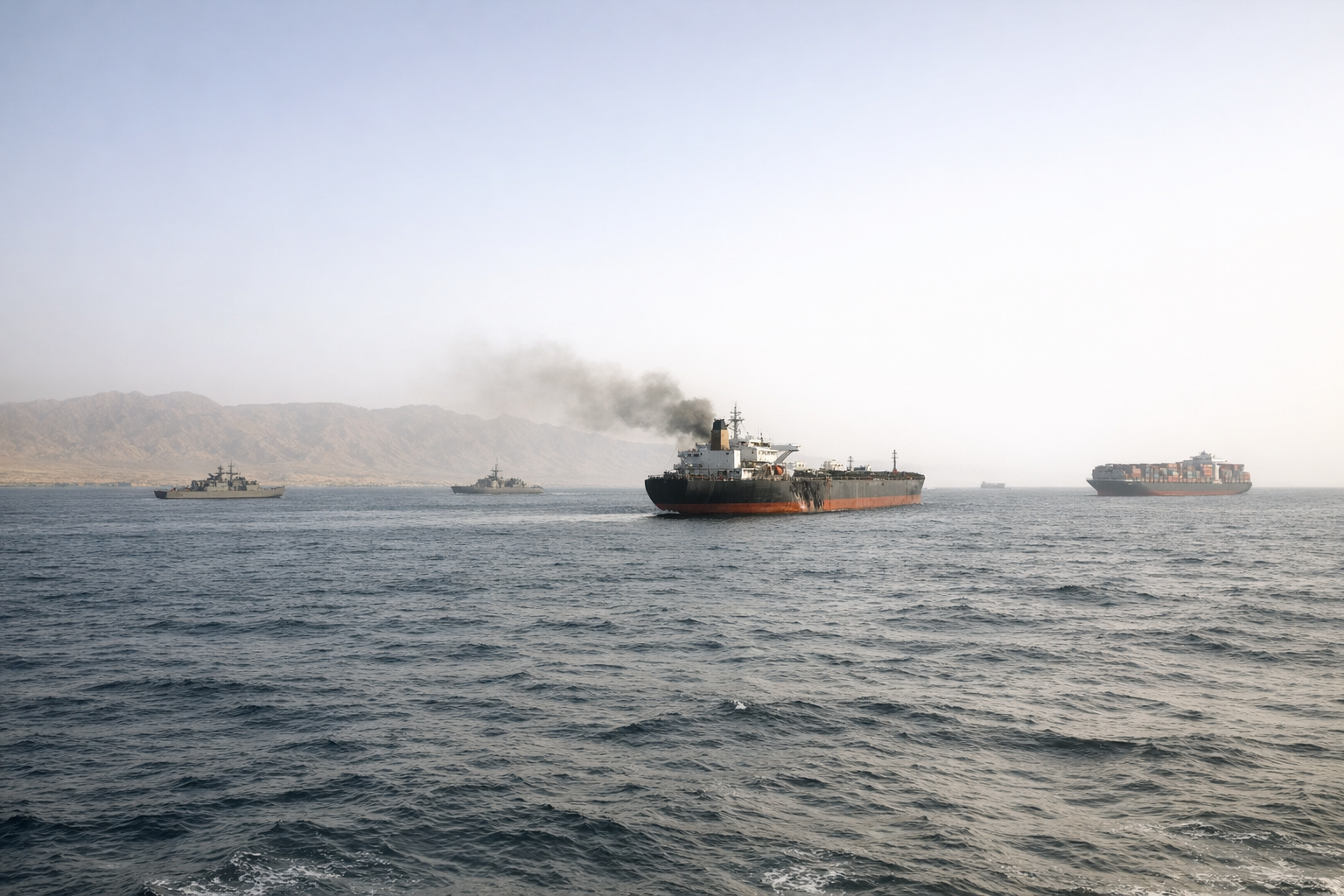
A widening conflict tests the limits of deterrence
The confrontation between the United States and Iran lurched into a more perilous stage over the weekend, as American forces struck three Iranian oil tankers after missiles were fired at U.S. Navy warships, and senior Trump administration officials openly cast doubt on whether a nuclear agreement with Tehran remained within reach.
The twin developments — one military, one diplomatic — suggested that a crisis once framed around pressure and negotiation is increasingly being shaped by direct attacks on energy infrastructure, shrinking room for talks and the growing possibility that parallel conflicts in Lebanon and Yemen could merge into a broader regional war.
American officials said the tanker strikes on Saturday came after Iranian missiles targeted U.S. naval vessels operating near the Gulf. Among the ships hit was a crude carrier near Kharg Island, Iran’s main oil export hub, a site of outsized importance to a country already under severe pressure from sanctions and a renewed American campaign to choke off its petroleum sales.
No U.S. personnel were reported injured in the attempted attack on the warships. But the symbolism of the American response was unmistakable: Washington was no longer limiting itself to military sites or proxy targets. It was striking assets tied directly to Iran’s oil lifeline.
Tehran, for its part, warned of stronger retaliation, even as Iranian officials acknowledged the mounting economic costs of the conflict.
Diplomacy recedes
Any hope that military escalation might be paired with a revived diplomatic track appeared to dim further on Sunday, when Energy Secretary Chris Wright said the United States “may not” be able to secure an agreement that would prevent Iran from obtaining a nuclear weapon.
That statement was notable not only for its bluntness, but for what it implied about the administration’s assessment of the moment. For months, Washington had maintained that pressure on Iran — through sanctions, maritime interdictions and military force — could coexist with the possibility of a negotiated outcome. Wright’s remarks signaled that officials may now see those goals as increasingly difficult to reconcile.
If diplomacy is indeed receding, the implications are significant. Without a credible negotiating channel, each military exchange carries greater risk of becoming self-reinforcing: a strike answered by a strike, a warning answered by a wider attack, with fewer offramps than in earlier phases of the crisis.
Energy and shipping come into the cross hairs
The latest American strikes also underscore how the conflict is shifting toward the region’s energy arteries, where local military decisions can quickly ripple through the global economy.
Kharg Island is central to Iran’s export system, and the waters around it sit close to the Strait of Hormuz, the narrow passage through which a large share of the world’s seaborne oil has long flowed. Commercial traffic there has already thinned sharply. Shipping data show commodity vessel movements through Hormuz have fallen to their lowest level since May, averaging roughly 10 a day over the last 10 days.
That decline reflects more than immediate fears of missile fire. It also follows months of intermittent U.S.-Iran clashes and a renewed American blockade pressure campaign targeting Iranian oil exports. By some shipping assessments, Iran had already gone about seven weeks without meaningful crude exports through Hormuz after the blockade was reimposed in mid-July.
Now the danger is that the conflict could move from constraining trade to directly menacing it. One of the unanswered questions is whether Iran will broaden retaliation beyond military targets to include commercial shipping, or seek to enforce a proposed restricted zone near Hormuz. Either step could jolt insurance markets, drive up freight costs and deepen concerns about energy supply.
Lebanon’s cease-fire frays
At the same time, the northern edge of Israel’s conflict with Iran-aligned forces has grown more unstable.
In Lebanon, fighting between Israel and Hezbollah intensified despite a U.S.-backed cease-fire framework reached in June. Lebanese officials said Israeli strikes on Sunday killed at least seven people, and additional strikes on Monday reportedly killed at least 11 more. President Joseph Aoun called on the United States to help halt the attacks.
The June arrangement had been intended to quiet the border after repeated exchanges of fire, but it never fully resolved disputes over military positions and strategic terrain in southern Lebanon. The latest bloodshed has renewed concern that what was meant to be a contained front could harden into a sustained second theater of war.
For Washington, that creates a familiar but increasingly difficult balancing act: backing Israel while trying to prevent a border conflict from colliding with the far more combustible U.S.-Iran confrontation.
Yemen’s war becomes more dangerous again
Farther south, Yemen offered another reminder of how quickly the region’s interlocking conflicts can intensify. More than 60 people, including civilians, were killed in heavy fighting on the country’s western coast, in one of the deadliest recent escalations there.
The clashes pitted the Iran-aligned Houthi movement against forces aligned with Yemen’s Saudi-backed government. Medical and military officials reported dozens of deaths among combatants, while a missile strike on a bus in Taiz killed civilians and wounded others.
Although Yemen’s civil war has its own long and devastating history, the renewed offensive carries broader significance at a moment when the United States and Iran are edging closer to open conflict. The Houthis have repeatedly shown their ability to threaten maritime routes tied to the Red Sea, and intensified fighting there raises fresh concerns about disruption to shipping beyond the Gulf.
A region edging toward a multi-front war
Taken together, the strikes in the Gulf, the fraying cease-fire in Lebanon and the surge in Yemeni combat suggest that the crisis is no longer confined to one channel of confrontation. It is expanding across several.
The immediate uncertainties are stark: whether Iran will retaliate again against American naval forces, whether commercial vessels will become targets, whether Hezbollah’s clashes with Israel will remain limited, and whether the Houthis will fold Yemen more directly into the wider struggle.
What has become clearer is that the old separation between direct U.S.-Iran hostilities and the region’s proxy wars is eroding. As diplomacy falters and energy infrastructure comes under fire, the Middle East is entering a phase in which local flare-ups and strategic escalation are becoming harder to distinguish.
Sources
Further reading and reporting used to add context:
- https://apnews.com/article/fc3f8c5ac5e09c93232b3a9841afb9f4
- https://www.thedailybeast.com/trumps-big-strait-of-hormuz-brag-blows-up-in-humiliating-reality-check/
- https://apnews.com/article/691deb2ccb571ec83c552efb794568cd
- https://www.axios.com/2026/09/06/chris-wright-gas-prices-labor-day
- https://apnews.com/article/b3650799901c56a6deeca962cbaa4109
- https://apnews.com/article/a52beec77dc90af3d040d0553837ad20
- https://www.axios.com/2026/09/02/iran-tankers-hormuz-attacks-oil
- https://apnews.com/article/6a083aa8bd1372c2ad25571e58d82a25
- https://www.theguardian.com/world/2026/sep/05/yemen-ground-fighting-escalates-houthi-rebels-government-forces
- https://www.theguardian.com/world/yemen
- https://www.theguardian.com/world/iran/2026/sep/05/all
- https://www.investing.com/news/commodities-news/us-strikes-three-iranian-oil-tankers-after-irgc-attack-on-american-naval-ships-central-command-says-4890210
- https://www.axios.com/2026/09/05/us-iran-war-oil-tankers-warships
- https://www.washingtonpost.com/world/2026/09/06/us-energy-secretary-chris-wright-says-iran-nuclear-deal-may-not-happen/
- https://www.washingtonpost.com/world/2026/09/05/us-says-it-hit-3-iranian-oil-tankers-including-one-near-kharg-island/
- https://hideme.live/proxy/www.theguardian.com/world/middleeast
- https://bsky.app/profile/theguardian.com/post/3murn2eavbb2a
- https://www.latimes.com/world-nation/story/2026-09-05/u-s-military-hits-3-iranian-oil-tankers
- https://www.theguardian.com/world/2026/sep/06/us-iran-nuclear-agreement-chris-wright
- https://www.marketscreener.com/news/us-central-command-says-it-hit-three-iranian-oil-tankers-ce785bdbda8ef420
- https://www.reddit.com/r/politics/comments/1w93uhz/us_energy_secretary_wright_says_iran_nuclear_deal/
- https://apnews.com/article/b4f64c7492d8c5b9ff71794cc152186d
- https://apnews.com/article/b7dea048552afc5a1e91c6a6b8adef65
- https://apnews.com/article/e33f8c97f368e7babd37c6d8c0a5759d
- https://apnews.com/article/7564a892bfb99a853aa150c8710b7985
- https://www.channelnewsasia.com/world/lebanon-president-calls-us-help-israeli-strikes-continue-6365941
- https://www.dawn.com/news/2027997/israeli-strikes-kill-seven-in-lebanon
- https://www.dawn.com/news/2027933
- https://www.investing.com/news/commodities-news/israeli-strikes-on-southern-lebanese-town-kill-11-state-news-agency-says-4890499
- https://www.al-monitor.com/originals/2026/09/lebanon-president-calls-us-help-israeli-strikes-kill-7
- https://today.lorientlejour.com/article/1546733/after-deadly-israeli-strikes-on-nabatieh-aoun-calls-on-washington-to-act-berri-denounces-a-bloodstained-ballot-box.html
- https://www.arabnews.com/middle-east/lebanon-president-calls-for-us-help-as-israeli-strikes-kill-7-3000647
- https://news.rthk.hk/rthk/en/component/k2/1869057-20260907.htm
- https://www.scmp.com/news/world/middle-east/article/3366563/lebanons-president-appeals-us-help-israeli-strikes-kill-7
- https://www.dawn.com/news/amp/2027933
- https://www.thenationalnews.com/news/mena/2026/09/06/at-least-four-killed-in-israeli-strikes-on-lebanon/
- https://apnews.com/article/7ab86fbec23313f055fc2ab47933c199
- https://apnews.com/article/49d0cb10d83827e52b56b5280e7d048d
- https://apnews.com/article/ad84a64884aedbbd1e5914182bb3cd8d
- https://apnews.com/article/73779f36e4b09480c5430d72f4385e23
- https://www.reutersconnect.com/item/us-ship-traffic-through-strait-of-hormuz-hits-lowest-level-since-may-kpler/dGFnOnJldXRlcnMuY29tLDIwMjY6bmV3c21sX09XU0hCQzExODI3MjY
- https://www.koreatimes.co.kr/amp/world/20260907/hormuz-traffic-dips-to-lowest-since-may-after-us-iranian-strikes-on-ships
- https://www.arabnews.com/middle-east/hormuz-traffic-dips-to-lowest-since-may-after-us-iranian-strikes-on-ships-3000731
- https://iranwire.com/en/news/157259-oil-prices-rise-amid-lowest-ship-traffic-in-the-strait-of-hormuz/
- https://www.koreatimes.co.kr/world/20260907/hormuz-traffic-dips-to-lowest-since-may-after-us-iranian-strikes-on-ships
- https://nz.news.yahoo.com/hormuz-shipping-falls-lowest-level-095852157.html
- https://humenglish.com/latest/hormuz-shipping-traffic-falls-to-lowest-level-since-may-after-us-iran-attacks/
- https://www.marketscreener.com/news/iran-to-announce-new-restricted-zone-in-the-gulf-state-media-ce785bdbdd80f527
- https://www.timesofisrael.com/liveblog_entry/hormuz-traffic-dips-to-lowest-since-may-after-us-iranian-strikes-on-ships/
- https://www.freemalaysiatoday.com/category/business/2026/09/07/hormuz-traffic-dips-to-lowest-since-may-after-us-iranian-strikes-on-ships
- https://gcaptain.com/hormuz-traffic-dips-to-lowest-since-may-after-us-iranian-strikes-on-ships/
- https://www.investing.com/news/commodities-news/blockade-succeeds-where-sanctions-failed-as-iran-oil-exports-stall-4884076
- https://www.reddit.com/r/NewIran/comments/1w4i3qo/iran_crude_exports_through_hormuz_stall_for_first/
- https://www.reddit.com/r/oil/comments/1w4ymm2/shipping_traffic_in_strait_of_hormuz_remains/
- US strikes three Iranian oil tankers after IRGC attack on American naval ships, Central Command says By Reuters
- Blockade succeeds where sanctions failed as Iran oil exports stall By Reuters
- Iran says it plans to announce a new 'exclusion zone' near the Strait of Hormuz