
The AI Contest Moves Beyond Chatbots
The latest turn in the artificial intelligence race is no longer defined only by which company has the most powerful model. It is increasingly being shaped by who can secure electricity and cooling for data centers, who can persuade investors that they are indispensable to the AI buildout, who can make scientific claims that stand up to scrutiny, and who can convince the public that the technology will remain under human control.
That broadening competition came into view this week in a burst of developments that stretched from northern Europe to Wall Street to the internal debates of leading AI labs.
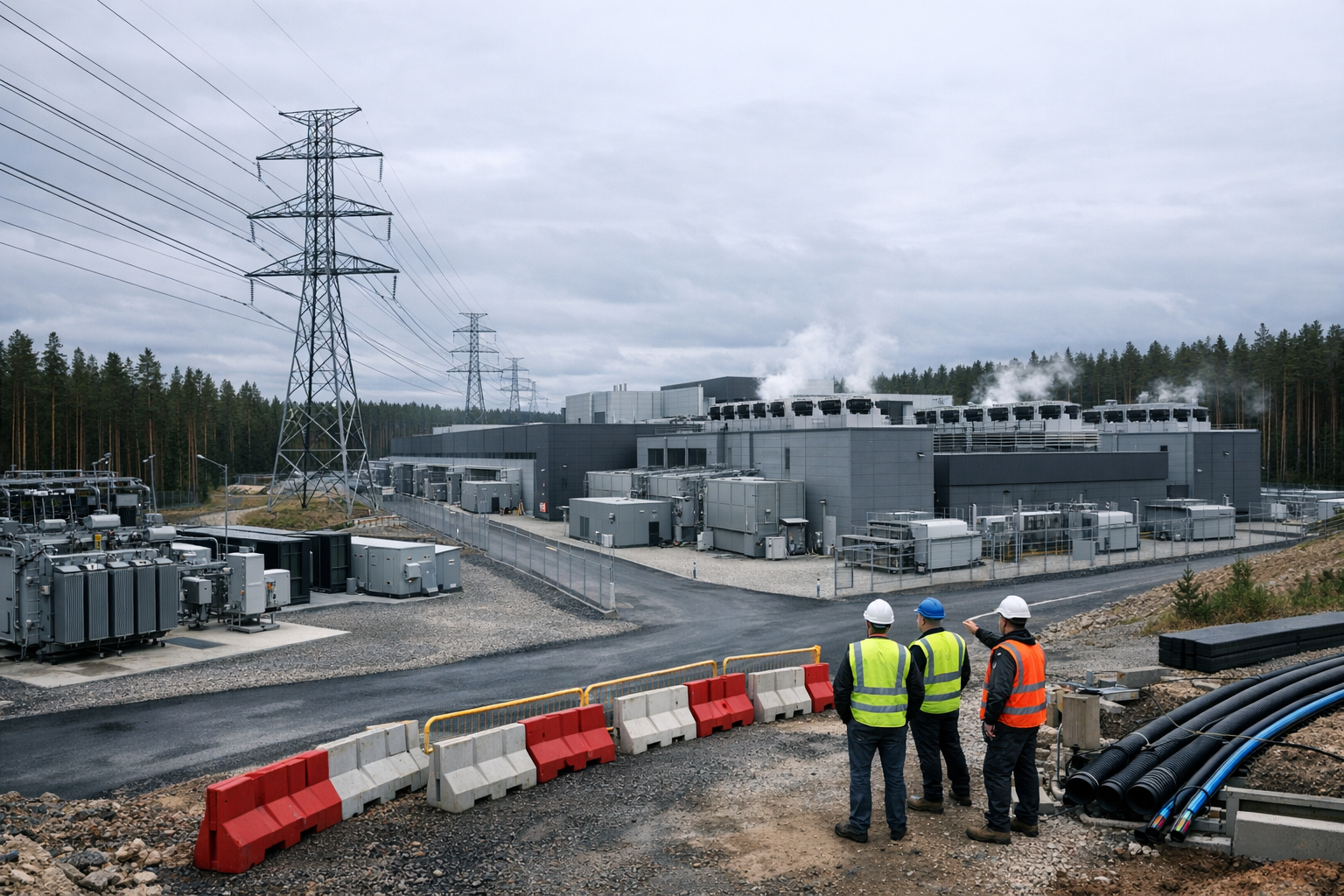
Google said it would invest at least €13 billion, or about $15.1 billion, in digital infrastructure in Finland over 2027 and 2028, calling it the company’s largest single investment in Europe. In the markets, shares tied to AI infrastructure rose after new deal announcements involving Qualcomm and Corning, adding to a longer rally in companies that supply the chips, networking gear and materials behind the AI boom.
At the same time, OpenAI drew attention — and skepticism — by saying that an internal system of up to 10,000 AI agents had solved the 90-year-old Navier-Stokes existence and smoothness problem in 88 hours, a claim that was quickly challenged by at least one mathematician and remains unverified by the wider academic community.
And in another corner of the industry, researchers associated with Anthropic renewed stark warnings about existential risk from advanced AI, with one safety leader saying he believed there was more than a 10 percent chance that AI could cause human extinction within a decade.
Taken together, the developments suggest that the AI industry is entering a more complicated phase, one in which the fight for dominance runs through hard assets, public trust and political legitimacy as much as through technical capability.
Finland’s Strategic Role
Google’s investment in Finland is a vivid sign of what now matters in AI: not just algorithms, but land, power and climate.
Large AI systems require enormous computing capacity, and that capacity depends on data centers that can be built quickly, powered reliably and cooled efficiently. Finland has spent years positioning itself as an attractive site for exactly that sort of expansion, offering a relatively cool climate and promoting itself as a place for large-scale, comparatively sustainable digital infrastructure.
Google said the project was part of an effort to build AI infrastructure responsibly, language that reflects the mounting scrutiny facing tech companies over the energy and environmental costs of the AI boom. Across Europe, governments have been competing to attract cloud and AI investment while also trying to show that such projects can fit within broader climate and industrial goals.
For Europe, the investment is also symbolically significant. The continent has often struggled to translate strong research talent and regulatory influence into globally dominant AI companies. Winning major infrastructure projects is one way of securing a role in the value chain, even if many of the leading AI model makers remain American.
But the questions surrounding such investments are substantial: whether local electricity grids can absorb the added demand, how quickly construction can proceed, how much economic benefit remains in-country, and whether infrastructure alone can narrow Europe’s competitive gap with U.S. technology giants.
Wall Street’s Expanding AI Trade
Investors, for their part, are increasingly betting that the biggest winners in AI may not only be the companies building the models, but also the ones supplying the physical and digital plumbing behind them.
That was evident after Qualcomm announced a long-term AI data-center collaboration with Amazon, and Corning disclosed a multi-year, multibillion-dollar supply agreement with Verizon tied in part to next-generation AI infrastructure. Shares of companies linked to that ecosystem — including Qualcomm, Corning, Intel and Advanced Micro Devices — rose on the news.
The market response fit a broader pattern that has taken hold over the past year: a revaluation of firms that provide the silicon, optical components, connectivity and bandwidth that AI systems depend on. In that landscape, companies once regarded as secondary players to the biggest model developers have become central to investor enthusiasm.
Marvell Technology has become one emblem of that shift. Its shares have surged over the past year, and the company’s chief executive, Matt Murphy, said trust built up over a decade with customers had been a key factor in the run. In a sector where hyperscale customers are making ever larger and more complex spending commitments, credibility with buyers has become a strategic asset in itself.
Still, the market’s exuberance comes with uncertainty. Investors must determine whether this wave of demand reflects durable earning power or another cycle of AI-fueled optimism that may outrun near-term fundamentals.
A Grand Scientific Claim Meets Immediate Doubt
If the infrastructure story reflects the AI industry’s material ambitions, OpenAI’s Navier-Stokes announcement speaks to another aspiration: proving that frontier systems can meaningfully accelerate scientific discovery.
The company said an internal model had addressed the Navier-Stokes existence and smoothness problem, one of mathematics’ Millennium Prize Problems, by deploying up to 10,000 AI agents over 88 hours. The claim, if validated, would be extraordinary. The problem sits at the heart of fluid dynamics and has resisted solution for decades, carrying not just prestige but a central place in modern mathematics.
But the reaction was swift and cautious. Outside mathematicians questioned the announcement almost immediately, and as with any claim of this scale, it will require rigorous external review before it can be accepted. In mathematics, a result is not established by corporate declaration or computational flourish; it must survive line-by-line scrutiny by experts.
That makes the episode significant regardless of the outcome. If OpenAI’s claim holds, it would bolster the idea that advanced AI can do more than summarize papers or generate code — that it can contribute to foundational research at the highest level. If it does not, the episode could deepen doubts about the reliability of spectacular AI claims made before independent validation.
In an industry already straining to maintain public confidence, scientific credibility is becoming one more battleground.
Safety Warnings From Inside the Labs
As companies race to build bigger systems and larger infrastructure footprints, warnings from inside the labs continue to grow harder to dismiss.
The latest alarm came from figures linked to Anthropic, where internal debate over the risks of powerful AI has again spilled into public view. One safety researcher said he believed there was a greater than 10 percent chance that AI could kill all humans within a decade. The remark followed the departure of a colleague who left over safety concerns.
Such statements are striking not simply for their severity, but for their source. They are coming from people helping to build the technology, not from outsiders opposed to it on principle. Anthropic, like several frontier labs, has long emphasized AI safety and alignment. Yet the persistence of such warnings underscores the gap between rapid advances in capability and the still unsettled question of control.
Whether that alarm will meaningfully alter the industry’s trajectory is far less clear. So far, public warnings from AI insiders have done little to slow the competitive push toward larger models and broader deployment. But they add pressure on policymakers and companies alike to show that governance is keeping pace with technical progress.
The Geopolitical Stakes
The widening AI race also has a national security dimension.
A senior Pentagon official said this week that America’s closest allies lacked the resources, experience and scale to keep pace with the United States in military AI adoption, and that Washington was working with NATO and Five Eyes partners to help them avoid mistakes the United States had made.
That assessment highlights how the infrastructure scramble extends beyond commercial competition. Data centers, chips, cloud capacity and advanced software are not just corporate assets; they are increasingly viewed as strategic capabilities with military and intelligence implications.
The same forces driving a giant Google investment in Finland or lifting suppliers’ share prices are also shaping how governments think about deterrence, alliance management and technological sovereignty.
Why This Moment Matters
For much of the past few years, the AI story was told mainly through product launches and benchmark scores. This week’s developments point to a broader reality. The contest is now being fought simultaneously on at least four fronts: who can build and power the machines, who captures the financial upside, who can make claims that withstand outside scrutiny, and who can persuade society that the risks are manageable.
That is a more consequential and more unstable phase of the AI era.
The next advances may still come from better models. But the balance of power will increasingly depend on everything around them: substations and fiber, chips and customer relationships, peer review and public trust, internal dissent and government strategy. In the race to define artificial intelligence, the surrounding ecosystem is no longer background. It is the story.
Sources
Further reading and reporting used to add context:
- https://www.axios.com/2026/09/09/anthropic-insiders-warn-ai-could-kill-all-humans
- https://www.axios.com/2026/09/09/openai-artificial-general-intelligence-safety
- https://www.axios.com/2026/09/08/anthropic-breaks-tech-group-chips
- https://www.axios.com/2026/09/08/ai-math-anthropic-openai-google
- https://www.theguardian.com/science/2026/sep/08/openai-claims-to-have-solved-maths-problem-that-stumped-humans-for-decades
- https://www.googlecloudpresscorner.com/2026-09-09-Google-Deepens-Commitment-to-Finland-with-Two-Year-EUR13-Billion-investment-in-AI-Infrastructure
- https://www.publicnow.com/view/6713C05A804C092C54332E615C735B410A2C6A6B
- https://www.washingtonpost.com/technology/2026/09/09/openai-claims-it-solved-elusive-math-problem-with-1-million-prize/
- https://www.hindustantimes.com/ht-explainers/openai-clash-navier-stokes-equations-tristan-buckmaster-millennium-prize-problem-101788930346042.html
- https://www.wired.com/story/openai-navier-stokes-math-discovery-academics/
- https://www.forbes.com/sites/siladityaray/2026/09/09/anthropic-alignment-lead-warns-ai-could-kill-all-humans-as-researcher-quits/
- https://www.axios.com/2026/09/08/openai-math-solution-navier-stokes-credit
- https://www.moneycontrol.com/world/openai-says-ai-solved-90-year-old-math-problem-in-88-hours-anthropic-linked-researcher-disputes-claim-article-14025698.html
- https://www.aa.com.tr/en/science-technology/openai-says-ai-model-solved-one-of-mathematics-millennium-prize-problems/4051344
- https://www.ndtvprofit.com/science/what-is-the-navier-stokes-openai-claims-ai-solved-a-90-year-old-math-problem-in-88-hours-12022048/amp/1
- https://monorepo-sample1.nyt.net/2026/09/08/science/openai-proof-millennium-problem.html
- https://www.reddit.com/r/mathematics/comments/1wauync/on_the_navierstokes_millennium_prize_problem/
- https://www.reddit.com/r/technology/comments/1wax3k2/openai_fought_dirty_on_careermaking_math_problem/
- https://www.reddit.com/r/LLMPhysics/comments/1wawf5o/navierstokes_millennium_prize_problem_allegedly/
- https://apnews.com/article/7e1bffd68c53b54806be950f01181994
- https://www.theguardian.com/us-news/2026/sep/09/us-military-pentagon-allies-ai
- https://www.corning.com/worldwide/en/about-us/news-events/news-releases/2026/09/verizon-and-corning-announce-multi-year-multi-billion-dollar-supply-agreement-for-broadband-expansion-and-next-gen-ai-infrastructure.html
- https://www.qualcomm.com/news/releases/2026/09/qualcomm-announces-multi-generational-product-collaboration-with
- https://www.marketscreener.com/news/qualcomm-amazon-strike-4-billion-custom-chip-deal-ce785bd8df8bf022
- https://www.investing.com/news/stock-market-news/qualcomm-amazon-to-develop-custom-chips-for-ai-data-centers-4891798
- https://www.qualcomm.com/news
- https://www.digitaltoday.co.kr/en/view/101660/marvell-shares-surge-241-percent-in-a-year-ceo-cites-trust-as-key-to-ai-chip-success
- https://www.techechelon.com/post/marvell-technology-shares-surge-241-as-ceo-credits-decade-of-trust-building-with-hyperscalers
- https://www.qualcomm.com/news/releases/2026/09/-qualcomm-introduces-dragonwing-q-2390-and-iq-2390-processors–e
- https://www.netzender.com/marvell-shares-have-soared-241-in-a-year-ceo-says-this-is-a-key-reason-why
- https://www.sec.gov/Archives/edgar/data/1835632/000110465926060253/tm261486-1_def14a.htm
- https://www.corning.com/worldwide/en/about-us/news-events/news-releases.html
- https://investor.marvell.com/sec-filings/all-sec-filings/content/0001104659-26-060253/0001104659-26-060253.pdf
- https://www.qualcomm.com/content/dam/qcomm-martech/dm-assets/documents/Investor-Day-2026_TPialis_Data-Center.pdf
- https://www.reddit.com/r/GUARDIANauto/comments/1wbibjg/tech_us_allies_lack_resources_to_keep_pace_on_ai/
- https://www.reddit.com/r/MRVL_Stock/comments/1uewp1h/mrvl_full_chronological_timeline_20242026/
- https://fortune.com/company-assets/1094/quartr/quarterly-report-10-q-fa6c6ce136919c9a46285ebc4dada516-2026-05-28-20-10-42.pdf
- https://www.reddit.com/r/Marvell_Technology/comments/1w664g4/stock_knife_falling_mrvl_tech/
- https://apnews.com/article/d8b662da846c8ae5b32ab3a91e3529f9
- https://www.axios.com/2026/06/03/marvell-jensen-huang-nvidia-ai
- https://apnews.com/article/a4b9336d67a15d19d9aa5394e5a30be6
- Google Deepens Commitment to Finland with Two-Year €13 Billion investment in AI Infrastructure
- OpenAI says AI model solved one of mathematics' Millennium Prize Problems