
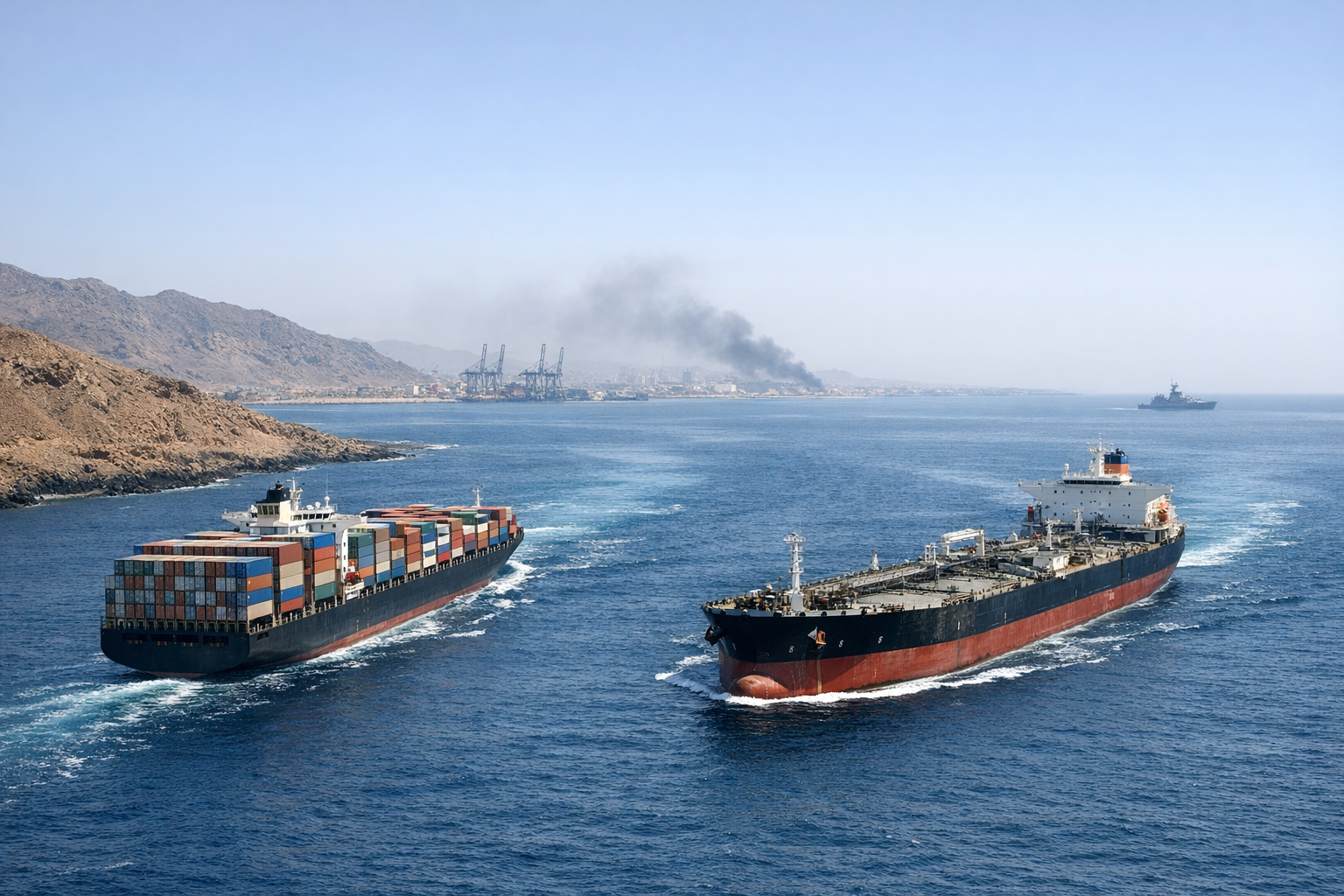
The United States is sharply escalating its pressure campaign on Iran, coupling the threat of a major new financial sanction with a hardening military posture, as Iran-backed Houthi fighters in Yemen have seized the port city of Mocha and moved closer to another of the world’s most sensitive shipping choke points.
The twin developments — one unfolding in global finance, the other on the Red Sea coast — have raised fears that the widening confrontation with Iran could deepen into a broader economic shock, disrupting oil flows and commercial shipping through waterways that are central to world trade.
Treasury Secretary Scott Bessent said the United States would sanction a “large bank” on Monday as part of its strategy to squeeze Tehran, though he did not identify the institution. The announcement came as President Trump publicly defended his decision to launch the war with Iran, saying he had no regrets and would have acted even if it carried a political cost at home.
Taken together, the moves suggest that Washington is intensifying pressure on multiple fronts at once: seeking to isolate Iran financially while confronting the growing reach of Iranian proxy forces across the region.
A New Threat at Bab el-Mandeb
In Yemen, Houthi forces said they had taken Mocha, a strategic port on the country’s Red Sea coast, in the most serious fighting there in years. The advance has alarmed regional governments and shipping markets because it places the group closer to the Bab el-Mandeb Strait, the narrow passage linking the Red Sea to the Gulf of Aden and onward to the Indian Ocean.
That waterway is one of the world’s most important maritime corridors. Tankers and cargo vessels passing through it connect European and Asian markets, and any sustained threat to traffic there can quickly ripple through energy prices, freight costs and supply chains.
The Houthis’ push beyond Mocha toward nearby islands and coastal positions has prompted Saudi airstrikes and renewed concern that the group could strengthen its ability to menace vessels transiting the area. The offensive also underscores how the conflict with Iran is no longer confined to direct clashes or diplomacy, but is increasingly playing out through proxy forces positioned near global trade arteries.
For Saudi Arabia and the United States, the danger is not only territorial. If the Houthis can consolidate control along more of Yemen’s Red Sea coast, Iran and its allies would gain greater leverage near Bab el-Mandeb even as the broader regional conflict has already strained shipping around the Strait of Hormuz on the other side of the Arabian Peninsula.
Washington’s Financial Offensive
The threatened bank sanction would be the latest step in an American campaign that Treasury has branded “Operation Economic Outcast,” an effort begun in late August to sever what officials describe as Iran’s remaining financial and commercial lifelines.
In recent days, Treasury and its Office of Foreign Assets Control have already rolled out a series of Iran-related measures. On Sept. 4, the United States imposed sanctions on a Turkish bank that American officials described as a crucial conduit for Tehran. The promised action against a still-unnamed “large bank” signals that Washington intends to widen that campaign, potentially increasing pressure not only on Iran but also on institutions and intermediaries across the region that do business with it.
The uncertainty over which bank will be targeted has added to anxiety in financial circles. If the institution has deep regional ties or a significant role in energy, trade finance or dollar clearing, the effects could stretch well beyond Iran itself.
That uncertainty is part of the pressure. By leaving the target unnamed, the administration has signaled both resolve and unpredictability, forcing banks and businesses with any exposure to Iranian transactions to reassess their risks.
Trump’s Defiant Message
Mr. Trump, for his part, has adopted a strikingly unapologetic tone as the conflict widens. In an interview, he said he did not regret starting the war with Iran and indicated that he would have moved ahead regardless of the potential effect on midterm elections.
His remarks amount to a political message as much as a strategic one: that the White House is prepared to absorb domestic criticism and market turbulence in pursuit of what it sees as a decisive confrontation with Tehran.
But that posture also raises the stakes. A strategy built on simultaneous military and economic coercion can impose costs on Iran, yet it also increases the risk of retaliation through exactly the channels that are now under strain — proxy militias, oil infrastructure and maritime routes.
Why It Matters Now
Markets have already begun reacting to the threat of tighter supply and shipping disruptions. Oil prices have risen as traders weigh the possibility that instability near both Hormuz and Bab el-Mandeb could constrain flows from the Gulf and the Red Sea. Saudi crude shipments moving through Bab el-Mandeb have reportedly fallen sharply from summer levels as the conflict has spread.
That combination — a war defended by the American president, a looming sanction on a major bank and a proxy force gaining ground near a strategic strait — has created a moment of unusual fragility.
The immediate questions are practical but consequential: whether the Houthis can hold Mocha, whether they can translate battlefield momentum into a sustained threat to commercial traffic, and whether Saudi or U.S.-aligned forces can roll them back. On the financial front, attention is centered on the identity of the bank the United States plans to sanction and how widely the measure will reverberate.
The larger question is strategic. Washington appears to be betting that tighter isolation will force Tehran toward restraint. But if Iran instead responds by leaning harder on regional proxies and maritime pressure points, the confrontation could become even more expensive for the global economy.
For now, the campaign against Iran is no longer measured only in missile strikes or diplomatic statements. It is also being tested in ports, shipping lanes and bank balance sheets — the places where regional war can become a global problem.
Sources
Further reading and reporting used to add context:
- https://apnews.com/article/e4e799701b382799a955969c212800ea
- https://www.axios.com/2026/09/10/trump-iran-war-regrets-fox-news-dallas
- https://apnews.com/article/025d052a14d9481258d51009a76d0bd6
- https://www.axios.com/2026/09/11/houthis-yemen-saudi-trump-mbs-strikes
- https://www.axios.com/2026/09/10/trump-5k-5000-dividend-checks-midterms
- https://apnews.com/article/2b126da67b09de2f328846eb656abe0e
- https://www.theatlantic.com/national-security/2026/09/trump-iran-war-navy/688563/?utm_source=openai
- https://www.axios.com/2026/09/10/trump-congress-republicans-rnc-convention-democrats
- https://www.thedailybeast.com/trump-cornered-on-his-bogus-cash-promise/
- https://apnews.com/article/f9cb75eca9a89664db0b6e84e4161ea0
- https://www.theguardian.com/world/2026/sep/10/houthis-seize-key-port-mocha-yemen-red-sea-coast-iran-saudi-arabia-us
- https://www.theguardian.com/world/2026/sep/10/violence-erupts-in-yemen-again-why-it-matters-globally-and-how-it-is-linked-to-the-us-iran-war
- https://www.theguardian.com/world/houthi
- https://www.theguardian.com/world/yemen
- https://www.theguardian.com/theguardian/mainsection/international/2026/sep/10/all
- https://worldnewsflow.com/news/2026/09/10/houthis-seize-4d55806119
- https://www.marketscreener.com/news/trump-says-iran-war-to-end-after-us-midterm-elections-threatens-to-attack-pickaxe-mountain-ce785bdedb8ffe27
- https://www.marketscreener.com/news/iranian-arms-and-advice-helped-yemen-s-houthis-seize-key-red-sea-city-sources-say-ce785bded18df525
- https://citrixnews.cz/article/houthis-seize-key-yemeni-port-of-mocha-in-drive-to-take-control-of-red-sea-coast
- https://www.reutersconnect.com/item/bessent-says-us-likely-to-announce-iran-bank-sanctions-this-week/dGFnOnJldXRlcnMuY29tLDIwMjY6bmV3c21sX1ZBOTM5OTAxMDkyMDI2UlAx
- https://www.investing.com/news/commodities-news/bessent-says-us-likely-to-announce-iran-bank-sanctions-this-week-4884250
- https://mins.news/en?d=2026-08-22&s=16-24
- https://apnews.com/article/22e6bda83c39b6c84a141053c5c95f97
- https://www.theatlantic.com/politics/2026/09/trump-midterms-dallas-convention/688568/?utm_source=openai
- https://apnews.com/article/7fbc77061abd778608068d3beb1bbbaf
- https://apnews.com/article/f26ad8d666cc1d38fcce78df4612a24d
- https://apnews.com/article/dde8b5408b85115f79b7351c8e882815
- https://www.axios.com/2026/09/10/bessent-bonds-buyback-treasury
- https://ofac.treasury.gov/recent-actions/20260908
- https://www.timesofisrael.com/liveblog_entry/us-to-sanction-unnamed-large-bank-on-monday-trump-aide-says/
- https://home.treasury.gov/news/press-releases/sb0614
- https://ofac.treasury.gov/recent-actions/sanctions-list-updates
- https://ofac.treasury.gov/sanctions-programs-and-country-information/iran-sanctions
- https://content.govdelivery.com/accounts/USTREAS/bulletins/428ebbc?reqfrom=share
- https://ofac.treasury.gov/recent-actions
- https://www.straitstimes.com/world/united-states/trump-administration-to-sanction-unnamed-large-bank-on-monday-bessent-says
- https://www.streetinsider.com/Reuters/Trump%2Badministration%2Bto%2Bsanction%2Bunnamed%2Blarge%2Bbank%2Bon%2BMonday%2C%C2%A0Bessent%2Bsays/27049690.html
- https://ofac.treasury.gov/press-releases
- https://currently.att.yahoo.com/att/trump-says-does-not-regret-001939591.html
- https://www.reddit.com/r/economy/comments/1wd2d4r/bessent_says_a_large_bank_will_be_sanctioned_on/
- Iran-backed Houthi rebels take strategic port city in Yemen, raising threat to Red Sea shipping
- Remarks from Secretary of the Treasury Scott Bessent on Operation Economic Outcast against Iran | U.S. Department of the Treasury
- Trump administration to sanction unnamed 'large' bank on Monday, Bessent says