
Strains Spread Across the Middle East as Security Risks, Hunger and Diplomatic Friction Deepen
Tensions across the Middle East widened on Monday, stretching from the Gulf’s shipping lanes to the olive groves of the occupied West Bank and the aid lines of Gaza, in a reminder that even where open warfare has eased, the region remains volatile and deeply fragile.
Iran said it had prepared a “new operational plan” in the event the United States resumed attacks, an announcement that came as commercial vessels reported fresh security incidents in and around Gulf shipping routes. At the same time, the World Food Programme said funding cuts would force it to stop supporting more than 500,000 Palestinians in Gaza each month, sharpening warnings of worsening hunger as winter approaches. And in the West Bank, a spate of settler assaults on an American photojournalist and a European diplomatic delegation drew unusual rebukes from a senior American official and added to allied concern over rising lawlessness.
The developments unfolded as oil prices fell rather than rose, reflecting a market calculation that the prospect of more Russian crude and fuel reaching buyers could, for now, outweigh the geopolitical risk premium usually attached to instability in the Gulf.
Iran Warns, Shipping Incidents Multiply
Mohsen Rezaei, the secretary of Iran’s Supreme National Security Council, said Iran’s military had prepared a response should Washington launch new attacks. The statement added to a climate of uncertainty already heightened by a run of maritime incidents tracked by the British military’s United Kingdom Maritime Trade Operations center.
The center has reported multiple recent episodes affecting commercial shipping, including projectile strikes near waters off the United Arab Emirates and Saudi Arabia, as well as an armed approach to a vessel off Yemen. Responsibility for the incidents has not been established publicly, and it remains unclear whether Iran’s warning was intended primarily as deterrence or as a sign of preparation for possible escalation.
Still, the pattern has unnerved shipping interests because it suggests the zone of risk is not confined to the Red Sea corridor that dominated earlier phases of the crisis. The latest reports point to insecurity across a broader network of sea lanes that handle crucial flows of energy and trade.
That should ordinarily have lent support to oil prices. Instead, crude fell after President Donald Trump invoked a national-interest waiver to suspend new duties on Russian goods and major buyers of Russian energy, raising hopes in the market that additional Russian supply could reach buyers. The drop underscored a delicate balance: traders appear, for the moment, more focused on prospective supply relief than on the possibility that attacks on shipping could disrupt flows. That balance could change quickly if maritime violence intensifies.
Gaza Aid Cuts Threaten a Harder Winter
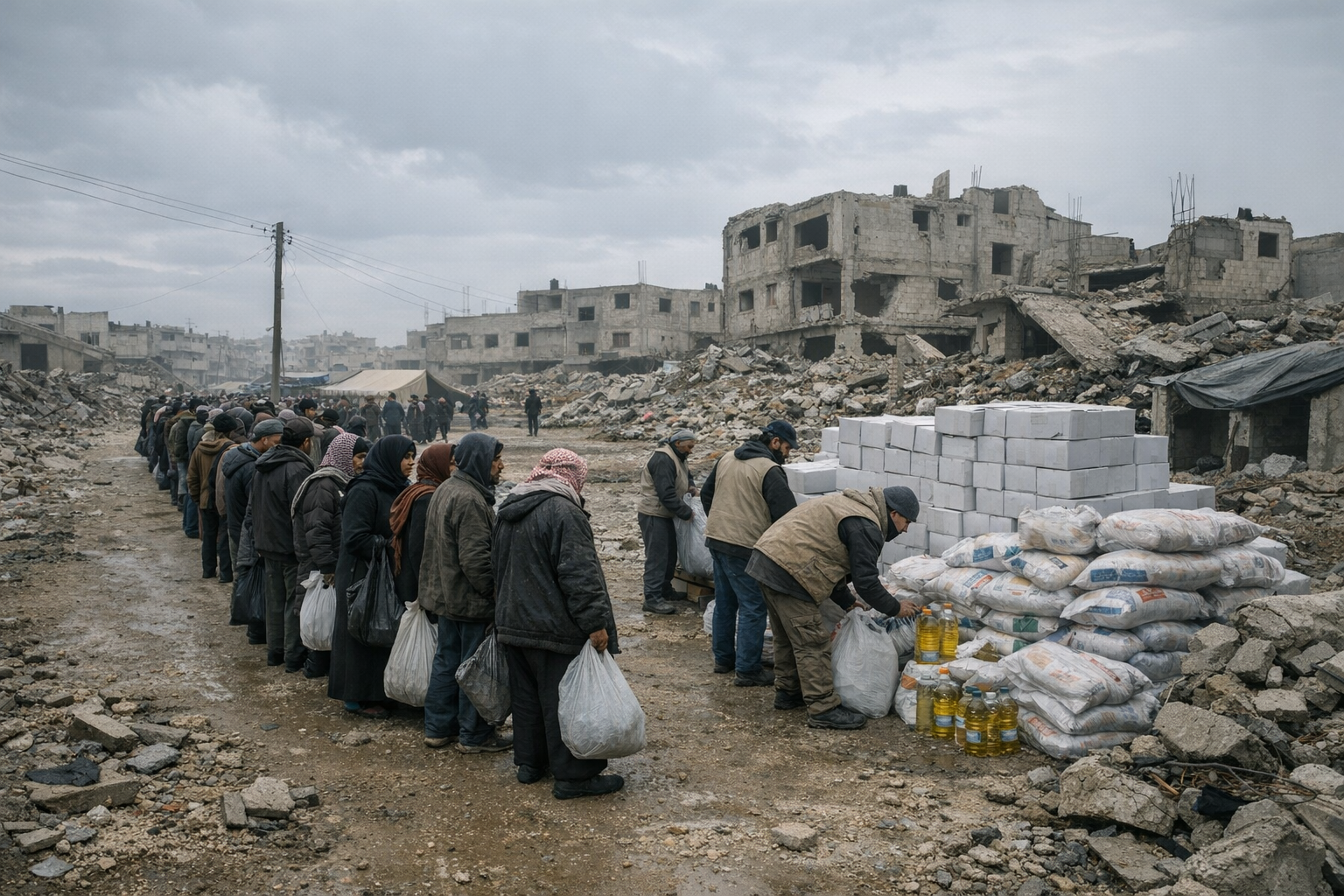
In Gaza, where the hunger crisis eased somewhat after the October 2025 cease-fire allowed a broader flow of assistance, the World Food Programme said those gains were now in jeopardy.
The agency said sweeping funding shortfalls would force it to reduce support by about one-third, cutting off roughly half a million people who had been receiving aid each month. It warned that two-thirds of Gaza’s population already faced crisis levels of food insecurity and that about 200,000 people were at risk of famine.
More than a year after the cease-fire took hold, reconstruction has still not begun on the scale many residents had expected. Jobs remain scarce, much of the territory lies shattered, and a large share of the population continues to depend on outside assistance simply to eat. Aid workers say that while access improved after the truce, the system remains highly vulnerable because so many families have no economic cushion of their own.
The World Food Programme has said it urgently needs hundreds of millions of dollars to continue operations in Gaza and the West Bank. Without fresh donations, humanitarian officials warn, winter is likely to bring deeper hardship at a moment when basic recovery has yet to begin.
West Bank Violence Draws Rare Public U.S. Rebuke
In the occupied West Bank, the annual olive harvest — long a flashpoint between Palestinian farmers and Israeli settlers — again became the scene of violence with international repercussions.
Heidi Levine, an award-winning Washington Post photojournalist who has covered the region for decades, was badly beaten by masked settlers while documenting attacks on Palestinians harvesting olives. She required surgery and was hospitalized with broken ribs and other injuries. Soon afterward, another group of settlers attacked a delegation that included European diplomats, French clergy and Bernard Baudoux, the mayor of Aulnoye-Aymeries in France, in Taybeh. Video recorded by a reporter captured masked assailants moments before the attack, undermining efforts to cast doubt on the accounts of those present.
The incidents prompted an unusually blunt response from Mike Huckabee, the American ambassador to Israel, who called the assault on Levine a “despicable act of terror” and demanded the arrest and prosecution of those responsible. Such language from a U.S. ambassador to Israel marked a rare public break with the more cautious tone that often accompanies American reactions to settler violence.
Israeli police said 10 people were arrested on Monday in connection with the weekend attacks. Whether those arrests lead to meaningful prosecutions is likely to be watched closely by Israel’s allies, who have repeatedly voiced concern that violence by extremist settlers is inadequately policed.
Prime Minister Benjamin Netanyahu’s initial response, which questioned elements of the diplomats’ account and spoke more generally of violence against “anyone,” did little to calm the criticism. The fact that the victims included an American journalist and European officials appeared to sharpen the diplomatic fallout.
Why the Moment Matters
Taken together, the latest developments suggest that the region’s pressures are broadening rather than receding.
In the Gulf and nearby waters, insecurity threatens commercial shipping and raises the risk of sudden disruption to global energy flows. In Gaza, the contraction of aid highlights how little resilience has been rebuilt since the cease-fire and how quickly progress can unravel when donor funding dries up. In the West Bank, attacks on foreigners as well as Palestinians are turning a long-running local pattern into a more direct test of Israel’s relations with key partners.
For now, financial markets are signaling confidence that extra supply from Russia may cushion oil shocks. But the humanitarian and diplomatic strains tell a different story: one of a region where calm remains partial, uneven and vulnerable to reversal.
Sources
Further reading and reporting used to add context:
- https://apnews.com/article/7812cdfd71fc7486322dd95e3547a176
- https://apnews.com/article/d2e75c3c3b9e256e3ad581c28ce49b62
- https://apnews.com/article/494fbe4361a0360b2f6368e7a6d8f058
- https://www.axios.com/2026/10/18/trump-russia-diesel-deal-rubio-wright-sanctions
- https://www.axios.com/2026/10/19/fallout-trump-russia-energy
- https://apnews.com/article/89ebd068167669db357ad1fa4f3a8758
- https://www.axios.com/2026/10/17/trump-russia-sanctions
- https://www.theatlantic.com/politics/2026/10/trump-ukraine-russia-oil/688975/?utm_source=openai
- https://www.theguardian.com/world/2026/oct/17/israeli-settlers-attack-european-diplomats-in-west-bank
- https://www.theguardian.com/world/2026/oct/19/cuts-world-food-programme-end-support-palestinians-gaza
- https://www.theguardian.com/world/2026/oct/18/us-ambassador-israel-mike-huckabee-west-bank-settler-attack-photojournalist-heidi-levine
- https://www.wfp.org/videos/wfp-news-video-gaza-aid-cuts-forthemedia
- https://wfpusa.org/news/funding-cuts-force-wfp-reduce-lifesaving-assistance-gaza/
- https://www.wfp.org/news/funding-shortfall-forces-world-food-programme-cut-food-assistance-half-west-bank
- https://www.aljazeera.com/news/2026/10/19/wfp-cuts-aid-to-500000-palestinians-in-gaza-amid-funding-shortages
- https://www.wfp.org/countries/palestine
- https://english.wafa.ps/Pages/Details/176045
- https://www.abc.net.au/news/2026-10-19/un-world-food-programme-slashes-assistance-in-gaza/107282322
- https://groups.wfp.org/emergencies/palestine-emergency
- https://live.euronext.com/en/financial-news/oil-tumbles-trumps-russia-sanctions-waiver-may-lead-more-fuel-supplies
- https://www.reddit.com/r/geopolitics/comments/1x96jq6/iran_says_it_has_a_new_operational_plan_if_the_us/
- https://www.ukmto.org/recent-incidents?gsid=e008ae1b-3fe7-4240-b253-1d403ba3cfcb
- https://www.ukmto.org/?adsBeforeAudio=true&adsBeforeVideo=true&core_dmena=pro&primarySection=%2Flos40_mexico%2Fla_corneta&sdi=ser_home_vistoenlos40&sv=4051bc4a68a84a45abdf33df4d0f2217&sv=e0c3d4569ac8082cae6d64afa38c6da0
- https://www.ukmto.org/?rev=d6bef2b424e648ed97666d5903403b95
- https://www.ukmto.org/?success=true
- https://www.ukmto.org/recent-incidents?gsid=2a8d8703-88ab-4be8-9c78-317304770d74
- https://www.ukmto.org/
- https://www.ukmto.org/recent-incidents
- https://www.ukmto.org/?trk=organization_guest_main-feed-card-text
- https://www.ukmto.org/?adsBeforeAudio=true&adsBeforeVideo=true&core_dmena=pro&pbsvideovertical=top&primarySection=&primarySection=%2Fcinetv&primarySection=%2Flos40_mexico%2Fde_estreno&primarySection=%2Flos40_mexico%2Fla_corneta&ssm=WH_CM&sv=c2a2fe0846c881ae4b2c7dea47291199
- https://www.ukmto.org/?item=%2Findian-ocean%2Fbest-management-practices%2Fannex-e-mschoa-vessel-movement-registration-form&site=website&user=extranet%5CAnonymous
- https://www.ukmto.org/recent-incidents?gsid=6a3f08e1-9784-435b-a05f-94d7857a03a3
- https://www.ukmto.org/?gsid=56780bde-4f0d-4af6-a7c5-fe33b26f431b
- https://www.ukmto.org/-/media/ukmto/products/20251003_ukmto_summary_report-03oct25.pdf?rev=9c1f8b6f0d984bc49bfb973dd5a7f1dd
- https://www.ukmto.org/-/media/ukmto/products/update-037-jmic-advisory-note-26-april.pdf
- Recent Incidents
- Palestine | World Food Programme