
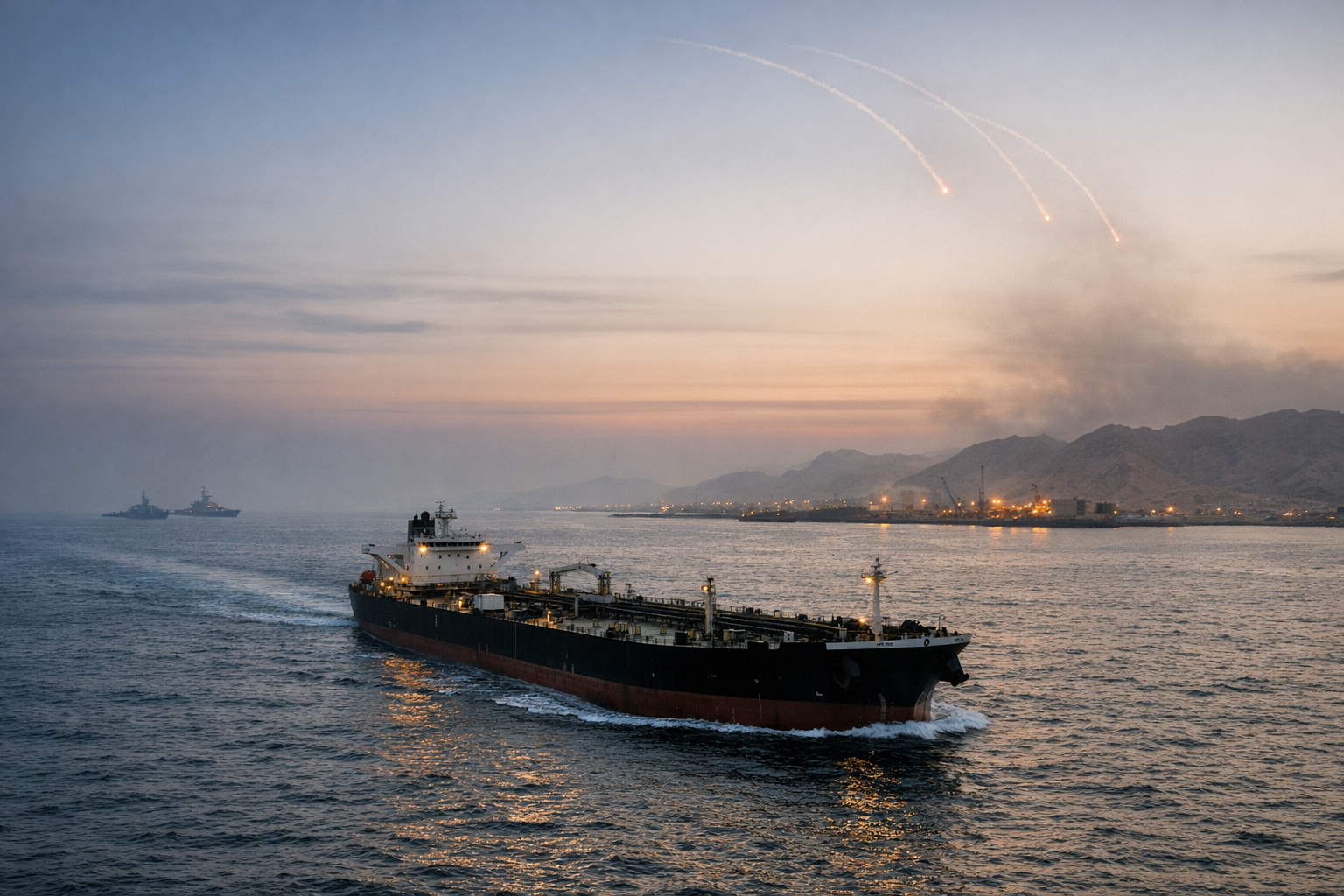
A Wider War Reaches the Gulf
The war with Iran widened sharply on Tuesday, drawing new Gulf states more directly into the conflict, rattling confidence in one of the world’s most important energy corridors and prompting fresh warnings in Washington that the fighting is beginning to strain American military readiness.
Iran said its army had targeted U.S. drone and missile facilities at Ali Al Salem Air Base in Kuwait, an assertion that, if borne out, would mark a significant extension of the conflict’s reach into a country that hosts American forces but has long sought to avoid becoming a battlefield. Gulf states also reported intercepting Iranian and Houthi missiles or drones after an American strike a day earlier on an Iranian missile site on Qeshm Island, in the Strait of Hormuz.
The new attacks underscored how a war that began on more defined fronts nearly nine months ago is now spreading across a region whose governments have tried to balance security ties with Washington against a desire to keep their own territory out of direct confrontation with Tehran.
That expanding risk has implications far beyond the battlefield. On the same day, Fatih Birol, the executive director of the International Energy Agency, said there was no “credible pathway” back to prewar normality in the Strait of Hormuz, arguing that confidence in the waterway as a dependable route for energy and trade had been badly damaged.
His warning captured a growing concern in oil markets and shipping circles: that the issue is no longer simply whether tankers can still pass through Hormuz on any given day, but whether exporters, insurers and traders can still treat the passage as predictably secure.
A Chokepoint Under Pressure
The Strait of Hormuz has long been the strategic hinge of the Gulf, the narrow maritime passage through which a large share of the world’s oil and liquefied natural gas supplies moves. Even during periods when exports have continued and volumes have partly recovered, attacks on shipping, missile launches and the threat of escalation have made clear that restored flows are not the same as restored confidence.
That distinction matters. Energy markets can absorb some disruption if traders believe it will be brief. They respond far more nervously when the underlying assumption of safe passage begins to erode.
Mr. Birol’s remarks suggested that this second, more damaging shift may now be underway. If so, the consequences could extend beyond crude prices to shipping costs, insurance availability and the broader calculation by Gulf producers and Asian buyers about the reliability of one of the global economy’s most essential arteries.
For Gulf monarchies that have spent years trying to portray themselves as islands of stability, the prospect that military exchanges are moving closer to American facilities on their soil raises both security and economic alarms. The more these states are seen as active nodes in the conflict, the greater the risk that they become recurring targets.
Questions About U.S. Staying Power
At the same time, the conflict is feeding concern in Washington about whether the United States can sustain a prolonged campaign without affecting readiness elsewhere.
During a Senate confirmation hearing on Tuesday, Acting Navy Secretary Hung Cao told lawmakers that the Navy had recoded and used munitions he described as expired, a striking indication of how the Iran war is consuming weapons stockpiles and placing pressure on deployments. Senators also pressed him on the cost of the campaign and on the health and welfare of sailors serving through an extended period of tension.
The exchange reflected a broader anxiety on Capitol Hill that a drawn-out conflict in the Gulf could pull resources from other priorities, particularly the military’s focus on China. Lawmakers in both parties have increasingly asked whether ships, interceptors and precision weapons used in the Iran theater are reducing the Pentagon’s flexibility in the Indo-Pacific, where planners have long argued that stockpiles and industrial capacity would be tested in any major contingency.
That debate is no longer abstract. The admission that older munitions are being recoded for use suggested that the pressure is not confined to budgets or planning documents, but is already being felt in inventories.
The Risk of Miscalculation
What comes next remains deeply uncertain. One question is whether Tehran intends to keep broadening the target set to include more Gulf states that host U.S. bases and logistics hubs. Another is whether Washington will answer with wider strikes of its own or seek to contain the exchange before it hardens into a larger regional war.
The danger is that both sides may now be operating in a tighter and more volatile space. Iranian attacks or claimed attacks on U.S.-linked sites in Gulf countries increase the chance of error, especially if interceptions fail, civilian areas are hit or host governments feel compelled to respond more openly. In such an environment, the line between signaling and escalation can collapse quickly.
For the United States, the challenge is twofold: protecting forces and partners in the Gulf while avoiding a conflict spiral that would require still more ships, aircraft and munitions at a time when senior officials are already confronting questions about overstretch.
For Gulf governments, the problem is equally acute. They depend on American protection, but each new strike near their territory threatens to erode the image of commercial safety on which their economies rely.
No Easy Return
Diplomacy could still reduce the immediate danger. But even if violence ebbs, analysts say restoring the old assumptions about Hormuz may prove far harder. Once insurers price in recurring military risk, once shipping companies reroute or demand premiums, and once governments begin to assume that bases in the Gulf may be targets rather than rear areas, the region does not simply revert to its previous equilibrium.
That is the deeper significance of Tuesday’s developments. The war is no longer only a matter of discrete strikes and counterstrikes. It is becoming a test of whether the Gulf can still function as a stable platform for U.S. power and a reliable corridor for the energy trade that underpins much of the world economy.
For now, oil continues to move, ships continue to sail and American forces remain in place. But the confidence that those arrangements can endure without major disruption — the confidence that once defined the prewar order — is increasingly in doubt.
Sources
Further reading and reporting used to add context:
- https://apnews.com/article/b1f0b530cffe951e6fcc1e27b2e1af94
- https://apnews.com/article/b71b1d25f3cff987b4b125196ecb4c3a
- https://www.thedailybeast.com/trump-navy-goon-makes-damning-admission-about-us-missiles
- https://apnews.com/article/a749a935c16c83b2c541842d0ff35ad5
- https://www.thedailybeast.com/hegseth-navy-goon-blasted-for-vile-suicide-remarks
- https://www.thedailybeast.com/trump-launches-fresh-attack-amid-doomsday-fears
- https://apnews.com/article/9c4456bac478a64c9aeff6f2fc6c84ae
- https://www.theatlantic.com/national-security/2026/11/iran-war-trump-limbo/689471/?utm_source=openai
- https://apnews.com/article/15d9c3978ed4f77657900cc2c327d375
- https://apnews.com/article/c8857280ee38c402a81d5e58987fad06
- https://apnews.com/article/2789231dbe0a7a5d8dfcdebe82c0f58f
- https://www.axios.com/2026/11/13/oil-markets-iran-prices-trump-deal
- https://www.thedailybeast.com/navy-families-erupt-at-hegseth-goon-over-christmas-blow
- https://www.investing.com/news/world-news/iran-attacks-us-bases-in-gulf-countries-despite-diplomatic-efforts-5034906
- https://news.aaja.co/articles/60420/
- https://www.investing.com/news/commodities-news/at-hearing-us-navy-chief-blasted-over-iran-war-and-its-toll-on-sailors-5034110
- https://www.aljazeera.com/news/liveblog/2026/11/18/iran-war-live-kuwait-says-intercepting-hostile-drone-attacks
- https://www.axios.com/newsletters/axios-pro-rata-f4fcb2c0-4012-49f5-8d2b-93e19791ce1a
- https://apnews.com/article/02378df1ec3073d2c0f8f162e697d181
- https://theweek.com/world-news/iran-will-trump-resume-the-war
- https://meridian.news/p/2395328443821660748/
- https://www.cityam.com/global-energy-watchdog-warns-no-credible-way-back-to-pre-iran-war-energy-markets/
- https://news.aaja.co/articles/60964/
- https://www.investing.com/news/economy-news/iea-chief-says-energy-markets-wont-return-to-preiran-war-levels-93CH-4971427
- https://finance.yahoo.com/energy/articles/iran-attacks-iea-chief-warns-125336104.html
- https://shortify.news/CNBC/iea-warns-strait-of-hormuz-risks-have-changed-for-good
- https://kompromatmedia.com/site/article.php?id=985278
- https://biztoc.com/x/4f96486c444a2295
- https://theedgemalaysia.com/node/823214
- https://goldseek.com/article/iea-chief-sees-no-credible-pathway-back-pre-war-normality-strait-hormuz
- https://upside.pandobit.com/en/news/2026/11/iea-chief-sees-no-credible-pathway-back-to-pre-war-normality-in-the-strait-of-1962094/
- https://www.newxc.com/article/249495
- Iran attacks US bases in Gulf countries despite diplomatic efforts By Reuters