
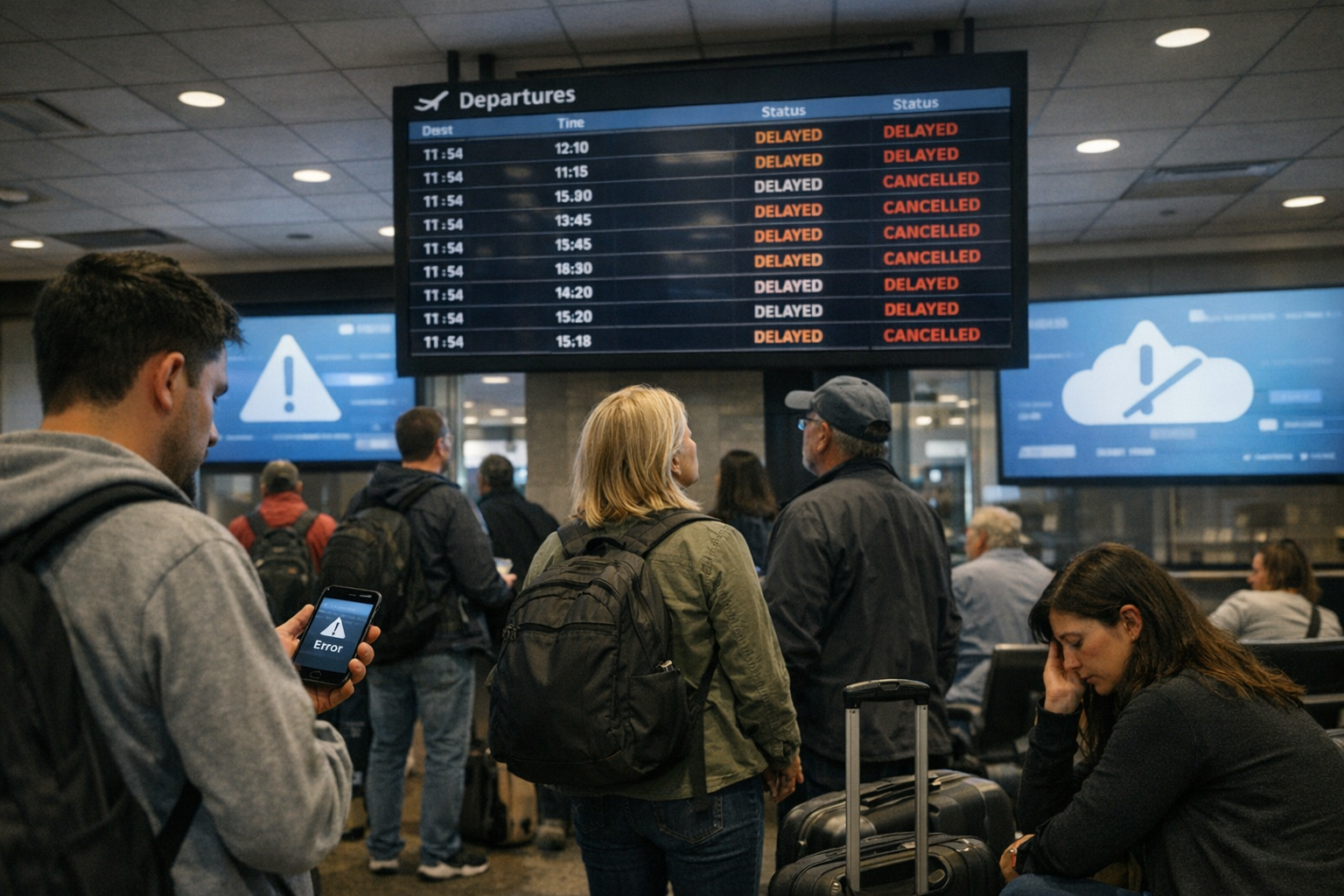
Americans Are Being Warned to Brace for More Tech Disruptions
A fresh warning from the nation’s top intelligence official is sharpening a message that millions of Americans have already absorbed through delayed flights, inaccessible email and interrupted bank transactions: the digital systems that underpin daily life are likely to remain unsteady for some time.
Jay Clayton, the director of national intelligence, said on Nov. 22 that Americans should expect more “bumps in the road” as government agencies and private companies replace aging technology and push through long-delayed upgrades. His remarks, arriving just before the Thanksgiving travel rush, amounted to a rare public acknowledgment from a senior official that turbulence in essential services may continue even if there is no single attack or mastermind behind it.
The warning comes after a striking run of unrelated but high-profile outages that have touched some of the country’s most critical systems: air travel, cloud software, banking networks and government communications. Officials have said they do not believe the disruptions were part of a coordinated or state-backed campaign. But taken together, the failures have raised broader concerns about how brittle key parts of the nation’s digital infrastructure have become.
For travelers heading into one of the busiest periods of the year, that message is especially pointed. Holiday travel has long been vulnerable to weather and staffing shortages. Now, technology itself is emerging as another source of uncertainty.
A String of Failures Across Sectors
In recent weeks, the United States has experienced a concentrated stretch of outages that would have been notable even in isolation.
Air travel was thrown into disarray after an FAA-related nationwide halt tied to a router malfunction and longstanding problems with older systems. Separately, Microsoft 365 suffered an outage that disrupted email and workplace tools used across businesses and institutions. Banking customers also encountered delays linked to JPMorgan Chase that rippled through parts of the payments ecosystem. Other airline glitches affected carriers including United and Delta. Even the National Security Agency experienced problems involving an internal network.
Each episode appeared to have its own technical explanation. Yet the accumulation of failures has unsettled officials and industry leaders because the affected systems are deeply interconnected. A problem in one layer — a router, a cloud platform, a payments rail — can cascade quickly into missed flights, delayed paychecks, inaccessible records or frozen communications.
That interdependence is one reason the recent outages have felt larger than the individual incidents might suggest. They have underscored how much of modern American life depends on a narrow set of digital backbones that are often invisible until they falter.
Modernization, and Its Risks
Clayton’s remarks suggest that officials see at least part of the current instability as a byproduct of modernization itself. Across the public and private sectors, organizations are trying to replace legacy systems that are expensive to maintain and prone to failure. But the transition to newer platforms can introduce its own risks, particularly when upgrades are layered onto infrastructure that has been patched together over many years.
That creates a difficult balancing act. Delay modernization, and old systems become ever more fragile. Move too quickly, and migrations or upgrades can produce fresh breakdowns.
The aviation sector has become a particularly visible example of that tension. Experts and lawmakers have warned for years that parts of the nation’s air traffic and airline technology are outdated, leaving the system vulnerable not only to routine malfunctions but also to major operational snarls when something goes wrong. Similar concerns have surfaced in banking, where payment processing depends on highly coordinated networks, and in corporate software, where cloud-based tools now function as a utility for millions of workers.
No Single Culprit, but Lingering Questions
Officials have repeatedly said the recent events do not appear to be one coordinated cyber campaign. That distinction matters: it suggests the disruptions are not, at least for now, evidence of a broad hostile operation aimed at destabilizing American infrastructure.
But the absence of a single culprit has not eased the underlying concern. If anything, it has shifted attention to a different vulnerability — the possibility that routine technical failures, aging equipment and poorly managed transitions can be just as disruptive to the public as a malicious attack.
There are still significant unanswered questions. It remains unclear how much of the recent turmoil reflects normal pain from long-overdue system upgrades and how much points to deeper structural weakness in critical networks. Another concern is whether future outages will remain mostly technical mishaps or begin to overlap with genuine cyber intrusions, making diagnosis and response more difficult.
Clayton declined to discuss separate reports involving cyberattacks on the F.B.I. and the Agriculture Department, a reminder that even if the recent outages are unrelated, they are unfolding in an environment where cyber threats remain persistent.
Why the Warning Matters Now
The timing of the alert is significant. Americans are about to enter a holiday period when air traffic swells, payment systems are heavily used and businesses are stretched thin. In that setting, even short-lived outages can have outsized effects.
The warning also carries a broader signal for markets, companies and consumers: instability in core digital services may not be a one-off event but part of a longer transition period. That could intensify pressure on both Washington and corporate leaders to accelerate infrastructure replacement, impose stricter resilience standards and strengthen coordination around cyber and operational risk.
Clayton is also expected to serve as acting national cyber director while a nominee awaits confirmation, according to Axios, placing him at the center of the administration’s response to a moment when the line between cybersecurity and basic technological reliability is increasingly blurred.
For the public, the practical lesson may be simple if unwelcome: disruptions once treated as anomalies are becoming common enough that officials are now openly advising Americans to plan for them.
Sources
Further reading and reporting used to add context:
- https://apnews.com/article/c26a27fd648f766252b54724d8a897a3
- https://www.axios.com/2026/11/23/jay-clayton-acting-national-cyber-director
- https://www.thedailybeast.com/new-tech-glitch-sparks-travel-chaos-at-major-us-airport
- https://www.axios.com/newsletters/axios-des-moines-76aecfb0-4d35-4045-98c0-b2612c66e3bb
- https://apnews.com/article/cf5a66aaa14f98763eabfb767ff8727c
- https://www.thedailybeast.com/trump-faces-corruption-claim-over-sex-mad-ceos-25m-ballroom-gift
- https://www.theatlantic.com/ideas/2026/11/trump-huang-national-security-risk/689547/?utm_source=openai
- https://apnews.com/article/aeb4b0d6b6789c8c96bb2520454a6d1e
- https://apnews.com/article/ce63a22797c61ee53d88678000236c37
- https://www.axios.com/newsletters/axios-am-4fdcdf3f-5786-4a64-b134-567fad56a564
- https://www.techradar.com/computing/cyber-security/yes-its-been-the-worst-week-of-major-outages-for-13-years-but-ai-cyberattacks-arent-to-blame-heres-whats-happening
- https://theweek.com/tech/are-ai-driven-outages-the-new-normal
- https://www.itpro.com/software/microsoft/satya-nadella-issues-apology-to-customers-in-wake-of-microsoft-365-outage
- https://www.theatlantic.com/technology/2026/11/why-mass-digital-outages/689501/?utm_source=openai
- https://www.tomsguide.com/computing/online-security/flights-banks-and-email-keep-going-down-heres-how-to-tell-if-its-an-outage-or-a-cyberattack
- https://www.techradar.com/computing/cyber-security/hey-you-stuffing-cash-into-your-mattress-this-series-of-unfortunate-tech-outages-is-not-connected-nor-is-it-the-end-of-our-digital-world
- https://www.theatlantic.com/politics/2026/11/license-plate-readers-ice/689515/?utm_source=openai
- https://apnews.com/article/0c0f0cf4983a0f81ba88c4c4d2b8383f
- https://www.theatlantic.com/politics/2026/11/trump-ai-tech-outages/689512/?utm_source=openai
- https://www.thedailybeast.com/hackers-hijack-websites-of-cnn-bbc-and-major-banks
- https://www.thedailybeast.com/wild-trump-blackout-conspiracy-explodes-after-outage-chaos
- https://www.gmanetwork.com/news/topstories/world/1010445/us-intelligence-chief-predicts-more-tech-outages-as-systems-undergo-upgrades/story/
- https://www.investing.com/news/stock-market-news/us-intelligence-chief-predicts-more-tech-outages-as-systems-undergo-upgrades-5044089
- https://qz.com/jay-clayton-tech-outages-ai-upgrades-warning-112326
- https://news.aaja.co/articles/68196/
- https://anr.news/technology/director-of-national-intelligence-jay-clayton-warns-americans-of-bumps-in-the-road-after-tech-outages/
- https://www.marketscreener.com/news/us-intelligence-chief-predicts-more-tech-outages-as-systems-undergo-upgrades-ce785ed3d18cf32d
- https://huelv.com/newsroom/71070-director-of-national-intelligence-jay-clayton-warns-americans-of-bumps-in-the
- https://www.businessinsurance.com/us-intelligence-chief-predicts-more-tech-outages/
- US intelligence chief predicts more tech outages as systems undergo upgrades By Reuters
- Tech outages are piling up, and AI is raising the stakes. Could this be the new normal?
- What to know about the online banking delays that affected major US banks
- US intelligence chief predicts more tech outages as systems undergo upgrades | GMA News Online