
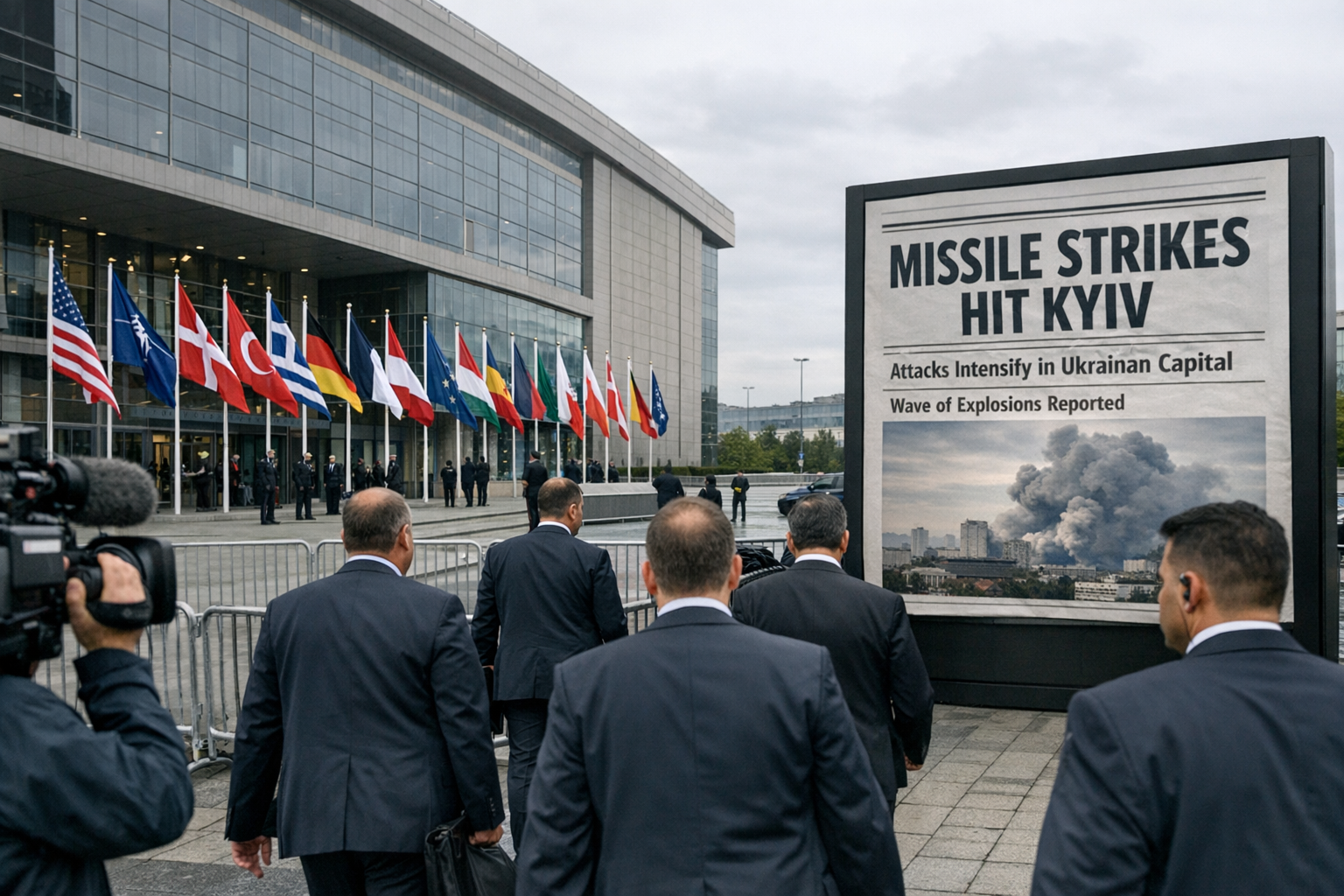
NATO Summit Opens in Shadow of Deadly Kyiv Barrage
NATO leaders convened in Ankara on Monday under the immediate shadow of one of the deadliest Russian assaults on Kyiv in recent weeks, a barrage of missiles and drones that killed at least 14 people and injured more than 100, according to Ukrainian officials, and sharpened President Volodymyr Zelensky’s appeal for “strong decisions” from the alliance.
The attack, which struck apartment buildings and other civilian sites in the Ukrainian capital on the eve of the summit, underscored the central question hanging over this year’s gathering: whether Western allies can turn ambitious promises on defense spending into concrete military support quickly enough to help Ukraine withstand an intensifying Russian campaign.
For Mr. Zelensky, the timing was brutal but politically clarifying. As NATO’s official program included a NATO-Ukraine Council working dinner at the foreign-minister level, the Ukrainian president entered the summit pressing not just for declarations of solidarity but for faster deliveries of air-defense systems, interceptors and longer-term security commitments.
The latest strike on Kyiv was the second major assault on the capital in a matter of days, and early casualty figures remained fluid, suggesting the toll could still rise.
A Summit Defined by Burden-Sharing
The Ankara meeting was intended to focus on what officials have described as three connected tasks: making burden-sharing inside the alliance “stronger and fairer,” increasing defense-industrial output and sustaining support for Ukraine as the war grinds on.
But those themes have become harder to disentangle. The pressure on Europe to spend more — a demand associated for years with President Trump and now revived with new intensity — is no longer simply an accounting dispute over alliance fairness. It is also a test of whether Europe can field real military power at speed as Russia continues to bombard Ukrainian cities and probe Western resolve.
At NATO’s 2025 summit in The Hague, allies committed to a new benchmark of spending 5 percent of gross domestic product on security by 2035, including 3.5 percent on core defense and up to 1.5 percent on broader security-related investments. Since then, NATO officials have pointed to a sharp rise in defense spending by European allies and Canada in 2025.
The unresolved question, however, is whether those pledges can be converted into deployable capabilities — more missiles, more air defenses, more ammunition production and more combat-ready forces — rather than remaining long-dated political commitments.
That issue is particularly acute for countries seen by Washington as lagging. In recent days, American pressure on allies to accelerate spending has again become public and pointed, setting up the possibility of friction in Ankara even as leaders seek to project unity.
Trump’s Presence Looms Over Ankara
Mr. Trump’s influence hovered over the summit before it formally opened.
He was expected to meet Mr. Zelensky on the sidelines after separate recent contacts involving both the Ukrainian leadership and President Vladimir V. Putin of Russia, according to reports circulating ahead of the gathering. Those interactions have added another layer of uncertainty to a summit already freighted with questions about American staying power, alliance cohesion and the eventual terms of any negotiated end to the war.
For many European officials, the burden-sharing debate is now inseparable from a broader strategic concern: how much responsibility the United States is prepared to retain for Europe’s defense, and how quickly Europeans must prepare for a world in which Washington expects a larger share of the load to be carried elsewhere.
That dynamic has given rise to talk in some policy circles of a reconfigured alliance — one in which NATO remains intact but the division of labor shifts more decisively toward Europe on conventional deterrence and support for Ukraine.
Ukraine Seeks More Than Symbolism
Mr. Zelensky has spent months urging allies to match their rhetoric with systems that can save lives immediately, especially as Russia has intensified combined missile-and-drone attacks designed to overwhelm Ukrainian air defenses.
The summit’s symbolism matters. But for Kyiv, the more important questions are practical and unresolved: whether allies will accelerate shipments of Patriot-class and other air-defense interceptors; whether they will lock in multiyear military support instead of piecemeal packages; and whether Ukraine can emerge from Ankara with concrete agreements that strengthen its military position before another winter of attacks on infrastructure and cities.
Ukrainian officials have also been trying to recast their country not only as a recipient of Western aid but increasingly as a defense partner, highlighting plans for major defense agreements with NATO countries and promoting Ukraine’s own wartime manufacturing expertise.
Still, the immediate imbalance remains stark. Russia can continue launching massed strikes. Ukraine’s ability to blunt them depends heavily on a steady supply of expensive Western munitions.
Markets Watch Geopolitics, Not Just Diplomacy
Investors were also watching the summit closely, an indication of how tightly war risk and alliance politics have become bound up with broader market sentiment. Treasury yields edged lower at the start of the week as traders looked ahead not only to U.S. economic data and Federal Reserve minutes, but also to developments in Turkey.
That attention reflects more than routine summit theater. Markets are weighing several overlapping uncertainties: the risk of further escalation between Russia and Ukraine, the durability of Western backing for Kyiv, and the possibility that disputes over defense spending could expose new fractures inside the alliance at a moment when deterrence depends heavily on political unity.
What Ankara May — and May Not — Deliver
NATO leaders are all but certain to reaffirm support for Ukraine and to cite progress toward the spending goals adopted last year. What remains far less clear is whether Ankara will produce the kind of immediate, measurable commitments Kyiv has sought.
The summit opens, then, with an old contradiction newly exposed. NATO is richer, larger and on paper more ambitious than at any point in decades. Yet as Russian missiles hit Kyiv, the alliance still faces the same unforgiving test: whether it can move quickly enough, and cohesively enough, to make those advantages count.
Sources
Further reading and reporting used to add context:
- https://apnews.com/article/0280e3d86022720fd5fa0236122ad90e
- https://apnews.com/article/8d994efb518c6a8538cbe3c6ac539147
- https://apnews.com/article/f8379b038dfbbf7afde80bb50a0bd96e
- https://www.theguardian.com/world/live/2026/jul/06/ukraine-russia-zelenskyy-nato-summit-strikes-kyiv-europe-latest-news-updates
- https://www.cbsnews.com/news/ukraine-russia-war-attack-kyiv-missile-drones/
- https://abcnews.com/International/russian-overnight-bombardment-kyiv-kills-14-ukrainian-officials/story?id=134509281
- https://www.investing.com/news/world-news/ukrainian-capital-kyiv-under-missile-attack-officials-say-4775500
- https://www.aljazeera.com/news/2026/7/6/russian-attacks-on-ukraine-kill-11-on-eve-of-nato-summit-authorities-say
- https://www.theguardian.com/world/2026/jul/06/ukraine-war-briefing-trump-to-meet-zelenskyy-at-nato-summit-as-us-says-battlefield-progress-frozen
- https://www.thestar.com.my/news/world/2026/07/06/trump-to-meet-leaders-of-ukraine-syria-alongside-nato-summit
- https://www.lemonde.fr/en/international/article/2026/07/06/politicial-scientist-alexandra-de-hoop-scheffer-the-us-is-pursuing-a-strategy-of-strategic-saturation_6755177_4.html
- https://www.brecorder.com/news/40428689/russian-attack-on-kyiv-kills-seven-hits-apartments-other-buildings
- https://www.investing.com/news/stock-market-news/erdogan-says-bilateral-talks-with-trump-likely-at-nato-summit-in-turkey-4758237
- https://kelo.com/2026/07/06/factbox-nato-ankara-summit-whos-going-and-what-to-expect/
- https://www.internazionale.it/ultime-notizie-reuters/2026/07/03/nato-leaders-to-affirm-ironclad-commitment-to-collective-defence-in-ankara-summit-text-says
- https://www.internazionale.it/ultime-notizie-reuters/2026/06/24/erdogan-says-bilateral-talks-with-trump-likely-at-nato-summit-in-turkey
- https://www.nato.int/content/dam/nato/webready/documents/events/2026/summit-ankara/20260707-Ankara%20Summit%20Media%20Programme.pdf
- https://en.wikipedia.org/wiki/2026_Kyiv_shooting
- https://www.nato.int/en/news-and-events/events/media-advisories/2026/04/22/nato-summit-media-advisory
- https://www.nato.int/en/news-and-events/events/event-programmes/2026/07/nato-summit-2026
- https://www.nato.int/en/what-we-do/introduction-to-nato/defence-expenditures-and-natos-5-commitment
- https://www.nato.int/en/news-and-events/events/2026/07/overview—2026-nato-summit-in-ankara-
- https://www.nato.int/en/what-we-do/deterrence-and-defence/deterrence-and-defence
- https://www.nato.int/fr/news-and-events/events/2026/07/overview—2026-nato-summit-in-ankara-
- https://www.nato.int/en/news-and-events/articles/news/2025/08/20/turkiye-to-host-2026-nato-summit-in-ankara
- https://www.nato.int/en/news-and-events/articles/news/2026/05/22/nato-foreign-ministers-wrap-up-preparations-for-ankara-summit-in-helsingborg
- https://www.nato.int/en/news-and-events/events/media-advisories/2026/06/03/north-atlantic-council-visits-ukraine
- https://www.nato.int/en/news-and-events/events/event-programmes/2026/02/meeting-of-nato-ministers-of-defence
- https://www.nato.int/en/news-and-events/articles/news/2026/03/26/nato-secretary-generals-annual-report-shows-significant-increase-in-defence-investment-from-europe-and-canada
- https://www.act.nato.int/activities/nato-summit/
- https://www.nato.int/content/dam/nato/webready/documents/publications-and-reports/annual-reports/sgar25-en.pdf
- https://www.nato.int/content/dam/nato/webready/documents/events/2025/20251203-FMM-Media-Programme-en.pdf
- https://www.nato.int/nato_static_fl2014/assets/pdf/pdf_2018_07/20180713_180711-summit-declaration-eng.pdf
- https://www.nato.int/docu/rdr-gde-ist/rdr-gde-ist-e.pdf
- https://www.investing.com/news/world-news/trump-to-meet-leaders-of-ukraine-syria-alongside-nato-summit-4775486
- https://whbl.com/2026/07/05/trump-to-meet-leaders-of-ukraine-syria-alongside-nato-summit/
- https://www.tbsnews.net/worldbiz/usa/trump-offers-help-putin-find-deal-ukraine-also-speaks-zelenskiy-1479731
- https://www.al-monitor.com/originals/2026/07/trump-meet-leaders-ukraine-syria-alongside-nato-summit
- https://www.euronews.com/2026/07/05/zelenskyy-and-putin-hold-fourth-of-july-phone-calls-with-trump
- https://www.internazionale.it/ultime-notizie-reuters/2026/07/05/trump-to-meet-leaders-of-ukraine-syria-alongside-nato-summit
- https://kelo.com/2026/07/05/trump-to-meet-leaders-of-ukraine-syria-alongside-nato-summit/
- https://tvpworld.com/94198459/trump-to-meet-zelenskyy-at-july-7-nato-summit-in-push-to-end-war-in-ukraine
- https://www.japantimes.co.jp/news/2026/07/04/world/politics/nato-commitment-collective-defense/
- https://www1.srna.rs/en/novost/1410487/trump-with-zelenskyy-on-ending-war-at-nato-summit-in-turkey
- https://en.wikipedia.org/wiki/Agreement_on_5%25_NATO_defence_spending_by_2035
- https://en.wikipedia.org/wiki/2026_United_States%E2%80%93Ukraine%E2%80%93Russia_meetings_in_Abu_Dhabi
- https://www.reddit.com/r/NewsExchange/comments/1uodnso/trump_to_meet_with_ukraines_zelenskyy_and_syrias/
- https://politicalscience.yale.edu/sites/default/files/2025-08-15-trump-and-zelelenskyy-meet-with-eu-leaders-meet-prior-to-putin-trump-meeting.pdf
- https://www.gulf-times.com/pdf/2025/07/06/business-20250706-1.pdf?ts=001223
- https://www.reddit.com/r/TrumpGlobalWar/comments/1uo5o52/global_war_briefing_05072026_1136_am_et_last_15/
- NATO Summit 2026, 07-Jul-2026 | NATO Event
- Russian missile and drone attack on Ukraine's capital kills at least 12
- Overview – 2026 NATO Summit in Ankara