
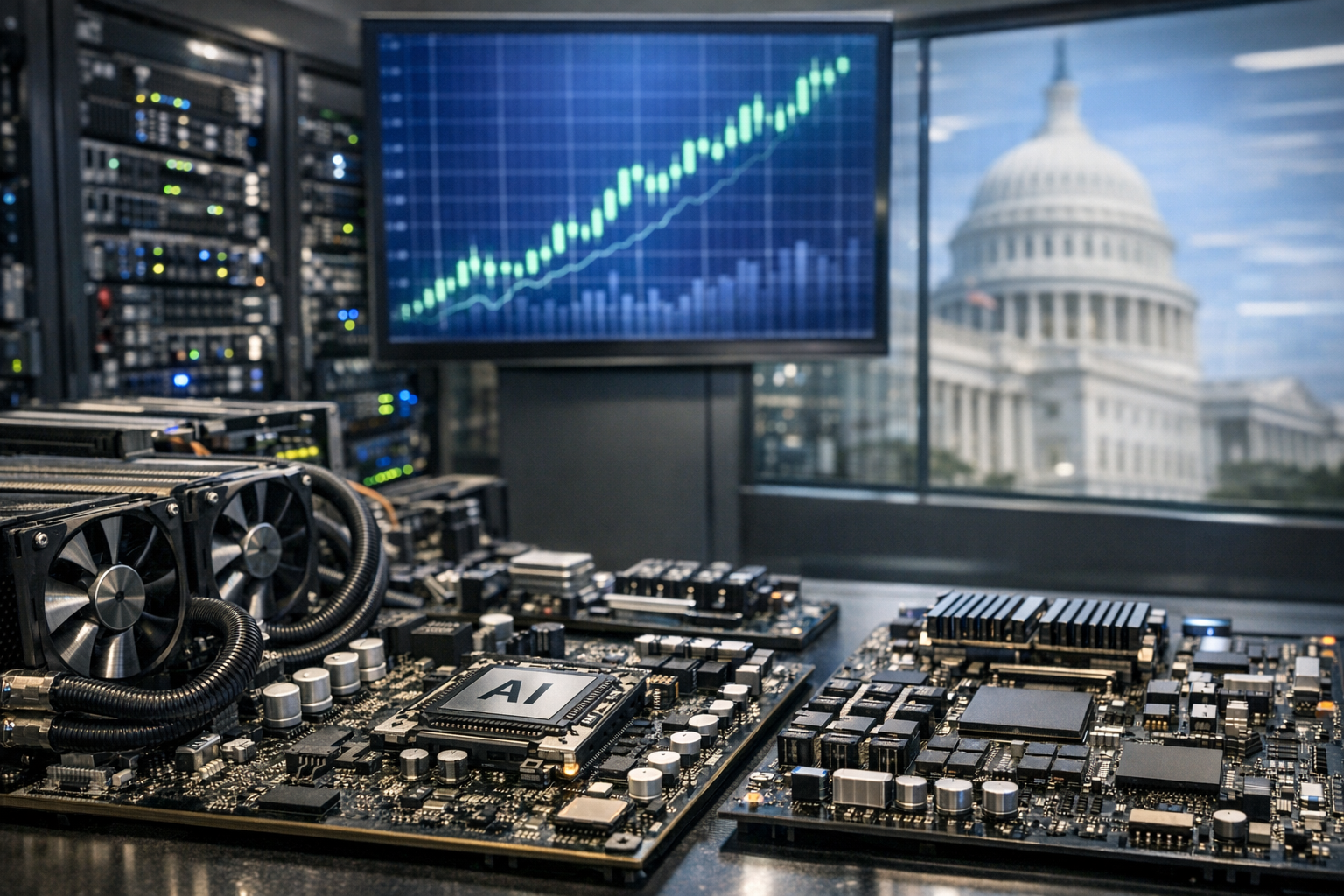
Nvidia jolted Wall Street back into an AI fervor this week, adding hundreds of billions of dollars in market value after reporting another quarter of surging sales and offering guidance that suggested the industry’s appetite for artificial-intelligence computing remains far from sated.
The rally did more than lift one company. It revived a trade that had lately shown signs of fatigue and, at the same time, underscored a larger reality now shaping the technology industry: the business of building AI has become deeply entangled with Washington’s industrial policy, national-security strategy and intensifying competition with China.
Investors seized on Nvidia’s results as evidence that the world’s largest cloud companies are still spending heavily on the data centers, networking gear and memory required to train and run advanced AI systems. Shares of the chipmaker climbed sharply after the report, helping propel a broader rebound across semiconductor and AI-linked stocks.
Yet the optimism arrived alongside a fresh set of political and regulatory risks. The Trump administration is said to be weighing another round of semiconductor tariffs, potentially tying trade pressure more closely to domestic manufacturing investment. Nvidia, for its part, has been expanding support for prominent Chinese open models, including DeepSeek and Qwen, even as it has warned that new U.S. restrictions on Chinese-origin AI models could damage its business.
AI demand shrugs off doubts
Nvidia’s earnings helped settle a question that had been hanging over markets in recent months: whether the enormous capital spending behind the generative-AI boom was beginning to cool.
Instead, the company’s late-August report pointed in the opposite direction. Revenue and guidance came in ahead of expectations, extending the pattern of triple-digit growth in the parts of Nvidia’s business tied most directly to AI infrastructure. For investors, that was enough to reassure them that the hyperscale cloud groups and other large buyers still see a clear payoff in pouring money into computing capacity.
That matters because Nvidia remains the central supplier to the AI buildout. Its chips sit at the heart of systems used to train large language models and increasingly to power inference, the process of generating responses and running AI applications at scale. When Nvidia’s outlook strengthens, it tends to reinforce confidence not just in one company but in the spending plans of the broader industry.
The market response reflected that dynamic. Nvidia’s gain rippled outward to other chipmakers and AI beneficiaries, restoring momentum to a sector that had come under pressure from concerns about valuation, supply constraints and whether demand would justify the scale of investment.
Washington’s leverage campaign
But even as investors celebrated, the policy backdrop grew more complicated.
The administration’s reported consideration of fresh semiconductor tariffs suggests that the United States is moving beyond export controls alone and looking for additional ways to influence where chips are made and how supply chains are organized. The idea fits a broader push to use trade policy to reinforce domestic manufacturing and reduce dependence on overseas production in critical technologies.
For the semiconductor industry, tariffs would add to a landscape already reshaped by subsidies, local-content expectations and restrictions on sales to China. The immediate effect could be higher costs and renewed uncertainty for companies that rely on globally dispersed manufacturing networks. The longer-term effect may be to accelerate the geographic reordering of the industry, especially in packaging, memory and other segments that have become crucial to AI hardware.
That shift is already underway. This week, SK Hynix broke ground on its first U.S. facility, a more than $4 billion project in Indiana focused on high-bandwidth memory packaging and research. The company said the site was intended to become a key American memory production base by 2030.
The move is significant because AI systems depend not only on advanced processors but also on the specialized memory and packaging technologies that allow those processors to function at scale. High-bandwidth memory has emerged as one of the most acute bottlenecks in the AI supply chain, making companies like SK Hynix increasingly strategic players in the competition to expand computing capacity.
The China model question
The geopolitical contest is also widening beyond chips themselves.
Nvidia has been optimizing its hardware and software support for Chinese open models such as DeepSeek and Alibaba’s Qwen, a sign that it sees continued commercial value in ensuring its systems work well with important AI ecosystems outside the United States. But that strategy now collides with a debate in Washington over whether Chinese-developed AI models pose risks related to security, intellectual property or geopolitical influence.
Policy makers have spent years tightening controls on advanced chip exports to China. Now the focus is beginning to extend to models — especially open-weight or openly distributed systems that can spread internationally through developers, cloud platforms and commercial applications.
How far the government might go remains unclear. Officials could target specific Chinese labs, the distribution of model weights, access to cloud infrastructure or the use of such models in sensitive sectors. Any of those steps would have implications not only for Chinese AI companies but also for American suppliers, cloud providers and software firms hoping to serve a global market.
For Nvidia, the risk is straightforward: restrictions that narrow the ecosystem around Chinese models could limit demand for its products or complicate its ability to support customers operating across borders. More broadly, such measures would mark another stage in the U.S.-China technology conflict, one in which the competition is no longer simply about semiconductor performance but about which AI platforms gain adoption worldwide.
Capital, courts and control
DeepSeek’s search for fresh capital shows how quickly that competition is moving into financial markets as well. The Chinese AI company, backed by the quant firm High-Flyer, is pursuing new funding as it navigates a volatile domestic listing environment and positions itself for possible public-market ambitions.
Its fundraising effort carries significance beyond one company. DeepSeek has become a symbol of China’s ability to produce high-profile AI models with global visibility, and any successful capital raise would be watched as a gauge of investor confidence in the country’s AI sector at a moment of both strategic urgency and regulatory sensitivity.
In Washington, meanwhile, a federal judge’s decision to block the Pentagon’s blacklist of Anthropic highlighted another front in the struggle over how the government can police AI. The Defense Department had barred the military from using Anthropic’s Claude on supply-chain risk grounds. The court’s intervention suggested that even as officials seek stronger tools to manage perceived AI threats, their authority to act through procurement restrictions or blacklist mechanisms may face legal limits.
That ruling could have consequences well beyond Anthropic. If agencies are constrained in their ability to sideline AI vendors unilaterally, the government may need to rely more heavily on formal rule-making, legislation or export-control authorities when trying to shape the market on national-security grounds.
A boom with new fault lines
Taken together, the week’s developments offered a vivid portrait of the current AI economy: exuberant demand at the top of the stack, and mounting friction everywhere around it.
Nvidia’s earnings suggested that the spending boom remains intact for now. But the same boom is making semiconductors, memory, packaging, model distribution and vendor access matters of state policy. The result is an industry in which quarterly sales figures can ignite a market rally even as tariffs, court fights and geopolitical scrutiny threaten to redraw the competitive landscape underneath it.
The crucial question now is whether the industry can keep expanding fast enough to satisfy investors while adapting to a world in which AI is no longer governed mainly by product cycles and customer demand. It is increasingly governed by governments themselves.
Sources
Further reading and reporting used to add context:
- https://apnews.com/article/f15e3c30186385e73e72bee82d85b05c
- https://apnews.com/article/b4216a1f191d0304b4ed59e6912e23a4
- https://www.thedailybeast.com/pete-hegseth-suffers-embarrassing-defeat-in-anthropic-legal-battle/
- https://www.axios.com/newsletters/axios-am-709c0f20-3279-4586-9151-d0110f2accb4
- https://apnews.com/article/fa718f6f57b0be019a27c88b01df526d
- https://www.axios.com/newsletters/axios-closer-9b96e528-7c1d-442d-ad1b-3867ac7cc281
- https://www.axios.com/2026/08/28/nvidia-ai-chip-circular-finance-startups
- https://apnews.com/article/dc8d556e709b50915cca9217a60b1991
- https://www.axios.com/2026/08/26/nvidia-earnings-jensen-huang-ai
- https://www.tomshardware.com/tech-industry/policy/trump-administration-weighs-expanding-chip-tariffs-to-laptops-consoles-and-servers
- https://www.investing.com/news/stock-market-news/us-judge-rules-pentagon-blacklisting-of-anthropic-unlawful-4880415
- https://www.investing.com/news/general-news/us-judge-blocks-pentagons-anthropic-blacklisting-4880421
- https://www.investing.com/news/world-news/us-weighs-a-new-round-of-tariffs-on-semiconductors-politico-reports-4878694
- https://www.marketscreener.com/news/us-judge-rules-pentagon-blacklisting-of-anthropic-unlawful-ce7858dfd88bfe20
- https://economictimes.indiatimes.com/industry/cons-products/electronics/us-weighs-a-new-round-of-tariffs-on-semiconductors-says-report/articleshow/133563596.cms
- https://www.marketscreener.com/news/us-weighs-a-new-round-of-tariffs-on-semiconductors-politico-reports-ce7858deda8bf225
- https://m.economictimes.com/industry/cons-products/electronics/us-weighs-a-new-round-of-tariffs-on-semiconductors-says-report/articleshow/133563596.cms
- https://www.marketscreener.com/news/us-judge-blocks-pentagon-s-anthropic-blacklisting-ce7858dfd88af725
- https://www.theguardian.com/technology/2026/aug/28/us-court-rules-pentagon-anthropic-ban-illegal-trump-claude-ai
- https://www.investing.com/news/stock-market-news/meta-anthropic-google-openai-to-meet-with-trump-white-house-amid-rogue-ai-agent-fallout-4834911
- https://www.washingtonpost.com/technology/2026/08/27/federal-judge-overturns-pentagon-ban-claude-chatbot-maker-anthropic/
- https://www.axios.com/newsletters/axios-pro-rata-348b8ec6-f9a1-4bca-9f25-c7880cfa1e5c
- https://news.skhynix.com/en/groundbreaking-ceremony-in-indiana/
- https://news.skhynix.com/en/indiana-groundbreaking-ceremony-sketch/
- https://asiainsiders.net/deepseek-looks-for-fresh-capital-as-founders-quant-empire-navigates-chinas-choppy-ipo-market/
- https://www.breakingviews.com/columns/considered-view/deepseek-ipo-lays-bare-chinas-shallow-capital-pool-2026-07-16/
- https://www.investing.com/news/stock-market-news/sk-hynix-holds-groundbreaking-ceremony-for-4-billion-indiana-ai-chip-packaging-facility-4879737
- https://cybersuit.tech/article/deepseek-looks-for-fresh-capital-as-founder-s-quant-empire-navigates-china-s-choppy-ipo-market
- https://www.marketscreener.com/news/deepseek-resumes-funding-round-seeking-nearly-8-billion-bloomberg-news-reports-ce7f50dddc88f525
- https://www.ajupress.com/view/20260828002253071
- https://www.koreatimes.co.kr/amp/business/20260828/sk-hynix-to-start-us-ai-chip-output-in-2029-sees-memory-shortage-through-2030
- https://www.koreatimes.co.kr/world/20260828/sk-hynix-to-start-us-ai-chip-output-in-2029-sees-memory-shortage-through-2030
- https://in.marketscreener.com/news/sk-hynix-holds-groundbreaking-ceremony-for-4-billion-indiana-ai-chip-packaging-facility-ce7858dedf8ef322
- https://www.reddit.com/r/NewMaxx/comments/1w08pe2/sk_hynix_ceo_says_the_memory_shortage_runs/
- https://www.reddit.com/r/SKHynix/comments/1vem26v/even_if_equipment_investment_increases_it_takes/
- https://www.reddit.com/r/stocks/comments/1vpbozk/sk_hynix_to_mark_groundbreaking_of_39_bn_indiana/
- https://www.axios.com/2026/07/22/nvidia-jensen-huang-china-open-source-ai
- https://www.axios.com/2026/08/05/trump-ai-framework-china
- https://www.axios.com/2026/08/27/nvidia-ai-earnings-stock
- https://moneyweek.com/investments/tech-stocks/nvidia-q2-results
- https://www.tomshardware.com/tech-industry/big-tech/nvidia-revenue-tops-usd96-billion-as-memory-commitments-soar-to-usd160-billion-ceo-jensen-huang-says-ai-has-reached-its-inflection-point
- https://www.investing.com/news/stock-market-news/nvidia-rises-after-signaling-longer-ai-spending-runway-4878530
- https://www.investing.com/news/stock-market-news/chinese-filing-implies-deepseek-valuation-of-around-52-billion-4796314
- https://www.investing.com/news/stock-market-news/chinas-deepseek-to-raise-fresh-capital-at-74-billion-valuation-ahead-of-onshore-ipo-sources-say-4799575
- https://www.thejakartapost.com/business/2026/07/19/deepseek-reportedly-to-raise-fresh-capital-at-74-billion-valuation-ahead-of-ipo
- https://www.marketscreener.com/news/nvidia-rises-after-signaling-longer-ai-spending-runway-ce7858dedb8ef022
- https://www.marketscreener.com/news/tech-stocks-bolster-wall-street-as-nvidia-quells-ai-growth-concerns-ce7858ded189f120
- https://www.marketscreener.com/news/chinese-filing-implies-deepseek-valuation-of-around-52-billion-ce7f5ed3db81f424
- https://www.investing.com/news/economy-news/chinas-deepseek-considers-new-fundraising-after-first-round-ft-reports-4790357
- https://www.fidelity.com/news/article/company-news/202607180432RTRSNEWSCOMBINED_L6N43K020_1
- https://www.investing.com/news/stock-market-news/nvidia-bounce-shows-wall-streets-ai-obsession-is-far-from-over-4878000
- https://www.investing.com/news/stock-market-news/key-republican-urges-us-to-stop-any-advanced-chips-from-reaching-sanctioned-chinese-firms-4848282
- https://www.investing.com/news/world-news/us-communications-agency-is-the-unlikely-spearhead-of-trumps-china-policy-4849718
- https://www.investing.com/news/stock-market-news/nvidia-to-ship-ai-chip-for-china-by-yearend-the-information-reports-4870258
- https://www.investing.com/news/stock-market-news/republican-senator-urges-trump-to-back-us-openweight-ai-models-amid-industry-debate-4860262
- https://www.investing.com/news/stock-market-news/exclusivealibaba-plans-to-charge-big-users-of-its-next-opensource-ai-model-sources-say-4845000
- https://www.investing.com/news/stock-market-news/trump-advisers-tell-ai-firms-they-will-not-safetytest-openweight-models-sources-say-4836070
- https://www.investing.com/news/stock-market-news/fcc-chair-says-robot-import-restrictions-aim-to-boost-us-production-4843337
- https://www.marketscreener.com/news/nvidia-to-invest-1-5-billion-in-sb-energy-under-openai-data-center-deal-ce7859dcd88ff123
- https://www.marketscreener.com/news/trump-advisers-tell-ai-firms-they-will-not-safety-test-open-weight-models-sources-say-ce7f50dfd98df425
- https://www.reutersconnect.com/item/trump-says-he-will-meet-next-week-with-top-ai-figures/dGFnOnJldXRlcnMuY29tLDIwMjY6bmV3c21sX1ZBNjYwNzE5MDgyMDI2UlAx
- https://www.investing.com/news/world-news/trump-says-congress-wants-to-regulate-ai-industry-out-of-business-4846908
- https://www.techradar.com/pro/security/the-us-almost-blacklisted-deepseek-for-contributing-to-chinas-military-and-intelligence-but-the-white-house-held-back-to-avoid-escalating-tensions
- https://www.reddit.com/r/NvidiaStock/comments/1vxi0kx/removed/
- https://www.reddit.com/r/DeepSeek/comments/1rew7ty/the_real_reason_why_deepseek_denied_v4_access_to/
- https://www.wsj.com/public/resources/documents/H5J6mo3vurW3jlCevKb1-WSJNewsPaper-8-12-2025.pdf
- https://www.reddit.com/r/StockMarket/comments/1vvyfmr/nvda_is_spending_6_billion_to_build_a_powerful_us/
- https://www.reddit.com/r/DeepSeek/comments/1vna3xl/bye_bye_deepseek/
- https://content.next.westlaw.com/Document/I7fde31d09b1611f1941d96d221ff75c6/View/FullText.html?contextData=%28sc.Default%29&transitionType=Default
- https://ubuntu.com/blog/genai-inference
- https://m.ajupress.com/amp/20260814074506579
- https://www.stockstracker.com/market/articles/24056
- https://www.reddit.com/r/LocalLLM/comments/1vzhihf/nvidia_agrees_to_buy_huggingface_for_129_billion/
- https://www.technotime.net/16326
- https://www.reddit.com/r/thewallstreet/comments/1vzryla/daily_discussion_august_27_2026/
- https://www.theinfomachine.fyi/story/us-debate-over-chinese-open-source-83
- https://economictimes.indiatimes.com/news/international/world-news/trump-declares-national-emergency-bans-foreign-equipment-from-us-electricity-grid-over-security-threats/articleshow/133555365.cms?from=mdr
- https://canonical.com/blog/genai-inference
- https://losangelesfinancialtimes.com/china-ai-firms-tap-nvidia-power-overseas-as-u-s-weighs-crackdown/
- https://rt.http3.lol/index.php?q=aHR0cHM6Ly9hcnhpdi5vcmcvaHRtbC8yNjA4LjA0NTAydjEjYmliLmJpYjIz
- https://tech.yahoo.com/articles/trump-administration-backs-off-nvidias-170237761.html
- https://blockchain.news/ainews/nvidia-expands-chinese-open-models-amid-crackdown-warning
- https://www.reddit.com/r/BlackwellPerformance/comments/1vlkeab/whats_the_best_model_youre_running_on_single_6k/
- https://www.axios.com/2026/08/26/nvidia-earnings-preview-jensen-huang-ai
- https://netzender.com/nvidia-is-bolstering-support-for-chinese-open-ai-models-as-it-warns-of-white-house-crackdown
- https://www.gate.com/en-us/news/detail/nvidia-bolsters-support-for-chinese-ai-models-including-deepseek-and-qwen-17853815
- https://www.bursa.ro/cnbc-nvidia-adapteaza-tehnologia-ai-si-avertizeaza-asupra-restrictiilor-americane-84630069
- https://www.netzender.com/cnbc-daily-open-tariffs-in-spotlight-and-trump-has-a-new-name-for-a-lake
- https://khao.ai/news/2026-08-12/meta-nvidia-plant-very-firm-flag-open-weight-ai-race-led
- https://finance.yahoo.com/technology/ai/articles/jim-cramer-slams-trump-team-150005691.html
- https://www.techtimes.com/articles/324047/20260812/chinas-ai-chip-boom-threatens-gpu-collateral-nvidias-500b-wall-street-deal.htm
- https://podscan.fm/podcasts/squawk-pod/episodes/nvidias-investable-chips-the-va-governor-amp-ai-gone-rogue-81127
- https://www.tradingview.com/news/cnbctv%3Ab54182e20094b%3A0/
- https://www.reddit.com/r/stocks/comments/1v5dghz/jensen_huang_on_why_open_ai_models_matter/
- https://www.reddit.com/r/TechSavvyNexus/comments/1ve3hyl/us_media_is_panicking_about_chinas_open_source_ai/
- https://www.axios.com/2026/07/24/white-house-ai-line-china
- https://www.axios.com/2026/07/23/nvidia-ceo-kimi-ai-fears-trump-washington
- Nvidia ignites chip stock rally as forecast shows AI boom is intact | MarketScreener
- Nvidia rises after signaling longer AI spending runway By Reuters
- Strong AI chip demand fuels Nvidia's Q2 results well beyond Wall Street's expectations
- US weighs a new round of tariffs on semiconductors, Politico reports By Reuters