
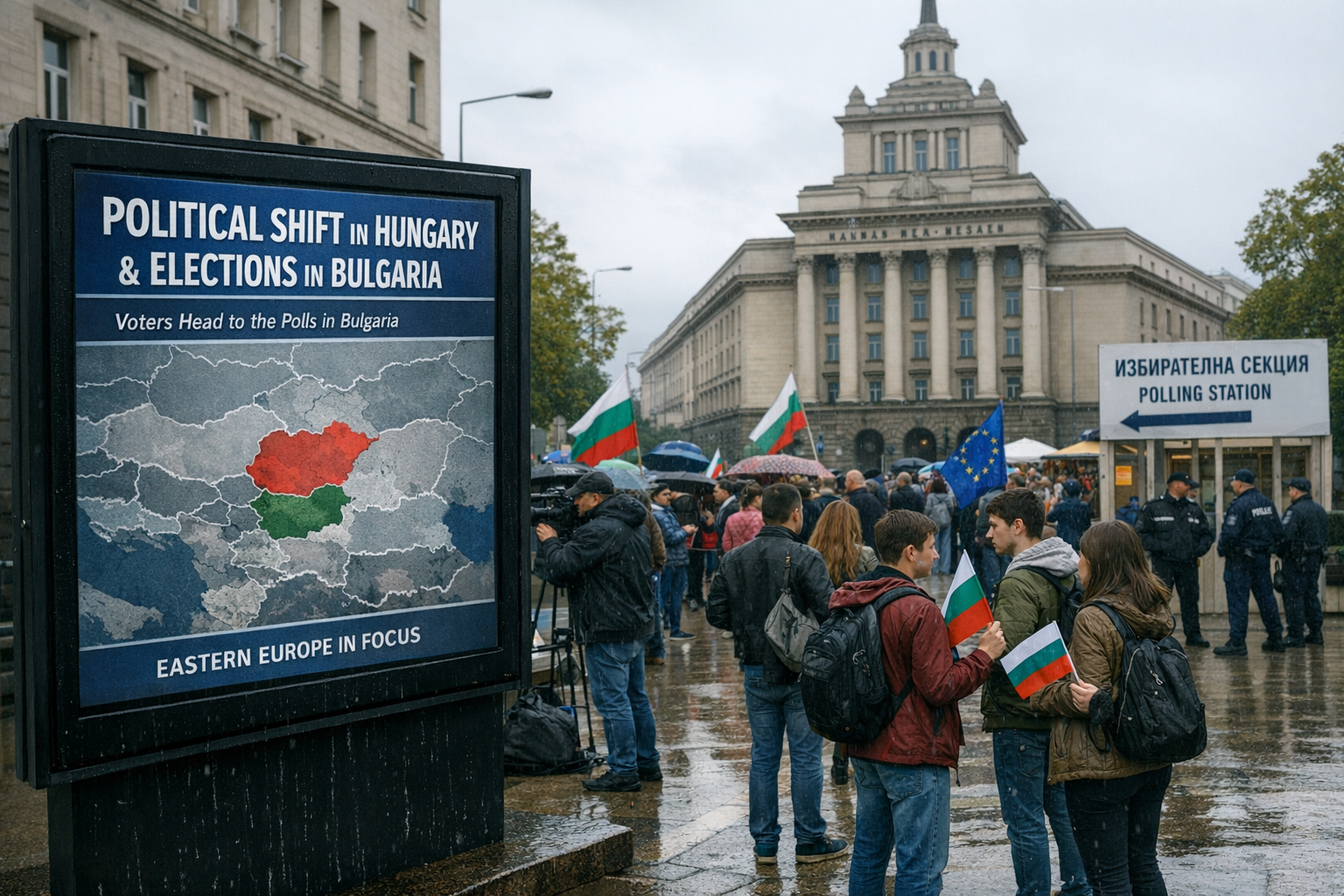
A political jolt in Eastern Europe
The defeat of Viktor Orbán in Hungary and another anti-establishment election in Bulgaria are reshaping political expectations across Eastern Europe, where the region’s direction since Russia’s invasion of Ukraine has often seemed trapped between public anger, institutional paralysis and the pull of Moscow.
In Hungary, the fall of Mr. Orbán after 16 years in power has been greeted in Ukraine with a mix of celebration and caution. In Bulgaria, where voters go to the polls on Saturday for the eighth parliamentary election in five years, many younger citizens are trying once again to turn street protest into political change, even as a pro-Russian current remains potent.
Together, the two moments underscore how unsettled politics remains along the European Union’s eastern flank — and how consequential domestic upheaval in member states can be for Ukraine, for Brussels and for the balance of influence between Europe and Russia.
Ukraine sees an opening in Budapest
For many Ukrainians, Mr. Orbán’s loss was more than a change of government in a neighboring country. It was the possible removal of one of Kyiv’s most difficult voices inside the European Union.
Under Mr. Orbán, Hungary frequently clashed with Ukraine and frustrated its Western partners. He had become one of Europe’s most prominent nationalist leaders and was seen as unusually accommodating toward Moscow, often slowing or complicating E.U. consensus on matters touching Russia and Ukraine. That made Hungary an outlier at a time when most of Europe had moved to harden its posture against the Kremlin.
So when Péter Magyar and his Tisza party won a constitutional supermajority on April 12, ending Mr. Orbán’s long dominance, the response in Ukraine was immediate and emotional. Ukrainians shared jokes, memes and celebratory posts online, treating the result as a symbolic setback not only for Mr. Orbán but also for President Vladimir V. Putin.
The mood was buoyant, but not naïve.
Mr. Magyar has indicated that he wants to improve Hungary’s relations with its allies and lower the temperature with Kyiv. Yet he has also made clear that better ties will depend in part on resolving longstanding disputes over the ethnic Hungarian minority in western Ukraine, an issue that poisoned relations during the Orbán years and is unlikely to disappear simply because power has changed hands in Budapest.
That tension helps explain the tempered optimism now circulating in Kyiv. Ukrainians and European officials alike are asking how far Mr. Magyar will actually go in reversing Orbán-era positions on rule of law, E.U. relations and Ukraine policy. His victory gives him room to act; whether he uses that mandate to pursue a decisive break remains the central question.
The timing is significant. Ukraine is still seeking deeper integration with the European Union, and Hungary under Mr. Orbán had often been viewed as an internal obstacle. A less confrontational government in Budapest could ease one recurring source of friction just as Kyiv tries to sustain Western support through a grinding war.
Mr. Magyar has said the new Hungarian Parliament could convene in early May, potentially beginning a swift transition. For Ukraine, that means the promise of change may soon be tested against governing reality.
Bulgaria’s voters return to the polls — again
To the south, Bulgaria is confronting a different but related drama: a democracy stuck in near-continuous electoral reset.
Saturday’s vote follows the December resignation of Prime Minister Rosen Zhelyazkov’s government after protests over economic policy and what many demonstrators described as another failure to address entrenched corruption. The election is the country’s eighth in five years, an extraordinary cycle that has worn down voters and eroded confidence in mainstream parties.
Into that vacuum has stepped a new anti-establishment alliance led by former President Rumen Radev, who has been running strongly in the polls. His rise reflects both public disgust with the political class and the enduring strength of a Russia-friendlier, more Euroskeptic mood in parts of Bulgarian society.
The contest has also revealed a pronounced generational divide. Younger Bulgarians, many of whom were highly visible in the latest wave of protests, have pushed for cleaner government and a break with the patterns that have left the country mired in revolving-door coalitions. Some have moved directly from demonstrations into politics, campaigning on social media, in public squares and in debates as representatives of a frustrated generation.
But protest energy does not necessarily translate into governable power. Bulgaria’s recent history is full of election results that expressed anger without producing durable majorities. The country has cycled through inconclusive ballots since 2021, with fragmented parliaments and unstable coalitions preventing coherent long-term governance.
That matters well beyond Sofia. Bulgaria is a member of both the European Union and NATO, and it sits on the Black Sea at a moment when the region’s strategic importance has only increased. Another fractured result could prolong instability in a state central to Europe’s southeastern flank. A more decisive anti-establishment breakthrough, meanwhile, could shift the country’s center of gravity in a direction more skeptical of Brussels and more open to Moscow.
A region in transition
The simultaneous upheavals in Hungary and Bulgaria point to a broader political realignment in Eastern Europe, though not one moving neatly in a single direction.
In Hungary, voters have repudiated a leader who came to embody illiberal nationalism within the E.U. In Bulgaria, voters are still searching for a way out of institutional deadlock, with anti-corruption demands colliding with populist and pro-Russian appeals. In both countries, established parties have been weakened by distrust, and new movements are trying to harness public anger into durable change.
For the European Union, the contrast is striking. One problem — Mr. Orbán’s habitual obstruction and his closeness to Moscow — may be easing. Another — chronic instability in Bulgaria and the possibility of a government less aligned with Brussels — may be sharpening.
And for Ukraine, the picture is similarly mixed. Budapest may become less hostile, but Sofia’s direction is uncertain. In a war that has repeatedly shown how much depends on cohesion inside Europe, those shifts matter.
The coming weeks are likely to clarify whether this is the start of a deeper regional turn or simply another phase in Eastern Europe’s unsettled politics. For now, there is relief in Kyiv, apprehension in Brussels and another test at the ballot box in Bulgaria.
Sources
Further reading and reporting used to add context:
- https://apnews.com/article/1a4eb0ba6b94e0c80c3cd18bd36254ab
- https://apnews.com/article/0d81f9786243ebfb94a92c6542777c29
- https://theweek.com/world-news/hungary-orban-ousted-landslide-defeat
- https://en.wikipedia.org/wiki/2026_Hungarian_parliamentary_election
- https://www.aljazeera.com/news/2026/2/18/bulgaria-%25E2%2581%25A0to-hold-snap-parliamentary-election-on-april-19-after-protests
- https://www.newsminimalist.com/articles/bulgarian-election-polls-show-rumen-radevs-party-leading-ahead-of-april-19-vote-d5ba06d2
- https://www.lemonde.fr/en/international/article/2026/04/13/hungary-celebrates-return-to-europe-after-orban-s-crushing-electoral-defeat_6752356_4.html
- https://www.theguardian.com/world/live/2026/apr/12/hungary-election-latest-results-viktor-orban-peter-magyar-fidesz-tisza-russia-europe-live-news-updates?filterKeyEvents=true&page=with%3Ablock-69db727f8f08dd4830774a61
- https://www.reutersconnect.com/item/magyar-says-hungarian-minority-rights-are-key-to-restoring-relations-with-ukraine/dGFnOnJldXRlcnMuY29tLDIwMjY6bmV3c21sX1ZBMjE3MTEzMDQyMDI2UlAx
- https://www.aa.com.tr/en/europe/bulgarias-8th-vote-in-5-years-tests-chances-of-breaking-cycle-of-instability/3910335
- https://www.hungarianconservative.com/articles/politics/orban-hungary-election-2026-politico-brussels-interference-peter-magyar/
- https://en.wikipedia.org/wiki/P%C3%A9ter_Magyar
- https://en.wikipedia.org/wiki/2026_Bulgarian_parliamentary_election
- https://www.vg.no/nyheter/i/7p7my3/petermagyarerklrerseier
- https://www.intellinews.com/radev-leads-polls-as-bulgaria-heads-for-eighth-election-in-five-years-429749/
- https://www.bloomberg.com/news/articles/2026-03-23/magyar-vows-to-oust-orban-s-allies-if-he-wins-hungary-s-election
- https://www.yahoo.com/news/articles/ukraine-summons-hungary-ambassador-over-122653444.html
- https://www.turkiyetoday.com/region/bulgaria-heads-to-8th-election-in-5-years-as-radev-leads-polls-3218268
- https://www.forbes.com/sites/davidkirichenko/2026/04/11/whats-at-stake-in-hungarys-election-for-ukraine-and-russia/
- https://united24media.com/latest-news/ukraine-signals-possible-zelenskyy-magyar-talks-after-hungary-election-shift-17860
- https://ru.wikipedia.org/wiki/%D0%9F%D0%B0%D1%80%D0%BB%D0%B0%D0%BC%D0%B5%D0%BD%D1%82%D1%81%D0%BA%D0%B8%D0%B5_%D0%B2%D1%8B%D0%B1%D0%BE%D1%80%D1%8B_%D0%B2_%D0%91%D0%BE%D0%BB%D0%B3%D0%B0%D1%80%D0%B8%D0%B8_%282026%29
- https://en.wikipedia.org/wiki/2025%E2%80%932026_Bulgarian_protests
- https://apnews.com/article/da341004c87a2e9935c580c42e982efa
- https://www.yahoo.com/news/articles/bulgarias-former-president-radev-registers-140724025.html
- https://www.aljazeera.com/news/2026/4/12/hungary-election-early-results-show-magyars-tisza-ahead-of-orbans-fidesz
- https://www.theguardian.com/world/2025/dec/11/bulgarian-government-resigns-mass-anti-corruption-protests
- https://www.washingtonpost.com/world/2026/04/17/bulgaria-election-radev-borissov-corruption-russia/c29a8e22-3a3d-11f1-90c4-9772c7fabc03_story.html
- https://www.lemonde.fr/en/international/article/2026/04/13/the-eu-related-reforms-awaiting-hungary-s-peter-magyar_6752371_4.html
- https://news.cgtn.com/news/2026-04-13/Orban-ousted-ending-16-year-tenure-as-EU-hails-turning-point-1MjjXZ20V1u/p.html
- https://www.washingtonpost.com/world/2026/04/15/hungary-magyar-orban-new-government-election-tisza/f98e8658-38b8-11f1-90c4-9772c7fabc03_story.html
- https://www.euronews.com/2025/05/11/ukraine-says-hungary-has-suspended-dialogue-with-them-on-minority-rights
- https://malaysia.news.yahoo.com/cannot-ask-country-territory-magyar-153417225.html
- Hungarian Prime Minister Orbán is ejected after 16 years in a European electoral earthquake
- Magyar says Hungarian minority rights are key to restoring relations with Ukraine | Reuters Connect
- Hungary's Orbán says 'complete renewal' needed within his party after election loss