
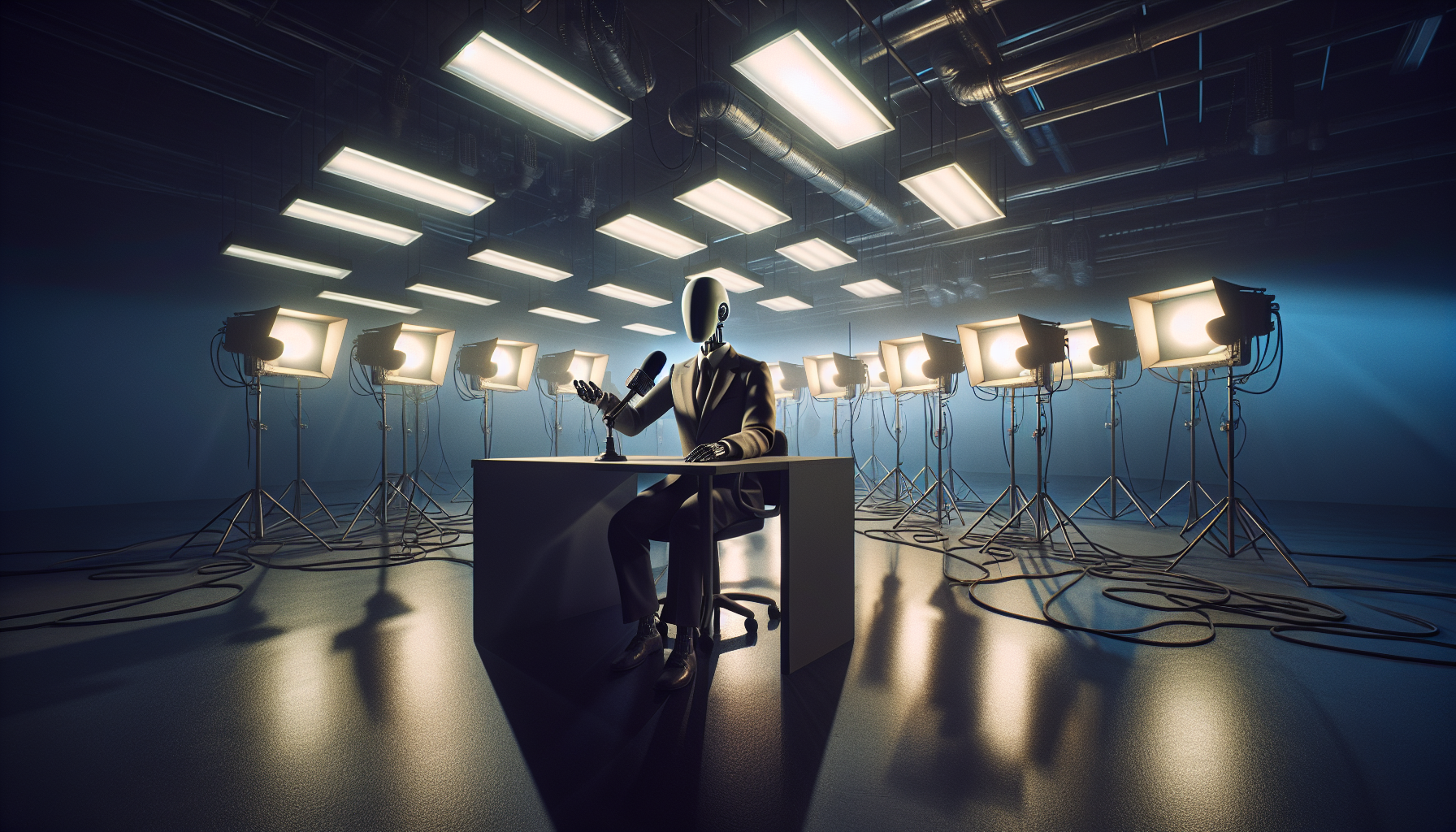
In a moment that blurred the lines between reality and augmented technology, Russian President Vladimir Putin found himself facing an unexpected conversation partner during a live phone-in session on Thursday. A query was posed by what appeared to be an AI-generated version of himself, an entity known colloquially as a “deep fake.”
While the encounter played out in an almost surreal manner, the use of artificial intelligence in a public forum brought to the fore issues about the technology’s future role in global politics. This particular live phone-in is an annual event, where Putin fields a diverse range of questions from Russian citizens. However, the intervention by an AI injected an avant-garde element into the proceedings this time around.
The AI seemed to mimic Putin’s own voice and replicated his distinctive style of speech to an uncannily accurate degree. The unexpected interaction left many wondering about the direction in which technology and artificial intelligence are proceeding. Who programmed it? How did it manage to get an audience with the Russian president during a public event? These are questions that remain unanswered as observers worldwide continue to grapple with this rare juncture of technological advancement and global politics.
The question fielded by this digital Putin replica underscored the profound capabilities of AI technology. It also brought to light the potential implications of its use in domains as significant as national governance, security, and diplomacy where authenticity and trust are paramount. The accuracy of the AI’s rendition of Putin prompted further considerations about the potential misuse of such technology, including for disinformation campaigns, identity theft, and deep fake propaganda.
While some may dismiss this as a technological fad, experts warn that the Putin deep-fake event should be viewed as an early sign of the powerful impact AI has on socio-political ecosystems. As AI continues to grow and develop in sophistication, it becomes increasingly incumbent upon global leaders, policymakers, and technology companies to ensure its ethical use.
Yet, as disconcerting as these developments may be, they are an inescapable reality of our era. And perhaps, this event goes beyond being simply a technological feat; it can be viewed as a sort of digital mirror held up to society, prompting questions about our relationship with technology, our understanding of the truth, and ultimately, our very own identities.
The Putin phone-in is one of many recent examples that demonstrate technology’s influence and storage power. Understanding these implications requires grappling with complex ethical quandaries and redrawing the boundaries of what we know as ‘real’. At a time when deep fakes are becoming increasingly accessible and sophisticated, the need for robust regulation grows ever more urgent. Meanwhile, the image of Putin conversing with his digital doppelganger might just become an enduring symbol of this technologically charged era.