
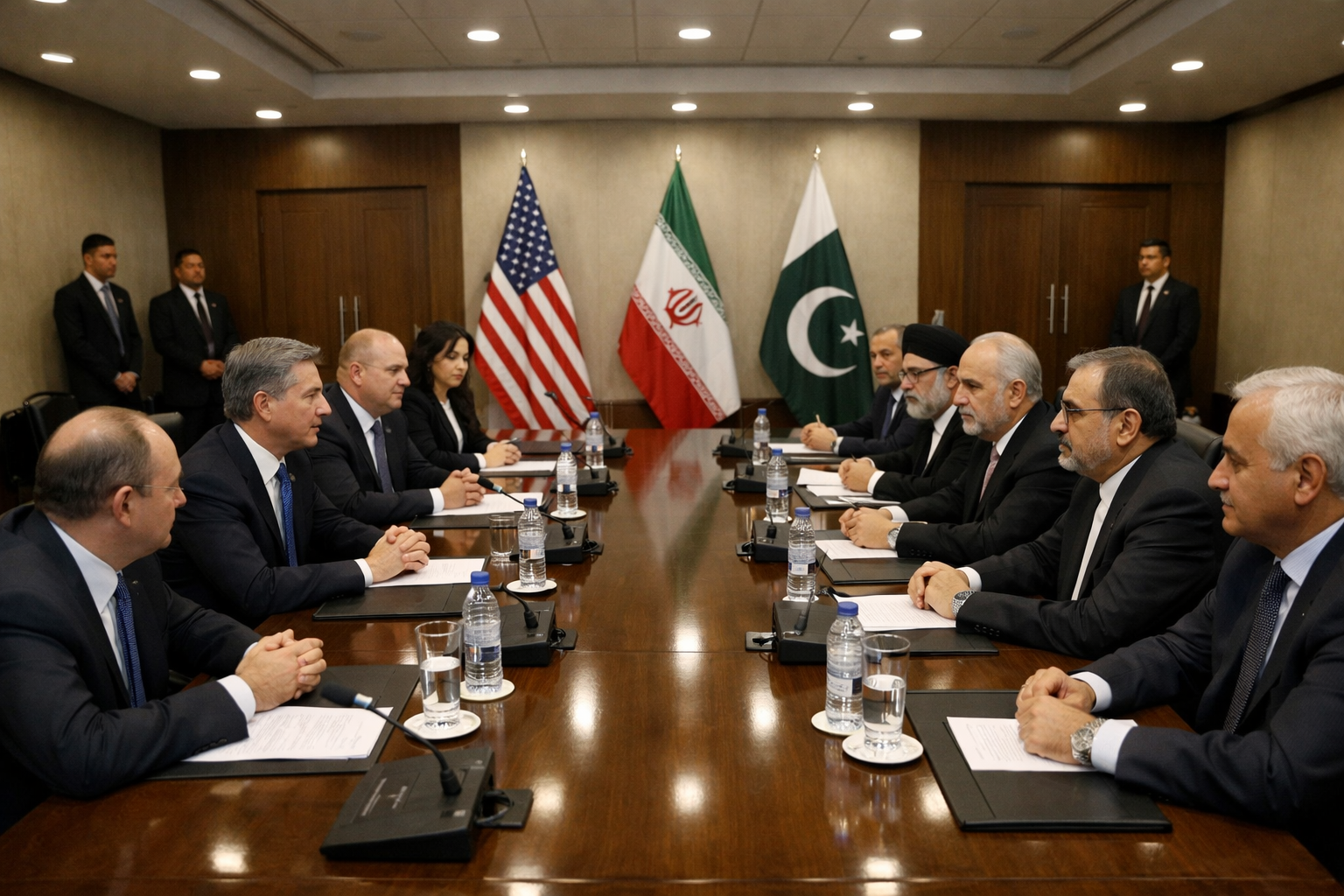
A Rare Direct Encounter Opens in Islamabad
American and Iranian delegations arrived in Islamabad on Saturday for direct talks that both sides are portraying as a chance to convert a shaky two-week ceasefire into something more durable, even as fresh strains across the region threaten to overwhelm the effort before it properly begins.
The American delegation is being led by Vice President JD Vance, while Iran has sent one of its most senior political teams, headed by Parliament Speaker Mohammad Bagher Qalibaf and joined by Foreign Minister Abbas Araghchi. Pakistani officials are hosting and facilitating the meeting, placing Islamabad at the center of one of the most delicate diplomatic episodes in the Middle East in years.
The encounter is remarkable not only for its timing but for its rank. By several accounts, it amounts to the highest-level direct contact between Washington and Tehran since Iran’s 1979 revolution severed formal relations and transformed the countries into entrenched adversaries. That fact alone underscores both the gravity of the crisis and the narrowness of the path now before them.
The talks begin with the ceasefire already under visible pressure. Tehran has accused Israel of violating the truce through continued attacks on Hezbollah targets in Lebanon, raising the possibility that events outside the negotiating room could determine the fate of the negotiations inside it.
A Ceasefire Under Pressure
The diplomacy in Islamabad follows weeks of war and a Pakistan-mediated cessation of hostilities that, while holding in formal terms, has not brought genuine calm. Iranian officials have publicly linked progress in the talks to an Israeli halt to military action in Lebanon and to the release of blocked Iranian assets. American officials, for their part, have said they are prepared to negotiate if Tehran demonstrates what they call good faith.
That leaves the two sides entering the room with demands that are not easily reconciled. Iran is signaling that it sees little reason to make early concessions while attacks linked to the broader conflict continue. The United States is under pressure to show that direct engagement can produce tangible results without rewarding escalation.
The immediate question is whether the talks can move beyond these opening conditions and into substantive bargaining. Diplomacy between Washington and Tehran has often foundered on exactly this point: each side insists it is ready for serious negotiation, but only after the other has first changed its behavior.
In Islamabad, the problem is more acute because the conflict has generated facts on the ground that neither side can ignore. The ceasefire is not a settled peace but a pause surrounded by active flash points. Any renewed violence in Lebanon, or at sea, could quickly harden positions and shrink the room for compromise.
Hormuz and the Global Stakes
What is at stake extends far beyond the immediate military confrontation. The talks are unfolding under intense pressure around the Strait of Hormuz, the narrow waterway through which a significant share of the world’s oil and liquefied natural gas passes. Disruption there has rattled energy markets and revived fears of a broader economic shock.
That gives the negotiations a significance not only for regional security but for the global economy. Shipping instability in Hormuz can send oil prices higher, unsettle supply chains and inject fresh volatility into inflation-weary economies far from the Gulf. Even a limited agreement that reduced the risk of confrontation at sea would be watched closely in financial capitals as much as in Middle Eastern ones.
For Washington, reopening or stabilizing transit through Hormuz has become an urgent strategic and economic priority. For Tehran, the waterway has also become a source of leverage, a reminder that Iran can impose costs far beyond the battlefield. That asymmetry helps explain the unusually high-level American representation at the talks, and the unusual sense that the United States is entering them under pressure.
Vance’s Difficult Assignment
For Mr. Vance, the meeting is an extraordinary test. He has long been identified with skepticism toward new American military entanglements in the Middle East, a position that gave him political distinction at home but offers little obvious advantage in talks with Iranian negotiators who may conclude that Washington is eager above all to avoid a wider war.
That perception matters. Negotiations of this sort turn not only on military realities and formal demands, but on each side’s reading of the other’s political constraints. Tehran appears to believe that its position has strengthened — by surviving weeks of pressure, by exploiting the vulnerability of maritime trade, and by watching divisions emerge among its adversaries over how far to push the conflict.
The vice president’s mission, then, is doubly difficult: he must convince Iran that the United States is serious about a diplomatic settlement, while also persuading Iranian officials that Washington retains enough leverage to make refusal costly. If he appears too eager for a deal, Tehran may hold out for more. If he appears too rigid, the ceasefire could collapse.
Why Pakistan, and Why Now
Pakistan’s role as host reflects its emergence, at least for this moment, as a rare intermediary acceptable to both sides. The earlier ceasefire that Islamabad helped broker gave it credibility, and its location offers a politically useful distance from the more familiar capitals of Middle East diplomacy.
The urgency is obvious. The longer the current uncertainty persists, the greater the risk that local incidents will trigger a return to open confrontation. Continued Israeli strikes in Lebanon have already complicated the atmosphere. Iran’s insistence on linking the talks to developments there suggests that the negotiations cannot be insulated from the wider regional war, however much diplomats may wish otherwise.
This is why the Islamabad talks matter now. They are not merely an attempt to tidy up the aftermath of a ceasefire. They are a test of whether a conflict that has already spilled across borders and threatened one of the world’s most critical energy chokepoints can still be contained through negotiation.
A Narrow Opening
No one appears to be expecting a sweeping breakthrough. The more realistic objective is to prevent deterioration: to keep the ceasefire from unraveling, to establish a channel for sustained high-level contact, and perhaps to sketch the outlines of a broader arrangement that could address military tensions, economic pressure and maritime security together.
But even that would be significant. For nearly half a century, direct American-Iranian diplomacy at this level has been the exception, not the rule. The very fact of these talks reflects how dangerous the crisis has become — and how costly failure could be.
As negotiators gather in Islamabad, the central uncertainty is whether both governments have arrived because they are ready to compromise, or because each believes time is on its side. The answer may determine not only the fate of the ceasefire, but whether a regional confrontation can be prevented from becoming something much larger.
Sources
Further reading and reporting used to add context:
- https://apnews.com/article/00bf6d9a8f19565dbcd437bc6bf09ea0
- https://apnews.com/article/2be904aee3f804892336730279e054b9
- https://www.thedailybeast.com/jd-vance-issues-stark-warning-for-iran-ahead-of-peace-talks/
- https://www.axios.com/2026/04/10/vance-iran-talks-pakistan
- https://apnews.com/article/b82625fd24adb2336a5a9615b6953629
- https://www.washingtonpost.com/world/2026/04/11/iran-us-israel-trump-lebanon-april-11-2026/4045f34a-355f-11f1-b85b-2cd751275c1d_story.html
- https://www.pakistantoday.com.pk/2026/04/09/islamabad-prepares-for-high-level-us-iran-negotiations-after-ceasefire/
- https://www.ndtv.com/world-news/us-iran-talks-live-news-pakistan-f-16s-escort-jd-vances-aircraft-as-he-arrives-in-islamabad-for-iran-talks-11342470
- https://www.pbs.org/video/war-wih-iran-sot-1775853686/
- https://www.newsmax.com/world/globaltalk/iran-pakistan-jd-vance/2026/04/10/id/1252544/
- https://www.china.org.cn/world/Off_the_Wire/2026-04/08/content_118425722.shtml
- https://www.theguardian.com/world/live/2026/apr/08/iran-war-ceasefire-live-updates-trump-deadline-middle-east-crisis-latest-news?page=with%3Ablock-69d6b9498f0892bae50d7aee
- https://www.pakistantoday.com.pk/2026/04/09/rawalpindi-declares-two-day-public-holiday-ahead-of-us-iran-talks/
- https://www.theguardian.com/p/x4nt2g
- https://www.dawn.com/news/1990461/iranian-delegation-touches-down-as-vance-en-route-for-islamabad-talks
- https://en.wikipedia.org/wiki/Islamabad_Talks
- https://en.cibercuba.com/noticias/2026-04-08-u1-e208574-s27061-nid325352-vicepresidente-eeuu-estara-al-frente-conversaciones
- https://www.bostonglobe.com/2026/04/11/nation/vance-arrives-in-pakistan-as-us-iran-peace-talks-set-to-kick-off/
- https://www.thedailybeast.com/trump-issues-deranged-new-threat-to-iran-amid-peace-talks/
- https://www.euronews.com/2026/04/10/jd-vance-warns-iran-not-to-play-us-during-planned-talks-in-pakistan
- https://www.washingtonpost.com/politics/2026/04/10/iran-us-negotiations-vance-trump/1ac304d2-3492-11f1-b85b-2cd751275c1d_story.html
- https://www.theguardian.com/world/2026/apr/10/jd-vance-warns-iran-against-trying-to-play-the-us-in-peace-talks/
- https://en.people.cn/n3/2026/0411/c90000-20445605.html
- https://www.tbsnews.net/world/vance-warns-iran-not-play-us-he-leaves-talks-1408151
- https://www.al-monitor.com/originals/2026/04/vance-warns-iran-not-play-us-talks-pakistan
- https://www.theguardian.com/world/live/2026/apr/11/middle-east-crisis-live-iranian-officials-arrive-in-islamabad-for-conditional-peace-talks-with-us?page=with%3Ablock-69d9f39b8f08dd4830774280
- https://www.euronews.com/video/2026/04/10/jd-vance-warns-iran-not-to-play-us-during-planned-talks-in-pakistan
- https://www.daily-sun.com/world/868068/vance-warns-iran-not-to-play-us-as-he-leaves-for-talks
- https://www.bostonglobe.com/2026/04/10/nation/iran-us-vance-cease-fire-talks/
- https://www.theguardian.com/world/live/2026/apr/10/iran-war-live-updates-trump-ceasefire-strait-hormuz-israel-lebanon-hezbollah?page=with%3Ablock-69d8b3e28f08dd4830773807
- https://en.wikipedia.org/wiki/2026_Iran_war_ceasefire
- https://en.wikipedia.org/wiki/2025%E2%80%932026_Iran%E2%80%93United_States_negotiations
- The Latest: Vance arrives in Pakistan for talks with Iranian officials to shore up shaky ceasefire
- Vance warns Iran not to 'play' the US as he departs for negotiations aimed at ending the war
- US and Iranian officials arrive in Pakistan for peace talks