
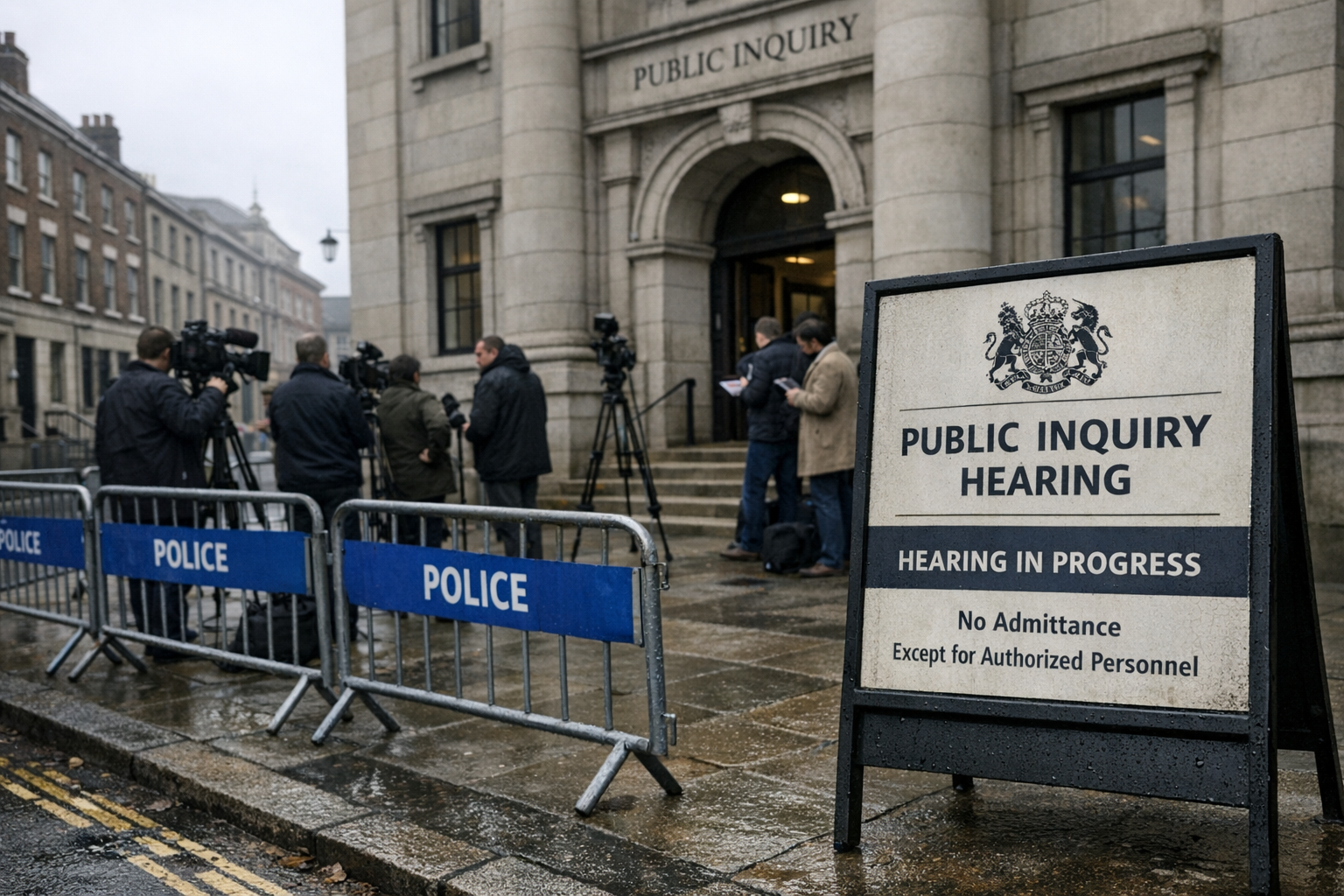
Inquiry Finds Southport Killings Could Have Been Prevented
A public inquiry into the mass killing of three young girls at a dance class in Southport concluded on Monday that the attack was both foreseeable and avoidable, the result of years of missed warnings, poor information sharing and what its chair described as “catastrophic” failures across public agencies and within the killer’s home.
The report, the first phase of a statutory inquiry into the July 29, 2024, attack, said the state had been alerted to the danger posed by Axel Rudakubana when he was 13, yet no single institution took responsibility for managing the risk he posed. Sir Adrian Fulford, the inquiry’s chair, said violent behavior had been “unambiguously signposted over many years,” but agencies repeatedly passed responsibility among themselves in what he called an “inappropriate merry-go-round.”
The report also assigned blame to Rudakubana’s parents, describing their role as irresponsible and harmful and concluding that significant parental failures formed part of the chain of events that led to the killings.
The findings represent one of the starkest official judgments yet in Britain on how institutions failed to stop a known high-risk young person from committing mass violence.
Years of Warning Signs
The inquiry said Rudakubana had been known to authorities since October 2019, when Childline passed on reports that he had spoken of murderous thoughts about a fellow pupil and said he had taken a kitchen knife to school on 10 occasions.
Two months later, according to the findings, he returned to school armed with a hockey stick and attacked another student, breaking the pupil’s wrist. Police later found a knife in his backpack and arrested him on suspicion of assault and possessing a bladed article.
Yet despite those episodes and later signs of escalating risk, the inquiry found that authorities failed to form a coherent picture of the threat. Instead, information was fragmented across policing, education, health, social care and youth justice agencies. Key details were not effectively shared, the report said, and troubling behavior was too often interpreted primarily through the lens of Rudakubana’s autism rather than as evidence of serious and mounting danger.
The inquiry identified five central failures: no lead agency took ownership of the case; information sharing was inadequate; dangerous conduct was misread; online behavior was not meaningfully investigated; and parental failings were significant.
The Attack and Its Aftermath
The Southport attack shocked Britain. Rudakubana killed Alice da Silva Aguiar, Elsie Dot Stancombe and Bebe King during a Taylor Swift-themed dance workshop, turning what should have been a children’s summer activity into one of the country’s most traumatic acts of violence in recent years.
He later pleaded guilty, and in January 2025 was sentenced to a minimum of 52 years in prison.
The government then established the inquiry in two phases: the first to determine how the attack happened and what went wrong, and the second to examine broader questions about how young people become drawn into extreme violence.
Monday’s report is therefore more than a reconstruction of institutional mistakes. It is a formal assignment of accountability, extending responsibility beyond the perpetrator and onto the systems that encountered him repeatedly and failed to act decisively.
Pressure for Reform
The report is likely to intensify pressure on the British government to move quickly on reforms that officials, police and safeguarding bodies have debated for years but often applied unevenly. Among the recommendations under discussion are creating a single lead structure for managing high-risk children and young people, improving multi-agency risk assessment tools and strengthening monitoring of dangerous online activity and suspicious purchases.
The findings are also expected to renew scrutiny of online sales of knives, machetes and other weapons, an area of mounting concern in Britain after a series of attacks involving young perpetrators and easily obtainable bladed weapons. The inquiry’s first phase sharpened questions about whether existing safeguards around internet platforms, retailers and delivery systems are sufficient when warning signs have already been identified.
For ministers, the challenge now is not simply to accept the inquiry’s conclusions but to decide who, in practice, will be responsible the next time a child or teenager presents a similarly disturbing pattern of threats, weapon possession and violence. That unresolved question sits at the heart of the report.
What Comes Next
Phase 2 of the inquiry is expected to examine wider structural issues, including the internet’s role in exposing vulnerable or violent-minded young people to harmful material, as well as whether tougher restrictions are needed on online weapons sales and detection of suspicious buying patterns.
It may also open the door to further regulatory, disciplinary or even criminal scrutiny of institutions and individuals whose actions are now under sharper examination.
For the families of the three girls, the report provides an official answer to a devastating question: not only how the attack happened, but whether it could have been stopped. The inquiry’s answer was unequivocal. It could have been.
Sources
Further reading and reporting used to add context:
- https://www.southport.public-inquiry.uk/news/
- https://www.theguardian.com/uk-news/2025/nov/07/southport-inquiry-atrocity-preventable-analysis
- https://www.theguardian.com/uk-news/2025/jan/20/yvette-cooper-announces-public-inquiry-into-southport-attack
- https://www.lemonde.fr/en/international/article/2025/01/21/in-the-uk-keir-starmer-launches-a-public-inquiry-into-the-southport-tragedy_6737268_4.html
- https://apnews.com/article/59163534d726b88eb86b1c63039077f7
- https://www.theguardian.com/uk-news/2025/jul/08/southport-inquiry-to-examine-wholesale-failure-to-prevent-attack
- https://www.standard.co.uk/news/crime/axel-rudakubana-southport-banks-lancashire-taylor-swift-b1255276.html
- https://www.southport.public-inquiry.uk/faqs/
- https://www.reddit.com/r/ukpolitics/comments/1sk7jqn/southport_attack_blamed_on_catastrophic_failures/
- https://modgov.sefton.gov.uk/documents/s134350/Southport%20Recovery%20Cabinet%20050226%20Final%20Version.pdf
- https://www.reddit.com/r/masskillers/comments/1sk7qqp/southport_killers_family_and_authorities_could/
- https://evrimagaci.org/gpt/southport-inquiry-reveals-systemic-failures-before-child-murders-500871
- https://www.lawyer-monthly.com/2025/11/southport-killer-parents-police-review-inquiry-2025/
- https://www.brabners.com/insights/regulatory/southport-murders-inquiry-process-legal-duties-and-policy-implications-explained
- https://www.gov.uk/government/publications/grenfell-tower-inquiry-government-annual-report-february-2026/annual-report-february-2026-response-and-recovery
- https://expose-news.com/2025/09/19/southport-public-inquiry/
- https://assets.publishing.service.gov.uk/media/68907502486754ec2887839f/Lessons_for_Prevent_13_July.pdf
- https://www.reddit.com/r/unitedkingdom/comments/1sk7ite/southport_attack_blamed_on_catastrophic_failures/
- https://www.southport.public-inquiry.uk/updates/
- https://publications.parliament.uk/pa/cm5901/cmselect/cmhaff/1642/report.html
- https://www.reddit.com/r/Southport/comments/14ihguw
- https://www.spotlightpa.org/news/2025/08/medical-child-abuse-investigation-keystone-forum-pennsylvania-caregiving/
- https://www.reddit.com/r/SkilledWorkerVisaUK/comments/1rsp3p9/home_affairs_committee_response_to_the_proposed/
- https://www.pahouse.com/files/Documents/2026-01-27_111303__1.28.26_Judiciary_voting_meeting_agenda_and_packet.pdf
- https://www.theguardian.com/world/2025/nov/11/tuesday-briefing-what-the-bbcs-new-crisis-reveals-about-its-failures-and-future
- https://news.sky.com/story/southport-inquiry-latest-killers-mum-profoundly-sorry-for-failure-13463298
- https://www.reddit.com/r/SkilledWorkerVisaUK/comments/1rsp3r0/home_affairs_committees_report_earned_settlement/
- https://southport-prod.s3.eu-west-2.amazonaws.com/2025/07/Southport-Inquiry-8-July-2025-Day-1.pdf
- https://southport-prod.s3.eu-west-2.amazonaws.com/2025/10/Southport-Management-Statement.pdf
- https://www.mediaborough.com/CivicAlerts.aspx?ARC=L&CC=2&From=AID%3D254&ItemID=254&What=2
- https://southport-prod.s3.eu-west-2.amazonaws.com/2025/10/Southport-Inquiry-14-October-2025-Day-23.pdf
- https://www.reddit.com/r/LabourUK/comments/1iaxs3w
- https://www.westmorelandcountypa.gov/CivicAlerts.aspx
- https://news.sky.com/story/what-weve-learned-from-the-southport-inquiry-victims-failed-at-every-possible-turn-13465899
- https://www.reddit.com/r/realbbcnews/comments/1luhh6i
- https://www.abingtonpa.gov/CivicAlerts.aspx
- https://www.reddit.com/r/realbbcnews/comments/1luidjv
- https://www.gov.uk/government/news/inquiry-into-the-southport-attack-begins-today
- https://ca.shop.bbc.com/pages/contact-us
- https://www.gov.uk/government/news/home-secretary-on-sentencing-at-liverpool-crown-court
- https://help.bbc.com/hc/
- https://www.gov.uk/government/speeches/southport-perpetrator-prevent-learning-review
- https://www.gov.uk/government/speeches/southport-attack-next-steps
- https://www.sefton.gov.uk/mysefton-news/latest-news/council-cabinet-approves-report-on-response-to-tragic-events-in-southport/
- https://help.bbc.com/hc/en-us/articles/42652680528659-Update-on-access-to-BBC-Sounds-outside-the-UK
- https://staff.bbc.com/
- https://help.bbc.com/hc/en-us/articles/42655683267091-Information-on-Closure-of-BBC-Sounds
- https://help.bbc.com/hc/en-us/articles/45794722976531-Why-do-I-need-JavaScript-and-how-do-I-enable-it
- https://webportal.ribblevalley.gov.uk/planx_downloads/Appeal_Start_Letter.pdf
- https://nsip-documents.planninginspectorate.gov.uk/published-documents/EN010121-000201-4.1.3%20Consultation%20Report%20Appendices%20Part%203%20%28E%20to%20H%29.pdf
- https://www.kent.gov.uk/__data/assets/pdf_file/0019/6184/Community-safety-agreement.pdf
- https://assets.publishing.service.gov.uk/government/uploads/system/uploads/attachment_data/file/684678/GOVERNMENT_RESPONSE_TO_THE_CONSULTATION_ON_THE_LEVESON_INQUIRY_AND_ITS_IMPLEMENTATION_.pdf
- https://www.secouncils.gov.uk/media/2025/06/SEC-APPG-Migration-Inquiry-Report-digital.pdf
- https://www.theguardian.com/uk-news/2025/jan/23/southport-attacker-axel-rudakubana-jailed
- https://www.abc.net.au/news/2025-01-24/southport-stabbing-rudakubana-jailed-for-52-years/104847078
- https://www.itv.com/news/granada/2025-01-23/southport-murderer-axel-rudakubana-jailed-for-51-years
- https://www.theguardian.com/uk-news/live/2025/jan/23/southport-attacks-axel-rudakubana-sentenced-over-murder-of-three-girls
- https://www.the-independent.com/news/uk/crime/axel-rudakubana-life-sentence-southport-attack-b2684239.html
- https://apnews.com/article/c03e5ab59cd2e2f5baf849710c9d6b3d
- https://apnews.com/article/5cd9275eebfba023ed8d2925898e5755
- https://www.theguardian.com/uk-news/2025/jan/20/southport-attacker-axel-rudakubana-admits-murdering-three-girls
- https://www.aljazeera.com/news/2025/1/23/uk-teen-who-killed-three-girls-at-dance-class-sentenced-to-52-years
- https://www.yahoo.com/news/southport-stabbing-everything-know-attack-133950234.html
- https://www.upi.com/Top_News/World-News/2025/01/24/southport-child-killer-receives-52-year-sentence/8861737710373/
- https://english.news.cn/europe/20250124/86049f550ebf4e1d9af6d712334b5764/c.html
- https://www.theguardian.com/uk-news/2025/mar/13/decision-not-to-classify-southport-killer-as-a-terrorist-was-right-says-uk-watchdog
- Report – Southport
- Southport Inquiry Report – Volume 1
- Teen who killed 3 girls at Taylor Swift-themed dance class in England sentenced to over 50 years