
Europe’s New Security Era Takes Shape on the Eastern Flank
Europe’s security order is being remade not by a single summit or declaration, but by the cumulative pressure of war, politics and money.
New figures published Monday by the Stockholm International Peace Research Institute showed that global military spending climbed to a record $2.887 trillion in 2025, the 11th consecutive annual increase. A major force behind that rise was Europe, where governments have accelerated rearmament at a pace not seen since the end of the Cold War.
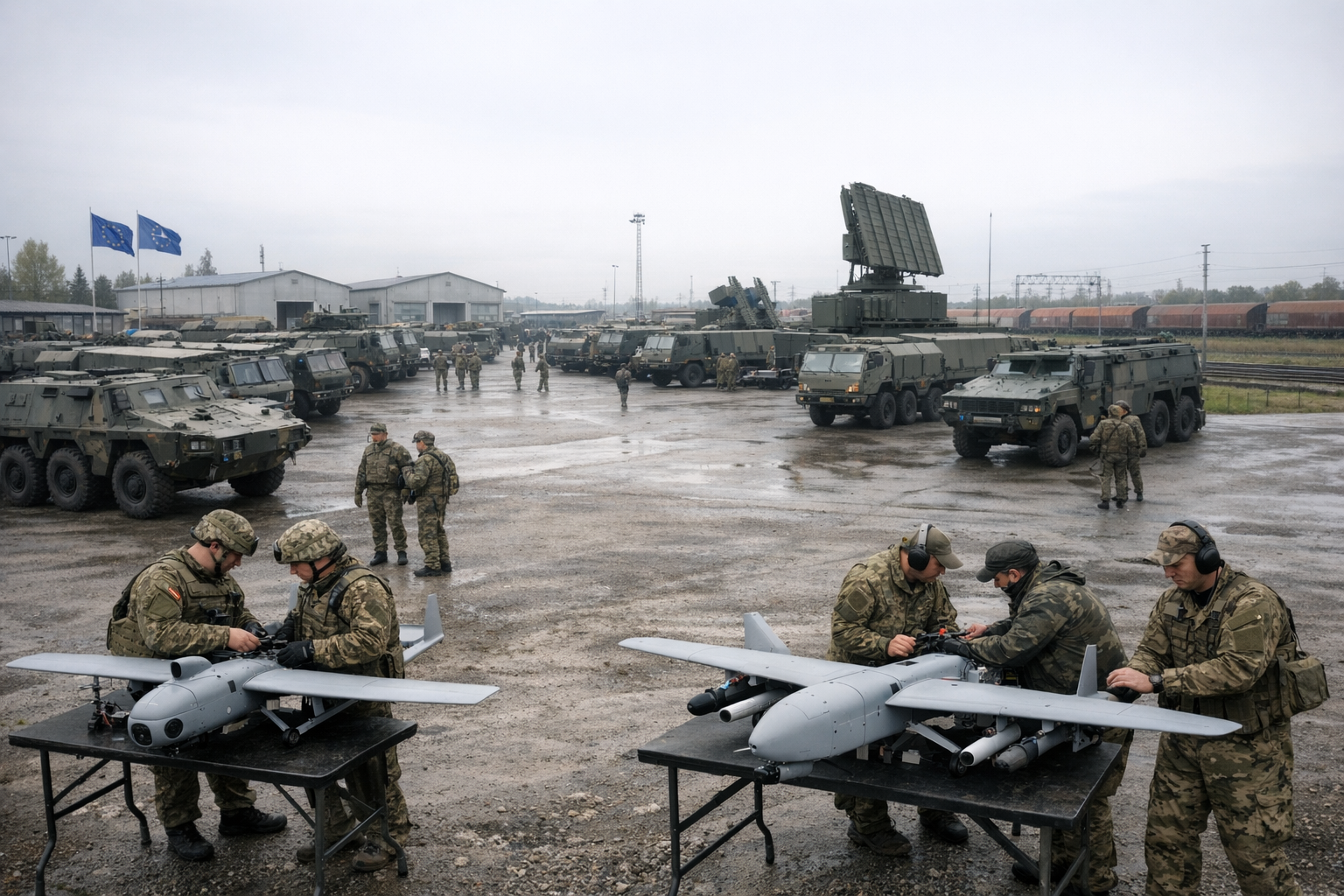
On the same day, Prime Minister Donald Tusk of Poland said his country wanted to build a “drone armada,” explicitly drawing on Ukraine’s battlefield experience in repelling Russian attacks. And in Hungary, after the defeat this month of Viktor Orbán, one of Europe’s most Russia-friendly leaders, reports emerged that figures tied to his circle were shifting assets abroad as they braced for scrutiny from the incoming government of Péter Magyar.
Taken together, the developments point to a broader transformation in Eastern and Central Europe: a region once defined by post-Cold War demilitarization and political hedging is moving toward heavier spending, faster procurement and a more confrontational posture toward Russia.
Rearmament Accelerates as U.S. Commitment Is Questioned
SIPRI said military spending in Central and Western Europe recorded its sharpest annual growth since the Cold War’s end, a sign that governments are no longer treating the war in Ukraine as a temporary crisis. Instead, many appear to be planning for a prolonged period of insecurity on Europe’s eastern border.
That shift comes as doubts deepen about the durability of American engagement. While the United States remained by far the world’s largest military spender, SIPRI reported that U.S. military expenditure declined in 2025. For European officials, that has sharpened an argument that the continent can no longer rely as heavily on Washington for deterrence, weapons stocks and industrial surge capacity.
The European Union has begun trying to institutionalize that response. Its Readiness 2030 agenda and the SAFE loan instrument are designed to channel much larger sums into joint procurement, with up to €150 billion in loans and a wider ambition to unlock more than €800 billion in defense spending. The aim is not only to spend more, but to spend together — and faster.
But the urgency is colliding with familiar constraints. Europe has pledged more on paper than its defense industries can always produce quickly, particularly in munitions, air defense systems and drones.
Poland Looks to Ukraine’s War for the Future of Its Own Defense
If Europe’s spending surge provides the scale of the shift, Poland offers perhaps its clearest expression.
Speaking in Rzeszów at a conference on Ukraine’s reconstruction, Mr. Tusk said Warsaw intended to build a “drone armada” with support from Ukrainian technical and practical experience. He said the war had created an unexpected technological leap, one that Poland, Ukraine and Europe should use to protect themselves from air attack.
His remarks reflected how deeply Ukraine’s war has changed military thinking along NATO’s eastern flank. Cheap drones, loitering munitions and layered air defense have become central to modern combat, often proving as important as tanks and artillery in shaping the battlefield.
The lesson has been reinforced in real time. Fresh Russian attacks on and around Odesa on Monday injured civilians, another reminder for countries near the conflict that air defense is no longer an abstract planning concept but a daily requirement.
Poland has already emerged as one of Europe’s most ambitious military spenders and a critical logistics hub for aid to Ukraine. Its effort to tie future defense planning directly to Ukrainian battlefield know-how suggests that the war is not only draining Europe’s arsenals, but rewriting its doctrine.
Still, many details of Mr. Tusk’s proposal remain unclear. Public reporting has yet to establish the scale, funding or timeline of the drone project, or whether it would rely mainly on domestic production, joint manufacturing with Ukraine, or a mix of both. Those questions matter because Europe’s problem is no longer simply recognizing what it needs, but building it in usable numbers.
Hungary’s Political Upheaval Could Alter Europe’s Internal Balance
The regional shift is not only military. It is political.
After Hungary’s April 12 election, in which Mr. Orbán was defeated after 16 years in power, reports indicated that associates of the outgoing prime minister had begun moving wealth abroad. According to those accounts, some were seeking to shield assets from possible investigation by Mr. Magyar’s incoming government, while others explored foreign residency or work options.
The full scale of any transfers remains uncertain, and much of the reporting relies on investigative claims and unnamed sources. But even the perception of a hurried financial exit underscores the significance of the political change in Budapest.
For years, Hungary occupied an anomalous place inside the European Union and NATO: formally part of the Western alliance, yet often obstructive on Ukraine and comparatively accommodating toward Moscow. A post-Orbán government could change that balance, removing one of the most persistent internal brakes on a harder European line against Russia.
That possibility gives the Hungarian transition significance beyond domestic anti-corruption politics. At a moment when the rest of Europe is hardening its security posture, Budapest may be moving — unevenly and with uncertainty — back toward the continental mainstream.
A Continent Moves From Shock to Structure
Four years into Russia’s full-scale war, Europe is shifting from emergency response to strategic redesign.
The increase in military spending, the embrace of Ukrainian battlefield lessons and the political weakening of one of Moscow’s closest partners inside the E.U. all suggest the same trend: Europe is trying to turn the trauma of the war into a more durable defense posture.
Whether it can do so fast enough is still an open question. Budgets can rise more quickly than factories can expand. Political declarations can outpace procurement. And Europe’s effort to build greater autonomy remains inseparable from the uncertainty of American policy.
But the direction of travel is now unmistakable. On Europe’s eastern flank, defense is no longer being treated as a peace dividend deferred. It is becoming the organizing principle of a new era.
Sources
Further reading and reporting used to add context:
- https://www.sipri.org/media/press-release/2026/global-military-spending-rise-continues-european-and-asian-expenditures-surge
- https://www.theguardian.com/world/2026/apr/26/viktor-orban-associates-wealth-hungary-election
- https://www.aljazeera.com/news/2026/4/12/hungary-election-early-results-show-magyars-tisza-ahead-of-orbans-fidesz
- https://www.bloomberg.com/news/articles/2026-04-25/hungary-s-next-premier-warns-investors-to-shun-orban-tied-assets?srnd=homepage-americas
- https://en.wikipedia.org/wiki/2026_Hungarian_parliamentary_election
- https://elpais.com/expres/2026-04-13/peter-magyar-derrota-a-orban-y-pone-fin-a-16-anos-de-gobierno-ultranacionalista-en-hungria.html
- https://www.sipri.org/yearbook/2025/03
- https://www.svd.se/a/43OmbR/rostningen-over-nu-vantar-drama-i-ungern
- https://www.sipri.org/media/newsletter/2026-march
- https://www.lemonde.fr/en/international/article/2026/04/24/the-political-left-is-disappearing-across-central-europe-despite-orban-s-defeat-in-hungary_6752779_4.html
- https://cadenaser.com/nacional/2026/04/12/peter-magyar-pone-fin-a-16-anos-de-gobierno-de-orban-gana-las-presidenciales-y-abre-un-nuevo-horizonte-politico-en-hungria-cadena-ser/
- https://www.pbs.org/newshour/world/hungarian-prime-minister-viktor-orban-concedes-defeat-after-painful-election-result-ending-16-years-in-power
- https://www.huffingtonpost.es/politica/elecciones-hungria-f202604.html
- https://www.wsws.org/en/articles/2026/04/14/mlbn-a14.html
- https://www.aljazeera.com/news/2026/4/13/who-is-peter-magyar-hungarys-new-leader-who-trounced-viktor-orban
- https://en.wikipedia.org/wiki/List_of_members_of_the_National_Assembly_of_Hungary_%282026%E2%80%932030%29
- https://www.washingtonpost.com/world/2026/04/13/hungary-orban-magyar-celebration-transition/
- https://www.turkiyetoday.com/opinion/after-16-years-of-orban-decoding-peter-magyars-historic-victory-in-hungary-3217990
- https://www.cbsnews.com/amp/news/hungary-general-election-viktor-orban-peter-magyar-results/
- https://en.wikipedia.org/wiki/Viktor_Orb%C3%A1n
- https://en.wikipedia.org/wiki/OSIRIS_UEB-1
- https://www.reutersconnect.com/item/polish-pm-tusk-observes-military-drone-systems-demonstration/dGFnOnJldXRlcnMuY29tLDIwMjY6bmV3c21sX01UMUFOQURMMDAwUFJCRkY0
- https://www.pbs.org/newshour/world/5-european-allies-pledge-millions-to-build-cheap-drone-defenses-with-ukrainian-know-how
- https://newsukraine.rbc.ua/news/planes-for-drones-tusk-confirms-poland-s-1770302205.html
- https://www.ukrinform.net/rubric-economy/4014080-tusk-outlines-polandukraine-cooperation-on-drone-production.html
- https://www.ukrinform.net/rubric-polytics/4071599-zelensky-tusk-discuss-strengthening-ukrainian-combat-aviation-joint-drone-production.html
- https://uatv.ua/en/zelenskyy-and-tusk-discuss-strengthening-ukrainian-air-force-and-joint-drone-production/
- https://www.gov.pl/web/primeminister/pm-tusk-polands-skies-are-safe-thanks-to-our-soldiers
- https://tvpworld.com/91430532/zelenskyy-ukraine-ready-to-swap-its-drones-for-polish-jets
- https://en.wikipedia.org/wiki/Donald_Tusk
- https://en.wikipedia.org/wiki/Violations_of_non-combatant_airspace_during_the_Russo-Ukrainian_war_%282022%E2%80%93present%29
- https://en.wikipedia.org/wiki/Unmanned_Systems_Forces_%28Ukraine%29
- https://www.euronews.com/2025/09/15/drone-neutralised-flying-over-government-buildings-in-warsaw-pm-donald-tusk-says
- https://en.wikipedia.org/wiki/Ukraine_in_the_2026_Iran_war
- https://en.wikipedia.org/wiki/2025_Russian_drone_incursion_into_Poland
- https://www.euronews.com/my-europe/2025/09/11/polish-military-to-take-part-in-a-drone-combat-training-in-ukraine-after-airspace-violatio
- https://www.washingtonpost.com/world/2026/01/27/poland-military-europe-hybrid-threats//
- https://www.pravda.com.ua/eng/news/2025/09/12/7530491/
- https://www.gov.pl/web/primeminister/prime-minister-tusk-in-kyiv-we-support-everything-that-is-right-and-true
- https://www.gov.pl/web/premier/udzial-premiera-donalda-tuska-w-otwarciu-konferencji-road-to-urc-security-and-defense-dimension
- https://www.gov.pl/web/primeminister/prime-minister-tusk-we-need-to-be-strong-we-cant-stop-being-good
- https://www.gov.pl/web/national-defence/ministers-of-defence-of-poland-and-estonia-on-security-of-the-region-and-building-drone-capabilities
- https://www.gov.pl/web/primeminister/news2
- https://www.gov.pl/web/primeminister/a-secure-poland-in-a-secure-europe
- https://www.gov.pl/web/primeminister/pm-tusk-our-support-gives-ukraine-greater-leverage
- https://www.gov.pl/web/primeminister/defending-ukraine-means-defending-ourselves
- https://www.gov.pl/web/diplomacy/deputy-prime-minister-radoslaw-sikorski-visits-kyiv
- https://rzeszow.uw.gov.pl/promowane?ModPagespeed=noscriptpolityka-prywatnosci.htmlpolityka-prywatnosci.htmlpolityka-prywatnosci.htmlpolityka-prywatnosci.html
- https://www.gov.pl/web/primeminister/western-unity-is-todays-top-priority
- https://police.praca.gov.pl/documents/d/wojewodzki-urzad-pracy-w-rzeszowie/1-info-o-stopie-bezrobocia-i-2026-powiaty-pdf
- https://www.senat.gov.pl/download/gfx/senat/pl/senatposiedzeniatematy/6270/drukisejmowe/2161.pdf
- https://www.senat.gov.pl/download/gfx/senat/pl/senat_przebieg_stenogramy_pdf/606/53_sprawozdanie_nb_internet.pdf
- https://www.gov.pl/attachment/556e0f43-5642-461c-96c6-8efad5df1ed2
- https://trybunal.gov.pl/fileadmin/content/uroczystosci_spotkania_wizyty/2025/2025_06_04_raport/THE_PROCESS_OF_RESTORING_THE_RULE_OF_LAW_IN_POLAND.pdf
- https://www.gov.pl/attachment/a58d4f90-26cd-4cc7-aaa7-43067528546c
- https://www.japantimes.co.jp/business/2026/04/27/tech/global-military-spending-insecurity/
- https://www.sipri.org/media/newsletter/2025-april
- https://www.jpost.com/defense-and-tech/article-894247
- https://www.ibtimes.sg/global-military-spending-hits-2-887-trillion-2025-reaching-record-high-sipri-85803
- https://www.ajupress.com/view/20260427171870343
- https://www.sipri.org/media/press-release/2025/unprecedented-rise-global-military-expenditure-european-and-middle-east-spending-surges
- https://mezha.net/eng/bukvy/172fcca0_global_military_spending/
- https://www.vaticannews.va/en/world/news/2026-02/iiss-report-military-spending-geopolitical-strife-wars-defence.html
- https://www.stripes.com/theaters/europe/2026-02-25/global-defense-spending-20870512.html
- https://www.dw.com/en/sipri-arms-defense-military-spending-increase-germany-bundeswehr-middle-east-v2/a-72356132
- https://www.sipri.org/sites/default/files/2025-06/yb25_summary_en.pdf
- https://www.imf.org/-/media/files/publications/weo/2026/april/english/text.pdf
- https://en.wikipedia.org/wiki/Security_Action_for_Europe
- https://www.sipri.org/sites/default/files/SIPRI%20Annual%20Review%202025.pdf
- https://en.wikipedia.org/wiki/2020s_European_rearmament
- https://www.sipri.org/sites/default/files/2025-04/2504_fs_milex_2024.pdf
- https://www.eeas.europa.eu/eeas/bolstering-european-defence-readiness-2030_en
- https://www.consilium.europa.eu/en/press/press-releases/2026/04/10/safe-final-green-light-for-financial-assistance-to-czechia-and-france/
- https://www.consilium.europa.eu/en/press/press-releases/2025/05/27/safe-council-adopts-150-billion-boost-for-joint-procurement-on-european-security-and-defence/
- https://www.consilium.europa.eu/en/policies/safe/
- https://defence-industry-space.ec.europa.eu/eu-defence-industry/readiness-roadmap-2030_es
- https://www.consilium.europa.eu/en/press/press-releases/2026/04/10/safe-final-green-light-for-financial-assistance-to-czechia-and-france/pdf/
- https://defence-industry-space.ec.europa.eu/eu-defence-industry/safe-security-action-europe_en
- https://www.europarl.europa.eu/thinktank/en/document/EPRS_BRI%282025%29769566
- https://www.consilium.europa.eu/en/infographics/2026-eu-budget-main-areas/
- https://www.eeas.europa.eu/delegations/ukraine/commission-unveils-white-paper-european-defence-and-rearm-europe-planreadiness-2030_en?s=232
- https://cor.europa.eu/en/our-work/opinions/cdr-1590-2025
- https://www.consilium.europa.eu/en/policies/defence-numbers/
- https://www.euronews.com/my-europe/2025/03/26/readiness-2030-how-is-europe-planning-to-rearm-and-can-it-afford-it
- https://www.europarl.europa.eu/RegData/etudes/BRIE/2025/769566/EPRS_BRI%282025%29769566_EN.pdf
- https://ec.europa.eu/commission/presscorner/api/files/document/print/en/qanda_25_790/QANDA_25_790_EN.pdf
- https://en.wikipedia.org/wiki/Readiness_2030
- https://www.consilium.europa.eu/en/press/press-releases/2025/06/26/european-council-conclusions-on-european-defence-and-security/pdf/
- https://www.consilium.europa.eu/en/press/press-releases/2025/05/27/safe-council-adopts-150-billion-boost-for-joint-procurement-on-european-security-and-defence/pdf/
- https://es.wikipedia.org/wiki/Plan_ReArmar_Europa/Preparaci%C3%B3n_2030
- https://ru.wikipedia.org/wiki/%D0%93%D0%BE%D1%82%D0%BE%D0%B2%D0%BD%D0%BE%D1%81%D1%82%D1%8C_2030
- https://it.wikipedia.org/wiki/ReArm_Europe
- https://ru.wikipedia.org/wiki/ReArm_Europe
- https://www.theguardian.com/world/live/2026/apr/27/europe-ukraine-russia-poland-germany-eu-latest-news-updates
- https://www.aljazeera.com/news/2026/4/25/overnight-russian-attacks-on-ukraine-kill-five-wound-over-30
- https://www.aljazeera.com/news/2026/4/22/russian-drone-attacks-in-ukraine-strike-odesa-port-and-kill-railway-worker
- https://www.reutersconnect.com/item/two-dead-one-injured-after-russian-drones-hit-odesa-says-regional-governor/dGFnOnJldXRlcnMuY29tLDIwMjY6bmV3c21sX1ZBMTY0OTExMDQyMDI2UlAx
- https://www.russiamatters.org/news/russia-review/russia-review-march-27-april-3-2026
- https://en.wikipedia.org/wiki/2026_Kyiv_shooting
- https://apnews.com/article/7607e48fd216b8fa7516e7ab6425d271
- https://newsukraine.rbc.ua/news/odesa-hit-apartment-building-damaged-search-1775441454.html
- https://www.euronews.com/video/2026/04/24/ukraine-russian-strike-on-odesa-kills-2-hits-hospitals-and-schools-overnight
- https://euromaidanpress.com/2026/04/16/how-russia-killed-15-ukrainian-civilians-overnight-even-as-ukraine-intercepted-95-of-its-missiles-and-drones/
- https://www.aljazeera.com/amp/news/2026/4/26/russian-strikes-kill-at-least-five-civilians-across-ukraine
- https://zmina.info/en/news-en/russian-overnight-strike-with-hundreds-of-drones-and-missiles-at-least-16-killed-and-dozens-injured-in-kyiv-dnipro-kharkiv-and-odesa/
- https://www.unhcr.org/ua/sites/ua/files/2026-04/UNHCR%20Ukraine%20Operational%20Update_14%20April%202026_final.pdf
- https://www.russiamatters.org/news/russia-review/russia-review-april-17-24-2026
- https://abcnews.com/International/massive-russian-attack-ukraine-injures-100-zelenskyy/story?id=132089541
- https://en.wikipedia.org/wiki/Russian_attacks_on_civilians_in_the_Russo-Ukrainian_war_%282022%E2%80%93present%29
- https://en.wikipedia.org/wiki/April_2025_Russian_attack_on_Kyiv
- https://en.wikipedia.org/wiki/Timeline_of_the_Russo-Ukrainian_war_%281_January_2026_%E2%80%93_present%29
- https://en.wikipedia.org/wiki/Odesa_strikes_%282022%E2%80%93present%29
- Global military spending rise continues as European and Asian expenditures surge | SIPRI
- Odesa bears brunt of latest Russian attacks on Ukraine – Europe live | Ukraine | The Guardian
- Orbán associates rush to move wealth out of Hungary after election defeat | Hungary | The Guardian
- Hungarian Prime Minister Viktor Orbán concedes defeat after 'painful' election result, ending 16 years in power | PBS News
- SAFE: Council adopts €150 billion boost for joint procurement on European security and defence – Consilium
- Prime Minister Tusk in Kyiv: We support everything that is right and true – The Chancellery of the Prime Minister – Gov.pl website
- SAFE | Security Action for Europe – European Commission