
A Gulf Power Shift Hits the Oil Market
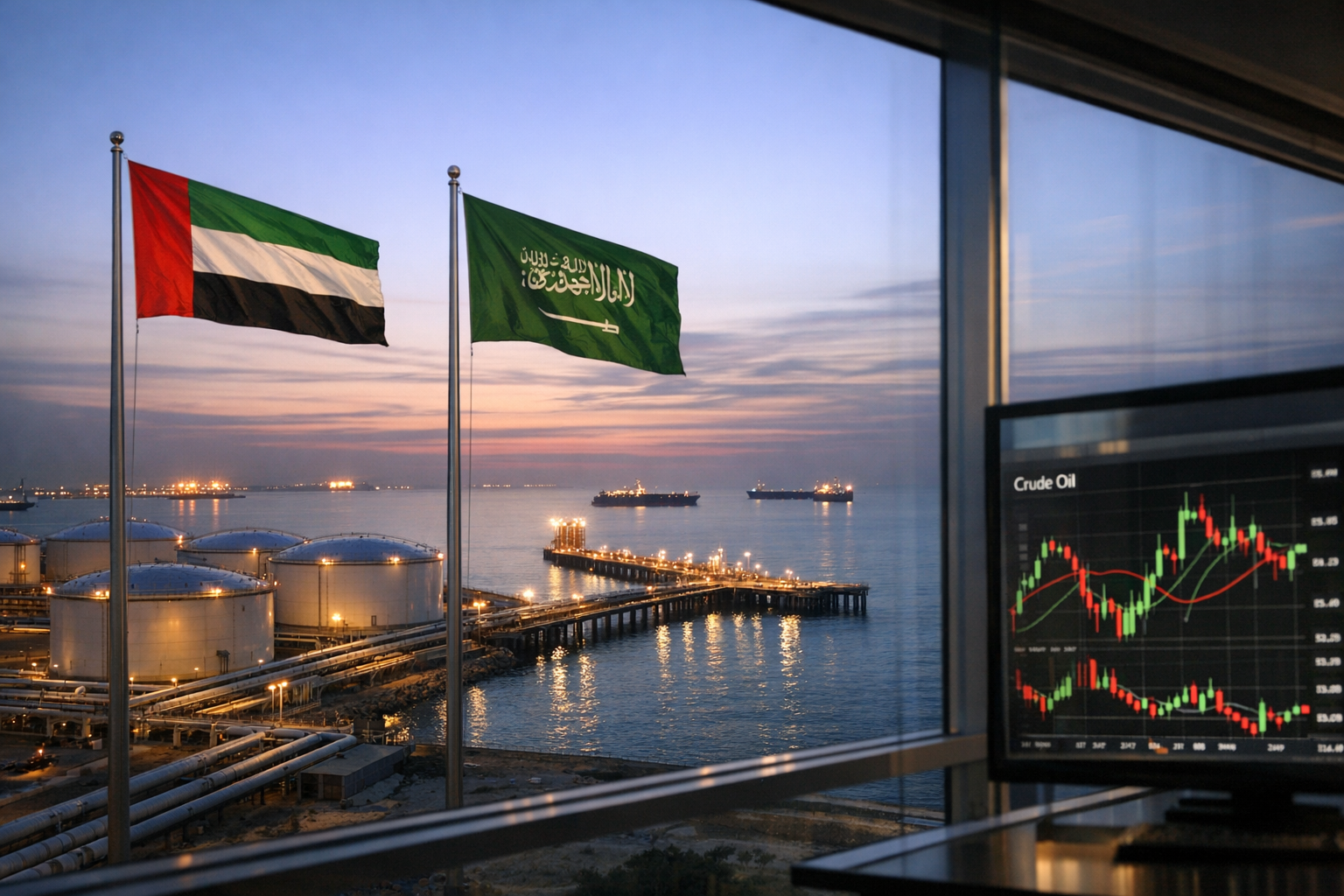
The United Arab Emirates said on Tuesday that it would leave OPEC effective May 1, ending nearly six decades in the oil cartel and delivering one of the sharpest blows in years to the group’s authority, its ability to manage supply and the regional clout of Saudi Arabia, OPEC’s dominant power.
The decision removes OPEC’s third-largest producer at a moment when oil markets are already strained by a wider Middle East supply shock and shipping disruptions around the Strait of Hormuz. Traders and analysts said the move immediately raised a cascade of questions: whether other members could follow, whether the Emirates would quickly raise output and whether the real damage would fall not just on OPEC, but on the broader OPEC+ alliance that has anchored oil policy in recent years.
In financial markets, the first reaction was to treat the news as potentially bearish for crude prices over time. If the Emirates is no longer bound by cartel limits, it would gain more freedom to pump from capacity it has spent years expanding. But the immediate effect was less clear, because any increase in Emirati supply is being weighed against regional instability that has complicated the movement of oil through one of the world’s most important energy chokepoints.
A Break Years in the Making
The rupture did not come out of nowhere.
For years, the Emirates had chafed at production quotas it regarded as too restrictive after investing heavily to lift its output capacity. The tension had surfaced repeatedly in OPEC and OPEC+ negotiations, where Abu Dhabi signaled growing frustration with limits that, in its view, prevented it from fully monetizing those investments.
As recently as this month, official OPEC communications still included the Emirates in production-management arrangements, underscoring how sudden the final break appeared from the outside. Yet the underlying dispute had been building for years, reflecting a wider tension at the center of producer alliances: countries that have spent billions to increase capacity often want to produce more, while the cartel’s logic depends on restraint.
There is precedent for that sort of split. Qatar left OPEC in 2019, a reminder that membership, while symbolically important, is not immutable. The Emirates’ departure, however, carries more weight. Unlike Qatar, it is a far larger oil producer and a central Gulf player whose relationship with Saudi Arabia has long been one of both strategic partnership and rivalry.
A Challenge to Saudi Leadership
More than any immediate shift in barrels, the decision is being read as a political setback for Riyadh.
Saudi Arabia has long served as OPEC’s de facto leader, using its size, spare capacity and diplomatic influence to keep the often-fractious group aligned. The departure of the Emirates suggests limits to that influence and risks emboldening other members that may also resent quota discipline or Saudi dominance.
That matters because OPEC’s power has never rested solely on production totals. It also depends on credibility — the market belief that the group can keep members in line and act collectively. Once that belief weakens, every future quota decision becomes harder to enforce.
Analysts say Saudi Arabia now faces a difficult choice. It could try to tighten discipline among the remaining members, signaling that defections will not unravel the group. Or it could move to adjust quotas more flexibly in an effort to keep dissatisfied producers from drifting away. Either option carries risks: a harder line could deepen resentment, while concessions could expose Saudi weakness.
The Economic Logic for Abu Dhabi
From the Emirati perspective, the decision appears rooted in long-term strategy as much as short-term politics.
The country has spent years positioning itself as a producer able to expand output while also investing in downstream industries, trading and energy infrastructure. In that framework, restrictions imposed by a cartel can look increasingly costly. Leaving OPEC gives Abu Dhabi more freedom to calibrate production according to its own commercial goals rather than collective discipline.
That does not necessarily mean a flood of new oil will reach the market immediately. Raising exports depends not only on policy freedom but also on logistics, customer demand and the broader security environment. With regional conflict already complicating tanker traffic and insurance costs, the practical room for a rapid output surge may be narrower than the headline suggests.
Still, the market significance lies in what the move signals about the future. If the Emirates begins producing more aggressively once conditions permit, it could add to downward pressure on prices and make the market more volatile than it would be under a tighter cartel framework.
Wider Middle East Consequences
The departure is also likely to reverberate beyond energy policy.
Relations between Abu Dhabi and Riyadh have often been presented as a close strategic partnership, especially in periods of shared concern over Iran and regional security. But beneath that alignment, differences have persisted over economic competition, foreign policy priorities and leadership in the Gulf.
By breaking with OPEC, the Emirates has exposed some of those tensions more openly. The move is widely seen as a reminder that Gulf unity can be tactical rather than seamless, and that Saudi Arabia’s claim to set the regional agenda is not unchallenged.
It may also create openings for Washington. American administrations have long had an uneasy relationship with OPEC, arguing that high oil prices hurt consumers and the global economy. A weaker cartel, or a looser producer alliance, could be seen in Washington as reducing the ability of major exporters to coordinate supply in ways that lift prices. At the same time, any fragmentation in Gulf politics carries its own risks for U.S. strategy, especially when maritime security and regional deterrence are under strain.
What Comes Next
The most important question now is whether the Emirates remains an exception or becomes the first domino.
Other producers have their own grievances, though few have the same combination of capacity, financial strength and geopolitical weight to act as decisively. If no one follows, OPEC may absorb the shock and continue as a diminished but still influential group. If others begin to rethink membership or openly defy quotas, the cartel could face a deeper crisis of relevance.
Another uncertainty is the fate of OPEC+, the broader coalition that includes major non-OPEC producers and has been more important than OPEC alone in shaping supply since the late 2010s. The Emirates’ exit from OPEC does not automatically settle how it will relate to that wider arrangement, but it complicates the architecture that has underpinned global oil management for years.
For now, the clearest effect is symbolic but powerful. In leaving OPEC, the Emirates has not just changed its own energy posture. It has exposed the strains inside the Gulf order, challenged Saudi Arabia’s standing and revived a question that oil markets have not had to confront in this way for years: how much influence the cartel still really has.
Sources
Further reading and reporting used to add context:
- https://apnews.com/article/c6779acba51365416ab1898b18f2beb2
- https://apnews.com/article/4966108c3fafacb67181152216deda14
- https://www.aljazeera.com/news/2026/4/28/uae-leaves-opec-and-opec
- https://www.atlanticcouncil.org/dispatches/a-long-time-coming-how-to-understand-the-uaes-decision-to-leave-opec/
- https://www.breakingviews.com/columns/breaking-view/uae-picks-an-opportune-moment-leave-opec-2026-04-28/
- https://www.theguardian.com/business/live/2026/apr/28/bp-profits-double-iran-war-oil-price-stock-markets-live-updates?page=with%3Ablock-69f0c4168f088137d9110db4
- https://www.axios.com/2026/04/28/uae-leaves-opec
- https://www.theguardian.com/business/live/2026/apr/28/bp-profits-double-iran-war-oil-price-stock-markets-live-updates?page=with%3Ablock-69f0b4be8f08f3c701fce0db
- https://www.semafor.com/article/04/28/2026/the-uaes-opec-exit-is-no-surprise
- https://www.businessday.co.za/world/middle-east/2026-04-28-oil-prices-trim-gains-after-uae-exits-opec-opec/
- https://www.100news.tv/2026/04/uae-leaves-opec-turning-point-for-oil.html
- https://houseofsaud.com/uae-opec-exit-may-2026/
- https://www.nationthailand.com/news/world/40065615
- https://www.prismnews.com/news/uae-to-exit-opec-and-opec-in-2026-after-capacity-review
- https://en.wikipedia.org/wiki/OPEC
- https://en.wikipedia.org/wiki/2026_in_the_United_Arab_Emirates
- https://www.reddit.com/r/WesternCoalition/comments/1syc0uf/uae_to_leave_opec_and_opec_oil_producer_groups/
- https://www.reddit.com/r/StopTheIdiocracy/comments/1syfbyj/the_united_arab_emirates_is_withdrawing_from_opec/
- https://www.reddit.com/r/newswall/comments/1sy1rz4/uae_to_exit_opec_and_opec_by_may_2026/
- https://www.reddit.com/r/askanything/comments/1syfx5s/what_does_uae_leaving_the_opec_mean/
- https://www.reddit.com/r/Stocksyourknowledge/comments/1sym9oq/uae_leaves_opec_in_blow_to_global_oil_producers/
- https://www.opec.org/pr-detail/597-5-april-2026.html?mod=livecoverage_web
- https://www.opec.org/pr-detail/598-7-april-2026.html
- https://www.opec.org/pr-detail/1574587-4-january-2026.html
- https://www.opec.org/pr-detail/564-28-may-2025.html
- https://www.opec.org/press-releases.html
- https://www.opec.org/pr-detail/28-05-dec-2024.html
- https://www.opec.org/pr-detail/1574596-5-april-2026.html
- https://www.opec.org/pr-detail/566-31-may-2025.html
- https://www.opec.org/pn-detail/273-17-november-2025.html
- https://www.moei.gov.ae/en/emergency-notices
- https://www.moei.gov.ae/en/media-center/news/4/11/2025/minister-of-energy-and-infrastructure-highlights-uaes-approach-to-diversify-energy-mix-at-adipec
- https://www.opec.org/opec_web/en/press_room/1051.htm
- https://www.opec.org/assets/assetdb/momr-may-2025.pdf
- https://www.opec.org/assets/assetdb/bulletin-2025-04-1.pdf
- United Arab Emirates will leave OPEC in a blow to the oil cartel
- The UAE's departure from OPEC shakes up the alliance that influences oil prices worldwide