
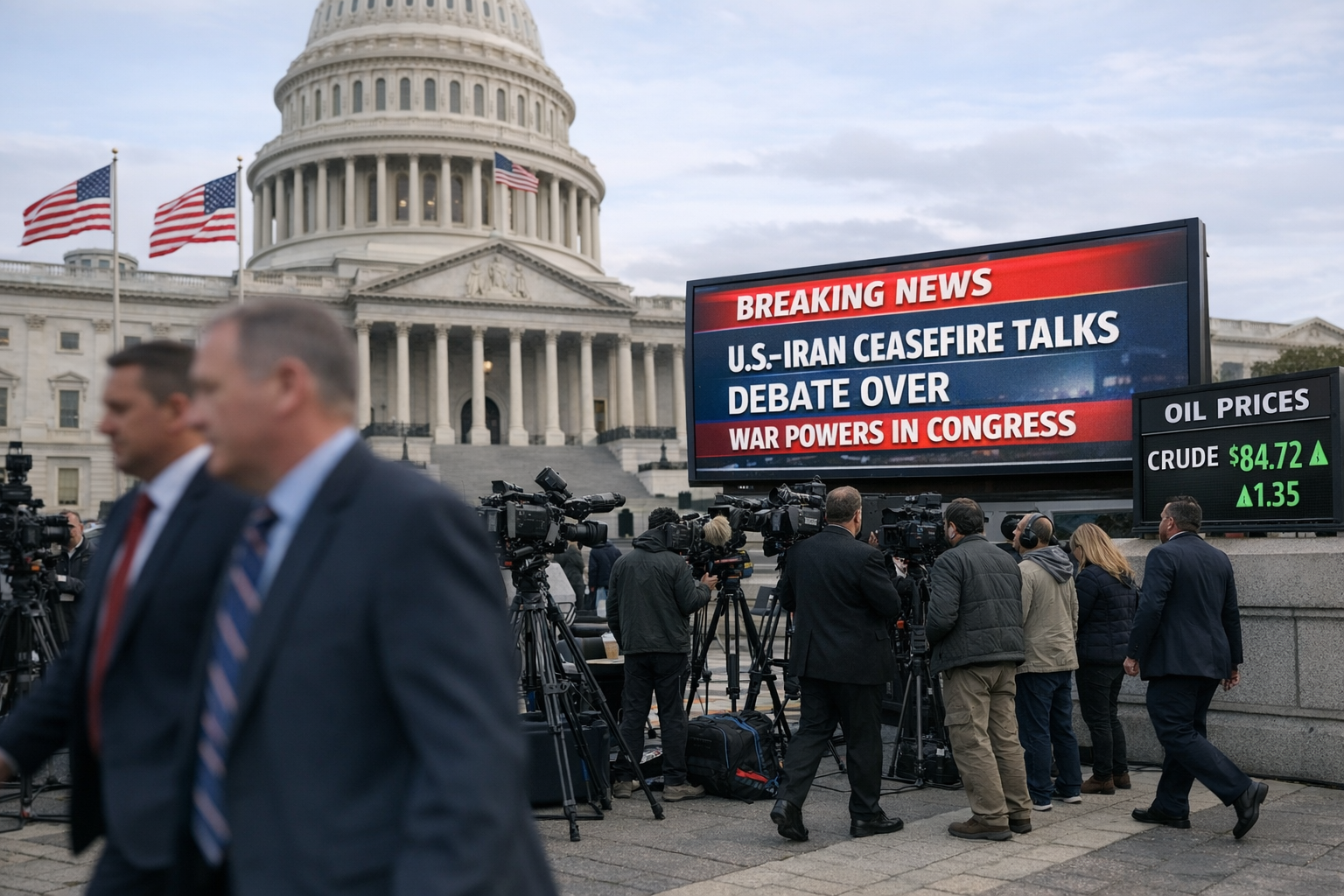
Washington Declares Iran Hostilities Over, but Questions Linger
With a 60-day congressional deadline arriving on Friday, the Trump administration said that a ceasefire with Iran had already brought U.S. hostilities to an end — at least for the purposes of the law.
That assertion, delivered just as lawmakers were leaving Washington without taking further action, has shifted the debate over the Iran conflict from the battlefield and oil markets to a familiar constitutional fault line: how much power Congress truly has to restrain a president once military action is underway.
Under the 1973 War Powers Resolution, presidents are generally required to terminate the use of U.S. armed forces within 60 days of notifying Congress, unless lawmakers authorize the operation or grant an extension. The administration now argues that requirement was satisfied because the fighting that began in late February effectively ended when a ceasefire took hold in early April.
The practical effect is immediate. Mr. Trump, who had faced pressure to either justify extending the campaign or wind it down before the deadline, is unlikely to confront a forced change in policy. The Senate had already turned back a Democratic effort to halt the operation, and Congress departed without imposing new limits.
But the legal and political implications may outlast the ceasefire itself.
If a president can treat a pause in fighting as sufficient to stop the War Powers clock, critics say, one of Congress’s few operational checks on unauthorized military action could be weakened further. The law has long been contested by presidents of both parties, and courts have often been reluctant to referee such disputes. Still, the administration’s position could become an important precedent for future conflicts in which hostilities ebb without a formal end.
A Ceasefire That Has Not Calmed Markets
The uncertainty is not only constitutional. It is also financial.
Oil prices rose again as traders weighed the White House’s claim that hostilities had “terminated” against continued signs that the confrontation remains unsettled. Brent crude, which briefly surged above $126 a barrel on Thursday before pulling back, has reflected a market struggling to decide whether the war has truly ended or merely entered a more ambiguous phase.
That ambiguity matters because the energy risks tied to the conflict have not disappeared. The Strait of Hormuz, a vital artery for global oil shipments, remains the central concern. Even without active large-scale strikes, disruptions linked to the U.S. blockade and Iranian restrictions have been enough to keep a war premium embedded in prices.
For traders, a ceasefire on paper is less important than whether tankers move normally, insurers regain confidence and military planners on both sides stop preparing for renewed escalation. None of those conditions appears fully in place.
Reports that U.S. officials are still considering new strike options, alongside Iranian warnings of retaliation if attacks resume, have only reinforced the sense that the conflict is paused rather than resolved.
Congress’s Check on War Powers, Tested Again
The current dispute stems from a campaign that began on Feb. 28, when U.S.-Israeli strikes on Iran opened a new phase of direct conflict. A ceasefire was announced on April 7 and took effect around April 8, creating the basis for the administration’s argument that the 60-day period no longer required a withdrawal or new approval from Congress by May 1.
That reading is certain to be challenged by some lawmakers and legal scholars, who argue that a ceasefire is not the same as a formal end to hostilities, particularly when military forces remain positioned for combat and contingency plans remain active.
Yet Congress has so far shown little capacity to force the issue. Repeated attempts to curb the president’s Iran war authority have fallen short, underscoring how difficult it remains for lawmakers to reclaim power once military operations begin. The Senate’s rejection of a resolution to halt the campaign effectively cleared the way for the administration to press its interpretation of the law.
The War Powers Resolution itself was designed in the aftermath of Vietnam to prevent presidents from sustaining military engagements indefinitely without legislative consent. In practice, however, its deadlines and reporting requirements have often collided with expansive presidential claims of commander-in-chief authority.
The administration’s latest move adds another complication: whether the law’s clock can be stopped not by congressional approval, but by a ceasefire whose durability remains in doubt.
Why the Next Few Days Matter
For now, the immediate crisis in Washington may have passed. The deadline has arrived without a showdown in Congress, and the White House has offered a legal rationale for avoiding one.
But the larger questions are unresolved.
One is institutional: whether Congress, the courts or future administrations will accept the idea that a temporary halt in fighting satisfies the statute’s requirement to end unauthorized hostilities. Another is strategic: whether the ceasefire can hold in a region where military forces remain on alert and diplomacy has stalled.
And then there is the economic question, which may prove the most unforgiving. Oil markets are less interested in legal theories than in physical risk. As long as Hormuz remains vulnerable and the possibility of renewed strikes hangs over the region, traders are likely to keep reacting as if the war is not entirely over.
That helps explain why prices have stayed volatile even as Washington insists the hostilities have ended. On paper, the administration may have found a way past the War Powers deadline. In the market — and perhaps in the region itself — the end of the conflict looks far less certain.
Sources
Further reading and reporting used to add context:
- https://www.axios.com/2026/05/01/iran-pentagon-hegseth-war-powers-senate-hearing-republicans
- https://apnews.com/article/422311a4443b987af87cd4ca35d54f48
- https://apnews.com/article/41ef029df176a6486422e9d68aa6d872
- https://apnews.com/article/49c1106ff37f044e772523f8c4c8eb45
- https://www.axios.com/2026/04/29/trump-iran-nuclear-deal-blockade
- https://www.theguardian.com/us-news/trump-administration
- https://www.investing.com/news/politics-news/us-house-republicans-block-latest-bid-to-rein-in-trump-iran-war-powers-4618779
- https://www.ksl.com/article/news/politics/senate-republicans-block-latest-bid-to-rein-in-trump-iran-war-powers/51483988
- https://www.investing.com/news/politics-news/us-senate-republicans-block-bid-to-rein-in-trump-iran-war-powers-voting-continues-4616248
- https://www.streetinsider.com/Reuters/US%2BSenate%2BRepublicans%2Bblock%2Bbid%2Bto%2Brein%2Bin%2BTrump%2BIran%2Bwar%2Bpowers%2C%2Bvoting%2Bcontinues/26317918.html
- https://www.investing.com/news/politics-news/us-republicans-block-bid-to-rein-in-trump-iran-war-powers-4606343
- https://www.al-monitor.com/originals/2026/04/us-senate-republicans-block-bid-rein-trump-iran-war-powers-voting-continues
- https://www.washingtonpost.com/politics/2026/04/30/trump-war-powers-pentagon-iran/b66cb8f6-44f5-11f1-b19d-32431046b5b4_story.html
- https://www.al-monitor.com/originals/2026/04/us-house-republicans-block-latest-bid-rein-trump-iran-war-powers
- https://www.streetinsider.com/Reuters/US%2BRepublicans%2Bblock%2Bbid%2Bto%2Brein%2Bin%2BTrump%2BIran%2Bwar%2Bpowers/26294598.html
- https://m.investing.com/news/politics-news/us-senate-republicans-block-bid-to-rein-in-trump-iran-war-powers-voting-continues-4616248?ampMode=1
- https://www.theguardian.com/us-news/2026/apr/07/trump-iran-war-ceasefire
- https://en.wikipedia.org/wiki/War_Powers_Resolution
- https://www.axios.com/2026/04/09/trump-iran-democrat-congress-war-powers-vote
- https://en.wikipedia.org/wiki/2026_Iran_war
- https://en.wikipedia.org/wiki/2026_Iran_war_ceasefire
- https://m.investing.com/news/world-news/for-war-powers-resolutionpurposes-us-hostilities-with-iran-that-began-in-february-have-terminated-official-says-4651847?ampMode=1
- https://au.investing.com/news/commodities-news/oil-retreats-after-hitting-fouryear-high-on-concern-of-usiran-war-escalation-4396701
- https://www.lse.co.uk/news/global-oil-price-hits-four-year-high-on-concern-of-us-iran-war-escalation-3soaxeq2fgwdxcu.html
- https://www.lse.co.uk/news/brent-jumps-to-4-year-high-as-concerns-of-us-iran-war-escalation-p4x0ufya69zl1wn.html
- https://www.marketscreener.com/news/global-oil-price-hits-4-year-high-on-concern-of-us-iran-war-escalation-ce7f58dbdc8af02d
- https://www.axios.com/2026/04/15/iran-war-negotiations-deal-pakistan
- https://www.axios.com/2026/04/07/oil-prices-plunge-us-iran-war-ceasefire-trump
- https://wsau.com/2026/04/30/for-war-powers-resolution-purposes-us-hostilities-with-iran-that-began-in-february-have-terminated-official-says/
- https://www.axios.com/2026/04/19/oil-prices-us-iran-war-strait-hormuz-ship-seized
- https://www.axios.com/2026/04/08/iran-ceasefire-economy-oil-energy
- https://za.investing.com/news/commodities-news/oil-jumps-more-than-2-as-usiran-peace-talks-stall-4233027
- https://www.investing.com/news/world-news/iran-threatens-painful-response-if-us-resumes-attacks-oil-prices-seesaw-4649219
- https://au.investing.com/news/commodities-news/oil-jumps-more-than-2-as-usiran-peace-talks-stall-4385007
- https://whtc.com/2026/04/30/us-crude-futures-rise-41-cents-to-105-50-bbl-after-prior-intraday-high-of-110-93-bbl/
- https://ca.marketscreener.com/news/for-war-powers-resolution-purposes-us-hostilities-with-iran-that-began-in-february-have-terminated-ce7f58d8d081f025
- https://www.marketscreener.com/news/oil-prices-hit-two-week-high-as-iran-talks-stall-and-strait-shipments-lag-ce7f59dcda8ff42d
- https://history.house.gov/Historical-Highlights/1951-2000/The-War-Powers-Resolution/
- https://www.nixonlibrary.gov/news/war-powers-resolution-1973
- https://commons.wikimedia.org/wiki/File%3AR41199_The_War_Powers_Resolution_After_Thirty-Six_Years_%28IA_R41199TheWarPowersResolutionAfterThirty-SixYears-crs%29.pdf
- https://www.congress.gov/crs_external_products/R/PDF/R42699/R42699.17.pdf
- https://factually.co/fact-checks/military/war-powers-resolution-marines-deployments-6f22ee
- https://factually.co/fact-checks/military/congress-compel-president-end-military-operations-war-powers-resolution-96157e
- https://factually.co/fact-checks/politics/war-powers-resolution-1973-limit-presidential-force-827b5b
- https://constitution.congress.gov/browse/essay/artI-S8-C11-2-4/ALDE_00013915/%5B%27war%27%5D
- https://www.congress.gov/93/crecb/1973/06/25/GPO-CRECB-1973-pt17-1-2.pdf
- https://factually.co/fact-checks/politics/war-powers-resolution-legal-powers-limits-presidential-responses-b681d7
- https://www.congress.gov/crs-product/R47603
- https://www.congress.gov/crs-product/IF13134
- https://www.congress.gov/congressional-record/volume-157/issue-73/senate-section/article/S3361-1
- https://www.congress.gov/93/crecb/1973/10/04/GPO-CRECB-1973-pt25-5-2.pdf
- https://www.law.cornell.edu/constitution-conan/article-2/section-2/clause-1/congressional-control-over-the-presidents-discretion
- https://www.congress.gov/crs_external_products/R/PDF/R42699/R42699.15.pdf
- https://en.wikipedia.org/wiki/1973_in_the_Vietnam_War
- https://www.congress.gov/crs_external_products/R/PDF/R42699/R42699.12.pdf
- US official says Iran war truce ’terminated’ hostilities for war powers deadline By Reuters
- Understanding the War Powers Resolution | Congress.gov | Library of Congress
- 2026 Iran war ceasefire
- Pentagon calls timeout on War Powers