
From Berlin to Canberra, Iran War Fallout Ripples Through Diplomacy and Economic Planning
As the war involving Iran widens beyond the battlefield and shipping lanes, governments far from the Gulf are confronting a more complicated reality: the conflict is no longer simply a security crisis in the Middle East, but a test of political alliances, fiscal resilience and diplomatic leverage stretching from Europe to the Indo-Pacific.
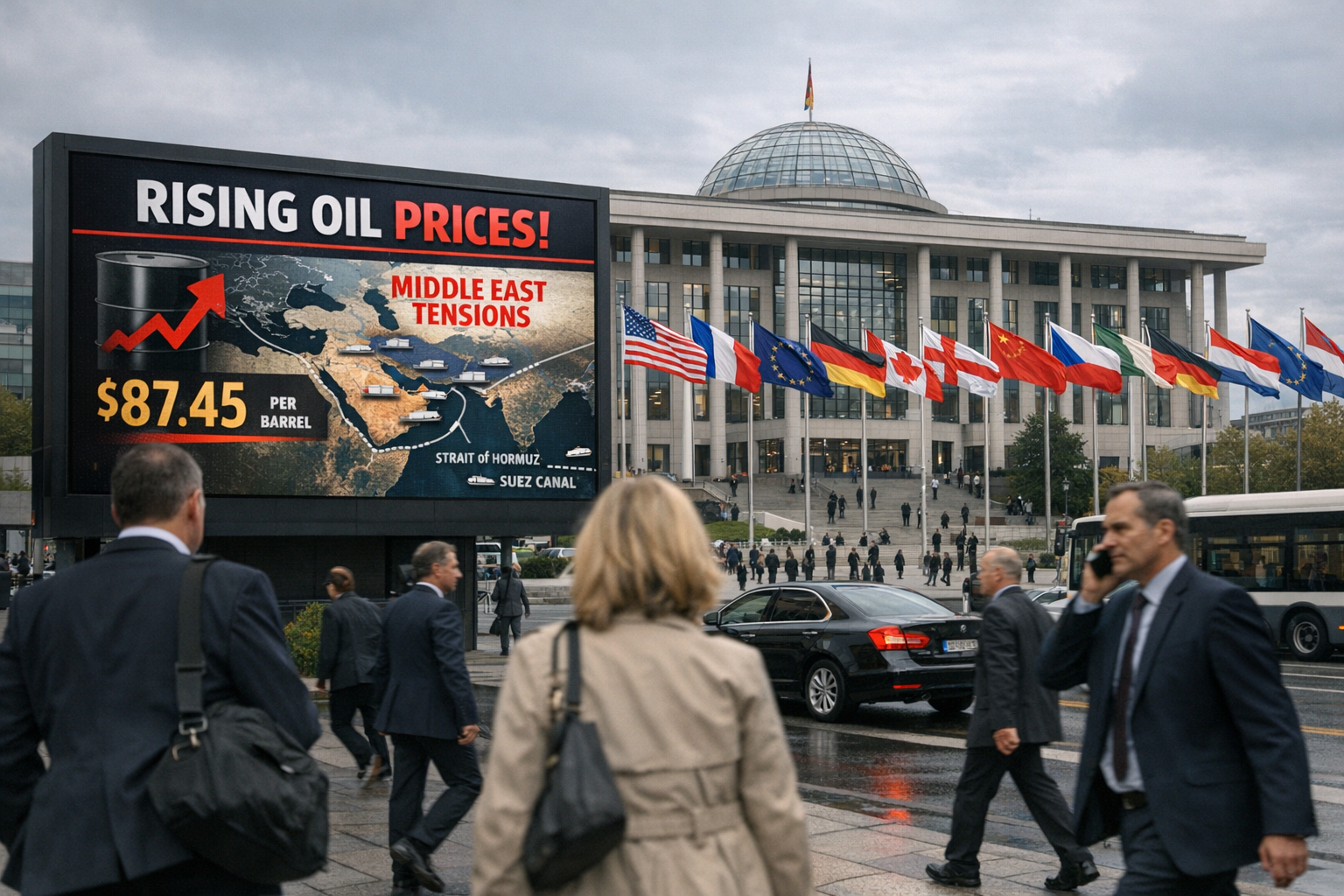
On Monday, Australia and Japan moved to tighten coordination on energy security, defense and critical minerals, reflecting mounting concern over disrupted supply chains and the effects of the effective closure of the Strait of Hormuz, a vital artery for global oil and gas shipments. In Germany, Chancellor Friedrich Merz sought to contain a public rupture with President Donald Trump over the war, even as he acknowledged the strain the conflict is placing on Europe’s economy and transatlantic ties. And in Tehran, officials faced a different kind of pressure: a deepening economic crisis that is increasingly shaping how firmly Iran can hold its line in talks with Washington.
Taken together, the developments underscored how the war’s consequences are radiating outward, reshaping not only military calculations but also household budgets, alliance management and the prospects for diplomacy.
Energy Shock Reaches the Indo-Pacific
For countries dependent on imported fuel, the disruption in Gulf shipping has become an immediate economic concern. Australia’s government has begun openly preparing for the possibility that prolonged volatility in oil prices could hit consumers and growth, even as it resists broad new relief measures for now.
Treasurer Jim Chalmers said the government would not extend a fuel tax cut beyond June, but acknowledged that officials were readying “a range of contingencies” to shield households and the wider economy from escalation in the Middle East. The comments came as Australia and Japan pledged to support the flow of energy and deepen cooperation at a moment when both countries see supply security as newly vulnerable.
The urgency is especially acute for Japan, which remains heavily reliant on imported energy. Australia, one of the world’s largest exporters of liquefied natural gas, supplies nearly half of Japan’s LNG, making the relationship a crucial buffer as Gulf routes come under pressure. Their talks reflected a broader shift underway in the Indo-Pacific, where governments are increasingly treating energy security not as a narrow commercial issue but as part of strategic defense planning.
The concern is not merely about current prices, but about the risk that a sustained disruption in Hormuz could force governments into larger fiscal interventions, add to inflation and further strain households already struggling with higher living costs.
Germany Tries to Steady a Fraying U.S. Relationship
In Europe, the conflict is exposing political fault lines inside the Western alliance. Mr. Merz, facing questions after a public dispute with Mr. Trump over the Iran war, said he was not giving up on cooperation with the American president or on the transatlantic relationship.
His remarks appeared aimed at preventing a policy disagreement over Iran from hardening into a broader rupture between Berlin and Washington. For Germany, that relationship remains central not only to European security but also to any coordinated response to the economic fallout from the conflict.
Mr. Merz has tried to strike a careful balance: preserving the alliance with the United States while warning of the economic costs that a prolonged war could impose on Europe. Germany, already grappling with sluggish growth and industrial anxiety over energy costs, has particular reason to fear another external shock. Even if Europe is less directly exposed than Asia to Gulf shipping disruption, higher global energy prices and renewed geopolitical instability carry clear risks for manufacturing, inflation and public finances.
The strain also comes at a delicate political moment. European leaders have spent months trying to manage an often unpredictable White House while maintaining a common front on security issues. A visible quarrel over Iran raises questions about how durable that cohesion will be if the war drags on or expands.
Iran’s Economic Pain Becomes a Negotiating Factor
Inside Iran, the pressure is more existential. Years of sanctions and chronic mismanagement had already left the economy fragile. Now war damage, disrupted trade, inflation, unemployment and currency weakness are compounding the crisis, making economic survival itself an increasingly important variable in diplomacy.
The U.S. blockade announced on April 13 has threatened one of Tehran’s few remaining lifelines: oil-export revenue. At the same time, the costs of war have mounted sharply. Estimates circulating in Iranian media have suggested that economic damage could far exceed the size of last year’s state budget, though the full scale remains uncertain.
International agencies have painted a grim picture. The United Nations Development Program has estimated that between 3.5 million and 4.1 million additional Iranians could be pushed below the $8.30-a-day poverty line, potentially driving the poverty rate as high as 41 percent. Inflation, displacement and supply-chain shortages are all worsening the pressure on households.
That deterioration is beginning to matter politically. The question now confronting Tehran’s leadership is whether it can afford to remain uncompromising in negotiations with Washington, or whether economic conditions will force greater flexibility.
But economic pain does not always produce moderation. It can also encourage brinkmanship, particularly if leaders believe that concessions under pressure would be politically or strategically intolerable. That uncertainty has become central to the diplomatic picture: whether Iran’s financial distress will bend negotiations toward a deal, or harden them further.
Why the Wider Fallout Matters Now
What is becoming clearer by the day is that the war’s significance lies not only in missile exchanges or maritime standoffs, but in how it is rearranging calculations in capitals far beyond the Gulf.
In Canberra, it is shaping budget choices and contingency planning. In Tokyo, it is accelerating efforts to secure fuel and strategic materials through trusted partners. In Berlin, it is testing the resilience of relations with Washington at a moment of already heightened unease. And in Tehran, it is narrowing the room for economic and diplomatic maneuver.
The conflict’s next phase remains uncertain. Shipping disruptions could ease, or they could deepen. The friction between Germany and the United States could fade, or widen into a larger strategic dispute. Iran’s economic distress could produce concessions, or it could fuel a more desperate defiance.
For now, though, one conclusion is already difficult to escape: the fallout from the Iran war is no longer regional. It is becoming a wider contest over alliance cohesion, economic endurance and the leverage each side can still bring to the negotiating table.
Sources
Further reading and reporting used to add context:
- Japan and Australia prime ministers boost cooperation during global tensions | AP News
- Merz ‘not giving up on working with Trump’ despite Iran war spat | Germany | The Guardian
- https://www.theguardian.com/world/2026/may/04/could-irans-escalating-economic-crisis-weaken-negotiating-position-with-us
- https://www.japantimes.co.jp/news/2026/05/04/world/germany-merz-working-with-trump/
- https://www.washingtonpost.com/business/2026/05/04/japan-australia-cooperation-takaichi-albanese-energy-agreements/220cc08a-477e-11f1-a119-857cd2bf4fd4_story.html
- https://www.investing.com/news/commodities-news/germanys-merz-sees-no-plan-for-bringing-iran-war-to-swift-end-4552318
- https://www.internazionale.it/ultime-notizie-reuters/2026/04/29/germany-s-merz-says-relations-with-trump-are-good-despite-spat-over-iran
- https://www.investing.com/news/world-news/us-to-blockade-iran-after-talks-fail-to-yield-adeal-4609134
- https://www.spacewar.com/afp/260503185811.gvj2ap1e.html
- https://www.japantimes.co.jp/business/2026/03/14/australia-lng-boost/
- https://www.brecorder.com/news/40419423/merz-downplays-row-with-trump-after-troop-drawdown-announced
- https://www.investing.com/news/economic-indicators/iranian-economic-collapse-may-come-too-late-for-trump-4649027
- https://www.lemonde.fr/en/international/article/2026/04/22/iran-s-uncomfortable-position-between-fragile-ceasefire-and-blockade-standoff_6752713_4.html
- https://www.investing.com/news/world-news/german-chancellor-merz-says-he-has-doubts-over-iran-war-aims-4585771
- https://www.undp.org/sites/g/files/zskgke326/files/2026-03/undp-rbap-military-escalation-middle-east-economic-human-development-iran.pdf
- https://cepr.org/system/files/publication-files/298740-policy_insight_150_is_a_lasting_u_s_iran_deal_now_possible_overcoming_time_inconsistency_and_political_debt_overhang.pdf
- https://en.wikipedia.org/wiki/2026_Iran_war_fuel_crisis
- https://en.wikipedia.org/wiki/2026_United_States_naval_blockade_of_Iran
- https://en.wikipedia.org/wiki/Australia_and_the_2026_Iran_war