
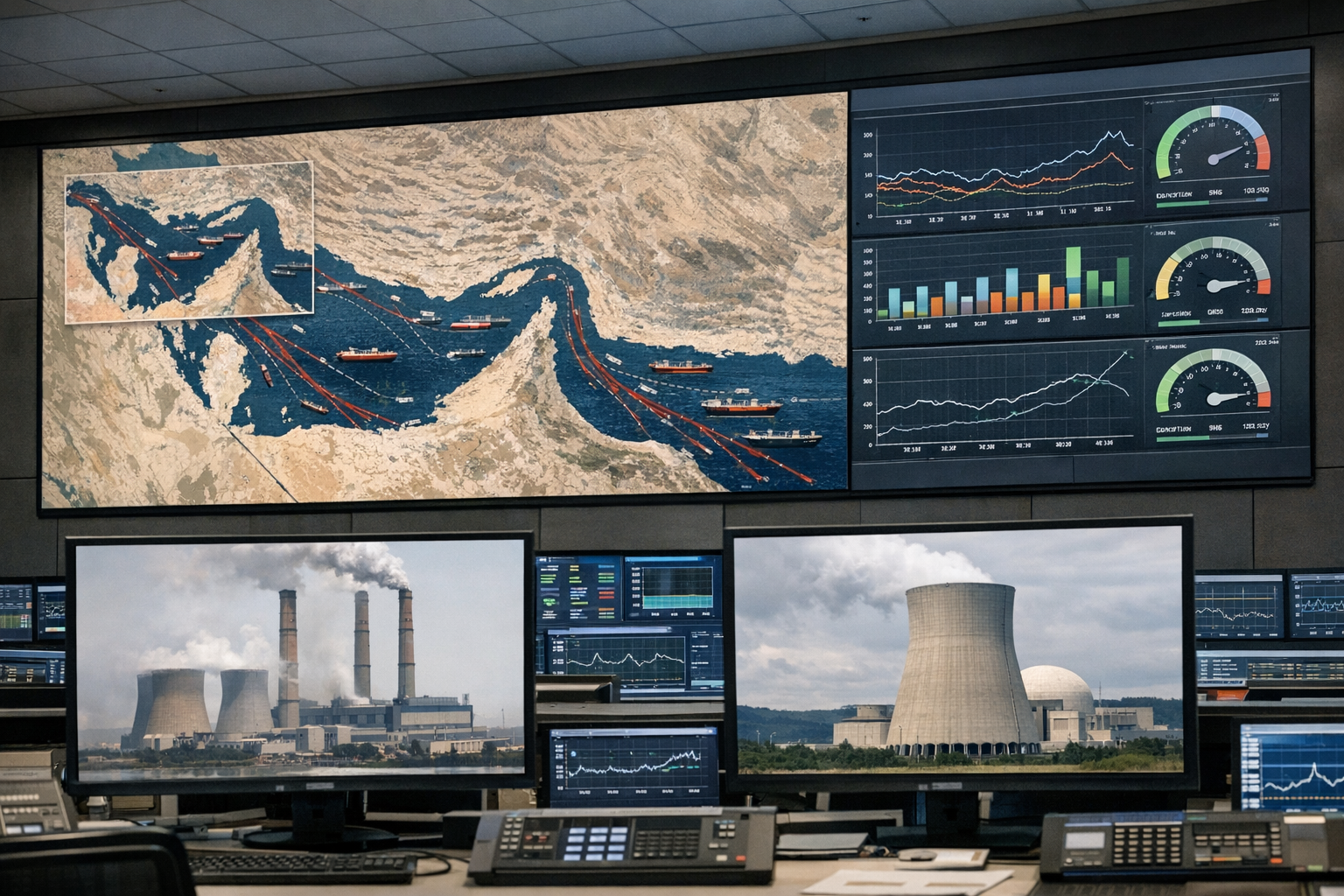
The latest convulsions in global energy markets are pushing governments and producers toward choices that, only months ago, many had tried to avoid.
Oil exporters are promising more supply even as a key shipping chokepoint remains constrained. India, under pressure from punishing heat and surging electricity demand, is burning more coal. And across Europe, officials and analysts are giving fresh weight to nuclear power as insurance against another era of costly dependence on imported fuels.
Taken together, the moves reflect a sharp turn toward energy security as the disruption around the Strait of Hormuz ripples outward, reshaping policy from the Persian Gulf to New Delhi to Brussels.
OPEC+ Signals More Oil, but Traders See Limits
OPEC+ said after a meeting on May 3 that it would raise June output targets by 188,000 barrels a day, a closely watched decision that came in the group’s first gathering since the United Arab Emirates’ departure on May 1.
The announcement was meant to reassure markets that major producers remain willing to manage supply during a period of extreme volatility. But the practical effect may be limited. With the conflict involving Iran still disrupting Gulf exports and traffic through the Strait of Hormuz, traders and analysts have questioned how much additional crude can actually reach world markets.
That gap between announced barrels and deliverable barrels has become central to the market’s unease. Oil prices have swung violently as investors alternated between fears of escalation and hopes for de-escalation. Exxon Mobil’s chief executive said recently that the market had not yet fully absorbed the supply impact of the war, a warning that prices could climb further if the disruption persists.
The Strait of Hormuz handles a substantial share of global oil and liquefied natural gas flows, making it one of the world’s most sensitive energy arteries. As long as shipments through the passage remain under strain, even formal production increases by OPEC+ risk being seen more as a signal of intent than a meaningful addition to supply.
India Turns Back to Coal
Nowhere is the pressure more immediate than in India, where extreme heat has driven electricity demand to new highs and forced the government to lean more heavily on the fuel it had hoped, over time, to rely on less.
In late April, India’s peak power demand reached a record 256.1 gigawatts, according to the research briefing, as temperatures climbed and air-conditioner use surged. To prevent shortages and blackouts, the country increased generation from coal- and gas-fired plants, with coal carrying most of the load.
For India, the calculation is brutally simple: keep the grid stable first, deal with the climate consequences later. The country is already the world’s third-largest emitter of carbon dioxide, and most of its electricity still comes from coal. Yet in periods of heat stress and fuel uncertainty, coal remains the most available large-scale backup.
The renewed reliance underscores the bind facing fast-growing economies. India has made major investments in renewable energy and has sought to diversify supply, but solar and wind alone cannot yet guarantee round-the-clock power during periods of exceptional demand. If high temperatures persist deeper into the summer, the country may have little choice but to keep coal plants running hard, even as that worsens local pollution, strains fuel supply chains and pushes emissions higher.
Europe Reopens the Nuclear Debate
In Europe, the same shock is reviving a debate many countries had considered settled.
The disruption around Hormuz has exposed how vulnerable import-dependent economies remain to swings in oil and gas prices. In response, political support is growing in parts of Europe for keeping existing nuclear reactors online longer and for investing in a new generation of atomic power.
The shift is not happening in a vacuum. European officials have spent years trying to reduce dependence on imported fossil fuels, a campaign accelerated after earlier energy crises. The European Commission has proposed measures aimed at strengthening energy independence, including support for innovative nuclear technologies. Ursula von der Leyen, the president of the European Commission, has described Europe’s earlier retreat from nuclear power as a strategic mistake.
For advocates, the argument is straightforward: nuclear plants can provide stable, low-carbon electricity without exposing countries to the kind of import shock now rattling global markets. Extending the life of reactors already in operation could help relatively quickly. New nuclear projects, however, are another matter — expensive, slow to build and politically divisive across the European Union.
That means atomic energy is better seen as a hedge against future vulnerability than as a rapid solution to the current crisis. Still, in a continent once deeply split over the role of nuclear power, the present turmoil is changing the political balance.
Security of Supply Takes Priority
The common thread running through all three developments is not ideology, but urgency.
OPEC+ is trying to show that it can still steady the market, even if the physical constraints on supply are beyond its control. India is burning more coal because avoiding blackouts during a deadly heatwave has become the overriding imperative. Europe is reconsidering nuclear not because the technology has suddenly become easier, but because dependence on imported hydrocarbons now looks more dangerous.
The result is a broader reordering of energy priorities. Governments that had emphasized emissions cuts, market liberalization or long-term transition planning are being pulled back toward the older and harder question of whether enough fuel and electricity will be available when households and industries need them.
Much now depends on how long the Hormuz disruption lasts. If shipping conditions improve, some of the emergency measures may prove temporary. If they do not, the world could face a more prolonged period of high fuel costs, added inflation pressure and policy choices increasingly driven by scarcity rather than strategy.
Sources
Further reading and reporting used to add context:
- https://apnews.com/article/54fc7aa399fca1fd45e9db2a75da17d1
- https://www.axios.com/2026/04/29/oil-iran-wall-street
- https://apnews.com/article/d900e3092cf157304abd659eae6388c5
- https://www.axios.com/2026/04/28/uae-leaves-opec
- https://www.axios.com/2026/04/29/trump-oil-execs-iran-war
- https://www.investing.com/news/commodities-news/opec-agrees-in-principle-on-small-oil-output-quota-hike-without-uae-sources-say-4654770
- https://www.moneycontrol.com/news/business/markets/more-to-come-exxon-ceo-says-markets-have-not-priced-in-the-hormuz-oil-shock-13905842.html
- https://www.investing.com/news/commodities-news/opec-set-to-agree-another-oil-output-hike-without-uae-sources-say-4646411
- https://www.newsmax.com/politics/exxon-mobil-chevron-oil/2026/05/01/id/1254937/
- https://fortune.com/2026/05/01/exxon-ceo-more-to-come-prices-spikes-iran-war-as-exxon-chevron-beat/
- https://m.investing.com/news/commodities-news/opec-set-to-agree-third-oil-output-quota-hike-since-hormuz-closure-sources-say-4654816?ampMode=1
- https://www.thenationalnews.com/news/gulf/2026/05/03/opec-producers-agree-on-june-output-adjustment-and-reaffirm-market-stability-commitment/
- https://www.tribuneindia.com/news/business/opec-countries-in-1st-meeting-after-uaes-exit-announces-188000-barrels-per-day-output-increase/
- https://m.investing.com/news/commodities-news/opec-agrees-in-principle-on-small-oil-output-quota-hike-without-uae-sources-say-4654770?ampMode=1
- https://en.aletihad.ae/news/business/4662827/opec–raises-june-oil-output-by-188-000-bpd
- https://ca.investing.com/news/commodities-news/opec-set-to-agree-third-oil-output-quota-hike-since-hormuz-closure-sources-say-4605102
- https://www.dawn.com/news/1997215/opec-agrees-third-oil-output-quota-hike-since-hormuz-closure
- https://www.reddit.com/r/worldnews/comments/1t11v0z/exxon_mobil_ceo_expects_higher_oil_prices_due_to/
- https://commission.europa.eu/news-and-media/news/commission-proposes-plan-phase-out-russian-gas-and-oil-imports-2025-06-17_en
- https://policy.trade.ec.europa.eu/news/commission-initiates-safeguard-investigation-imports-grain-oriented-electrical-steel-2026-03-27_en
- https://commission.europa.eu/topics/energy/eu-action-address-energy-crisis_lt
- https://www.investing.com/news/commodities-news/eus-kallas-floats-black-sea-model-to-unblock-strait-of-hormuz-4563603
- https://commission.europa.eu/news-and-media/news/boosting-eus-energy-independence-and-lowering-costs-2026-03-10_en
- https://www.breakingviews.com/columns/breaking-view/gulf-crisis-moves-acute-chronic-phase-2026-04-17/
- https://www.euronews.com/my-europe/2026/04/28/from-crisis-to-transition-how-europe-is-rethinking-its-energy-strategy
- https://www.investing.com/news/commodities-news/exclusiveus-intelligence-warns-iran-unlikely-to-ease-hormuz-strait-chokehold-soon-sources-say-4597407
- https://www.euronews.com/2026/03/21/is-europe-going-to-be-forced-to-return-to-nuclear-energy
- https://energy.ec.europa.eu/strategy/repowereu-roadmap_en?prefLang=pl
- https://uk.marketscreener.com/news/macron-reaffirms-efforts-to-reopen-strait-of-hormuz-as-totalenergies-warns-of-energy-shortages-ce7f59dcdb89f526
- https://ca.investing.com/news/commodities-news/oil-whiplash-iran-war-shock-to-flip-market-to-deficit-in-2026-analysts-say-4559645
- https://ec.europa.eu/commission/presscorner/api/files/document/print/en/ip_26_629/IP_26_629_EN.pdf
- https://en.wikipedia.org/wiki/2026_Strait_of_Hormuz_crisis
- https://en.wikipedia.org/wiki/2026_Strait_of_Hormuz_campaign
- https://en.wikipedia.org/wiki/2026_Iran_war
- https://europa.eu/newsroom/ecpc-failover/pdf/ip-26-744_en.pdf
- https://en.wikipedia.org/wiki/2026_United_States_naval_blockade_of_Iran
- https://en.wikipedia.org/wiki/2026_Iran_war_fuel_crisis
- https://en.wikipedia.org/wiki/Strait_of_Hormuz
- https://www.europarl.europa.eu/RegData/docs_autres_institutions/commission_europeenne/com/2025/0440/COM_COM%282025%290440_EN.pdf
- https://www.reutersconnect.com/item/decision-to-turn-back-on-nuclear-was-a-strategic-mistake-eus-von-der-leyen-says/dGFnOnJldXRlcnMuY29tLDIwMjY6bmV3c21sX1ZBMjYyMjEwMDMyMDI2UlAx/dGFnOnJldXRlcnMuY29tLDIwMjY6bmV3c21sX0xWQTAwMjI2MjIxMDAzMjAyNlJQMQ
- https://it.investing.com/news/commodities-news/ue-sconsiglia-uscite-anticipate-da-nucleare-per-affrontare-crisi-energia-3321256
- https://uk.marketscreener.com/news/allies-fear-a-rushed-us-iran-framework-deal-could-backfire-leaving-technical-deadlock-ce7e50d3dc8bf726
- https://www.tbsnews.net/world/allies-fear-rushed-us-iran-framework-deal-could-backfire-leaving-technical-deadlock-1415626
- https://hardware.slashdot.org/story/26/03/12/0137208/reducing-europes-nuclear-energy-sector-was-strategic-mistake-eu-chief-says
- https://gbm.com/media/noticia/la-ue-advierte-contra-el-cierre-anticipado-de-las-centrales-nucleares-ante-la-crisis-energetica/
- https://www.timeslive.co.za/news/world/2026-04-19-allies-fear-a-rushed-usiran-framework-deal-could-backfire-leaving-technical-deadlock/
- https://uk.marketscreener.com/news/eu-warns-of-prolonged-energy-shock-forced-cuts-if-iran-war-continues-ce7e50dcdd88f326
- https://it.marketscreener.com/notizie/ue-sconsiglia-uscite-anticipate-da-nucleare-per-affrontare-crisi-energia-ce7f59dbd98fff22
- https://www.marketscreener.com/news/europe-s-energy-crisis-response-avoids-consumption-curbs-for-now-ce7f59d3d08bf123
- https://m.investing.com/news/commodities-news/reducing-nuclear-energy-a-strategic-mistake-eu-chief-says-4552159?ampMode=1
- https://www.marketscreener.com/news/eu-to-warn-against-early-nuclear-exits-in-effort-to-address-energy-crisis-ce7f59dbd989f322
- https://www.reddit.com/r/EnergyAndPower/comments/1scff3j/faced_with_new_energy_shock_europe_asks_if/
- https://www.reddit.com/r/europe/comments/1sc4h94/faced_with_new_energy_shock_europe_asks_if/
- https://www.reddit.com/r/EU_Economics/comments/1sc0xoo/faced_with_new_energy_shock_europe_asks_if/
- https://www.semafor.com/article/04/27/2026/india-power-demand-hits-record-amid-fuel-crisis
- https://www.petromindo.com/news/article/india-power-demand-hits-record-as-heatwave-boosts-coal-use-strains-supply
- https://es.marketscreener.com/noticias/india-incrementa-la-producci-n-de-carb-n-y-gas-ante-el-record-de-demanda-electrica-por-la-ola-de-cal-ce7f59dcde8af523
- https://www.reutersconnect.com/item/india-ramps-up-coal-production-amid-global-energy-crisis/dGFnOnJldXRlcnMuY29tLDIwMjY6bmV3c21sX01UMUFOQURMMDAwVTdTSUM0
- https://www.investing.com/news/commodities-news/war-in-iran-is-causing-biggest-energy-crisis-in-history-iea-says-4626395
- https://www.multibagg.ai/market-pulse/articles/india-power-demand-april-2026-cmoncybanab4xp50jseqh9wpy
- https://www.straitstimes.com/asia/south-asia/indias-power-demand-hits-record-as-heat-wave-batters-nation/
- https://www.realclearenergy.org/2026/04/30/iran_war_pushing_india_back_to_coal_off_gas_1178884.html
- https://wkzo.com/2026/04/27/india-boosts-coal-and-gas-output-as-power-demand-hits-record-peak-in-heatwave/
- https://ca.marketscreener.com/news/india-boosts-coal-and-gas-output-as-power-demand-hits-record-peak-in-heatwave-ce7f59dcde8af523
- https://timesofindia.indiatimes.com/india/solar-infra-helps-india-meet-record-256gw-power-demand/amp_articleshow/130539197.cms
- https://en.wikipedia.org/wiki/2016_Indian_heat_wave
- https://en.wikipedia.org/wiki/India_in_the_2026_Iran_war
- https://en.wikipedia.org/wiki/Economic_impact_of_the_2026_Iran_war
- https://en.wikipedia.org/wiki/Electricity_sector_in_India
- https://en.wikipedia.org/wiki/List_of_power_stations_in_India
- https://ima-api.org/wp-content/uploads/2026/03/IMA-Daily-News-Update-Wednesday-March-11-2026.pdf
- https://www.reddit.com/r/technology/comments/1sx2958/indias_power_demand_hits_record_as_heat_wave/
- https://www.reddit.com/r/worldnews/comments/1sxt0o9/india_boosts_coal_and_gas_output_as_power_demand/
- https://ima-api.org/wp-content/uploads/2026/04/IMA-Daily-News-Update-Thursday-April-02-2026.pdf
- https://www.reddit.com/r/india/comments/1szvqaq/solar_news_india_pulls_off_a_power_miracle_a_big/
- https://www.reddit.com/r/climatechange/comments/1t0m2u5/report_electrifying_industrial_heat_in_india_is/
- OPEC+ agrees third oil output quota hike since Hormuz closure By Reuters
- Exclusive-US intelligence warns Iran unlikely to ease Hormuz Strait chokehold soon, sources say By Reuters