
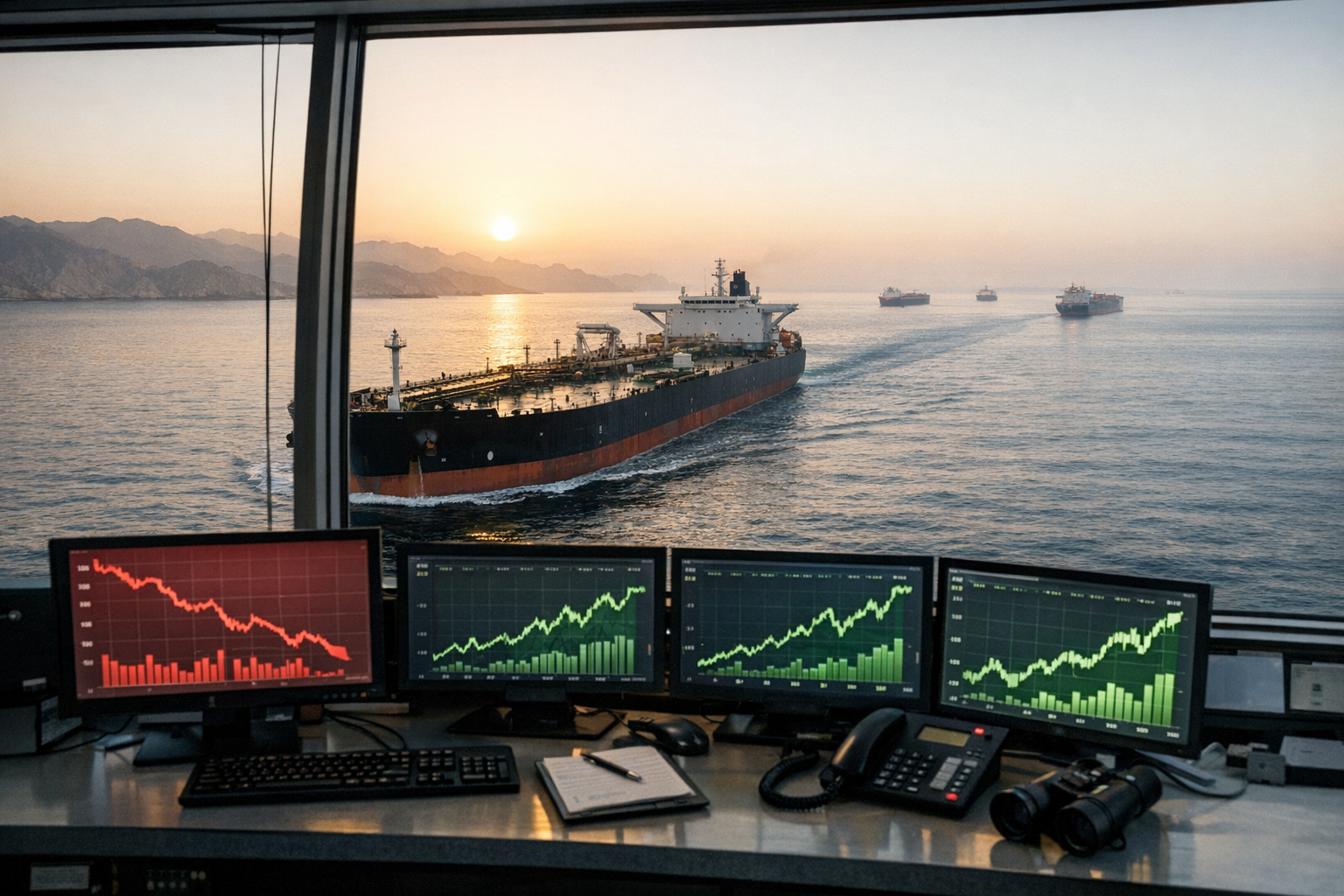
The prospect of a limited breakthrough between Washington and Tehran sent a jolt through oil markets and global equities on Monday, as investors bet that one of the world’s most dangerous energy chokepoints could soon begin to reopen even while officials on both sides cautioned that no final deal was yet at hand.
After weeks of mixed signals, the outlines of a possible interim framework have come into sharper view: a reopening of the Strait of Hormuz, an extension of the ceasefire that has tenuously held since early April, and a short, structured round of follow-on talks over Iran’s nuclear program and sanctions relief. The arrangement, still under discussion, would stop well short of a comprehensive settlement. But for traders, shippers and governments rattled by months of disruption, even the possibility of movement was enough to reshape expectations.
Oil prices fell sharply to their lowest levels in two weeks, while risk assets rallied across Asia. In Tokyo, the Nikkei 225 climbed above 65,000 for the first time, lifted in part by the view that a prolonged supply shock in the Gulf might yet be avoided.
A tentative opening
President Trump, speaking over the weekend, struck a now-familiar balance between optimism and pressure. He said the talks were proceeding constructively, but insisted he had told American negotiators not to hurry. The United States, he said, would keep its naval blockade on Iranian ports in place until any agreement was reached, certified and signed.
Iranian officials, for their part, signaled that progress had been made on many issues in the draft under discussion, while warning that a deal was not imminent and that major decisions still required approval at the top of the Iranian system. Public messages from Tehran remained edged with defiance, underscoring how politically fraught any compromise remains after roughly 12 weeks of war.
Regional mediators, especially from the Gulf, have played an increasingly visible role. Qatar has been deeply involved in efforts to bridge gaps between the two sides, part of a broader push by neighboring states to prevent the conflict from again spilling across maritime lanes and energy infrastructure. The diplomacy now appears focused less on resolving every dispute at once than on sequencing them: first restore navigation through Hormuz and preserve the ceasefire, then use that breathing space for harder arguments over uranium stockpiles, sanctions and frozen Iranian assets.
That distinction matters. The issue under discussion is not yet a grand bargain, but an emergency framework designed to stabilize the immediate crisis.
Why Hormuz matters so much
Few waterways have a more immediate influence on the global economy than the Strait of Hormuz, the narrow passage connecting the Persian Gulf to the open ocean. Before the conflict, roughly one-fifth of the world’s oil and liquefied natural gas shipments passed through it. When that flow is threatened, the effects are felt far beyond the Middle East — in gasoline prices, shipping insurance, factory costs, airline fuel bills and central bank inflation forecasts.
Iran’s effective closure of the strait, combined with the American blockade of Iranian shipping, helped produce the energy squeeze now unsettling major economies. Analysts have warned that inventories in parts of Asia are running perilously low, with Europe not far behind. Some market veterans have argued that if disruptions persisted into summer, shortages could begin to appear more visibly in the United States as well.
That is why markets responded so quickly to even partial signs of diplomatic progress. Traders are trying to price not simply the likelihood of a formal agreement, but the odds that tankers could resume more normal passage, that insurance premiums might retreat, and that emergency stock draws may not have to deepen.
Still, the relief in financial markets may be running ahead of events on the water. Even if a memorandum is signed, restoring shipping volumes to something close to normal could take weeks or months. Vessel owners, insurers and commodity buyers will want proof that the route is genuinely secure and that the ceasefire will hold.
Trump’s political squeeze
The nascent opening with Tehran has also exposed a rare split within Mr. Trump’s political coalition. Republican hawks who strongly backed military action are now attacking the emerging diplomacy as a capitulation, arguing that the administration risks trading away leverage before securing tougher concessions on Iran’s nuclear activities and regional posture.
Mr. Trump has pushed back forcefully, portraying the arrangement under discussion as fundamentally different from the Obama-era nuclear deal that he abandoned in 2018. Yet the criticism has created a new constraint on the White House, which must now show that any agreement delivers visible strategic gains without appearing to reward Iran for escalation.
That balancing act helps explain the president’s contradictory messaging: openness to a deal, insistence on maximum pressure until signatures are in place, and repeated reminders that military force remains available if talks fail. For Mr. Trump, the economic logic of de-escalation is increasingly obvious as energy prices threaten consumers and growth. The political logic is more complicated.
Tehran’s own limits
Iran faces its own pressures. The war and the economic siege around it have inflicted severe strain, but hard-line factions remain wary of any arrangement that looks like surrender under duress. Iranian officials have therefore paired signs of flexibility with warnings that the country will not negotiate from weakness.
Among the most sensitive unresolved questions are access to frozen funds, the scope and timing of sanctions relief, and the fate of Iran’s highly enriched uranium. Some proposals under discussion appear to defer the most contentious nuclear issues rather than settle them immediately, buying time through a 30- to 60-day diplomatic window. That may be the only politically viable route in the short term, but it also leaves open the question of whether a temporary pause can evolve into something durable.
The history of U.S.-Iran negotiations offers ample reason for caution. Interim understandings have often collided with deeper mistrust, domestic opposition and disputes over verification. Final approval will almost certainly require buy-in from Iran’s top leadership and security establishment, just as any American commitment will be scrutinized by Congress, allies and an already divided political class.
Markets are betting on de-escalation
For now, investors appear willing to wager that the immediate trajectory is improving. The sharp drop in oil prices reflected not confidence in peace so much as a reduced probability of worst-case outcomes: a sustained closure of Hormuz, further attacks on Gulf shipping or a renewed round of direct strikes.
That shift in sentiment is already filtering through other asset classes. Lower crude prices ease pressure on inflation and reduce one of the main macroeconomic risks hanging over equities. Import-dependent economies in Asia stand to benefit quickly if energy costs retreat. Europe, which has faced its own vulnerability to energy disruptions in recent years, would also welcome any durable improvement in Gulf flows.
But the danger of whiplash remains high. A failed round of talks, a dispute over implementation or a new military incident in or around the strait could send oil surging again. In that sense, Monday’s market moves were less a verdict than a provisional repricing of risk.
What has changed is not that the crisis is over, but that the possibility of a controlled off-ramp now looks more real than it did only days ago. In an energy market stretched thin and a political environment thick with mistrust, even that narrow opening has become enough to move the world.
Sources
Further reading and reporting used to add context:
- What to know about possible Iran war deal | AP News
- Details emerge of a potential Iran deal after Trump claims progress | AP News
- Global shares gain and oil prices fall as Trump comments on Iran peace talks | AP News
- https://www.axios.com/2026/05/24/oil-prices-iran-war-hormuz-strait-trump-tehran-peace-talks
- https://www.axios.com/2026/05/24/iran-deal-white-house-delay-days-trump
- https://www.thedailybeast.com/murdoch-paper-wall-street-journal-sounds-alarm-on-who-really-holds-trump-card-in-iran-war/
- https://www.thedailybeast.com/trump-goons-buy-themselves-more-time-to-fix-boss-mess/
- https://www.worldoil.com/news/2026/5/5/trump-puts-hormuz-reopening-mission-on-hold-amid-escalation-risk/
- https://www.worldoil.com/news/2026/5/24/u-s-iran-reportedly-near-interim-hormuz-agreement/
- https://www.bloomberg.com/news/articles/2026-05-16/trump-returns-from-china-with-little-progress-to-reopen-hormuz
- https://www.theguardian.com/us-news/trump-administration/2026/may/25/all
- https://worldoil.com/news/2026/5/6/oil-sinks-as-possible-u-s-iran-deal-raises-hopes-for-hormuz-reopening/
- https://www.washingtonpost.com/world/2026/05/24/us-iran-near-deal-extend-ceasefire-reopen-hormuz//
- https://www.bloomberg.com/news/articles/2026-05-17/us-and-iran-far-from-hormuz-deal-as-drone-hits-uae-power-plant?srnd=phx-industries
- https://newsdig.tbs.co.jp/articles/withbloomberg/2681617?display=1
- https://fortune.com/2026/05/24/oil-prices-us-ceasefire-deal-iran-hormuz-strait-reopening/
- Trump says there is no rush for Iran deal, US blockade stays – Internazionale
- https://www.gmanetwork.com/news/topstories/world/983603/trump-vows-to-blockade-strait-of-hormuz-after-iran-peace-talks-stumble/story/
- https://www.theguardian.com/world/2026/may/24/trump-says-he-does-not-make-bad-deals-but-even-republican-hawks-doubt-that-now
- https://en.wikipedia.org/wiki/2026_Iran_war_ceasefire
- https://en.wikipedia.org/wiki/May_2026_United_States_strikes_on_Iran
- https://en.wikipedia.org/wiki/2026_Strait_of_Hormuz_campaign
- https://en.wikipedia.org/wiki/2026_United_States_naval_blockade_of_Iran
- https://en.wikipedia.org/wiki/Operation_Project_Freedom
- https://en.wikipedia.org/wiki/2026_Iran_war
- https://www.thedailybeast.com/marco-rubio-brutally-undercuts-trumps-nonsensical-boast-on-an-iran-deal/
- https://www.axios.com/2026/05/18/iran-peace-deal-offer-nuclear-unacceptable
- https://wkzo.com/2026/05/25/iran-says-conclusions-reached-on-many-topics-in-potential-u-s-memorandum-but-no-deal-imminent/
- https://www.investing.com/news/commodities-news/rubio-cites-some-progress-on-iran-talks-but-were-not-there-yet-4706951
- https://www.streetinsider.com/Reuters/Iran%2Bsays%2Bconclusions%2Breached%2Bon%2Bmany%2Btopics%2Bin%2Bpotential%2BU.S.%2Bmemorandum%2Bbut%2Bno%2Bdeal%2Bimminent/26543951.html
- https://www.theguardian.com/us-news/video/2026/may/24/marco-rubio-says-significant-progress-made-in-talks-with-iran-video
- https://www.investing.com/news/stock-market-news/rubio-says-us-will-find-another-way-if-iran-talks-fail-4708305
- https://www.thedailystar.net/news/world/us-israel-war-iran/news/iran-has-not-agreed-hand-over-highly-enriched-uranium-stockpile-reuters-4183346
- https://www.japantimes.co.jp/news/2026/05/25/world/politics/trump-iran-deal-us-blockade/
- https://www.aljazeera.com/amp/news/2026/5/25/iran-war-day-87-trump-says-us-not-in-rush-to-sign-deal-dashing-optimism
- https://www.investing.com/news/world-news/rubio-says-us-will-either-have-a-good-agreement-with-iran-or-deal-with-it-another-way-4708289
- https://www.bangordailynews.com/2026/05/22/nation/rubio-some-progress-iran/
- https://www.japantimes.co.jp/news/2026/05/25/world/trump-iran-deal-us-blockade/
- https://www.al-monitor.com/originals/2026/05/rubio-cites-some-progress-iran-talks-were-not-there-yet
- https://www.reddit.com/r/worldnews/comments/1tm82b4/iran_has_not_agreed_to_hand_over_highly_enriched/
- https://cepr.org/system/files/publication-files/298740-policy_insight_150_is_a_lasting_u_s_iran_deal_now_possible_overcoming_time_inconsistency_and_political_debt_overhang.pdf
- https://www.moneycontrol.com/news/business/markets/japan-s-nikkei-tops-65-000-for-first-time-as-trump-iran-peace-hopes-sink-oil-below-100-13929646.html
- https://www.ndtvprofit.com/markets/asian-markets-today-nikkei-crosses-65-000-for-first-time-as-oil-slumps-on-iran-deal-expectations-11542584/amp/1
- https://www.koranmanado.co.id/en/nikkei-hits-record-oil-drops
- https://easternherald.com/2026/05/25/oil-prices-fall-nikkei-record-us-iran-deal-hormuz-may-2026/
- https://apnews.com/article/0da189a3d33b041087b7df6096e5c8ad
- https://www.goodreturns.in/news/crude-oil-price-falls-asian-stocks-surge-on-hopes-of-us-iran-peace-deal-and-strait-of-hormuz-reopen-014-1510655.html
- https://fortune.com/2026/05/03/oil-market-outlook-nightmare-scenarios-crude-inventories-tank-bottoms-iran-tank-tops/
- https://www.breakingviews.com/columns/considered-view/oil-markets-demand-crunch-is-about-go-global-2026-04-24/
- https://www.gmanetwork.com/news/money/economy/986535/oil-dips-but-still-above-100-a-barrel-investors-take-heart-from-upbeat-earnings/story/
- https://www.bloomberg.com/news/videos/2026-05-06/us-oil-storage-tanks-to-run-empty-around-july-4-currie-video
- https://www.moneycontrol.com/news/business/oil-dollar-fall-on-expectations-over-iran-deal-13929340.html
- https://www.investing.com/news/commodities-news/factboxubs-raises-brent-oil-price-view-as-straitof-hormuz-disruptions-persist-4610170
- https://www.washingtonpost.com/business/2026/05/24/stocks-markets-iran-trump-oil/8e60a232-57e2-11f1-8a9d-afb1148204e1_story.html
- https://www.reddit.com/r/oil/comments/1tn05lv/oil_market_at_tank_bottoms_in_asia_europe_isnt/
- https://en.wikipedia.org/wiki/2026_Strait_of_Hormuz_crisis