
A Split Economy Comes Into Sharper Focus
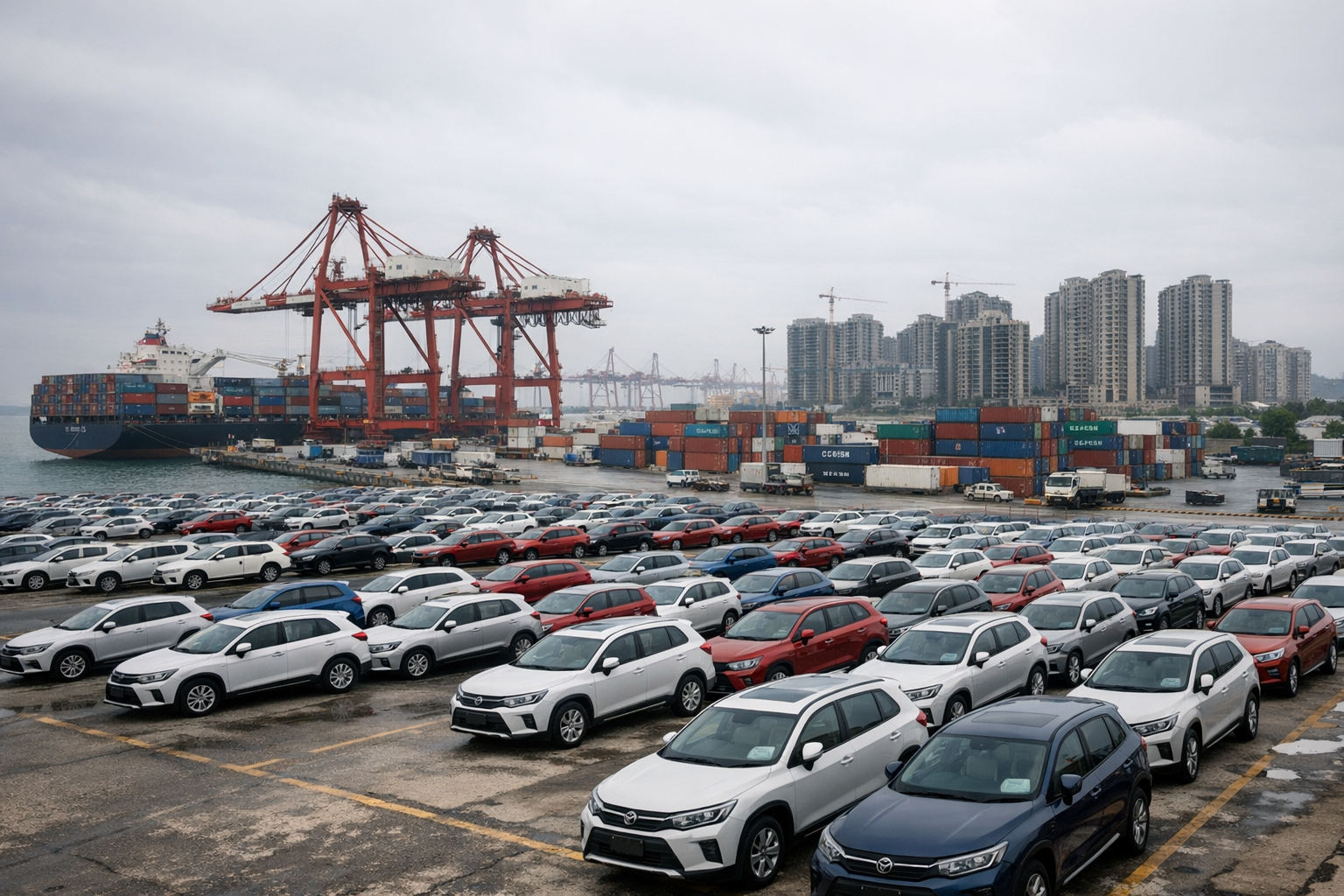
China’s economy slowed markedly in the second quarter, recording its weakest quarterly growth since late 2022 even as exports surged and car shipments hit a record, underscoring the increasingly uneven nature of the country’s recovery.
Official data showed gross domestic product grew 4.3 percent from a year earlier in the April-to-June period, down from 5.0 percent in the first quarter and below the pace many economists say would be needed to comfortably meet Beijing’s annual goal. The deceleration reflected persistent weakness in domestic demand, a prolonged property slump and a broader retreat in investment.
Fixed-asset investment fell 5.7 percent in the first half of the year, while property investment dropped 18 percent, figures that reinforced how deeply the housing downturn continues to weigh on the broader economy. For years, property and construction were central engines of Chinese growth; now they remain among its biggest drags.
Yet the same batch of data also highlighted a striking counterweight: China’s export machine is still humming.
June exports rose 27 percent from a year earlier, and the country’s trade surplus widened to $125.6 billion. Vehicle exports topped one million in a single month for the first time, another sign of China’s growing dominance in global auto markets, particularly in electric vehicles and other lower-cost manufactured goods.
Exports Carrying More of the Load
The contrast points to what many economists have described as a two-speed economy. On one side are factories, exporters and segments of advanced manufacturing, helped by strong overseas demand for industrial products, autos and some technology-related goods. On the other are households, private investors and the battered property sector, where confidence has yet to recover.
That imbalance has become more important as China leans more heavily on trade to compensate for softness at home. Goods trade rose 16.9 percent in the first half of the year to 25.47 trillion yuan, according to official figures, with exports up 13.4 percent. High-tech shipments have also been strong, aided in part by demand tied to artificial intelligence supply chains.
The result is an economy still expanding, but in a way that looks increasingly dependent on external demand rather than a broad-based revival in spending at home.
That matters not only for China’s own outlook, but for the rest of the world. A China powered more by exports than consumption can intensify political tensions abroad, especially as Chinese manufacturers gain market share in sectors that governments in Europe and the United States regard as strategic.
Pressure Builds on Beijing
The slower growth reading is likely to increase calls for Beijing to do more to support the economy, particularly through fiscal measures aimed at boosting demand and stabilizing investment.
China’s official growth target this year, set in a range of roughly 4.5 percent to 5 percent, was already its least ambitious in decades. Even so, the second-quarter slowdown has raised doubts about how easily that goal can be reached without additional support.
Investors and policy analysts are now looking to the late-July Politburo meeting for clues about the leadership’s next steps. The central question is whether officials will move beyond incremental support for production and infrastructure and do more to revive household confidence, shore up the property market and encourage private-sector investment.
Many economists expect any response to carry a stronger fiscal tilt — more spending, targeted support and perhaps additional help for local governments — rather than a dramatic policy shift. Rate cuts remain possible, but analysts say cheaper credit alone may do little if households and businesses remain reluctant to borrow and spend.
The Risks Beyond China
China’s export strength, while offering a near-term cushion, comes with its own vulnerabilities.
If global demand weakens, the external sector may no longer be able to offset weakness at home. And if Chinese exports continue rising rapidly — especially autos and other industrial goods — they are likely to invite more scrutiny and more trade barriers.
That risk is already visible. Chinese carmakers have expanded aggressively overseas, and their gains have unsettled competitors and policymakers in both the European Union and the United States. Further tariffs or other restrictions could challenge one of the few clear bright spots in China’s economy.
For now, the latest figures suggest that China has not stalled, but neither has it found a balanced recovery. Its factories are producing, its exporters are shipping and its carmakers are setting records. But at home, investment is falling, the property slump is deepening and consumers remain cautious.
That divergence is becoming harder for Beijing to ignore.
Sources
Further reading and reporting used to add context:
- https://apnews.com/article/95136222f87d5a1e62918f41efab00be
- https://apnews.com/article/29da1a43eba2961b57f6cfbe6f936e42
- https://apnews.com/article/4bce218f337534299f230c510917b84c
- https://www.theguardian.com/business/2026/jul/14/china-car-exports-june-trade-us-eu-trump-tariffs
- https://carnewschina.com/2026/07/10/chinas-monthly-vehicle-exports-exceed-1-million-for-the-first-time-with-nevs-claiming-over-half/
- https://www.investing.com/news/economy-news/chinas-q2-growth-set-to-lose-steam-stimulus-to-remain-calibrated-4791821
- https://www.channelnewsasia.com/watch/chinas-car-exports-top-million-in-june-6253546
- https://www.caixinglobal.com/2026-07-10/chinas-monthly-auto-exports-top-1-million-vehicles-for-first-time-102462538.html
- https://www.stats.gov.cn/english/PressRelease/202507/t20250728_1960507.html
- https://www.china.org.cn/2026-07/14/content_118598180.shtml
- https://english.scio.gov.cn/pressroom/node_9019860.html
- Instant View: China's second-quarter economic growth misses market forecast | MarketScreener Australia
- https://ca.marketscreener.com/news/china-car-sales-fall-again-exports-stay-strong-ce7f5ed8d18cf120
- China's H1 foreign trade posts 16.9 pct growth with optimized structure
- https://www.marketscreener.com/news/china-s-june-trade-tops-forecasts-buoyed-by-ai-boom-ce7f5edcdc89f526
- https://www.reddit.com/r/RWATimes/comments/1uww2kp/china_posts_slowest_quarterly_growth_since_2022/
- https://www.stats.gov.cn/english/PressRelease/202507/t20250715_1960408.html
- https://www.stats.gov.cn/sj/zxfbhjd/202607/t20260715_1964121.html
- https://www.stats.gov.cn/english/PressRelease/202407/t20240715_1955620.html
- https://www.stats.gov.cn/english/PressRelease/202107/t20210715_1819447.html
- https://www.stats.gov.cn/english/PressRelease/202604/t20260416_1963326.html
- https://www.stats.gov.cn/sj/zxfbhjd/202607/t20260715_1964129.html
- https://www.stats.gov.cn/english/PressRelease/ReleaseCalendar/202512/t20251226_1962154.html
- https://www.stats.gov.cn/english/
- https://www.stats.gov.cn/sj/zxfb/202607/t20260715_1964127.html
- https://www.stats.gov.cn/english/PressRelease/202604/t20260420_1963362.html
- https://www.stats.gov.cn/english/PressRelease/202207/t20220715_1886414.html
- https://www.stats.gov.cn/english/PressRelease/index_26.html
- https://www.stats.gov.cn/zs/tjwh/tjkw/tjqk/zgxxb/202605/P020260513314347281500.pdf
- https://www.stats.gov.cn/zs/tjwh/tjkw/tjqk/zgxxb/202606/P020260603350986721236.pdf
- https://www.stats.gov.cn/english/Statisticaldata/yearlydata/yarbook2003_e.pdf
- https://csr.stats.gov.cn/kydt/xhyq/202604/P020260427527027644865.pdf
- https://unbdc.stats.gov.cn/en/gjjlyhz/gjsjjsqxm/202503/P020250303518701275524.pdf
- https://unbdc.stats.gov.cn/nljs/lhghksbs/2024lhghksbs/ymnr/202409/P020240924386215728154.pdf