
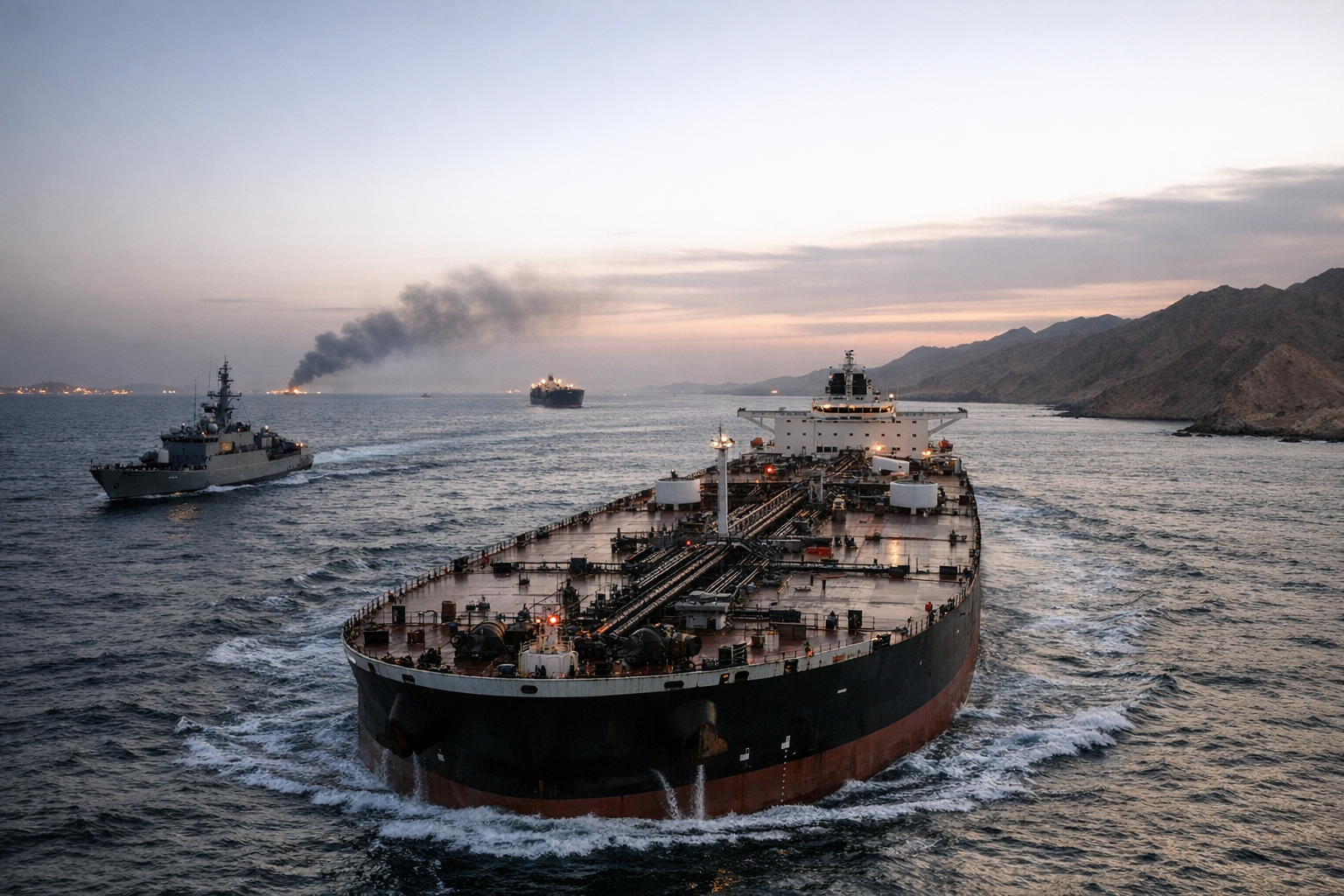
Oil Surges Past $100 as New Shipping Threats Spread Beyond Hormuz
Oil prices climbed above $100 a barrel on Thursday, and stocks fell sharply, after Yemen’s Houthi militia said it had attacked two Saudi oil tankers in the Red Sea, opening a second major threat to global energy flows alongside the already strained Strait of Hormuz.
The move jolted markets because it suggested the region’s conflict was no longer confined to one maritime choke point. Traders have spent weeks weighing the danger that fighting involving Iran and the United States could disrupt Hormuz, the narrow waterway through which a large share of the world’s seaborne oil passes. But the latest attacks raised a more troubling possibility: simultaneous pressure on both Hormuz and the Bab el-Mandeb corridor at the southern entrance to the Red Sea.
Brent crude settled at $100.69 a barrel, its first close above $100 since May, as investors priced in the risk that two of the world’s most important shipping lanes could be constrained at once. U.S. equities, which had until recently shown a surprising resilience to the widening war, turned lower, posting their worst decline in about a month as energy costs and fears of broader escalation rippled through markets.
A Second Pressure Point
The Houthis said the strikes on the Saudi tankers were part of a declared blockade on Saudi shipping. The attacks immediately sharpened concern over the security of the Red Sea route, which has become more important as Saudi Arabia redirected millions of barrels a day of exports to its Red Sea port at Yanbu to work around war-related disruption in Hormuz.
That adaptation, once seen as a useful hedge, now appears more vulnerable.
Bab el-Mandeb, the narrow passage linking the Red Sea to the Gulf of Aden, is one of the world’s critical maritime bottlenecks. It carries not only oil but a significant share of global trade. If shipowners, insurers and commodity traders begin to treat the route as effectively semi-closed, even without a formal blockade, the impact could spread quickly through freight rates, fuel prices and supply chains far beyond the Middle East.
The central question for markets is not simply whether attacks occur, but whether they become persistent enough to deter regular commercial traffic. Some tankers are still transiting the area, suggesting that disruption remains episodic rather than absolute. But Thursday’s price jump reflected growing fear that the threshold may be nearing where isolated strikes become a sustained commercial problem.
Trump Threatens Iran With Retaliation
President Trump responded by saying the United States would hold Iran responsible for any future Houthi attacks on shipping, tying Tehran more directly to the Red Sea threat and raising the prospect of wider U.S. military action.
His warning came as tensions were already intensifying over maritime traffic and Iranian actions in and around Hormuz. Earlier, Iran’s Revolutionary Guard said it had stopped three oil tankers from passing through the strait, adding to the sense that the conflict was closing in on the arteries of global energy trade.
Trump also issued a stark threat over any Iranian attack on a ship in Hormuz, saying the United States would respond by striking Iranian infrastructure. The language was among the most explicit yet from the White House in linking maritime harassment to direct punishment inside Iran.
That message deepened investor anxiety because it suggested a growing risk of a cycle in which attacks on shipping prompt retaliation on land, which in turn invites wider regional responses. What had been viewed as a series of dangerous but compartmentalized episodes now appears increasingly connected.
Britain Drawn Further Into the Crisis
The widening confrontation has also placed American allies under greater pressure. Britain said it was ready to defend itself after Iran’s military warned that any bases used by the United States were legitimate targets.
The warning followed reports that the United States had launched defensive operations from British bases hosting American aircraft, though London has said it is not participating in offensive action. Even so, the Iranian threat underscored how the conflict’s geography is broadening: from the Gulf and the Red Sea to Western military facilities linked to American operations.
For Britain and other U.S. partners, the challenge is no longer only diplomatic. It is now also about force protection, domestic security and the risk of being drawn more deeply into a conflict through logistical support alone.
Why Markets Are Reacting Now
Financial markets had, until this week, appeared to assume that the conflict would remain contained enough to spare the global economy from a major oil shock. That assumption is being tested.
“It’s too hard to ignore $100 oil,” one market refrain has become, as the rise in crude threatens to complicate inflation, increase transport and manufacturing costs, and weaken consumer sentiment. Higher energy prices can also constrain central banks, which may be less willing to cut interest rates if a fresh oil spike begins feeding into broader prices.
What changed on Thursday was not only the violence itself, but the location. Hormuz has long been the obvious flashpoint. The attack in the Red Sea suggested that alternate export routes, including those Saudi Arabia had leaned on to reduce its Hormuz exposure, may no longer offer much safety.
That is why the latest escalation matters beyond a single day’s trading. If both Hormuz and Bab el-Mandeb are seen as vulnerable at the same time, the world oil market loses some of its flexibility just as war risk is increasing.
What Comes Next
The next phase may depend less on rhetoric than on whether shipping patterns materially change.
If the Houthis can sustain attacks at a pace that pushes insurers to raise rates sharply or causes owners to reroute vessels, oil and freight markets could tighten further. If the United States follows through on Trump’s warnings with broader strikes on Iran, the conflict could move into a more direct and unpredictable stage. And if commercial traffic continues to pass, however nervously, some of Thursday’s price spike could fade.
For now, though, traders and governments alike are confronting a more dangerous scenario than the one they faced only days ago: not one threatened choke point, but two.
Sources
Further reading and reporting used to add context:
- Houthi blockade of Saudi Arabia could further disrupt global trade | AP News
- https://apnews.com/article/3cb4bc150707e0a4378312fbb825f5e4
- https://apnews.com/article/c492604ca2bf139c6d7db7065c951ff1
- https://apnews.com/article/0b9c3b2aa5ca83eb391c1388efe03c97
- https://apnews.com/article/78c2dbf538f6e61ab816479a4d9bdd85
- https://www.thedailybeast.com/trump-melts-down-at-smart-terrorists-after-oil-prices-rocket-past-100/
- https://apnews.com/article/60d46bf8c83c43a8f2268b7b87627c55
- https://theweek.com/politics/yemen-houthis-bab-el-mande-strait
- https://www.investing.com/news/commodities-news/houthis-say-they-attacked-saudi-tankers-in-the-red-sea-threatening-new-chokepoint-in-iran-war-4807467
- https://www.investing.com/news/commodities-news/us-energy-shares-gain-as-houthi-tanker-attacks-push-brent-to-100-4809174
- https://www.internazionale.it/ultime-notizie-reuters/2026/07/23/uk-says-armed-forces-ready-to-defend-country-after-iran-warning-over-us-bombers
- Trump vows to punish Iran for Houthi attacks in Red Sea; oil surges over $100 By Reuters
- Oil settles over $100 as Houthi attacks intensify Middle East supply risks | live
- https://www.washingtonpost.com/business/2026/07/23/iran-us-hormuz-strait-war/be34abba-8664-11f1-9cec-0fb26676f07e_story.html
- https://theprint.in/world/trump-threatens-iranian-infrastructure-after-houthis-block-red-sea-artery/2993984/
- https://ca.investing.com/news/commodities-news/houthis-say-they-attacked-saudi-tankers-threatening-new-chokepoint-in-iran-war-4748600
- https://live.euronext.com/en/financial-news/uks-ftse-100-slips-oil-tops-100-middle-east-conflict-bond-yields-rise
- https://live.euronext.com/en/financial-news/oil-extends-gains-after-houthi-attack-saudi-tankers-worsens-oil-supply-disruption
- https://sa.marketscreener.com/news/uk-says-armed-forces-ready-to-defend-country-after-iran-warning-over-us-bombers-ce7f51dede81f023
- https://www.internazionale.it/ultime-notizie-reuters/2026/07/23/houthis-say-they-attacked-saudi-tankers-in-the-red-sea-threatening-new-chokepoint-in-iran-war
- https://hansard.parliament.uk/pdf/%E2%80%8CCommons/2026-03-05
- https://en.wikipedia.org/wiki/2026_Iranian_strikes_on_British_military_facilities
- https://hansard.parliament.uk/pdf/Commons/2026-03-17
- https://www.reddit.com/r/TrumpGlobalWar/comments/1v499l8/global_war_briefing_23072026_06_26_am_et_last_24/
- https://www.reddit.com/r/geopolitics/comments/1v41vk9/houthis_claim_attack_on_saudi_tankers_in_red_sea/
- https://www.reddit.com/r/news/comments/1v41ufw/houthis_claim_attack_on_saudi_tankers_in_red_sea/
- https://www.theguardian.com/business/2026/apr/02/oil-price-rises-markets-slide-following-trump-iran-war-address
- https://www.theguardian.com/business/2026/may/26/oil-price-energy-market-us-iran-peace-talks
- https://www.theguardian.com/us-news/2026/mar/11/us-oil-iran-israel-war/
- https://www.theguardian.com/business/2026/mar/09/iran-war-drives-oil-price-above-100-a-barrel-for-first-time-since-2022
- https://www.theguardian.com/business/live/2026/mar/02/oil-price-us-israel-iran-war-100-dollars-a-barrel-stock-markets-drop-travel-news-updates?page=with%3Ablock-69a543ae8f0863f6a3eff95a
- https://www.theguardian.com/business/2026/jul/13/oil-prices-leap-stocks-fall-us-iran-strait-of-hormuz-brent-crude-markets
- https://www.theguardian.com/world/2026/mar/02/oil-prices-iran-war-strait-of-hormuz-shipping
- https://www.theguardian.com/business/2026/jun/25/oil-price-falls-pre-iran-war-levels-more-tankers-exit-strait-of-hormuz
- https://www.theguardian.com/business/2026/mar/01/oil-price-surge-iran-us-israel-strikes-markets
- https://www.theguardian.com/world/2026/jul/08/oil-prices-rise-iran-attack-tankers-strait-of-hormuz
- https://www.theguardian.com/business/live/2026/apr/24/stock-market-warning-bank-of-england-deputy-governor-trump-threatens-uk-tariff-business-live?page=with%3Ablock-69eb71c28f089bd0e8b1faa0
- https://www.theguardian.com/business/2026/mar/17/oil-gas-prices-rise-iran-us-israel-war-brent-crude-uae-strikes
- https://fm.cnbc.com/applications/cnbc.com/resources/editorialfiles/2012/05/03/2226650_goldman_sachs_superspike.pdf
- https://fm.cnbc.com/applications/cnbc.com/resources/editorialfiles/2012/07/03/2012-02-27%20Ask%20Warren%20Transcript.pdf
- https://www.theguardian.com/us-news/2026/feb/23/trump-iran-airstrikes-nuclear-deal
- https://www.theguardian.com/world/2026/jun/11/trump-seize-control-iran-oil-gas-ceasefire
- https://www.theguardian.com/world/2026/mar/02/what-is-uk-involvement-middle-east-war-us-israel-iran
- https://www.theguardian.com/world/2026/mar/21/iran-reportedly-fires-missiles-towards-uk-us-base-on-diego-garcia
- https://www.theguardian.com/us-news/2026/feb/19/forget-the-board-of-peace-trump-may-be-closer-than-thought-to-attacking-iran
- https://www.theguardian.com/us-news/trump-administration
- https://www.theguardian.com/world/2026/may/19/trump-iran-analysis
- https://www.theguardian.com/politics/2026/mar/01/uk-to-allow-us-to-use-british-bases-for-defensive-strikes-against-iran
- https://www.theguardian.com/world/2026/mar/23/trump-extends-iran-deadline-five-days-energy-infrastructure
- https://www.theguardian.com/us-news/2026/feb/24/first-thing-trump-iran-airstrikes-kushner-witkoff
- https://www.theguardian.com/politics/2026/feb/28/starmer-chairs-cobra-meeting-after-us-israel-strikes-on-iran
- https://www.theguardian.com/world/2026/may/19/trump-threatens-a-big-hit-if-tehran-does-not-make-deal-soon
- https://advertising.theguardian.com/assets/files/the-guardian-advertising-awards-2025-t%26cs-%281%29.pdf
- https://recruiters.theguardian.com/assets/files/schools_recruitment_guide/Guardian-Jobs-Schools-Recruitment-Guide-2021.pdf
- https://recruiters.theguardian.com/assets/files/inclusive_recruitment/The-Guardian-Jobs-guide-to-inclusive-recruitment.pdf
- https://advertising.theguardian.com/assets/files/media-kit-2026-1772022840.pdf