
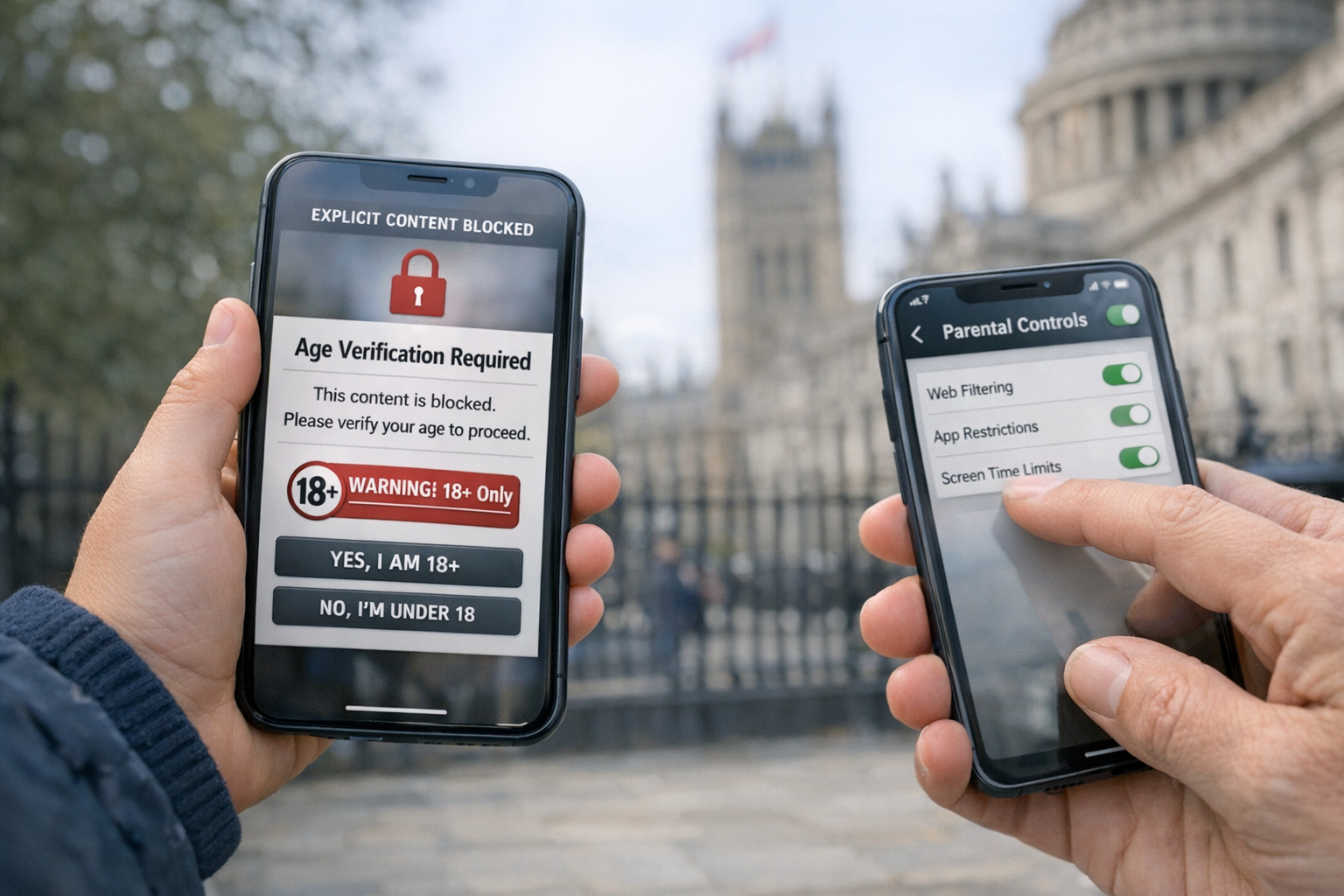
Prime Minister Keir Starmer on Monday gave Apple, Google and other technology companies until September to install protections on children’s phones and tablets that would block the taking or sharing of explicit images unless a user is verified as an adult, opening a new front in Britain’s effort to police online harms.
If the companies do not act voluntarily, Mr. Starmer said, his government will introduce legislation to compel them.
The demand marks a significant escalation in Britain’s child-safety agenda. Rather than focusing only on social media companies and websites, ministers are now pressing for safeguards to be built into the devices themselves — at the level of operating systems and default settings — so that harmful content can be stopped before it is sent, received or stored.
A Shift From Platforms to Devices
The government said the proposed changes would apply to smartphones and tablets used in Britain, including devices already in circulation as well as newly sold ones. Ministers want technology companies to activate nudity-detection tools or similar measures that would prevent children from taking or sharing sexual images, while allowing adults to access lawful content if they prove they are over 18.
Officials say existing protections are too uneven: some features are optional, some are switched off by default, and some merely blur images rather than preventing them from being created or exchanged. The government has pointed to technology already on the market as evidence that stronger protections can be deployed without broadly undermining user privacy.
That approach would move Britain beyond the logic of platform moderation, where companies are asked to remove harmful material after it appears, and toward prevention built into the device itself.
A Tougher Online-Safety Climate
The move comes as Britain is already enforcing one of the Western world’s most muscular online-safety regimes under the Online Safety Act. Ofcom, the communications regulator, has been pressing platforms to protect children from harmful content and to introduce robust age checks, and major pornographic websites and online services have begun tightening access controls in response.
Earlier this year, Mr. Starmer’s government said it wanted powers to move more quickly on child-protection measures after launching a broader consultation on youth online safety. That review has examined not only age thresholds for social media use, but also product features that critics say encourage compulsive use among children.
Apple has already taken some steps in Britain, introducing adult-age confirmation for certain 18-plus features and turning on “Communication Safety” protections by default for under-18 users. Whether Google and other companies will match that level of device-based intervention — and on what timetable — remains uncertain.
Politics of a Crackdown
The pressure on the companies is arriving in the middle of a widening political argument over how far Britain should go in restricting children’s access to digital services.
Kemi Badenoch, the Conservative leader, dismissed Mr. Starmer’s warning to the technology firms as inadequate and argued that a ban on social media for under-16s would be a simpler answer. That position reflects a broader push from some lawmakers and campaigners who say only bright-line age rules can meaningfully curb harms to children online.
But opponents of broad teen social-media bans say such measures carry their own risks. Critics, including executives at smaller social platforms, have warned that strict age-gating regimes can strengthen the market power of the largest technology companies, which have the money, technical infrastructure and legal teams to comply. Smaller entrants, they argue, may struggle to meet the same standards, making it harder to build alternative online spaces that might be healthier by design.
That tension — between child safety and competition, between parental demands and privacy concerns — is likely to shape the next phase of the debate.
The Questions Still Unanswered
For all the force of the government’s deadline, many of the practical details remain unsettled.
It is not yet clear what technical standard ministers expect companies to meet by September, whether nudity detection alone would satisfy the requirement, or how age verification would work without creating new privacy and surveillance concerns. The government says any system must protect children without collecting unnecessary personal data, but exactly how that would be enforced has not been spelled out.
It is also unclear whether ministers intend to rely on voluntary compliance, secondary legislation or a more sweeping rewrite of child-safety rules if the companies fall short. And because modern app ecosystems involve operating-system makers, app stores, device manufacturers and retailers, enforcement could become complicated quickly.
Still, the message from Downing Street was unmistakable: Britain wants children’s devices to be safe by default, not merely safer if families manage to find and turn on the right settings.
The significance of that demand extends beyond explicit images alone. If the government succeeds, it could establish a precedent for regulating not just what children see online, but what the hardware and software in their hands are allowed to do. And with the government expected to respond this summer to its wider consultation on child online safety, the ultimatum to Apple and Google may be only the beginning of a broader tightening of the rules around how young people use the internet.
Sources
Further reading and reporting used to add context:
- https://www.ofcom.org.uk/online-safety/illegal-and-harmful-content/quick-guide-to-childrens-risk-assessments
- https://www.gov.uk/government/news/tech-firms-will-have-to-take-down-abusive-images-within-48-hours-under-new-law-to-protect-women-and-girls
- https://www.ofcom.org.uk/online-safety/illegal-and-harmful-content/statement-protecting-children-from-harms-online?language=en
- https://www.ofcom.org.uk/online-safety/protecting-children/keep-underage-children-off-your-platforms-ofcom-tells-tech-firms?language=en
- https://ground.news/article/social-media-bans-on-teens-risk-strengthening-big-techs-grip-on-the-sector-bluesky-exec-warns
- https://www.gov.uk/government/news/pm-no-platform-gets-a-free-pass-government-takes-action-to-keep-children-safe-online
- https://techgolly.com/social-media-regulation-monopoly-risk-why-teen-bans-strengthen-big-techs-grip/
- https://www.ofcom.org.uk/online-safety/protecting-children/new-rules-for-a-safer-generation-of-children-online?language=en
- https://www.gov.uk/government/news/keeping-children-safe-online-changes-to-the-online-safety-act-explained
- https://www.independent.co.uk/news/uk/politics/keir-starmer-apple-prime-minister-government-shabana-mahmood-b2991614.html
- https://www.ofcom.org.uk/online-safety/protecting-children/tech-firms-commit-to-stronger-anti-grooming-measures-in-response-to-ofcom-demands
- https://techcrunch.com/2026/03/19/bluesky-announces-100m-series-b-after-ceo-transition/
- https://www.ofcom.org.uk/siteassets/resources/documents/online-safety/research-statistics-and-data/os-standards/online-safety-in-2025-summary-of-the-technology-sectors-response-to-our-rules.pdf?v=408836
- https://www.pcgamer.com/hardware/uk-regulators-explain-what-highly-effective-age-assurance-for-the-online-safety-act-actually-means/
- https://www.techradar.com/vpn/vpn-privacy-security/hands-off-the-vpns-mozilla-warns-uk-regulators-that-age-restricting-vpns-would-undermine-the-privacy-and-security-of-all-users-while-failing-to-protect-kids
- https://www.techradar.com/vpn/vpn-privacy-security/vpns-are-not-a-threat-industry-hopes-for-an-evidence-based-outcome-to-uk-online-safety-consultation
- https://www.reddit.com/r/NBCauto/comments/1ty87pn/tech_social_media_bans_on_teens_risk/
- https://www.reddit.com/r/devopsish/comments/1tztpft/social_media_bans_on_teens_risk_strengthening_big/
- https://www.reddit.com/r/AutoNewspaper/comments/1ty8lry/tech_social_media_bans_on_teens_risk/
- Growing up in the online world: a national consultation – GOV.UK
- https://www.childrenscommissioner.gov.uk/resource/children-nudification-tools-and-sexually-explicit-deepfakes/
- https://www.gov.uk/government/publications/review-of-sexual-abuse-in-schools-and-colleges/review-of-sexual-abuse-in-schools-and-colleges?v=1731499270
- https://www.childrenscommissioner.gov.uk/blog/protecting-children-online-why-we-need-to-act-now-to-keep-children-safe-from-online-dangers/
- https://www.nationalcrimeagency.gov.uk/news/retired-detective-inspector-sought-images-of-girls-aged-14?highlight=WyJuYXRpb24iLCJuYXRpb25hbCIsIm5hdGlvbmFsbHkiLCJuYXRpb25zJyIsIm5hdGlvbmFsaXR5IiwibmF0aW9uYWxzIiwibmF0aW9ucyIsIm5hdGlvbmFsbHknIiwibmF0aW9uYWxpdGllcyIsIm5hdGlvbidzIl0%3D
- https://www.cps.gov.uk/prosecution-guidance/indecent-and-prohibited-images-children
- https://www.gov.uk/government/publications/crime-and-policing-bill-2025-echr-supplementary-memoranda/crime-and-policing-bill-echr-supplementary-memorandum-10-april-2026–2
- https://www.gov.uk/government/publications/relationships-education-relationships-and-sex-education-rse-and-health-education/
- https://www.gov.uk/government/publications/crime-and-policing-act-2026-factsheets/crime-and-policing-act-2026-child-sexual-abuse-material-factsheet
- https://www.gov.uk/guidance/child-online-safety-protecting-children-from-online-sexual-exploitation-and-abuse
- https://safeguardingchildren.stoke.gov.uk/professionals
- https://assets.childrenscommissioner.gov.uk/wpuploads/2025/04/Children-nudification-tools-and-sexually-explicit-deepfakes-April-2025.pdf
- https://assets.publishing.service.gov.uk/media/64a53f36c531eb001364fe85/Online_Harms_Study_Final_report_updated_51222_updated_290623.pdf
- https://www.surreyi.gov.uk/download/2ok3n/yn7/160412_CSE_NA_for_publication_final.pdf
- https://decisionmaking.westberks.gov.uk/documents/g8564/Printed%20minutes%20Thursday%2011-Sep-2025%2018.30%20Children%20and%20Young%20People%20Scrutiny%20Committee.pdf?T=1
- https://assets.publishing.service.gov.uk/media/684036f6cb73e8b12647b3de/TRATMPO_William_Atkins_conduct_panel_outcome.pdf
- https://assets.apnews.com/19/1b/545643064e0caecf2c92d2897ce0/ap-ncaa-bracket-men.pdf
- https://www.cnbc.com/quotes/AAPL?qsearchterm=APPL
- https://fm.cnbc.com/applications/cnbc.com/resources/editorialfiles/2026/05/26/Anti-Fraud_Task_Force_Letter_With_EditsBlackline51_1.pdf
- https://www.cnbc.com/2025/09/04/trump-to-host-tech-ceos-over-dinner-for-inaugural-event-in-rose-garden.html?msockid=29e802642175608130fa143920b461ce
- https://www.cnbc.com/video/2021/10/06/regulating-social-media-like-big-tobacco-not-the-way-to-do-it-the-atlantics-brooks.html
- https://product.cnbc.com/
- https://www.cnbc.com/amp/2025/08/26/meta-messenger-instagram-child-safety-pta.html
- https://www.cnbc.com/2025/07/30/ai-meta-zuckerberg-superintelligence.html?_bhlid=e80835572f2ec8d18be15b47a1aa9a2c820d93a1
- https://www.cnbc.com/2025/09/19/trump-overhaul-h-1b-visa.html?msockid=3a1aae41db246e3a28aeb82eda4c6fa5
- https://www.cnbc.com/2020/07/22/existing-home-sales-surge-nearly-21percent-in-june-the-highest-monthly-gain-on-record.html
- https://www.cnbc.com/2025/08/12/musk-altman-battle-escalates-as-tesla-ceo-drags-apple-into-the-spat-.html?msockid=1334520ca405606f0e71444ba59e6116
- https://link.cnbc.com/public/32941663
- https://www.cnbc.com/video/2021/03/25/lawmakers-grill-big-tech-ceos-over-misinformation-on-social-media-and-search-platforms.html
- https://changemakersnominations.cnbc.com/page/5105158/application-fee
- https://fm.cnbc.com/applications/cnbc.com/resources/editorialfiles/2021/06/30/20200826_Mid_Year_crime_stats_for_jan_to_june_2020_stats_4.pdf
- https://fm.cnbc.com/applications/cnbc.com/resources/editorialfiles/2025/11/10/202511_-_Trump_Administration_-_AI_Data_Center_Energy_Prices.pdf
- https://fm.cnbc.com/applications/cnbc.com/resources/editorialfiles/2020/10/06/investigation_of_competition_in_digital_markets_majority_staff_report_and_recommendations.pdf
- https://support.apple.com/en-us/125662
- https://www.phonearena.com/news/some-iphone-users-asked-to-confirm-age_id178582
- https://support.apple.com/en-euro/guide/iphone/iph0d3607e18/26/ios/26
- https://support.apple.com/en-us/105069
- https://www.techradar.com/phones/iphone/ios-26-4-age-verification-is-proving-a-disaster-for-some-users-heres-how-to-fix-it-or-stop-the-update
- https://www.techradar.com/phones/ios/i-cant-believe-this-is-happening-iphone-users-are-threatening-to-defect-to-android-over-new-ios-age-verification-push-and-id-do-the-same
- https://support.apple.com/en-ie/125662
- https://support.apple.com/en-my/125662
- https://www.theguardian.com/technology/2026/mar/25/apple-iphone-users-face-over-18-age-check-to-use-services-after-update
- https://discussions.apple.com/thread/256269437
- https://techcrunch.com/2026/02/24/apple-rolls-out-age-verification-tools-worldwide-to-comply-with-growing-web-of-child-safety-laws/
- https://support.apple.com/en-al/125662
- https://www.bloomberg.com/news/articles/2026-03-25/apple-rolls-out-age-verification-requirements-for-uk-users
- https://www.gsmarenax.com/news/apple-uk-age-verification-ios-26-4
- https://www.apple.com/os/pdf/All_New_Features_iOS_26_Sept_2025.pdf?pubDate=20250929
- https://www.reddit.com/r/ios/comments/1s3cwxz/apple_is_lying_about_their_uk_age_verification/
- Starmer gives tech companies ultimatum over children sending naked images | The Independent
- Statement: Protecting children from harms online