
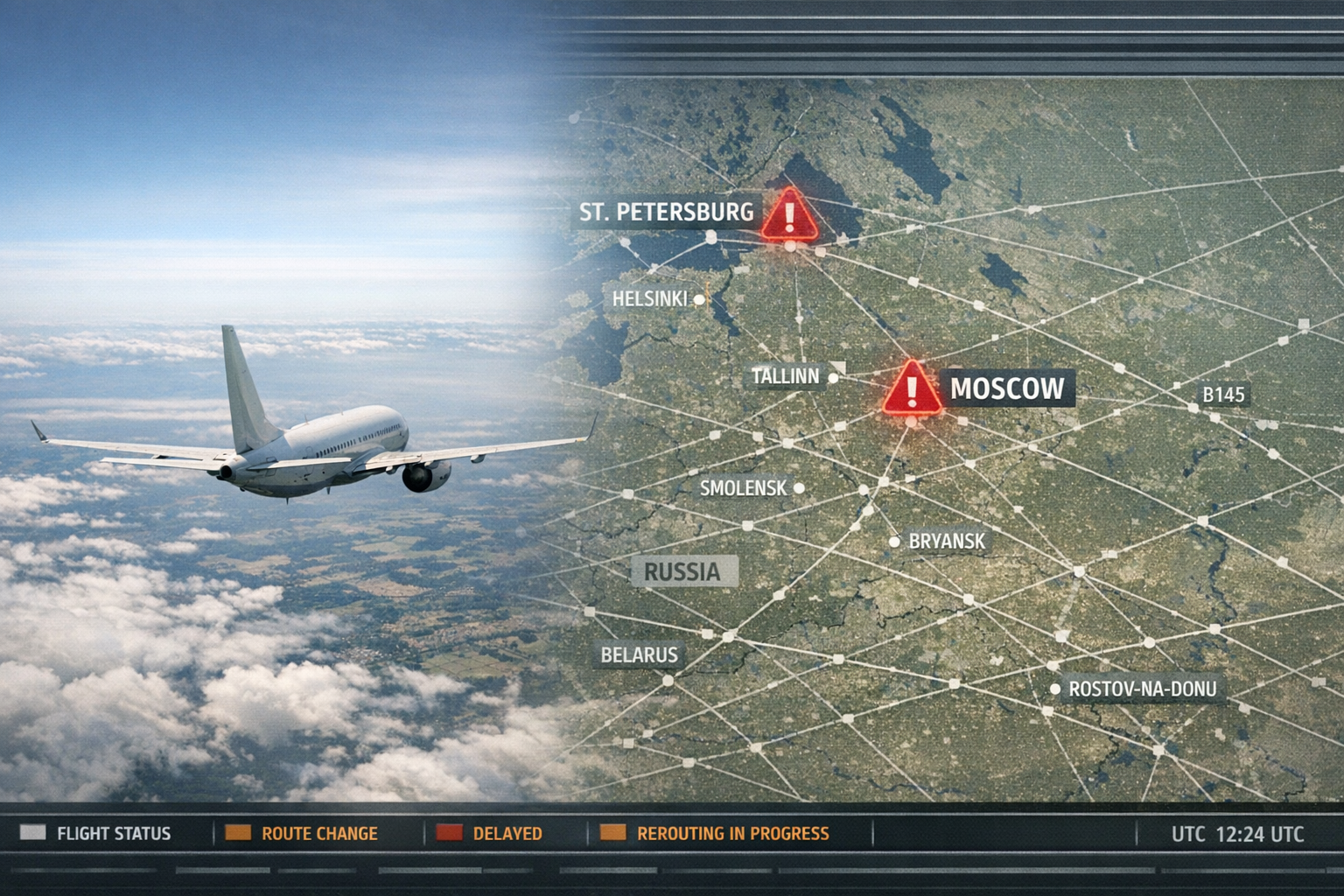
Ukraine Presses a New Front in the Air War: Civil Aviation Risk Over Russia
President Volodymyr Zelensky of Ukraine warned this week that commercial airlines should reconsider flying through Russian airspace, saying an expanding Ukrainian drone campaign is making the skies over parts of Russia increasingly dangerous for civilian traffic.
The warning, delivered on Sept. 1 and 2, opens a new dimension in the war’s widening risk map: not only the danger to soldiers, cities and energy infrastructure, but now the growing possibility that commercial aviation could be caught in the hazards created by long-range strikes, air-defense responses and electronic interference.
Mr. Zelensky said Ukraine was not seeking to threaten civilian aircraft. But he argued that airlines, insurers and foreign governments could no longer treat Russian airspace as insulated from the war, particularly around major destinations such as Moscow and St. Petersburg, where repeated drone incursions have disrupted operations in recent months.
His comments amounted to a public effort to push the aviation industry to acknowledge what Ukrainian officials say has become obvious: as Kyiv extends the reach of its drone and missile campaign deeper into Russia, the risks are no longer confined to the front lines or border regions.
The Kremlin reacted angrily. President Vladimir V. Putin accused Ukraine of engaging in “state terrorism,” according to reports carried by The Associated Press, while also vowing to intensify strikes on Ukraine’s energy system ahead of winter.
A Warning With Financial and Operational Consequences
The immediate significance of Mr. Zelensky’s statement lies less in any formal ban than in what it could mean for carriers still using Russian routes. If airlines, underwriters and regulators judge the threat to be rising, the result could be more rerouting, higher insurance premiums and fresh delays across some of the world’s busiest long-haul corridors.
Since Russia’s full-scale invasion of Ukraine in 2022, most Western carriers have already avoided Russian airspace because of sanctions, reciprocal bans and war-risk concerns. But some non-Western airlines have continued to use Russian routes, preserving shorter flight times between Europe and Asia and giving them a cost advantage over competitors forced onto longer paths.
Mr. Zelensky’s intervention raises pressure on those operators by framing the question not simply as one of geopolitics or sanctions compliance, but of passenger safety.
That argument already has support from European regulators. The European Union Aviation Safety Agency, or EASA, has an active conflict-zone bulletin recommending that operators not fly in western Russian airspace at any altitude. The agency extended that warning on July 24 through Jan. 31, 2027.
EASA has cited several threats: the risk that civil aircraft could be unintentionally targeted, weak coordination between military and civilian authorities, air-defense activity during Ukrainian drone attacks, and persistent spoofing or jamming of satellite navigation signals.
A Conflict Zone Expands Beyond Ukraine
Ukraine’s own airspace has been closed to civilian traffic since Feb. 24, 2022, the day Russia launched its full-scale invasion. Russian civilian aviation, by contrast, has continued to operate, even as Ukrainian strikes have become more frequent and more ambitious.
That asymmetry has sharpened over the past year. Waves of Ukrainian drones have periodically forced temporary suspensions at airports serving Moscow, while officials and aviation analysts have increasingly warned that attacks deeper inside Russia are likely to continue through 2026.
The risk is not necessarily that civilian aircraft are being deliberately targeted. The greater fear is a more chaotic and familiar danger in modern conflict zones: that air-defense systems, responding to fast-moving drone alerts, may misidentify or endanger civilian flights, or that pilots may face degraded navigation in heavily jammed airspace.
EASA has pointed specifically to the December 2024 incident involving Azerbaijan Airlines Flight 8243 as evidence of the hazards created when civil aviation operates amid active military responses and electronic interference.
That backdrop gives Mr. Zelensky’s remarks more weight than a political taunt. They align with an existing regulatory judgment that the war has already made parts of western Russia unsafe.
Pressure on Russia, Questions for Airlines
For Ukraine, the message serves several purposes at once. It underscores Kyiv’s claim that Russia should not be able to wage war while preserving a sense of normality at home. It also seeks to increase the economic and psychological costs for Moscow by threatening one of the practical conveniences that much of the country has retained: functioning domestic and international air travel.
Whether the warning leads to major changes remains uncertain.
It is not yet clear how many international carriers will abandon Russian routes, how quickly insurers may reprice war-risk exposure, or whether Russian authorities will impose broader temporary closures around key hubs if drone attacks continue to intensify. Another unanswered question is whether Ukraine’s campaign will remain concentrated in western Russia and around major cities or spread farther across the country.
For now, the aviation market faces a familiar wartime dilemma: whether to treat the latest alerts as manageable disruption or as evidence that an important commercial air corridor is becoming untenable.
What is clear is that the conflict’s geography is shifting again. The battle is no longer only over trenches, power stations and Black Sea shipping lanes. It is increasingly being fought in the calculations of airline dispatchers, safety regulators and insurers deciding whether the skies over Russia can still be treated as routine.
Sources
Further reading and reporting used to add context:
- https://apnews.com/article/117ececb1e1fa4b4084fa0938ce9943d
- https://apnews.com/article/8a0054face48cc56f6cb6bcf9a8f4b51
- https://apnews.com/article/35e50e202b767c38258075ed1ca5c698
- https://apnews.com/article/fa3deebe59f81baadc821c743fb26814
- https://apnews.com/article/7564a892bfb99a853aa150c8710b7985
- https://apnews.com/article/5cfe71b2954a40489c070459ba82116e
- https://www.theguardian.com/world/2026/sep/02/russian-airspace-unsafe-commercial-airlines-zelenskyy
- https://www.euronews.com/my-europe/2026/09/01/zelenskyy-warns-russian-airspace-will-effectively-be-closing
- https://aerospaceglobalnews.com/news/ukraine-russian-airspace-warning-airlines/
- https://www.rferl.org/a/zelenskyy-russia-ukraine-war-airspace/33845033.html
- Russian Airspace Will Effectively Be Closing – The War Started by Russia Is Closing Its Skies – Address by the President — Official website of the President of Ukraine
- https://armyinform.com.ua/en/2026/09/02/%E2%80%9Cthere-are-no-longer-any-safe-moments-in-russia%E2%80%99s-skies%E2%80%9D-volodymyr-zelenskyy-warns-airlines-about-flight-risks/
- https://www.faa.gov/air_traffic/publications/us_restrictions
- https://www.kyivpost.com/post/83529
- https://kyivindependent.com/the-russian-sky-is-becoming-completely-dangerous/
- https://www.moneycontrol.com/world/zelensky-warns-safe-days-in-russian-skies-are-over-urges-airlines-to-assess-risks-article-14020303.html
- https://m.interfax.ru/1112600
- https://herald.express/2026/09/02/ukraine-war-briefing-russian-sky-full-of-our-drones-and-not-safe-zelenskyy-warns-airlines/
- https://www.icao.int/Meetings/a39/Documents/WP/wp_297_en.pdf
- https://www.icao.int/aviation-security-policy-section/Conflict-Zones
- https://www.icao.int/safety/conflictzones?source=post_page—————————
- https://www.icao.int/news/icao-statement-safety-and-security-aviation-operations
- https://www.icao.int/Meetings/a39/Documents/WP/wp_376_en.pdf
- https://www.icao.int/Meetings/anconf13/Documents/WP/wp_245_en.pdf
- https://www.icao.int/aviation-security-policy-section/Guidance-Material
- https://store.icao.int/en/risk-assessment-manual-for-civil-aircraft-operations-over-or-near-conflict-zones-doc-10084
- https://www.easa.europa.eu/en/conflict-zone-status/active
- https://www.icao.int/aviation-security-policy-section/Acts
- https://finance.ec.europa.eu/news/eu-adopts-21th-package-sanctions-against-russia-2026-07-23_en
- https://www.easa.europa.eu/en/domains/air-operations/information-on-conflict-zones
- https://commission.europa.eu/topics/eu-solidarity-ukraine/eu-sanctions-against-russia-following-invasion-ukraine/sanctions-transport_en
- https://www.easa.europa.eu/en/faq/136185
- https://transport.ec.europa.eu/news-events/news/aviation-safety-commission-adopts-new-eu-air-safety-list-2022-06-01_en
- https://eur-lex.europa.eu/eli/C/2026/1530/oj/eng/pdf
- https://www.europarl.europa.eu/doceo/document/E-10-2025-002846_EN.pdf
- https://www.easa.europa.eu/en/print/pdf/node/141480/267227
- https://www.investing.com/news/commodities-news/moscow-shoots-down-nearly-60-drones-airports-reopen-authorities-say-4751717
- https://tass.com/economy/2019941
- https://www.internazionale.it/ultime-notizie-reuters/2026/09/02/zelenskiy-says-ukrainian-drones-have-effectively-closed-russian-airspace
- https://www.onvista.de/news/2026/09-02-russland-will-beeintraechtigung-der-zivilen-luftfahrt-nicht-zulassen-0-20-26549035
- https://tass.com/society/1669829
- https://www.internazionale.it/ultime-notizie-reuters/2026/09/01/germany-says-russia-responsible-for-drone-attack-at-leipzig-airport
- https://www.internazionale.it/ultime-notizie-reuters/2026/09/01/zelenskiy-says-ukrainian-drones-have-effectively-closed-russian-airspace
- https://www.investing.com/news/world-news/russia-attacks-kyiv-with-missiles-as-zelenskiy-speaks-to-trump-europe-for-a-peace-deal-4748804
- https://www.internazionale.it/ultime-notizie-reuters/2026/06/22/moscow-shoots-down-nearly-60-drones-airports-reopen-authorities-say
- https://theprint.in/world/moscow-shoots-down-nearly-60-drones-russian-attacks-kill-five-in-ukraine/2966413/
- https://www.marketscreener.com/news/moscow-shoots-down-nearly-60-drones-airports-reopen-authorities-say-ce7f5cd3d881fe27
- https://www.internazionale.it/ultime-notizie-reuters/2026/09/01/russia-calls-germany-s-leipzig-drone-attack-claims-false-and-an-unprecedented-escalation
- https://www.themoscowtimes.com/2026/06/22/moscow-airports-temporarily-suspend-flights-amid-latest-drone-assault-a93066/pdf
- https://eksandesh.org/cdn-backup/uploads/tenant_7/2026/06/2026-06-19_choice_times_1781848164.pdf
- https://www.youtube.com/watch?v=VNWZNXIWXBg
- https://en.wikipedia.org/wiki/Moscow_Domodedovo_Airport
- https://thefrontierpost.com/wp-content/uploads/2024/11/FP-Pages-11-11-24-P.pdf
- https://www.youtube.com/watch?v=we0ft2EOZn0
- https://www.wsj.com/public/resources/documents/2Ds0F94ouIwK1GjCVYaj-WSJNewsPaper-3-12-2025.pdf
- Airspace of the Russian Federation | EASA
- Airspace of Ukraine | EASA
- Zelenskiy says Ukrainian drones have effectively closed Russian airspace – Internazionale