
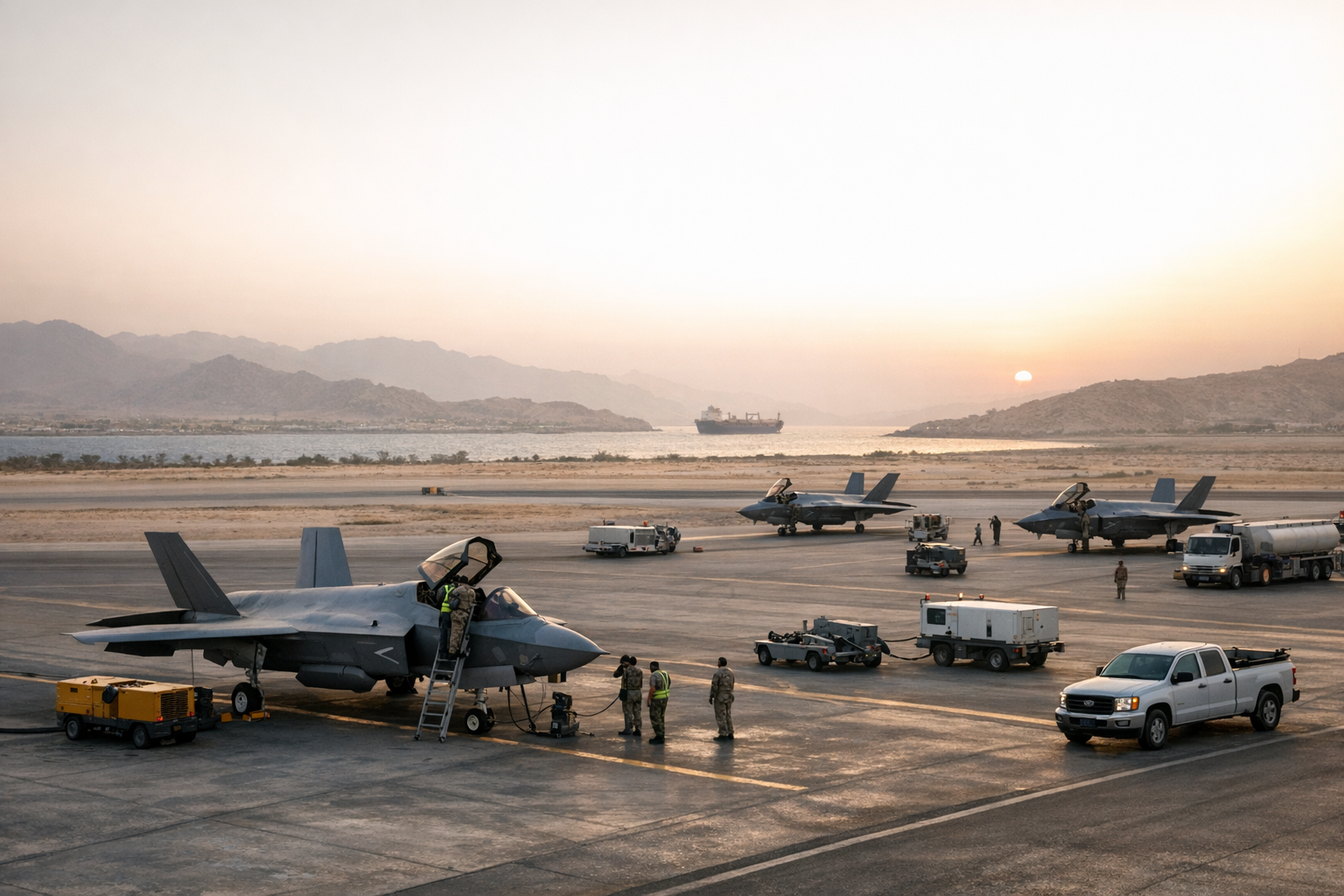
Washington Pushes Major Saudi Arms Sale as Red Sea Threats Grow
The Trump administration has moved forward with a possible $24.3 billion sale of 48 F-35 fighter jets to Saudi Arabia, injecting a major new military commitment into the Middle East at the very moment President Trump is suggesting the United States may be nearing the end of its war with Iran.
The proposed deal, which includes engines and support equipment and still faces congressional review, comes as Saudi Arabia and the Iran-backed Houthi movement trade strikes and as the security of the Red Sea has become newly precarious. Houthi attacks on Saudi territory and their pressure along Yemen’s Red Sea coast have sharpened fears about the vulnerability of oil infrastructure, commercial shipping and the Bab el-Mandeb Strait, one of the world’s most important maritime chokepoints.
The juxtaposition is striking: a White House speaking in the language of possible de-escalation while advancing one of the most significant arms packages in years to a Gulf partner that feels increasingly exposed.
On Wednesday, Trump said the United States was “hopefully” nearing the end of its nearly seven-month war with Iran and indicated that Tehran appeared open to a deal. But the Saudi package suggests that even if diplomacy gains momentum, Washington is preparing for a prolonged period of instability in which its regional allies will demand stronger defenses and clearer assurances.
A Regional War’s Yemen Front
The Yemen theater has become more deeply entwined with the broader confrontation between Washington and Tehran. What was once often treated as a separate conflict is now viewed by officials across the region as one of the most active fronts in a larger struggle.
Houthi forces have advanced along Yemen’s western coastline and seized strategically important positions near the Bab el-Mandeb, the narrow passage linking the Red Sea to the Gulf of Aden. Any sustained threat there carries consequences far beyond Yemen or Saudi Arabia. The strait is a vital artery for global trade and energy shipments, and disruptions can quickly ripple through shipping insurance markets, freight costs and oil prices.
At the same time, the Houthis have intensified drone and missile attacks on Saudi targets, testing the kingdom’s air defenses and reviving concerns that infrastructure once thought better protected remains at risk. For Saudi Arabia, which has spent years trying to exit the Yemen war and reposition itself as a hub for investment and regional diplomacy, the renewed pressure is especially unwelcome.
That helps explain why the fighter sale matters beyond the hardware itself. The message from Washington is not simply that it is willing to sell advanced aircraft, but that it is still prepared to underwrite the security architecture on which Gulf monarchies depend, even amid uncertainty over how far the conflict with Iran may yet spread.
Trump’s Two-Track Approach
The administration appears to be pursuing two tracks at once: deterrence through arms and force posture, and diplomacy through back-channel contacts and high-level meetings.
American officials have been pursuing reported contacts with the Houthis through Oman, which has long served as an intermediary in regional crises. Trump is also expected to meet Gulf leaders at the United Nations General Assembly next week to discuss what officials describe as the next phase of the conflict.
Whether that amounts to a genuine opening is far from clear.
Trump’s suggestion that Tehran wants a deal may signal that both sides are looking for an off-ramp after months of conflict. But officials and analysts caution that similar rhetoric has preceded renewed military action before. The uncertainty has left regional capitals trying to interpret whether the president is describing an imminent diplomatic breakthrough or merely a temporary lull.
In that context, the Saudi arms package serves another purpose: reassuring a partner that Washington will not leave it exposed if talks fail or if the conflict mutates rather than ends.
Limits to U.S. Coalition-Building
At the same time, the administration is confronting visible limits to its effort to broaden support for its campaign against Iran.
On Thursday, South Korean President Lee Jae Myung said his country would not send forces in any way that could draw it into the war, despite pressure from Washington. Seoul said it was still reviewing ways to help protect navigation, a nod to South Korea’s heavy dependence on Middle Eastern energy routes, but Lee made clear that his government would not join military operations.
The refusal is significant not because South Korea is a central military player in the Gulf, but because it underscores the caution of even close American allies when the risk of regional escalation remains high and the political end state is uncertain.
For Washington, that hesitancy complicates any attempt to portray the Iran conflict as backed by a broad international coalition. It also increases the importance of traditional security partners in the Gulf, particularly Saudi Arabia, the United Arab Emirates and others that sit closest to the danger.
Congressional Questions Ahead
The Saudi deal is not yet final. Under the normal review process, Congress will have the opportunity to examine the sale, and questions are likely to arise over both regional strategy and the longstanding American commitment to preserving Israel’s qualitative military edge.
Such scrutiny is familiar terrain for major arms deals with Arab states, especially when they involve top-tier aircraft like the F-35. Lawmakers may also ask whether the transfer is principally about countering the Houthis, deterring Iran, or binding Saudi Arabia more tightly to the United States at a time of shifting alliances and recurring doubts about American staying power.
Still, the administration’s decision to advance the package now reflects a broader strategic calculation: that whatever Trump may say publicly about ending the war, the security environment around the Gulf and the Red Sea is deteriorating fast enough to warrant immediate reinforcement.
The central unanswered question is whether the Houthis can continue pressing Saudi targets and threatening the Bab el-Mandeb without provoking a wider multinational intervention. Until that is resolved, the region is likely to remain caught between the promise of diplomacy and the logic of preparation for a larger fight.
Sources
Further reading and reporting used to add context:
- https://apnews.com/article/024350a0820dfc5dd433b4e13445fab5
- https://www.axios.com/2026/09/17/state-department-f-35-saudi-arabia-israel
- https://www.axios.com/2026/09/17/trump-axios-interview-iran-war
- https://apnews.com/article/d29f7fb71331bea0098cbdb38d7577e0
- https://apnews.com/article/22e64e72775886625da676aee92edca2
- https://apnews.com/article/3f91ccc8def4a9d5499b7c8620450864
- https://apnews.com/article/97449f2691440933ddc68fb40dfda797
- https://apnews.com/article/742e1eebb7d099ea42372d978e271900
- https://apnews.com/article/5bb1f82555c147514fc2e8d2d61baf0c
- https://www.axios.com/2026/09/16/trump-iran-talks-gulf-leaders-un
- https://apnews.com/article/90dc86201ef51410ebcdd913837d741d
- https://apnews.com/article/895320bde6dc589cebb628b63832c38a
- https://www.theguardian.com/world/2026/sep/18/south-korea-will-not-send-military-to-support-us-war-on-iran-defying-trump-pressure
- https://en.yna.co.kr/view/AEN20260918001555315
- https://en.yna.co.kr/view/AEN20260918001552315?section=national%2Fpolitics
- https://www.investing.com/news/world-news/south-koreas-lee-rules-out-military-involvement-in-middle-east-conflict-4906666
- https://www.koreatimes.co.kr/southkorea/politics/20260918/lee-rules-out-troop-deployment-involving-korea-in-iran-war
- https://www.koreatimes.co.kr/southkorea/politics/20260918/lee-rules-out-korean-troop-deployment-in-iran-war
- https://www.aljazeera.com/news/2026/9/17/trump-administration-approves-sale-of-f-35-jets-to-saudi-arabia
- https://www.investing.com/news/commodities-news/trump-hopes-iran-war-nearing-end-as-houthisaudi-fighting-escalates-4904794
- https://apnews.com/article/c1359273dd970b969e823356e5ead377
- https://www.axios.com/2026/09/15/military-commanders-us-israel-arab-countries-iran-meeting-germany
- https://www.axios.com/2026/09/11/houthis-yemen-saudi-trump-mbs-strikes
- https://www.local10.com/news/world/2026/09/11/saudi-arabia-shuts-down-a-pipeline-as-houthis-seize-an-island-opening-a-new-front-in-the-iran-war/
- https://www.marketscreener.com/news/one-killed-as-saudi-arabia-intercepts-drone-launched-by-yemen-s-houthis-ce785bd3df89f726
- https://travel.state.gov/en/international-travel/travel-advisories/saudi-arabia.html
- https://www.marketscreener.com/news/houthi-blitz-leaves-saudi-arabia-exposed-iran-emboldened-ce785bd2df88f623
- https://www.internazionale.it/ultime-notizie-reuters/2026/09/10/saudi-says-no-danger-after-khamis-mushait-alert-amid-clashes-with-houthis
- https://www.investing.com/news/stock-market-news/us-state-department-oks-possible-243-billion-military-aircraft-sale-to-saudi-arabia-4906175
- https://www.defensedaily.com/state-department-approves-more-than-24-billion-sale-of-48-f-35as-to-saudi-arabia/air-force/
- https://www.janes.com/defence-intelligence-insights/defence-news/defence/us-approves-f-35-sale-to-saudi-arabia
- https://www.marketscreener.com/news/houthi-advance-in-yemen-puts-u-s-in-a-new-bind-ce785bdfd080f62d
- https://breakingdefense.com/2026/09/us-clears-24b-f-35-sale-for-saudi-arabia/
- https://www.axios.com/2026/09/17/iran-war-crimes-un-mission-finds
- https://apnews.com/article/e75c77fb1b6773ccc5f3c715de9359e5
- https://www.thedailybeast.com/trump-blurts-out-wild-warning-about-big-decision-on-iran/
- https://www.theatlantic.com/books/2026/09/maggie-haberman-jonathan-swan-atlantic-festival/688665/?utm_source=openai
- https://www.axios.com/2026/09/16/us-houthi-oman-to-discuss-red-sea-crisis
- https://www.aljazeera.com/news/2026/9/17/trump-claims-direct-talks-with-iran-is-diplomacy-picking-up-again
- https://www.cbsnews.com/live-updates/iran-war-us-trump-un-war-crimes-iran-deal/
- https://www.timesofisrael.com/liveblog_entry/trump-again-voices-hope-iran-war-is-nearing-its-end/
- https://economictimes.indiatimes.com/news/defence/trump-says-hopefully-we-are-towards-end-of-iran-war/articleshow/134300218.cms
- https://iranwire.com/en/news/157723-trump-says-direct-contact-from-iran-and-potential-end-to-war/
- https://www.marketscreener.com/news/trump-to-hold-talks-on-iran-with-gulf-leaders-next-week-axios-reports-ce785bd2d080f02c
- https://www.internazionale.it/ultime-notizie-reuters/2026/09/17/trump-hopes-iran-war-nearing-end-as-houthi-saudi-fighting-escalates
- https://www.israelnationalnews.com/news/433281
- https://www.democracynow.org/2026/9/17/headlines/trump_on_iran_hopefully_we_are_towards_the_end_of_the_war
- https://ca.marketscreener.com/news/trump-hopes-iran-war-nearing-end-as-houthi-saudi-fighting-escalates-ce785bd3d981f125
- https://quews.news/trump-says-hopefully-we/
- https://www.youtube.com/watch?v=9BG-SN5rBew
- https://www.govinfo.gov/content/pkg/CREC-2026-08-06/pdf/CREC-2026-08-06.pdf
- https://www.govinfo.gov/content/pkg/DCPD-202600421/pdf/DCPD-202600421.pdf
- https://www.reddit.com/r/politics/comments/1wito15/trump_says_us_hopefully_nearing_end_of_iran_war/
- State Department approves potential F-35 sales to Saudi Arabia
- A week after Houthis seized a Red Sea city, the Iranian-backed rebels eye the oil-rich east
- Trump tells Axios he's approaching major crossroads in Iran war