
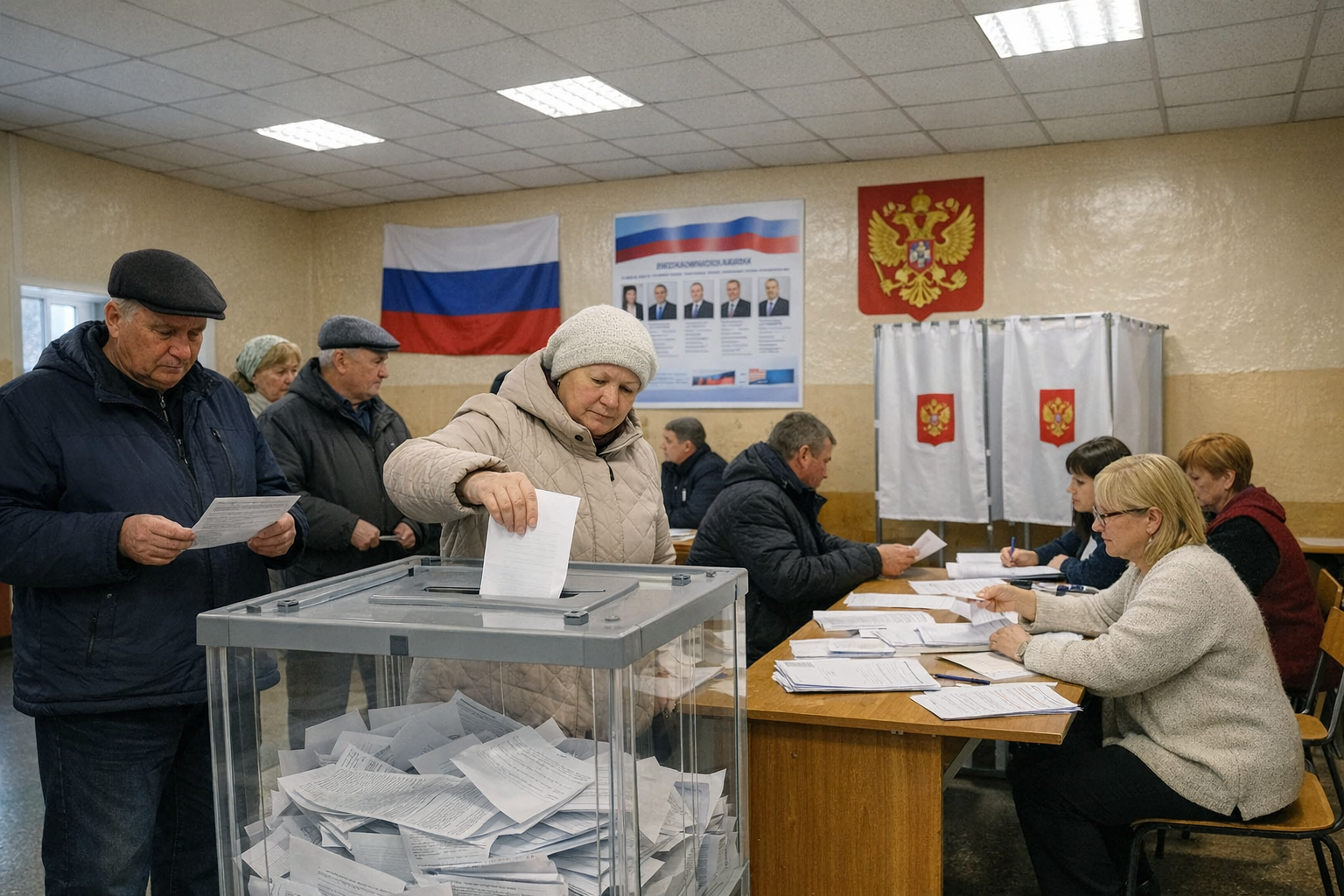
A Vote With Little Doubt About the Winner
Russians began voting on Friday in a three-day parliamentary election that is expected to leave President Vladimir Putin’s ruling United Russia party firmly in control of the State Duma, while offering one of the clearest tests yet of how much public strain the Kremlin can absorb after more than four years of war in Ukraine.
There is little suspense over which party will dominate the 450-seat lower house. The larger question is whether the Kremlin can produce the kind of turnout and margin of victory that Mr. Putin increasingly treats as proof not simply of political loyalty, but of national unity behind the war. In recent months, he has cast participation itself as a signal of support for Russia’s campaign in Ukraine, raising the stakes of an election whose outcome is otherwise tightly managed.
This is Russia’s first parliamentary vote since the full-scale invasion of Ukraine in February 2022, and it arrives at a moment of mounting pressure beneath the surface of official stability. Growth has slowed, the budget deficit has widened under the weight of military spending, and businesses and consumers have grown gloomier even as economists stop short of predicting an immediate financial breakdown. For the Kremlin, the election is less a contest than a demonstration: that despite battlefield costs, sanctions and a more strained economy, the system can still manufacture broad consent.
Managed Competition
United Russia already holds 310 seats in the Duma, more than the 300 needed for a constitutional supermajority, and is widely expected to retain command of the chamber. The body has long served as a dependable instrument for Kremlin priorities, approving major wartime and domestic measures with little resistance.
What has become even more striking in this election is the absence of meaningful opposition. Liberal and antiwar voices have been squeezed out of public life through exile, imprisonment, legal pressure and ballot restrictions. The liberal Yabloko party was barred from the party-list ballot, though some of its candidates remain in individual district races. The result is a political field populated largely by parties that may differ in tone but rarely defy the Kremlin on consequential issues.
That narrowing of competition has made secondary indicators more important. Analysts are watching turnout figures, regional vote shares and whether United Russia’s final margin appears comfortably high or suspiciously inflated. In a political system where outright defeat is barely conceivable for the ruling party, any signs of apathy, protest voting or administrative overreach can offer clues to public sentiment that official rhetoric tends to obscure.
Economic Frustration Beneath Wartime Discipline
The election comes as many Russians are feeling the costs of a wartime economy that has prioritized defense production and military spending while leaving households to contend with stubborn financial pressure. The state has so far succeeded in avoiding collapse and preserving a degree of macroeconomic resilience. But resilience is not the same as confidence.
Rising expenditures tied to the war, a broader budget squeeze and weaker consumer sentiment have complicated the Kremlin’s effort to project normalcy. Many Russians have adapted to the conflict as a permanent condition of public life; that does not mean they are untouched by the price. The government’s challenge in this election is to ensure that private frustration does not become visible as public indifference.
That is one reason turnout matters so much. A strong showing would allow the Kremlin to claim that Russians remain mobilized behind the state despite fatigue and hardship. A weaker or more heavily engineered turnout could suggest something less reassuring for the authorities: not open revolt, but erosion.
A Digital State Tightens Its Grip
Hovering over the election is a second, newer concern: the rapid expansion of Max, a state-backed Russian “super-app” that has spread across daily life and, according to recent reporting and technical research, may offer the authorities a powerful new channel for digital surveillance.
Promoted as a patriotic alternative to foreign messaging services like WhatsApp and Telegram, Max has been pushed with unusual speed since 2025 and has reportedly become the country’s most-used messaging app. Its growth has coincided with tighter restrictions on rival platforms and deeper integration with state services. European Union sanctions documents have described the app as having “extensive surveillance features,” and records indicate it is pre-installed on some mobile devices sold in Russia and linked to Gosuslugi, the government’s digital services portal.
Researchers examining the architecture of apps of this design have warned that they can observe and control mini-app activity at a deep level, giving the platform’s operator extraordinary visibility into users’ communications, payments and interactions. In practical terms, rights advocates and outside analysts say, that means a tool presented as convenience can also become infrastructure for monitoring civic life.
There is no public evidence that Max is determining the vote count. But that is not the main concern. Rather, its significance lies in how it extends state power beyond traditional coercion and into the routines of ordinary life — messaging, payments, services, identification. In an election already defined by curtailed opposition and carefully stage-managed politics, such a platform reinforces the broader logic of control.
What the Kremlin Needs From This Weekend
For Mr. Putin, this weekend’s vote is about more than preserving a parliamentary majority. It is about demonstrating that political obedience remains intact even as the war drags on and economic pressures deepen. The Kremlin does not need uncertainty over who governs; it needs an image of enthusiastic compliance.
Whether that image reflects genuine support, bureaucratic pressure or simple resignation is harder to know. In contemporary Russia, elections seldom answer the question of who holds power. More often, they reveal how much effort the state must expend to make that power look unchallenged.
This year, that effort is visible not only in the exclusion of rivals and the choreography of the campaign, but also in the digital systems surrounding everyday life. The ballot may be the formal event of the weekend. The larger story is the tightening mesh of political and technological control in which it is taking place.
Sources
Further reading and reporting used to add context:
- https://apnews.com/article/7f10803a87456051be876c0c33375af8
- https://apnews.com/article/79bf1c1abd5da48769ed8dab4a766de0
- https://apnews.com/article/a2001537fc104755e071a38217987331
- https://apnews.com/article/91b6b9c65d52494a09fe8985ecf9fb18
- https://www.thedailybeast.com/putin-humiliated-as-kremlins-impossible-to-hack-system-is-hacked/
- https://www.theguardian.com/world/2026/sep/18/russia-parliament-election-duma-putin
- https://www.theguardian.com/world/russia
- https://www.theguardian.com/world/2026/sep/18/russian-super-app-max-spy-citizens
- https://www.marketscreener.com/news/putin-casts-parliamentary-election-as-barometer-of-support-for-war-urges-russians-to-vote-ce785bd2df8ffe23
- https://eur-lex.europa.eu/eli/dec/2026/1709/oj/eng/pdf
- https://arxiv.org/abs/2609.11814
- https://eur-lex.europa.eu/legal-content/EN/ALL/?uri=CELEX%3A32026R1708
- Voting begins in Russian parliamentary election which Putin has cast as barometer of support for war | MarketScreener UK
- https://www.reutersconnect.com/item/russia-votes-in-parliamentary-elections/dGFnOnJldXRlcnMuY29tLDIwMjY6bmV3c21sX09XRUZWQzU1MDIxNDM0MzU3MDAx
- https://www.theguardian.com/commentisfree/2026/sep/13/the-guardian-view-on-russian-parliamentary-elections-glimpses-of-weakness-behind-the-facade
- https://rt.http3.lol/index.php?q=aHR0cHM6Ly9hcnhpdi5vcmcvYWJzLzI2MDkuMTE4MTQ
- What to know about Russia's upcoming parliamentary election | MarketScreener
- https://eurosmi.com/article.php?id=ece5f8b1b9516ba918&lang=en
- https://streamlinefeed.co.ke/news/russias-max-super-app-works-as-surveillance-backdoor-research-finds
- https://www.consilium.europa.eu/en/policies/sanctions-against-russia/timeline-sanctions-against-russia/
- https://eur-lex.europa.eu/eli/reg/2024/1485/2026-07-13/eng
- https://finance.ec.europa.eu/news/eu-adopts-21st-package-sanctions-against-russia-2026-07-23_en
- https://finance.ec.europa.eu/eu-and-world/sanctions-restrictive-measures/sanctions-adopted-following-russias-military-aggression-against-ukraine_en
- https://eur-lex.europa.eu/legal-content/EN/ALL/?uri=CELEX%3A32026R1848
- https://eur-lex.europa.eu/legal-content/EN/TXT/?uri=LEGISSUM%3A25_2
- https://finance.ec.europa.eu/eu-and-world/sanctions-restrictive-measures/overview-sanctions-and-related-resources_en
- https://www.eeas.europa.eu/eeas/exposing-russias-malicious-cyber-ecosystem-eu-adopts-its-biggest-cyber-sanctions-package_en
- https://meduza.io/en/news/2026/07/13/eu-sanctions-russian-social-network-vk-and-russia-s-state-backed-messaging-app-max
- https://www.consilium.europa.eu/en/press/press-releases/2026/06/15/russia-s-war-of-aggression-against-ukraine-new-eu-sanctions-target-energy-revenues-the-military-industrial-complex-propaganda-and-human-rights-violations/pdf/
- https://www.lemonde.fr/en/international/article/2026/07/23/eu-struggles-to-adopt-new-round-of-economic-sanctions-against-russia_6755756_4.html
- https://www.reddit.com/r/technology/comments/1wji60w/revealed_how_russia_use_mobile_superapp_max_to/
- https://en.wikipedia.org/wiki/Max_%28app%29
- https://www.europarl.europa.eu/RegData/etudes/BRIE/2025/767243/EPRS_BRI%282025%29767243_EN.pdf
- https://www.reddit.com/r/europe/comments/1uw2v9e/eu_fails_to_agree_21st_sanctions_package_making/
- https://www.reddit.com/r/worldnews/comments/1uw3urz/eu_fails_to_agree_21st_sanctions_package_making/