
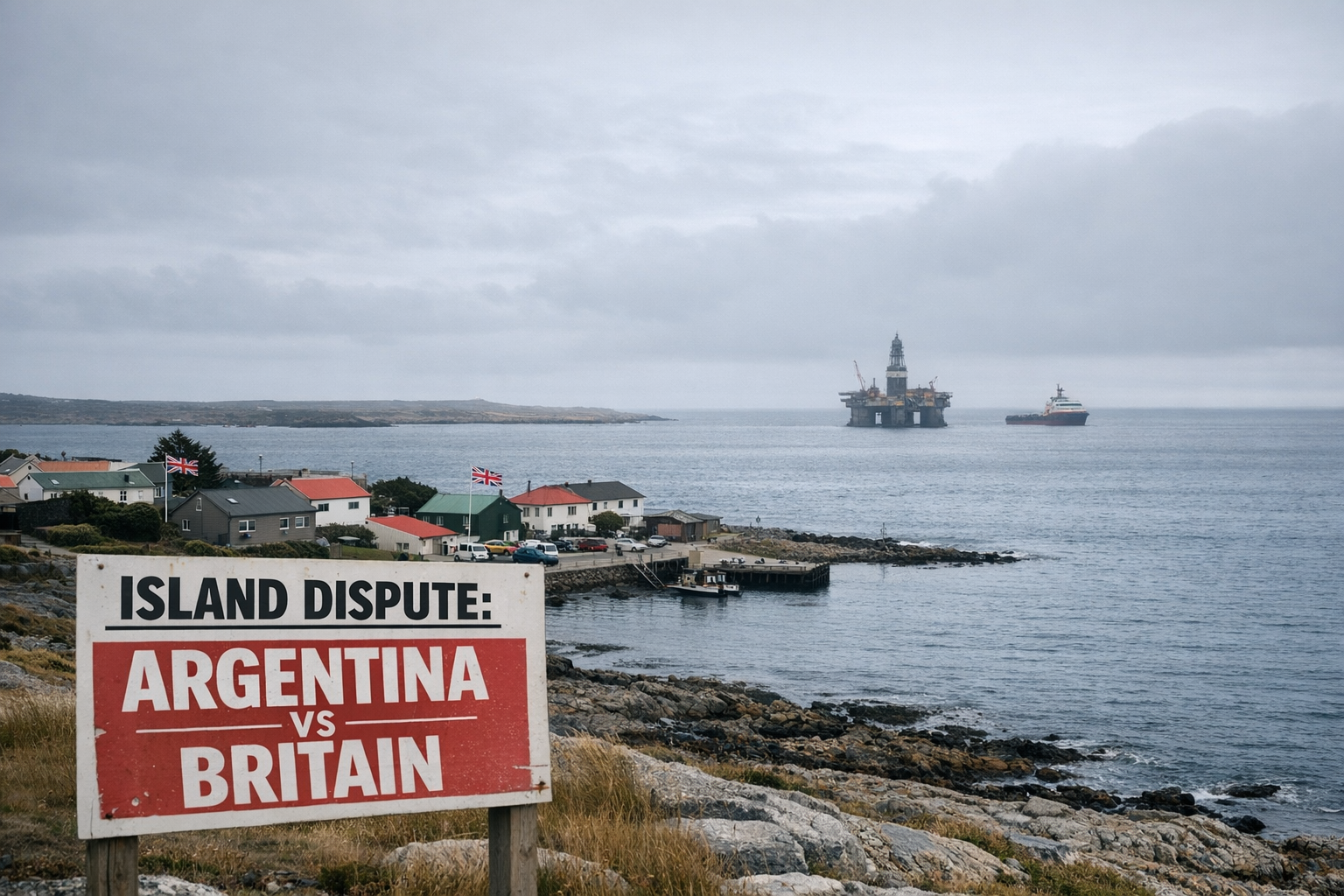
Argentina Renews Falklands Pressure, Prompting Swift British Rebuff
President Javier Milei of Argentina has sharply escalated his country’s long-running sovereignty dispute with Britain over the Falkland Islands, declaring that global “winds of change” are turning in Buenos Aires’ favor and threatening tougher penalties against companies involved in oil development around the archipelago.
In a national address on Wednesday, Mr. Milei renewed Argentina’s claim to the islands, known there as the Malvinas, and tied his latest push to what he suggested were shifts in the international environment — including indications that the United States might reconsider its traditional backing for Britain’s position.
Argentina’s presidency said Mr. Milei had ordered a regulatory decree and sent forward legislation aimed at responding to the Sea Lion offshore oil project, a long-delayed development north of the islands that has recently moved closer to production. The measures are intended to bar companies involved in the project from operating in Argentina, raising the prospect of a new front in the dispute: not only over sovereignty, but over energy investment and corporate access to one of South America’s largest markets.
Britain answered within hours on Thursday, rejecting any suggestion that its stance had changed. British officials said the Falklands remain British and insisted that the future of the islands rests on the right of their residents to determine their own status.
The rapid exchange underscored how quickly an old territorial conflict can flare when it intersects with geopolitics, energy and uncertainty over Washington’s role.
A Dispute Recast Through Energy
At the center of Mr. Milei’s announcement is Sea Lion, one of the most significant undeveloped oil discoveries in the North Falkland Basin. For years, the project was delayed by commercial hurdles, weak oil prices and political risk. But after reaching final investment decisions and advancing toward drilling, it now appears closer than at any previous point to actual development.
That has given Argentina a more immediate target.
By threatening sanctions on participating companies, Mr. Milei appears to be trying to make the project more costly and more complicated, not necessarily by stopping it outright, but by increasing legal and commercial uncertainty around it. For companies weighing financing, insurance, logistics and long-term regional strategy, exclusion from Argentina could become a meaningful consideration.
Whether those threats can be enforced effectively remains far from clear. Much will depend on the structure of the companies involved, their assets and operations in Argentina, and whether Buenos Aires can translate political declarations into measures that materially disrupt the project’s timetable. But even symbolic pressure can have consequences in extractive industries, where investor confidence and regulatory predictability are critical.
Britain Falls Back on Self-Determination
London’s response was swift and familiar. British ministers said their position was “unwavering” and that they would continue to uphold the islanders’ right to self-determination, the principle that has anchored Britain’s case for years.
That argument was reinforced in 2013, when Falkland Islanders voted overwhelmingly in a referendum to remain a British Overseas Territory. Britain has consistently treated that vote as decisive evidence that sovereignty should not be negotiated against the wishes of the population.
Argentina, by contrast, rejects the legitimacy of British control and has long argued that the islands were wrongfully taken and remain part of its national territory. Successive governments in Buenos Aires, across the political spectrum, have upheld the claim, though tactics have varied from diplomatic lobbying to economic pressure.
Mr. Milei’s intervention suggests a willingness to intensify that pressure at a moment when offshore oil has given the sovereignty dispute renewed practical stakes.
Why the Timing Matters
The immediate importance of Mr. Milei’s remarks lies not only in their tone, but in their timing.
The Sea Lion project is no longer a distant prospect. As development inches forward, Argentina’s government is trying to raise the price of participation now, before capital is fully committed and operations become harder to derail.
Mr. Milei also appears to see an opening beyond the South Atlantic. By pointing to signs that President Donald Trump may revisit Washington’s longstanding position, he has sought to broaden what has largely remained a bilateral dispute between Argentina and Britain.
For decades, the United States has generally aligned with Britain, even while managing relations with Argentina. Any real shift in that posture would carry diplomatic weight well beyond the islands themselves. It could embolden Buenos Aires, unsettle London and complicate the calculations of energy companies and allies alike.
But for now, that remains speculative. It is not clear whether Washington will in fact alter its stance, or whether Mr. Milei is trying to capitalize on ambiguity rather than a substantive policy change.
A Symbolic Clash With Real Risks
The Falklands dispute has deep emotional and political resonance in Argentina, where the claim is a rare point of enduring national consensus. For British governments, too, the issue is politically sensitive and closely tied to the principle that the islanders’ wishes are paramount.
That helps explain the speed and force of the British rebuttal. Any suggestion of wavering on sovereignty would carry domestic as well as diplomatic costs.
What remains uncertain is whether this latest escalation stays largely symbolic or evolves into a broader campaign of legal, trade and diplomatic pressure. Argentina’s threatened sanctions may prove difficult to execute. Yet by targeting a live energy project rather than issuing only rhetorical appeals, Mr. Milei has given the dispute fresh commercial significance.
For now, both sides are reaffirming familiar positions. But with oil development advancing and geopolitical alignments appearing less settled than before, the latest clash has opened a more consequential phase in a dispute that neither country has ever truly left behind.
Sources
Further reading and reporting used to add context:
- https://apnews.com/article/e84d99c99cfb1cb1ad232be8e3ea6c8a
- https://www.theguardian.com/world/2026/sep/04/president-javier-milei-winds-of-change-support-argentina-claim-to-falkland-islands
- https://www.theguardian.com/uk-news/2026/sep/04/uk-ministers-hit-back-argentinian-falkland-islands-claim
- https://www.theguardian.com/world/americas/2026/sep/04/all
- https://www.argentina.gob.ar/noticias/cadena-nacional-del-presidente-javier-milei-sobre-la-causa-malvinas
- https://www.theguardian.com/business/live/2026/sep/04/uk-car-sales-rise-food-prices-bank-of-england-us-jobs-repost-latest-news-updates?page=with%3Ablock-6a9a828c8f0865844a4bd82b
- https://www.argentina.gob.ar/noticias/comunicado-oficial-numero-157
- https://www.theguardian.com/uk/falklands
- https://www.euronews.com/2026/09/04/milei-touts-winds-of-change-as-he-reasserts-argentinas-claim-to-the-falklands
- https://www.casarosada.gob.ar/slider-principal/51360-cadena-nacional-del-presidente-javier-milei-sobre-la-causa-malvinas
- https://www.gov.uk/government/speeches/the-falkland-islands-lord-collins-oas-statement-june-2026
- https://www.upi.com/Top_News/World-News/2026/09/04/latam-argentia-revives-falkand-island-claims/6171788509870/
- https://www.gov.uk/government/speeches/uk-does-not-accept-that-argentina-has-any-legitimate-claim-to-sovereignty-over-the-falkland-islands
- https://researchbriefings.files.parliament.uk/documents/CBP-9893/CBP-9893.pdf
- https://digitallibrary.un.org/record/212545/files/A_AC.109_2027-EN.pdf
- https://assembly.gov.fk/component/jdownloads/?Itemid=101&catid=146&id=836&m=0&task=download.send
- https://elpais.com/argentina/2026-09-04/milei-anuncia-sanciones-para-las-petroleras-que-operen-en-malvinas-sin-autorizacion-argentina.html
- https://as.com/actualidad/politica/milei-endurece-su-postura-con-las-malvinas-y-reino-unido-responde-lo-eligieron-f202609-n/
- https://apnews.com/article/240a5fcd72446efd674fd6d9eb52572a
- https://speechbank.un.org/sites/default/files/2023-03/EN_00008_FLK_C24_2012.pdf
- https://elpais.com/argentina/2026-09-02/milei-se-abraza-a-la-causa-malvinas-tras-un-espaldarazo-de-trump.html
- https://digitallibrary.un.org/record/4045041/files/A_AC.109_2024_6-EN.pdf
- https://www.reddit.com/r/unitedkingdom/comments/1w6zj9d/uk_ministers_hit_back_at_argentinian_falklands/
- https://www.gov.uk/foreign-travel-advice/falkland-islands
- https://www.whitehouse.gov/presidential-actions/2026/08/temporary-suspension-of-additional-duties-to-offset-canadian-discrimination-against-the-commerce-of-the-united-states-with-respect-to-alcoholic-beverages-dairy-and-motor-vehicles/
- https://www.whitehouse.gov/fact-sheets/2026/08/fact-sheet-president-donald-j-trump-bolsters-national-security-and-strengthens-u-s-supply-chains-by-imposing-tariffs-on-drones-and-their-parts-and-components/
- https://www.argentina.gob.ar/normativa/nacional/decreto-681-1982-322769
- https://www.gov.uk/government/news/falkland-islanders-free-to-determine-their-own-future
- https://www.argentina.gob.ar/normativa/nacional/norma-428613/texto
- https://www.argentina.gob.ar/node/468200
- https://www.gov.uk/government/news/falkland-islanders-must-be-masters-of-their-own-fate
- https://www.argentina.gob.ar/normativa/buscar-boletin?numero_boletin=35983&s=1
- https://www.gov.uk/government/news/there-can-be-no-negotiations-on-the-sovereignty-of-the-falkland-islands-unless-and-until-such-time-as-the-islanders-so-wish
- https://www.argentina.gob.ar/sites/default/files/2023/08/plieg-2023-84619130-apn-dafyppmad-2_-_enniley_tuero.pdf
- https://www.argentina.gob.ar/sites/default/files/2022/08/di-2022-100896819-apn-dgpfeycimad.pdf
- https://www.whitehouse.gov/wp-content/uploads/2026/08/eo-14418.pdf
- https://www.argentina.gob.ar/sites/default/files/if-2024-65634918-apn-deiayaramad.pdf
- https://rockhopperexploration.co.uk/2026/05/sea-lion-operators-update-3/
- https://www.navitaspet.com/ir-inner/immediate-reports/
- https://hansard.parliament.uk/Commons/2013-03-12/debates/13031261000002/FalklandIslandsReferendum
- https://publications.parliament.uk/pa/cm201314/cmselect/cmfaff/695/69507.htm
- https://rockhopperexploration.co.uk/2025/12/final-investment-decision-on-sea-lion/
- https://www.navitaspet.com/wp-content/uploads/2026/02/Investor-Presentation.pdf
- https://www.gov.fk/press/fig-notes-final-investment-decisions-for-sea-lion-development-programme/
- https://www.gov.uk/government/speeches/the-falkland-islands-referendum
- https://hansard.parliament.uk/commons/2013-03-12/debates/13031261000002/FalklandIslandsReferendum
- https://publications.parliament.uk/pa/cm201213/cmhansrd/chan128.pdf
- https://www.gov.uk/government/news/falkland-islands-vote-to-remain-british-overseas-territory
- https://rockhopperexploration.co.uk/
- https://www.gov.uk/government/publications/2010-to-2015-government-policy-falkland-islanders-right-to-self-determination/2010-to-2015-government-policy-falkland-islanders-right-to-self-determination
- https://hansard.parliament.uk/lords/2015-03-24/debates/15032472000391/FalklandIslandsDefenceReview
- https://www.navitaspet.com/wp-content/uploads/2025/07/Sea-Lion-Project-Social-Impact-Assessment-June-2025-2.pdf
- https://assets.publishing.service.gov.uk/government/uploads/system/uploads/attachment_data/file/197434/Queens-Speech-2013.pdf
- https://rockhopperexploration.co.uk/wp-content/uploads/2025/09/RKH-Interims-2025.pdf
- https://en.wikipedia.org/wiki/2013_Falkland_Islands_sovereignty_referendum
- https://en.wikipedia.org/wiki/2013_Falkland_Islands_general_election
- https://en.wikipedia.org/wiki/Sea_Lion_Field
- https://en.wikipedia.org/wiki/Rockhopper_Exploration
- Cadena Nacional del Presidente Javier Milei sobre la Causa Malvinas | Argentina.gob.ar
- Final Investment Decision on Sea Lion • Rockhopper Exploration plc
- The Falkland Islands: Lord Collins' OAS statement, June 2026 – GOV.UK
- Comunicado Oficial Número 157 | Argentina.gob.ar