
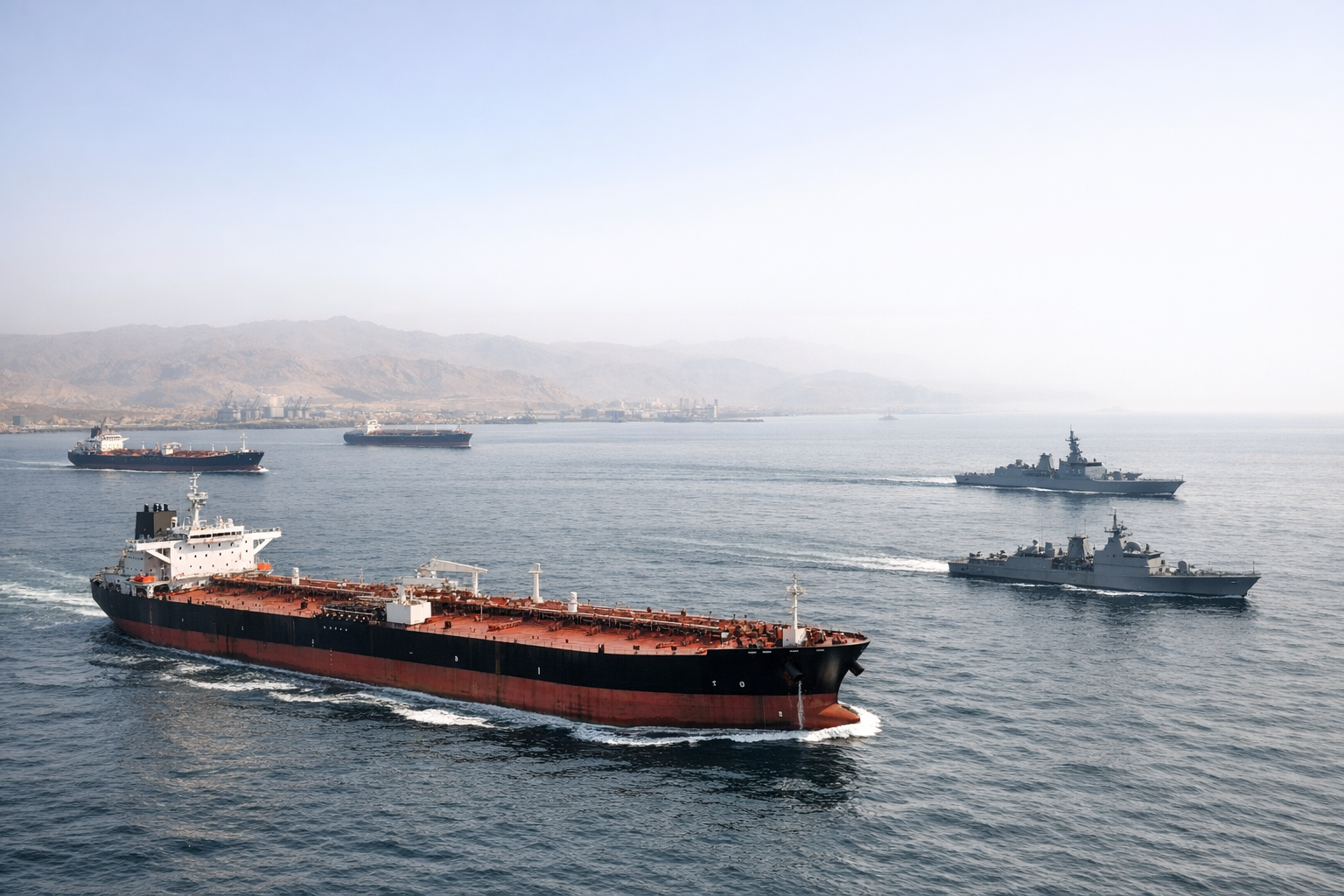
A Wider Front Takes Shape Against Iran
The campaign to pressure Iran entered a more international phase this week, as European governments moved closer to Washington’s sanctions drive and South Korea weighed whether to play a more direct role in securing the Strait of Hormuz, the narrow waterway at the center of the confrontation.
The shift suggested that what began as a largely American effort, backed by periodic military action and an escalating sanctions regime, is evolving into a broader test of allied resolve — and of how much additional strain Iran, and the region around it, can bear after more than six months of war.
The Trump administration said the European Union had joined its sanctions push, known in Washington as “Operation Economic Outcast.” European institutions have already built out sanctions tools this year tied to threats to navigation in and around Hormuz, and in recent days Brussels has signaled support for stronger economic pressure on Tehran. Exactly how far that alignment goes — whether it amounts to a fully coordinated new sanctions package or firmer political endorsement of parallel measures — remains less than fully clear.
Still, even partial convergence matters. For months, one of Tehran’s calculations has been that trans-Atlantic divisions might soften the economic blow of American policy. A tighter Western front raises the likelihood that Iran will face deeper isolation in trade, shipping and finance at the same time it is trying to sustain a war effort and deter further strikes.
Hormuz Again Becomes the Strategic Center
At the same time, attention turned to South Korea, a close American ally with deep energy dependence on Middle Eastern crude. South Korean officials pushed back on reports that a deployment to the Strait of Hormuz was imminent, saying no final decision had been made. But domestic reports in Seoul said the government was reviewing possible options, including whether parliamentary approval would be needed for a mission involving military assets.
Even the public discussion underscored how the crisis is widening beyond the immediate combatants. Any South Korean role — whether escort, surveillance or logistical support — would carry symbolic and practical weight. The Strait of Hormuz remains one of the world’s most sensitive maritime chokepoints, and traffic there has been subdued since renewed exchanges between the United States and Iran.
For Asian importers, the stakes are immediate. South Korea, like other major buyers of Gulf energy, has a direct interest in keeping shipping lanes open. For Washington, persuading allies to share the burden in Hormuz would help frame the mission less as a unilateral American confrontation with Iran and more as a collective effort to protect global commerce.
But the risks are equally obvious. Tehran has long treated outside military activity near the strait as both a provocation and an opportunity, and Israeli officials have warned that growing economic pressure could push the Iranian leadership toward more extreme retaliation.
Iran Shows It Can Still Strike
Those warnings were sharpened by fresh attacks linked to Iran on air bases in the United Arab Emirates and Kuwait used by the United States, a reminder that even after months of conflict and a tightening sanctions regime, Tehran retains the capacity to hit U.S.-linked targets across the Gulf.
That ability complicates a central premise behind the current pressure campaign: that a combination of military punishment and economic isolation can steadily narrow Iran’s options without triggering a broader regional rupture. Instead, the latest strikes suggested that Tehran may still be capable of imposing costs on the United States and its partners even as its own economy comes under mounting pressure.
The concern now, diplomats and analysts say, is that each new layer of sanctions or military cooperation around Hormuz may invite an answer in kind — against shipping, against Gulf bases or through attacks designed to remind outside powers that Iran can still destabilize the region.
Civilian Toll Deepens Scrutiny
Inside Iran, the human toll of the conflict has also come into sharper view. In Kuhestak, a predominantly Baloch town in Hormozgan Province on the Strait of Hormuz, residents were mourning after a strike on a wedding killed at least four people, including a child, and wounded dozens more.
The episode has resonated far beyond the small coastal community, both because of the symbolism of a wedding turned into a scene of devastation and because it has intensified questions about civilian protection in a conflict already straining international support. American officials are reviewing what happened.
Civilian casualty reports have become a particularly sensitive pressure point for Washington. As the administration seeks to sustain allied backing for a harder line on Tehran, incidents involving noncombatants risk eroding that support, especially in Europe, where governments are balancing concerns about Iranian behavior with domestic unease over the war’s expanding human cost.
The strike has also stirred anger in Iran’s marginalized Baloch مناطق, where residents have long complained of neglect and vulnerability. In a war increasingly defined by chokepoints, sanctions and deterrence, such episodes are a reminder that the consequences are not confined to military planners or oil markets.
Confusion in Washington
At the same moment the United States was asking allies to tighten ranks, the administration was also confronting questions about its own message.
Vice President JD Vance said he would not describe President Trump’s campaign against Iran as a “war,” a formulation that reflected the administration’s effort to avoid the political and legal implications of a term that suggests a more open-ended conflict. But the remark also highlighted uncertainty over how the White House wants the campaign understood: as a limited operation to secure shipping and deter Iran, or as a broader confrontation aimed at forcing strategic change in Tehran.
The ambiguity was compounded after Commerce Secretary Howard Lutnick wrongly said that no Americans had died in the conflict. He later apologized, acknowledging that 18 U.S. service members had been killed. President Trump said Lutnick had been thinking of a different operation when he made the comment.
The correction did little to quiet criticism. At a minimum, the episode exposed a striking disconnect inside an administration trying to project control at a moment of rising military and diplomatic stakes. More broadly, it raised fresh questions about whether officials are fully aligned on the costs of the campaign, its objectives and what success would look like.
Why This Moment Matters
The developments of the last two days point to a conflict entering a new stage: more internationalized, more economically coordinated and potentially more durable.
If Europe’s support hardens into a sustained sanctions alignment, Iran could face a level of economic pressure far more difficult to circumvent than a largely U.S.-driven regime. If South Korea or other allies move closer to a Hormuz mission, Tehran may conclude that the United States is succeeding in turning protection of the strait into a wider coalition effort.
Yet the same moves could produce the opposite of what Washington says it wants. Iran has shown that it can still strike regional targets, and its leaders may judge that sharper retaliation is the only way to break allied unity or raise the costs of enforcement. Civilian casualty investigations, meanwhile, could alter the political balance in capitals whose support is crucial to sustaining the campaign.
The central unanswered question is whether rising pressure will force Tehran toward negotiation or toward escalation. For now, the signs point to a standoff broadening in scope, with more governments drawn in, more civilians caught in its wake and more of the world’s energy and security architecture tied to what happens next in and around the Strait of Hormuz.
Sources
Further reading and reporting used to add context:
- https://apnews.com/article/7ab86fbec23313f055fc2ab47933c199
- https://www.thedailybeast.com/donald-trump-bootlicker-howard-lutnick-forced-into-humiliating-apology-for-war-dead-insult/
- https://www.thedailybeast.com/vance-pretends-trumps-biggest-problem-doesnt-exist/
- https://www.axios.com/2026/09/03/pentagon-reaffirms-anthropic-blacklist
- https://apnews.com/article/73779f36e4b09480c5430d72f4385e23
- https://apnews.com/article/6b5f8c2e6153fa199cbdb567acef6806
- https://www.axios.com/newsletters/axios-am-67657e57-9404-4bbe-a014-9f03a826d21b
- https://en.yna.co.kr/view/AEN20260904005853315
- https://www.investing.com/news/world-news/lutnick-apologizes-for-saying-no-americans-have-died-in-iran-war-4888040
- https://www.consilium.europa.eu/en/press/press-releases/2026/05/22/middle-east-council-extends-eu-legal-framework-to-target-those-involved-in-iran-s-actions-impeding-lawful-transit-passage-and-freedom-of-navigation/pdf/
- https://en.yna.co.kr/view/AEN20260903010900320
- https://www.theguardian.com/world/2026/sep/04/south-korea-pushes-back-reports-hormuz-deployment-us-pressure
- https://www.investing.com/news/world-news/south-korea-prepares-hormuz-military-deployment-media-reports-say-4888650
- https://www.consilium.europa.eu/en/policies/sanctions-against-iran/timeline-eu-sanctions-against-iran/
- https://www.koreatimes.co.kr/opinion/editorial/20260904/ed-korea-weighs-military-role-in-hormuz
- https://currently.att.yahoo.com/att/lutnick-apologizes-saying-no-americans-163512474.html
- https://en.sedaily.com/politics/2026/09/04/presidential-office-says-hormuz-contribution-possible
- https://abcnews.com/video/136189150/
- https://news.sbs.co.kr/english/article.do?news_id=N1008738033
- https://world.kbs.co.kr/service/news_view.htm?Seq_Code=204027&lang=e
- https://www.reddit.com/r/behindthebastards/comments/1w6j65p/lutnick_apologizes_for_asserting_that_there/
- https://apnews.com/article/49d0cb10d83827e52b56b5280e7d048d
- https://apnews.com/article/621f86ef80bf116ff69814f9777a444c
- https://apnews.com/article/b7dea048552afc5a1e91c6a6b8adef65
- https://apnews.com/article/cc891e22860d7a53bf7ade9a3d74c0ae
- https://www.axios.com/2026/09/02/witkoff-uae-iran-war-trump-bessent
- https://www.euronews.com/business/2026/09/04/us-claims-eu-joined-new-iran-sanctions-push-yet-brussels-only-endorsed-it
- https://www.securitycouncilreport.org/monthly-forecast/2026-09/iran-17.php?print=true
- https://latimesnow.com/2026/09/04/european-union-joins-u-s-led-operation-economic-outcast/
- https://www.consilium.europa.eu/en/press/press-releases/?keyword=Iran
- https://www.investing.com/news/commodities-news/blockade-succeeds-where-sanctions-failed-as-iran-oil-exports-stall-4884076
- https://www.consilium.europa.eu/en/policies/sanctions-against-iran/
- https://www.marketscreener.com/news/us-pressure-on-iran-starting-to-tell-as-sanctions-and-blockade-bite-ce785bdad980f123
- https://www.internazionale.it/ultime-notizie-reuters/2026/09/03/us-pressure-on-iran-starting-to-tell-as-sanctions-and-blockade-bite
- https://www.consilium.europa.eu/en/press/press-releases/2025/09/29/iran-sanctions-snapback-council-reimposes-restrictive-measures/
- https://apnews.com/article/6011cce3d5b5a6f898bb3a66dc9fa612
- https://2eu.brussels/en/news-articles/eu-backs-stronger-economic-pressure-on-iran-and-demands-full-freedom-of-navigation-through-strait-of-hormuz
- https://ebs.publicnow.com/view/D13CEECC0DB97AE9962D2EFA4D86319E1332082A
- https://home.treasury.gov/news/press-releases/sb0613
- https://fr.euronews.com/business/2026/09/04/washington-dit-que-lue-rejoint-ses-sanctions-contre-liran-bruxelles-ne-fait-que-les-souten
- https://es.euronews.com/business/2026/09/04/eeuu-afirma-que-la-ue-se-suma-a-nuevas-sanciones-a-iran-bruselas-solo-las-respalda
- https://iran.timesofnews.com/breaking-news/eu-vows-to-maintain-pressure-on-iran-despite-growing-criticism-of-alignment-with-washington.html
- https://www.europarl.europa.eu/delegations/en/statement-by-the-chair-on-un-sanctions-a/product-details/20250929DPU40413
- https://www.consilium.europa.eu/nl/press/press-releases/2026/08/14/statement-by-the-high-representative-on-behalf-of-the-eu-on-the-alignment-of-certain-countries-concerning-restrictive-measures-against-iran/
- https://austria.representation.ec.europa.eu/news/erklarung-im-rahmen-der-g-20-treffen-asheville-2026-09-01_de?prefLang=el
- https://www.consilium.europa.eu/en/press/press-releases/2026/03/01/statement-by-the-high-representative-on-behalf-of-the-european-union-on-developments-in-the-middle-east/pdf/
- https://www.consilium.europa.eu/en/policies/eu-position-situation-middle-east/
- https://finance.ec.europa.eu/news/commission-welcomes-new-sanctions-against-iran-2026-01-30_en
- https://www.reddit.com/r/worldnews/comments/1w6v5l1/bessent_welcomes_eu_joining_usled_operation/
- https://www.reddit.com/r/NewIran/comments/1w6oyrs/bessent_welcomes_eu_joining_usled_operation/
- https://www.reddit.com/r/NewIran/comments/1w6osfy/breaking_the_eu_has_joined_operation_economic/
- https://www.reddit.com/r/NewIran/comments/1w5bri0/iran_on_the_verge_of_collapse_washington_times/
- https://www.axios.com/2026/09/04/iran-wedding-strike-us-military-investigation
- https://apnews.com/article/553d4ed8204070be97b1671db0c5cd53
- https://apnews.com/article/0b8dbb60863eb28e3dde59ff59e88735
- https://apnews.com/article/e0165815fef56d94b1a07793d24fdee3
- https://apnews.com/article/9342eb46aedd484cdf58895c8a116677
- https://www.reutersconnect.com/item/iran-iran-claims-us-strike-hit-wedding-in-hormozgan-killing-at-least-four/dGFnOnJldXRlcnMuY29tLDIwMjY6bmV3c21sX09XU0hCQzExODE1NDk
- https://www.local10.com/news/world/2026/09/02/iran-fires-on-its-gulf-neighbors-retaliating-for-us-strikes-after-a-wedding-was-hit/
- https://www.reutersconnect.com/item/us-strike-hits-kuhestak-wedding/dGFnOnJldXRlcnMuY29tLDIwMjY6bmV3c21sX09XTURFQ01FSVZJUk5NQUFJVVNIS1cyMDI2MDkwMTAwMw
- https://www.reutersconnect.com/item/us-strike-hits-kuhestak-wedding/dGFnOnJldXRlcnMuY29tLDIwMjY6bmV3c21sX09XTURFQ01FSVZJUk5NQUFJVVNIS1cyMDI2MDkwMTAwMQ
- https://www.reutersconnect.com/item/iran-us-strike-hits-kuhestak-wedding/dGFnOnJldXRlcnMuY29tLDIwMjY6bmV3c21sX09XU0hCQzExODEzNTk
- https://www.reutersconnect.com/item/iran-us-strike-hits-kuhestak-wedding-3/dGFnOnJldXRlcnMuY29tLDIwMjY6bmV3c21sX09XU0hCQzExODEzNjI
- https://www.reutersconnect.com/item/us-strike-hits-kuhestak-wedding/dGFnOnJldXRlcnMuY29tLDIwMjY6bmV3c21sX09XTURFQ01FSVZJUk5NQUFJVVNIS1cyMDI2MDkwMTAwMg
- https://www.reutersconnect.com/item/iran-us-strike-hits-kuhestak-wedding-2/dGFnOnJldXRlcnMuY29tLDIwMjY6bmV3c21sX09XU0hCQzExODEzNjE
- https://economictimes.indiatimes.com/news/international/world-news/what-to-know-about-a-reported-us-airstrike-that-hit-a-wedding-in-iran/articleshow/133724683.cms
- https://www.aljazeera.com/amp/news/2026/9/2/what-do-we-know-about-the-fatal-us-bombing-of-a-wedding-in-irans-sirik
- https://599046384.r.worldcdn.net/Detail/2026/09/04/775627/Reuters-analysis-confirms-US-munition-directly-hit-wedding-party-in-Sirik–Probe-exposes-American-war-crime
- https://ca.investing.com/news/world-news/iran-buries-victims-of-reported-us-wedding-attack-fires-on-kuwait-4827934
- https://apnews.com/article/8ea01b827305ea96b1b8dce1c3d0be67
- https://apnews.com/article/df3b8ca74ab42afb93086e9a22ac255d
- https://apnews.com/article/ad84a64884aedbbd1e5914182bb3cd8d
- https://www.axios.com/2026/09/02/iran-tankers-hormuz-attacks-oil
- https://www.investing.com/news/world-news/iran-war-escalation-raises-concern-over-civilian-death-toll-4886932
- https://www.reutersconnect.com/item/vance-rejects-calling-iran-conflict-a-war-as-fighting-enters-seventh-month/dGFnOnJldXRlcnMuY29tLDIwMjY6bmV3c21sX09XQ1ZNQzQ0NTg4Mi1WSURFTw
- https://www.investing.com/news/world-news/us-probes-iran-wedding-strike-that-analysis-shows-was-likely-direct-hit-by-us-munition-4888714
- https://www.marketscreener.com/news/vance-says-no-talks-with-iran-until-hormuz-attacks-stop-ce785bdada89f325
- https://www.investing.com/news/world-news/vance-us-probing-airstrike-that-iran-says-hit-a-wedding-party-4888407
- https://1-e8259.azureedge.net/news/2026/9/3/us-vice-president-jd-vance-declines-to-offer-timeline-for-end-of-iran-war
- https://www.marketscreener.com/news/iran-war-escalation-raises-concern-over-civilian-death-toll-ce7858d3dd81f324
- https://currently.att.yahoo.com/att/us-strikes-targets-iran-hostilities-185728092.html
- https://www.investing.com/news/commodities-news/vance-says-us-not-talking-to-iran-unless-they-stop-shooting-at-ships-4888397
- https://www.navytimes.com/news/pentagon-congress/2026/09/03/vance-us-probing-airstrike-that-iran-says-hit-a-wedding-party/
- US claims EU joined new Iran sanctions push, yet Brussels only endorsed it | Euronews
- An Israeli release, a shipping slowdown and other Mideast news
- Trump turns to a dual economic and military approach in latest attempt to squeeze Iran