
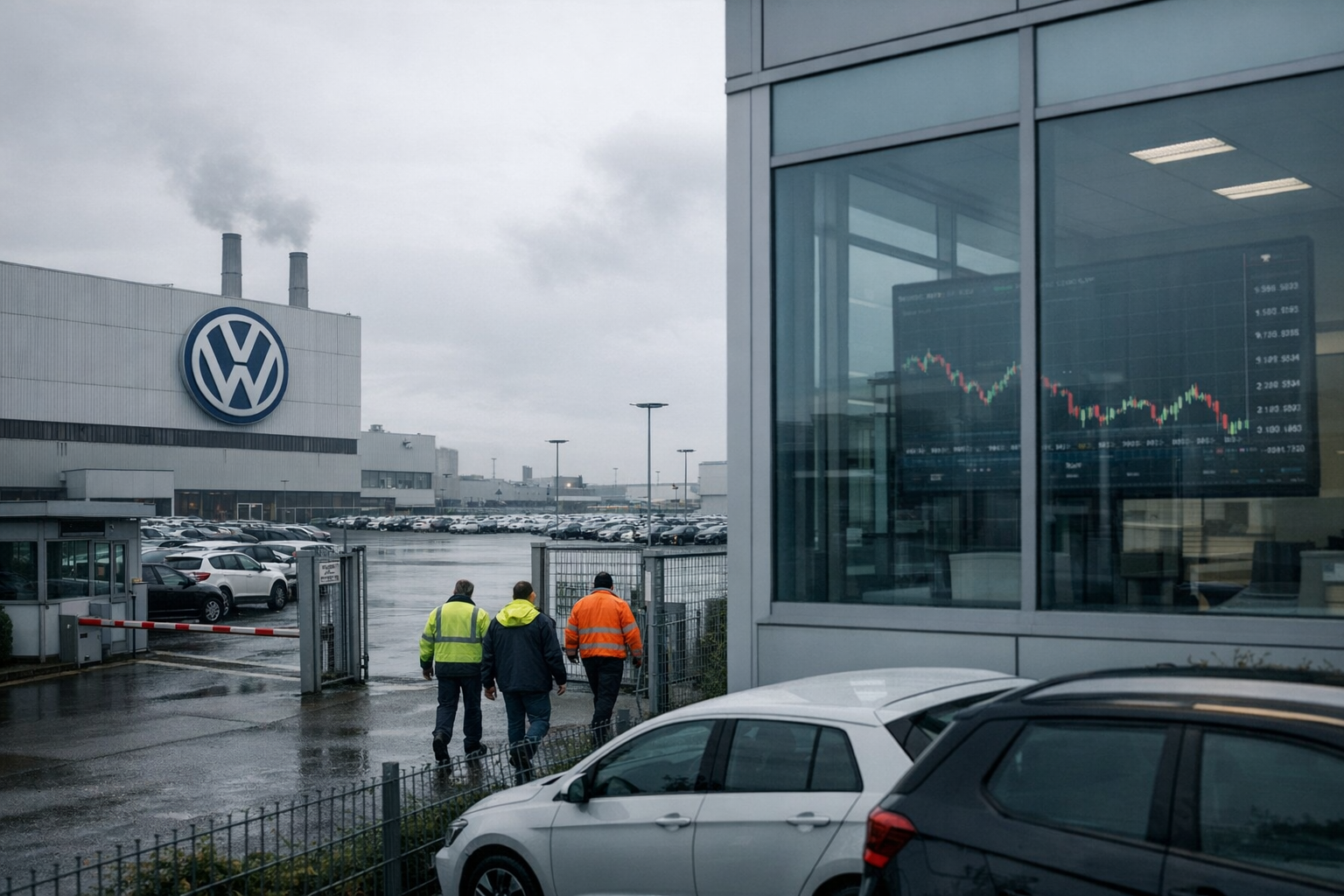
Volkswagen, Europe’s largest carmaker, said it would cut another 50,000 jobs as part of a sweeping overhaul meant to confront a punishing mix of weak demand in Europe, tariff pressure from the United States and intensifying competition from Chinese rivals — a move that investors hailed as evidence the company is finally embracing the depth of its crisis.
The company’s supervisory board approved what it calls “Future Plan 2030,” expanding an existing restructuring effort into one of the most far-reaching industrial shake-ups in the history of Europe’s auto sector. The additional cuts bring Volkswagen’s planned workforce reduction to roughly 100,000 jobs worldwide, while also setting out to slim its sprawling product range, simplify management and tackle excess manufacturing capacity across Europe.
Volkswagen shares rose sharply after the announcement, climbing about 6 percent intraday and ending Thursday nearly 8 percent higher, a sign that markets viewed the plan as a serious attempt to restore profitability after months of mounting concern over the group’s direction.
A Turning Point for a German Industrial Icon
For Volkswagen, the decision marks a stark acknowledgment that the pressures facing established automakers are no longer cyclical. They are structural.
The company said it intended to halve its model portfolio by 2035 and reorient its operations around a leaner investment strategy and more region-specific product development. It is targeting annual vehicle sales of about 9 million and an operating margin of 9 percent by 2030, goals that would require a significant improvement from current performance.
Volkswagen has said its European factories have capacity exceeding demand by more than 500,000 vehicles, an imbalance that has become harder to ignore as electric-vehicle growth has slowed in some markets, costs have remained high and Chinese manufacturers have expanded aggressively into both battery-powered cars and Europe itself.
Four German sites — Emden, Zwickau, Hanover and Audi’s plant in Neckarsulm — were identified as lacking secured follow-on production. Volkswagen said current production at those facilities would end on a staggered basis between 2031 and 2034 unless alternative uses or competitive new products could be found.
That leaves the future of some of the company’s most important domestic operations unsettled, underscoring how deeply the restructuring could reverberate through Germany’s industrial base.
Pressure From China and Washington
Volkswagen’s strain has been especially acute in China, long its most important market. For years, the company relied on China as a source of scale and profits. But domestic Chinese brands, particularly in electric vehicles, have taken market share with faster development cycles, lower costs and products better tailored to local tastes.
That erosion has become one of the central problems facing Volkswagen’s leadership. At the same time, Chinese manufacturers have become more formidable competitors in Europe, where they are trying to win customers with lower-priced electric models and rapidly improving technology.
The company is also contending with trade tensions. U.S. tariff pressure has added another layer of uncertainty for global carmakers already trying to reorganize supply chains and decide where to invest. For Volkswagen, those pressures have compounded a broader reassessment of where it can manufacture profitably and how much capacity it truly needs in Europe.
A Deeper Restructuring Than Before
The latest announcement goes well beyond a restructuring agreement reached in late December 2024, when Volkswagen had already committed to a socially managed reduction of more than 35,000 jobs at German sites by 2030 and to significant production cuts.
This new phase is markedly larger in scale and broader in ambition. It suggests that earlier measures were insufficient to close the gap between Volkswagen’s cost base and the realities of a changing auto market.
The company has not yet said exactly when the newly announced 50,000 job cuts will be made or how they will be divided among brands and regions, leaving workers, suppliers and local governments with major unanswered questions. Nor has it clarified what replacement activity, if any, could preserve employment at the four German plants now facing uncertain futures.
Why It Matters
Volkswagen’s overhaul matters well beyond the company itself. The group sits at the center of a vast network of suppliers, engineering firms and factory towns in Germany and across Europe. Any prolonged downsizing will ripple through that ecosystem, affecting employment, investment and the political debate over how Europe can remain competitive in one of its signature industries.
The scale of the plan also sends a wider message: Europe’s legacy carmakers are preparing for a more austere era, one in which they can no longer assume that global scale, premium branding and engineering pedigree will be enough to fend off lower-cost and faster-moving challengers.
Whether Volkswagen can execute the strategy remains uncertain. Labor resistance, political scrutiny and the practical difficulty of shrinking a company of its size could still slow the turnaround. So could the unanswered question hanging over the industry as a whole: whether European manufacturers can adapt quickly enough to compete with Chinese rivals while navigating an increasingly fragmented global trading system.
For now, Volkswagen has chosen a drastic course, one that reflects how profoundly the ground has shifted beneath one of Germany’s most important corporate pillars.
Sources
Further reading and reporting used to add context:
- https://apnews.com/article/07fa1168b8effaf593bae4f5471c8a92
- https://apnews.com/article/8ebf1cc6693a06d06b12fac5693c8333
- https://www.theguardian.com/business/2026/sep/03/volkswagen-confirms-100000-job-cuts-by-2030
- https://www.youtube.com/watch?v=_Yu3QxPEDW8
- https://www.volkswagen-group.com/en/press-releases/agreement-reached-volkswagen-ag-positions-itself-competitively-for-the-future-18911
- Supervisory Board approves Future Plan 2030: A strong signal for Volkswagen Group | Volkswagen Group
- https://www.igm-bei-vw.de/meldung/einigung-im-aufsichtsrat-so-lauten-die-antworten-auf-die-wichtigsten-fragen
- https://www.investing.com/news/stock-market-news/factboxwhich-volkswagen-factories-in-germany-could-be-shut-down-4762903
- https://www.youtube.com/watch?v=pyzUhkS5Jak
- https://www.ndr.de/nachrichten/niedersachsen/vw-will-100000-jobs-streichen-vier-werke-auf-der-kippe%2Cvw-1152.html
- https://www.automobil-produktion.de/news/vw-konkretisiert-produktionsende-in-vier-deutschen-werken/2729042
- https://www.lavanguardia.com/dinero/20260901/11624954/volkswagen-cerrar-fabricas-plantas-alemania-reunion.html
- https://unionpress.eu/2026/09/04/lower-saxonys-minister-president-frames-vws-50-000-job-cut-plan-as-a-f/
- https://correctiv.org/aktuelles/wirtschaft/2026/09/03/60-000-jobs-fuenf-werke-vw-emden-hannover-zwickau-neckarsulm/
- https://www.ndr.de/nachrichten/niedersachsen/hannover_weser-leinegebiet/vw-aufsichtsrat-stimmt-ueberraschend-sanierungsplan-des-vorstands-zu%2Cvw-1438.html
- https://www.volkswagen-group.com/en/financial-news-17302
- https://www.volkswagen-group.com/en/publications/presentations/agreement-reached-volkswagen-ag-positions-itself-competitively-for-the-future-2920/download?disposition=attachment
- https://www.volkswagen-group.com/en/publications/more/annual-report-2024-2931/download?disposition=attachment
- https://www.volkswagen-newsroom.com/en/press-releases/volkswagen-brands-biggest-performance-program-on-track-with-earnings-contribution-of-up-to-four-billion-euros-expected-for-2024-18023/download
- https://www.reddit.com/r/news/comments/1w6n5a6/volkswagen_announces_it_will_cut_100000_jobs_by/
- https://www.investing.com/news/stock-market-news/volkswagen-shares-jump-in-early-trade-following-turnaround-agreement-4888864
- https://www.investing.com/news/stock-market-news/european-shares-edge-lower-ahead-ofus-jobs-data-volkswagen-jumps-4888893
- https://finance.yahoo.com/markets/stocks/articles/european-shares-edge-lower-ahead-073050669.html
- https://www.aol.com/articles/volkswagen-shares-jump-early-trade-062423000.html
- https://www.marketscreener.com/news/european-shares-dip-ahead-of-us-jobs-data-volkswagen-jumps-ce785bdade88f626
- https://ca.marketscreener.com/news/european-shares-edge-lower-ahead-of-us-jobs-data-volkswagen-jumps-ce785bdadf8afe2c
- https://uk.marketscreener.com/news/european-shares-edge-lower-ahead-of-us-jobs-data-volkswagen-jumps-ce785bdadf8afe2c
- https://www.devdiscourse.com/article/international/3972349-volkswagen-flags-50000-job-cuts-across-group-as-board-approves-turnaround-plan
- https://ae.marketscreener.com/news/european-shares-edge-lower-ahead-of-us-jobs-data-volkswagen-jumps-ce785bdadf8afe2c
- https://sa.marketscreener.com/news/european-shares-edge-lower-ahead-of-us-jobs-data-volkswagen-jumps-ce785bdadf8afe2c
- https://ca.marketscreener.com/news/dax-barely-budges-ahead-of-us-jobs-data-vw-shares-take-off-ce785bdadf8cf627
- https://www.marketscreener.com/news/volkswagen-board-approves-turnaround-plan-flags-50-000-possible-job-cuts-across-group-ce785bdadb8bff22
- https://www.reddit.com/r/business/comments/1w6nc2u/volkswagen_to_slash_half_its_vehicle_lineup_and/
- https://www.volkswagen-group.com/en/publications/more/s-p-ratings-direct-volkswagen-ag-release-01-09-2025-3084/download?disposition=attachment
- https://www.reddit.com/r/Economics/comments/1w6ji4i/vw_to_cut_a_massive_50k_jobs_due_to_competition/
- https://www.reddit.com/r/technology/comments/1w6xl8m/volkswagen_plans_to_cut_50000_jobs_amid_dire_need/
- https://www.reddit.com/r/electricvehicles/comments/1w6n746/automakers_urge_congress_to_quickly_pass_law/
- https://www.dailymaverick.co.za/article/2026-09-04-volkswagen-flags-50000-job-cuts-across-group-as-board-approves-turnaround-plan/
- https://www.marketscreener.com/news/volkswagen-launches-probe-into-chinese-auto-supplier-s-graduate-dismissals-ce7858dddc8df021
- https://m.economictimes.com/news/international/business/volkswagen-flags-50000-job-cuts-across-group-as-board-approves-turnaround-plan/articleshow/133749139.cms
- https://www.investing.com/news/stock-market-news/vws-blume-says-overhead-costs-30-above-rivals-50000-jobs-figure-a-guide-4871879
- https://www.devdiscourse.com/article/international/3972504-volkswagen-shares-jump-as-surprise-turnaround-deal-averts-showdown-as-job-cuts-loom
- https://www.investing.com/news/stock-market-news/volkswagen-q2-deliveries-fall-86-as-demand-in-china-slumps-4785592
- https://www.streetinsider.com/Reuters/Volkswagen%2Bflags%2B50%2C000%2Bjob%2Bcuts%2Bacross%2Bgroup%2Bas%2Bboard%2Bapproves%2Bturnaround%2Bplan/27024547.html
- https://live.euronext.com/en/financial-news/volkswagen-needs-deep-cuts-remain-competitive-ceo-says-ahead-crunch-talks
- https://www.investing.com/news/stock-market-news/volkswagens-crisis-in-five-charts-4767648
- https://www.investing.com/news/stock-market-news/tariffs-have-cost-volkswagen-billions-so-far-this-year-ceo-says–reuters-4228838
- https://www.youtube.com/watch?v=kugz71p_bHc
- https://www.volkswagen-group.com/en/publications/presentations/volkswagen-group-investor-relations-roadshow-presentation-august-2025-3080/download?disposition=attachment
- https://www.gulf-times.com/pdf/2025/06/03/business-20250603-1.pdf?ts=011021
- https://en.wikipedia.org/wiki/Volkswagen
- https://www.gulf-times.com/pdf/2026/03/11/business-20260311-1.pdf?ts=012329
- https://www.wsj.com/public/resources/documents/ADQZpUu5lIL9DpEdyHDO-WSJNewsPaper-11-27-2024.pdf