
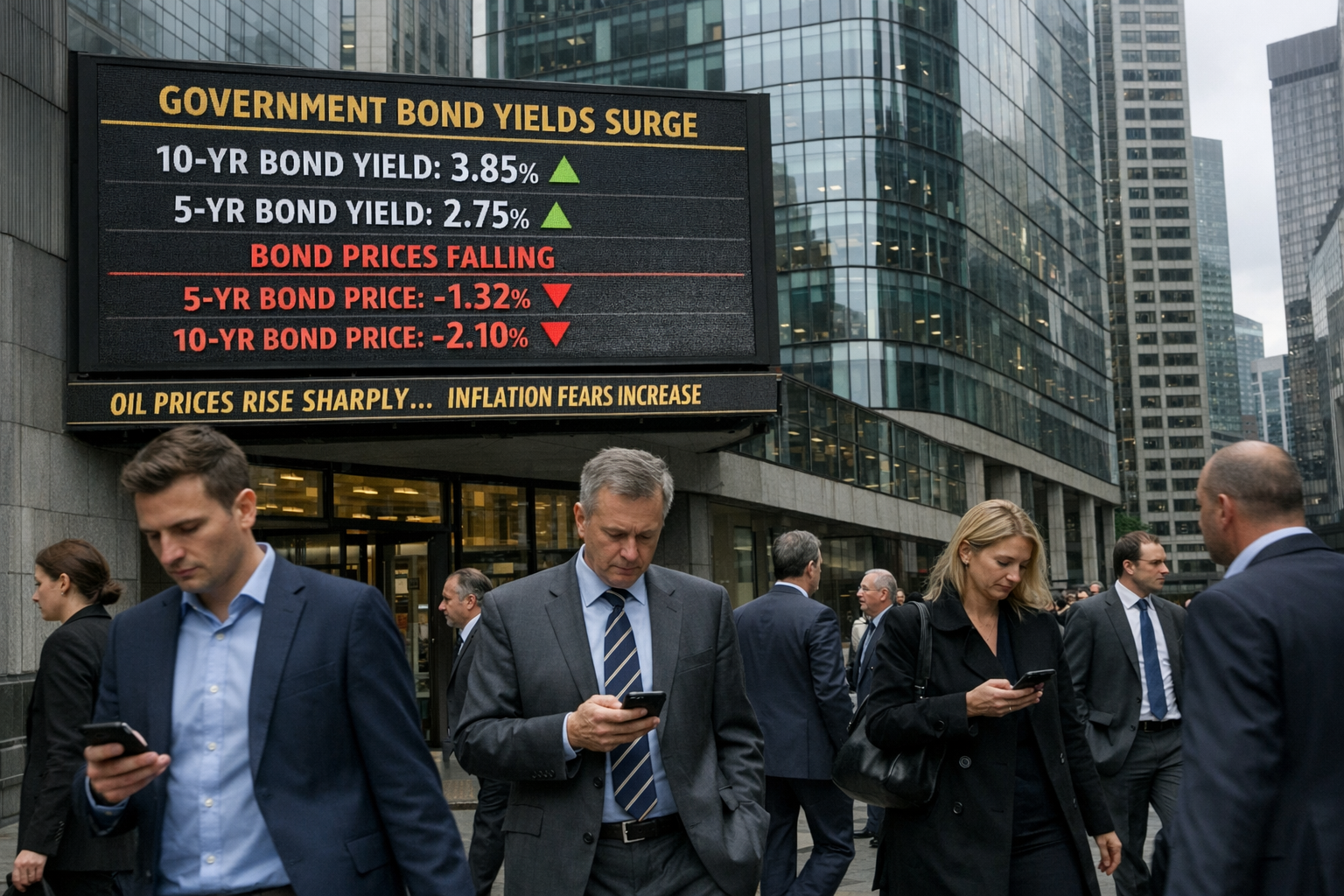
The global bond selloff deepened this week, sending government borrowing costs in the United States, Britain and Japan toward or to multi-decade highs as investors confronted an increasingly troubling mix of geopolitical tension, stubborn inflation and swelling public debt.
U.S. Treasury yields rose again, with the benchmark 10-year note hovering around 4.79 percent on Monday, near its highest level since January 2025. In Britain and Japan, long-term government yields also climbed sharply, extending a move that has unsettled markets for months but has now taken on fresh urgency after renewed hostilities involving the United States and Iran drove oil prices higher.
The immediate trigger was the risk that a wider Middle East conflict could push up energy costs and feed inflation just as central banks were hoping price pressures would continue to cool. But investors and analysts said the selloff reflected more than a one-day geopolitical jolt. Bond markets had already been straining under a broader reassessment of what higher inflation, larger deficits and reduced central-bank support mean for the price of sovereign debt.
A market repricing with wider consequences
Rising bond yields can sound abstract, but they ripple quickly through the economy. Governments must pay more to finance deficits. Companies face higher costs to borrow. Mortgage rates and other consumer lending rates can stay elevated. And because Treasury yields serve as a benchmark for valuing assets around the world, climbing yields can also pressure stocks and corporate bonds.
In effect, investors are demanding more compensation to lend to governments for a decade or longer. Part of that reflects concern that inflation could prove stickier than policymakers had hoped. Part reflects the sheer amount of debt governments need to sell. And part reflects the reality that central banks, having spent years suppressing long-term yields through vast bond-buying programs, are no longer acting as such reliable buyers.
That shift is especially significant now. Even without an immediate interest-rate increase from the Federal Reserve or other central banks, higher long-term yields tighten financial conditions on their own. They can do some of the work of monetary policy by slowing borrowing and investment, but in a less controlled and less predictable way.
Oil revives fears that disinflation could stall
The renewed rise in yields came as oil prices advanced on fears that tensions with Iran could disrupt supplies or at least embed a fresh geopolitical risk premium in energy markets. Investors have become acutely sensitive to any shock that might reverse progress on inflation.
Energy prices have often complicated central banks’ efforts to bring inflation down, and markets are now asking whether the latest rise in oil will prove brief or persistent. If it lasts, it could feed into transport, manufacturing and household costs, making it harder for inflation to return convincingly to official targets.
That matters because the recent optimism in bond markets had depended in part on the idea that inflation was easing enough to allow central banks eventually to reduce policy rates. A renewed energy shock threatens that narrative. If inflation expectations remain anchored, the damage may be limited. But if households and businesses begin to assume higher prices will persist, policymakers could face pressure to keep rates higher for longer.
Debt burdens and bond supply add to the strain
Even before the latest flare-up in the Middle East, sovereign debt markets were confronting another uncomfortable reality: governments are issuing vast amounts of debt at the same time that demand from official buyers is less dependable.
Large fiscal deficits in major economies have increased the amount of bonds that must be absorbed by private investors. At the same time, many central banks are shrinking their balance sheets or at least no longer expanding them in the way they did during the era of ultra-low rates. The result is a market that requires higher yields to clear.
In Japan, the move has drawn particular attention. For years, extremely low Japanese yields encouraged domestic investors to seek better returns overseas, helping support foreign bond markets, especially U.S. Treasuries. As yields at home rise, more Japanese capital may stay in domestic assets, reducing a crucial source of demand abroad. That dynamic has made Japan’s bond market increasingly important to global investors, even if the immediate headlines are elsewhere.
Britain, too, has felt the pressure, with gilt yields climbing as investors weigh inflation risks against already fragile public finances and weak growth. In all three markets, the message from investors has been similar: the price of long-term money is rising.
Investors debate how to respond
For fixed-income investors, the selloff has created both anxiety and opportunity. Bonds have endured repeated losses as yields climbed, challenging the traditional view that government debt offers a straightforward refuge when markets become volatile. Yet the sharp rise in yields also means investors can now lock in income levels that were unavailable for years.
That has sharpened a debate over strategy. Some investors are keeping portfolios short in duration, preferring bonds that mature sooner and are less vulnerable to further increases in yields. Others are favoring inflation-protected securities or selective credit exposures. Still others argue that, after such a severe repricing, longer-dated bonds are beginning to offer attractive value if inflation eventually recedes and growth slows.
The difficulty is timing. If oil retreats and inflation expectations remain contained, current yields may look compelling. If energy prices keep rising, deficits remain large and central banks signal a tougher stance, the selloff could have further to run.
What markets are watching next
The next tests will come quickly. Investors are watching whether upcoming government debt auctions attract solid demand or reveal signs of strain. They are also monitoring whether higher yields begin to spill more forcefully into equity markets and corporate credit, where financing conditions could tighten abruptly.
Above all, markets are focused on whether the latest inflation scare changes the policy outlook. The Federal Reserve and its peers have spent years trying to restore price stability after the inflation surge of the early 2020s. A bond market that is pushing yields higher on its own suggests investors are not yet convinced that job is finished.
For now, the selloff is a reminder that the era of cheap sovereign borrowing is over — and that in a world of geopolitical instability, heavy debt loads and still-unsettled inflation, the bond market remains a powerful enforcer of fiscal and monetary credibility.
Sources
Further reading and reporting used to add context:
- https://apnews.com/article/52d5e82d851a624b95bc142a0c90d924
- https://apnews.com/article/61f03262bb5dfa1c414c4fb7be40772e
- https://apnews.com/article/27b78c349725ac744c96a6b8b8167bae
- https://www.kiplinger.com/investing/fixed-income/are-registered-index-linked-annuities-rilas-right-for-you
- https://www.kiplinger.com/investing/stocks/stocks-lose-again-as-us-iran-war-heats-up-stock-market-today
- https://www.kiplinger.com/personal-finance/charity/how-to-support-communities-with-your-fixed-income-investing
- https://apnews.com/article/775d7cf741349c7c8e689c0beb57f074
- https://energynews.today/2026/09/01/global-bond-yields-soar-to-multi-decade-highs-as-middle-east-turmoil-reignites-inflation-fears/
- https://beijingtimes.com/business/bonds/2026/09/02/global-bond-yields-multi-decade-highs-iran-inflation/
- https://www.vibetrader.com/news/a12b333f-96f0-4bdc-a967-3eee9ef6c9f0
- https://www.brivv.com/en/article/global-bond-yields-multi-decade-highs-middle-east-inflation
- https://www.reddit.com/r/neoliberal/comments/1w4eage/global_bond_yields_soar_to_multidecade_highs_as/
- https://www.investing.com/news/economy-news/bond-selloff-deepens-as-inflation-oil-prices-jolt-markets-4885291
- https://www.imf.org/en/blogs/articles/2026/02/18/stock-bond-diversification-offers-less-protection-from-market-selloffs
- https://www.asiafinancial.com/global-bond-yields-hit-multi-decade-highs-on-war-inflation-fears
- https://primexbt.com/news/global-bond-sell-off-deepens-as-middle-east-tensions-and-inflation-fears-push-yi/
- https://investor.vanguard.com/investor-resources-education/article/how-to-hedge-against-inflation-in-your-portfolio
- https://www.reddit.com/r/DeepStateCentrism/comments/1w4eb8p/global_bond_yields_soar_to_multidecade_highs_as/
- https://www.cnbc.com/quotes/US10Y?msockid=1ee6e0138721632315d1f64f866f620a
- https://www.cnbc.com/world/?msockid=1afbb9b74e9160b30b77afe94ff16159®ion=world
- https://link.cnbc.com/public/32871854
- https://www.cnbc.com/2025/09/17/golds-record-rally-takes-breather-as-spotlight-shifts-to-fed.html?msockid=0b6d2253f30e62f10cf0343cf2236368
- https://www.cnbc.com/2025/08/12/cpi-inflation-report-july-2025.html?hss_channel=lcp-10531695
- https://www.cnbc.com/amp/select/best-brick-and-mortar-savings-accounts/
- https://www.cnbc.com/video/2018/02/01/u-s-10-year-hits-highest-level-since-april-2014.html
- https://www.cnbc.com/video/2021/09/28/emons-rates-are-catching-up-to-the-fact-that-inflation-is-going-to-be-higher-and-stickier.html
- https://ftalphaville-cdn.ft.com/wp-content/uploads/2017/09/15182134/LewAlexander.pdf
- https://www.cnbc.com/markets/?msockid=127660b9067f6adb24a576e707cf6b41
- https://media.ft.com/cms/bd4154e2-064e-11dd-802c-0000779fd2ac.pdf
- https://www.cnbc.com/2025/09/11/cpi-report-health-care-inflation-rises.html?msockid=1b54f0cd3a7466b23cdfe6a23bf9670a
- https://www.cnbc.com/2018/02/02/bill-miller-higher-rates-will-be-fine-for-stocks-as-long-as-inflation-stays-in-check.html
- https://www.cnbc.com/2025/09/16/stock-market-today-live-updates.html?msockid=3fa4a154338161300ad7b73b32e56080
- https://media.ft.com/cms/b362ea0c-c873-11dd-b86f-000077b07658.pdf
- https://media.ft.com/cms/bb4cae8c-4269-11e2-979e-00144feabdc0.pdf
- https://investor.vanguard.com/investor-resources-education/online-trading/bond-strategies
- https://corporate.vanguard.com/content/corporatesite/us/en/corp/articles/japans-higher-rates-raise-stakes-global-markets.html
- https://investor.vanguard.com/investor-resources-education/understanding-investment-types/us-treasury-bonds
- https://www.fidelity.com/learning-center/trading-investing/bond-market-outlook
- https://www.schwab.com/learn/story/bond-vigilantes-explained
- https://www.schwab.com/learn/story/how-do-treasury-auctions-work
- https://advisors.vanguard.com/strategies/fixed-income/bond-funds/bond-ladder
- https://www.schwab.com/learn/story/bond-market-2026-what-could-go-wrong
- https://www.schwabassetmanagement.com/content/positioning-client-portfolios-amid-interest-rate-uncertainty
- https://www.fidelity.com/learning-center/wealth-management-insights/manager-mindset
- https://www.fidelity.com/learning-center/investment-products/fixed-income-bonds/bond-prices-rates-yields
- https://www.schwab.com/learn/story/fixed-income-outlook?msockid=0c01c9971c216cc73af4df431db96d4b
- https://institutional.fidelity.com/app/proxy/content?literatureURL=%2F9922547.PDF
- https://corporate.vanguard.com/content/dam/corp/articles/pdf/afi_perspectives_q22026_income_in_focus.pdf
- https://workplace.vanguard.com/assets/corp/fund_communications/pdf_publish/us-products/investment-profiles/0119.pdf
- https://www.fidelity.com/bin-public/060_www_fidelity_com/documents/learning-center/Transcript_Bonds%20beyond%20yield_v2.pdf
- How major US stock indexes fared Tuesday 9/1/2026
- Why bond yields are rising and why everyone should care
- Bond selloff deepens as inflation, oil prices jolt markets By Reuters