
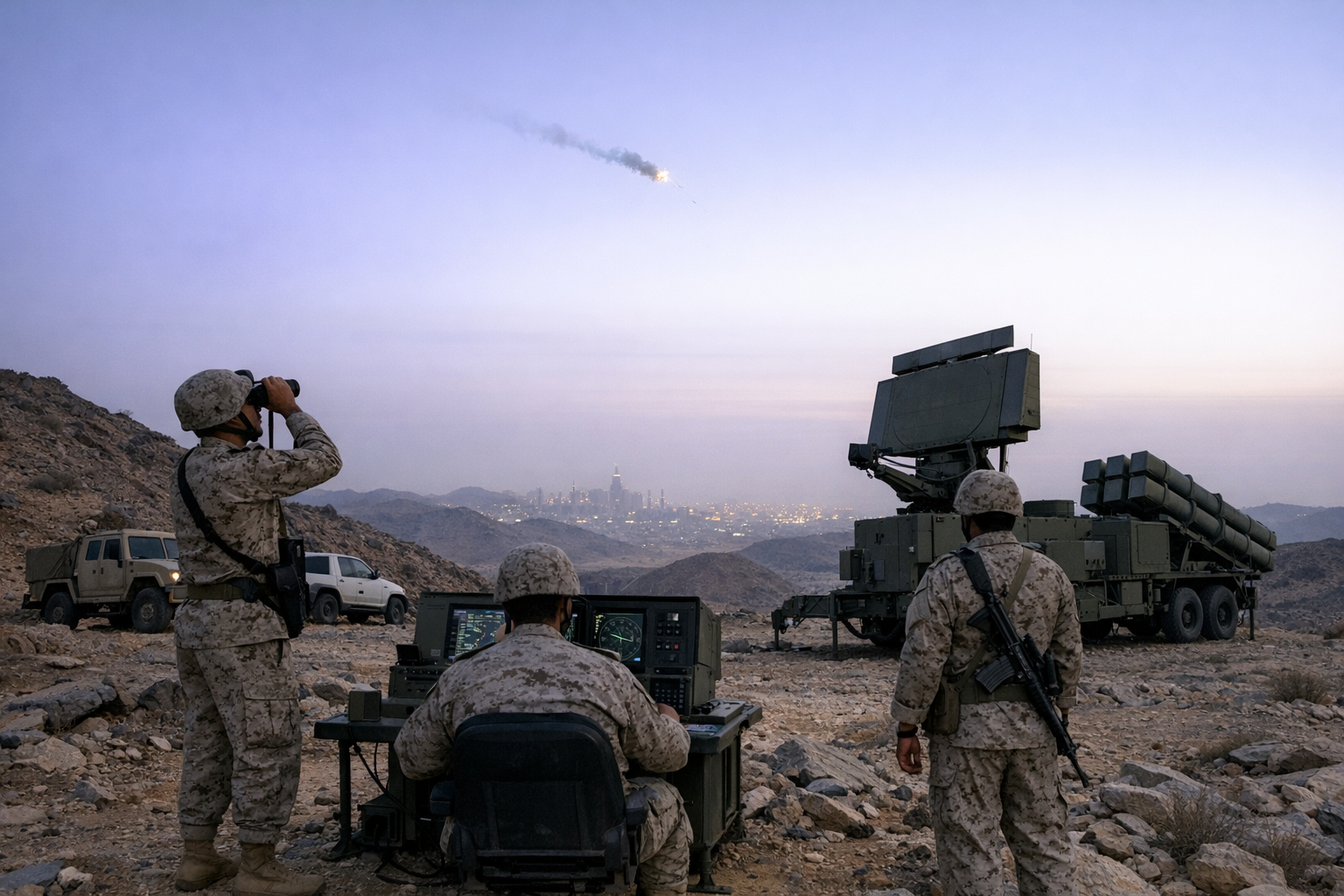
Saudi Arabia said on Tuesday that it had intercepted a drone launched by Yemen’s Houthi movement near Mecca, a claim that has sharply escalated the political and religious stakes of a conflict that was already spilling beyond Yemen and into the kingdom’s energy and security infrastructure.
Riyadh said the drone was destroyed south of Mecca before it entered restricted airspace over the holy city, and warned that the security of Mecca and Medina was a “red line.” Houthi officials denied that they had targeted Mecca, calling the accusation false. But the report drew swift condemnation from the Organization of Islamic Cooperation and from governments across the region, reflecting the extraordinary sensitivity of any perceived threat to Islam’s holiest sites.
The episode comes as Saudi Arabia is still grappling with the aftermath of recent attacks on oil facilities and transport links, including damage to the East-West pipeline, a key artery that carries crude across the kingdom to the Red Sea. Together, the incidents have deepened fears that a conflict once largely contained to Yemen is entering a more combustible phase, one with implications for regional security, global energy markets and the Muslim world at large.
A conflict takes on greater religious weight
An attack near Mecca, even one whose intended target remains disputed, carries a significance far beyond the battlefield. Mecca, the birthplace of the Prophet Muhammad and the focal point of the Hajj pilgrimage, occupies an unmatched place in the Islamic world. Any suggestion that it was threatened is likely to intensify pressure on Saudi leaders to respond forcefully and to rally support from Muslim-majority countries.
Saudi officials framed the incident in precisely those terms, casting it not simply as another cross-border strike but as an unacceptable affront to sacred ground. That framing may leave Riyadh with little room to de-escalate publicly, particularly after years in which the kingdom has sought to present itself as guardian of Islam’s holiest places while also trying to contain a grinding war on its southern border.
Yet crucial questions remain unresolved. Saudi Arabia’s account of the drone’s intended destination has not been independently verified, and the Houthis insist they were not aiming for Mecca. In a region where military claims are often difficult to confirm in real time, that uncertainty may do little to ease tensions.
Oil facilities and shipping routes under pressure
The reported drone interception follows a series of attacks that have already rattled Saudi Arabia’s sense of security. The East-West pipeline was temporarily shut after a drone strike that Saudi Arabia blamed on Iran-aligned groups operating from Iraq, broadening concerns that multiple fronts are opening against the kingdom.
American officials have sought to reassure markets that the disruption may be brief. U.S. Energy Secretary Chris Wright said flows through the pipeline could resume within days. But regional officials have offered more cautious assessments, with some warning that substantial repairs could take weeks, underscoring the uncertainty surrounding Saudi export capacity.
The attacks have landed at a delicate moment for global oil markets, where even short-lived interruptions can send prices higher if traders fear wider instability. The pipeline is strategically important because it allows Saudi crude to bypass the Strait of Hormuz and reach Red Sea terminals. Damage there, combined with mounting threats along Red Sea shipping lanes, has revived concerns over supply disruption from one of the world’s most important energy-producing regions.
The Yemen war widens again
The latest flare-up also marks a stark reversal from the relative lull that had settled over the Yemen war after years of devastating fighting. A ceasefire and subsequent negotiations had reduced large-scale hostilities, raising cautious hopes that the conflict might remain contained even without a comprehensive peace agreement.
Those hopes have eroded quickly this month. The Houthis, who are aligned with Iran, have stepped up military pressure, gained ground in Yemen and expanded threats to maritime traffic in the Red Sea, according to regional officials and international reporting. Saudi Arabia, in turn, has resumed airstrikes, signaling that the war is once again becoming entwined with broader regional rivalries.
That wider context matters. Riyadh has long accused Tehran of arming and directing the Houthis, while Iran has denied direct operational control. Each new drone or missile attack, especially one touching strategic infrastructure or holy sites, strengthens the argument among Saudi and allied officials that the kingdom is facing not an isolated insurgent challenge but a coordinated regional campaign.
What comes next
Much now depends on how Saudi Arabia chooses to respond and whether its partners move beyond statements of support. The denunciations from the Islamic world may increase diplomatic isolation for the Houthis, but they do not in themselves resolve the central risks: more strikes on energy assets, more attacks affecting Red Sea commerce, and the possibility that sacred geography becomes part of an expanding war narrative.
For Riyadh, the challenge is both military and symbolic. Protecting oil installations is one imperative; defending Mecca and Medina is another, far more emotionally charged one. If Saudi leaders conclude that the drone episode has crossed a threshold, the prospect of a stronger retaliation against Houthi positions in Yemen — and perhaps against perceived backers elsewhere — becomes more likely.
For now, the immediate facts remain contested. But even without independent confirmation of the drone’s precise target, the claim alone has altered the atmosphere. In a region already strained by attacks on pipelines, shipping routes and border areas, the suggestion of a threat near Mecca has made the conflict harder to compartmentalize and far more dangerous to ignore.
Sources
Further reading and reporting used to add context:
- https://apnews.com/article/895320bde6dc589cebb628b63832c38a
- https://apnews.com/article/567498d0aa85a32e9c294759bd943501
- https://apnews.com/article/5696629010c86b8cc83f69cbd093e3f1
- https://apnews.com/article/025d052a14d9481258d51009a76d0bd6
- https://apnews.com/article/324485fad65647d4a897d5bfdcb7849c
- https://apnews.com/article/efa431e2fa771e34880c8453c62ffb92
- https://apnews.com/article/8c18d82c109a8ea91347ce53c0096c53
- https://www.axios.com/2026/09/11/houthis-yemen-saudi-trump-mbs-strikes
- https://www.theguardian.com/world/saudiarabia
- https://www.zetik.com/news/article/story_id-p008-215214
- https://una-oic.org/en/ALL/2026/09/12/The-Muslim-World-League-condemns-the-targeting-of-5-a/
- https://oic-pr.mfa.gov.tr/Mission/ShowAnnouncement/419422
- https://interestana.com/articles/saudi-arabia-warns-of-red-line-after-houthi-drone-intercepted-close-to-holy-city-of-mecca-00wuu1z8
- https://www.oic-oci.org/en
- https://qna.org.qa/en/news/news-details?date=16%2F09%2F2026&id=oic-condemns-houthi-attacks-on-makkah-madinah
- https://www.aljazeera.com/amp/news/2026/9/16/saudi-led-coalition-intercepts-drone-headed-for-mecca
- https://www.newsminimalist.com/articles/saudi-arabia-intercepts-houthi-drone-near-mecca-warns-of-deterrent-action-0d46f5f1
- https://www.thenationalnews.com/news/mena/2026/09/16/live-saudi-houthis-makkah/
- https://www.tradingview.com/news/reuters.com%2C2026-09-16%3Anewsml_Zaw9Gdhm5%3A0-zawya-saudi-air-defenses-intercept-houthi-drone-south-of-makkah/
- https://apnews.com/article/4ca491bf0073cc073e04b787ac835807
- https://apnews.com/article/bfee618a925924b8562f9fb0a58538b7
- https://www.theguardian.com/world/2026/sep/16/saudi-arabia-houthi-drone-shot-down-mecca-iran-middle-east
- https://www.investing.com/news/commodities-news/saudi-coalition-says-houthi-drone-destroyed-near-mecca-4902841
- https://www.thenationalnews.com/news/gulf/2026/09/16/saudi-led-coalition-says-houthi-drone-destroyed-near-makkah/
- https://www.investing.com/news/commodities-news/us-energy-chief-says-saudi-arabia-oil-pipeline-should-be-back-online-within-days-4902318
- https://amp.dw.com/en/saudi-arabia-says-houthis-target-mecca-warns-of-red-line/a-79285099
- https://www.aa.com.tr/en/middle-east/saudi-air-defenses-intercept-houthi-drone-near-mecca-houthis-deny-involvement/4058420
- https://www.khanlist.com/story/saudi-says-houthis-targeted-mecca-with-a-drone-iran-backed-7e8d17f9
- https://www.internazionale.it/ultime-notizie-reuters/2026/09/16/saudi-coalition-says-houthi-drone-destroyed-near-mecca
- https://www.internazionale.it/ultime-notizie-reuters/2026/09/16/saudi-led-coalition-says-it-destroys-houthi-drone-south-of-mecca
- https://apnews.com/article/0b44bfb43960c6ae850567c0c4e5003a
- https://apnews.com/article/2b126da67b09de2f328846eb656abe0e
- https://apnews.com/article/17bb6a0401abc3eaa7d4586150a41d7d
- https://apnews.com/article/ab2e69eb2959979bae44eb4d45ae637e
- https://apnews.com/article/c76f53f7a53def0c464ca44ac637f203
- https://www.kwch.com/2026/09/14/saudi-oil-pipeline-hit-by-drones-will-be-out-service-weeks-heres-what-that-could-mean/
- https://toronto.citynews.ca/2026/09/14/what-the-closure-of-saudi-arabias-east-west-pipeline-could-mean-for-oil-flows/
- https://www.ttnews.com/articles/saudi-pipeline-out-service
- https://www.greenwichtime.com/business/article/what-the-closure-of-saudi-arabia-s-east-west-22431784.php
- https://www.wral.com/news/ap/8c18d-yemens-houthi-rebels-seize-more-key-islands-in-southern-red-sea-tighten-grip-on-shipping-routes/
- https://www.thenationalnews.com/business/energy/2026/09/14/oil-nears-108-after-saudi-arabia-shuts-pipeline-amid-attacks/
- https://www.marketscreener.com/news/saudis-shut-down-oil-pipeline-as-houthis-tighten-grip-on-red-sea-shipping-ce785bdfd088f12c
- https://ca.investing.com/news/commodities-news/saudis-shut-down-oil-pipeline-as-houthis-tighten-grip-on-red-sea-shipping-4837188
- https://apnews.com/article/90dc86201ef51410ebcdd913837d741d
- https://www.oic-oci.org/en/news
- https://www.radio.gov.pk/16-09-2026/oic-denounces-houthi-attacks-on-makkah-madinah-region
- https://oic-oci.org/ar
- https://www.ertnews.gr/eidiseis/diethni/o-organismos-islamikis-synergasias-katadikazei-tis-epitheseis-ton-xouthi-kata-tis-mekkas-sti-saoudiki-aravia/
- https://www.timesofisrael.com/liveblog_entry/organization-of-islamic-cooperation-condemns-heinous-houthi-attack-on-mecca/
- https://www.arabtimesonline.com/news/oic-condemns-iran-backed-houthi-attacks-on-mecca-medina/
- https://www.astroawani.com/berita-dunia/oic-kutuk-serangan-houthi-terhadap-mekah-madinah
- https://www.antaranews.com/berita/5743239/oki-kecam-keras-serangan-houthi-ke-makkah-dan-madinah
- https://www.una-oic.org/en/general-secretaries/2026/09/08/Secretary-General-of-the-Organization-of-Islamic-Cooperation-173/
- https://www.una-oic.org/en/ALL/2026/09/15/The-Secretary-General-of-the-Gulf-Cooperation-Council-condemns-the-attack.-a/
- https://www.oic-oci.org/docdown/?docID=4498&refID=1251
- https://www.oic-oci.org/docdown/?docID=463&refID=33
- https://new.oic-oci.org/Lists/ConferenceDocuments/Attachments/2839/exec_feb27_2026_final_communique_en.pdf
- https://www.oic-oci.org/upload/journals/content/oic_journal_issue_48_en.pdf
- https://www.oic-oci.org/docdown/?docID=4510&refID=1254
- https://new.oic-oci.org/Lists/ConferenceDocuments/Attachments/2731/Resolutions%20of%20the%20Political%20Affairs.pdf
- Saudi coalition says Houthi drone destroyed near Mecca By Reuters
- US energy chief says Saudi Arabia oil pipeline should be back online within days By Reuters
- Saudi crown prince goes to Egypt for support against Houthi strikes, and other Mideast developments