
Google is trying to force its way back into the center of the artificial intelligence race just as one of the world’s most lucrative customer bases — Wall Street — begins to shift from AI experimentation to the harder work of putting the technology into daily operations.
On Sept. 30, the company unveiled Gemini 4 Argon, a new flagship model that Google says reaches the front rank of AI systems in software engineering, enterprise knowledge work and cybersecurity. The release, at least for now, is narrow: access has been limited to trusted cybersecurity partners rather than thrown open to the broader public. Even so, the launch has revived a question that has dogged Google for much of the year: whether a company that helped invent the modern AI era can still keep pace with OpenAI and Anthropic at its leading edge.
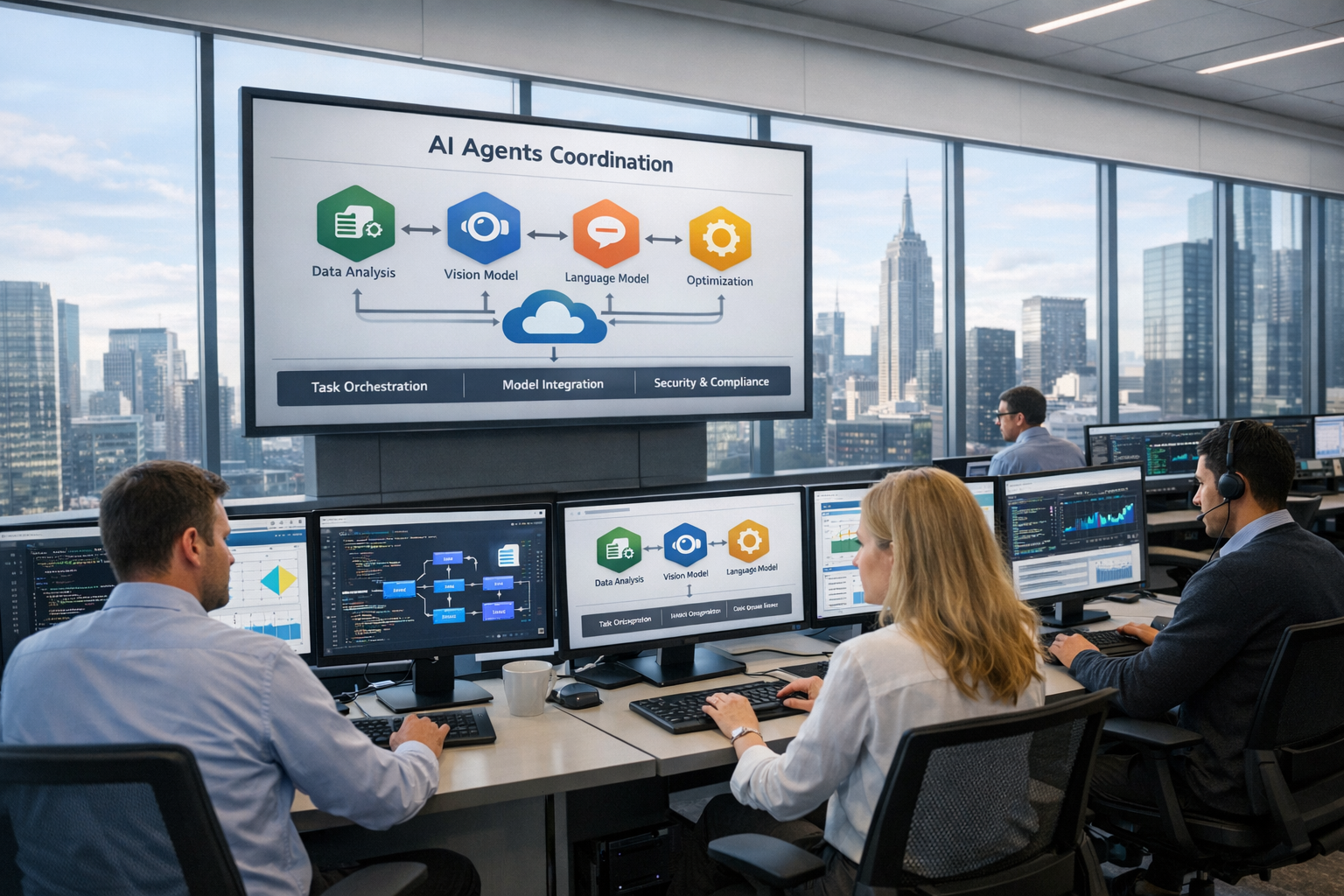
At the same time, financial firms are increasingly hiring for a skill that barely registered in job postings not long ago: “agent orchestration,” or the design of systems that coordinate multiple specialized AI agents, route tasks among them and supervise their outputs. One hiring-data analysis cited in market reports found demand for that expertise had jumped 1,721 percent, with bank postings increasingly mentioning multi-agent workflows, governance and audit controls.
Taken together, the two developments point to the next phase of the AI contest. The battle is no longer only about splashy demos or chatbot popularity. It is also about who can supply the models and tools for businesses willing to spend heavily — and who can prove those systems are reliable enough to handle real work in regulated industries.
Google’s bid to rejoin the front line
For Google, Argon is more than a product announcement. It is a statement of competitive intent.
The company has spent much of 2026 answering doubts about whether it had fallen behind more nimble rivals. OpenAI and Anthropic captured much of the momentum around frontier models, while Google faced scrutiny over the pace of its own releases and the delayed arrival of Gemini 4. In that context, Argon’s debut serves as both a technical claim and a market signal: Google wants customers, developers and investors to see it as firmly back in the top tier.
Google has framed the new model around high-value tasks that businesses are more likely to pay for immediately, especially coding, cybersecurity and knowledge work. Those are areas where superior performance can translate into obvious economic value, whether by accelerating software development, reducing security risks or helping workers manage large volumes of internal information.
The company’s decision to start with limited access in cybersecurity also reflects the tension facing every frontier AI provider. Restricting release can help manage risks and cultivate enterprise credibility, but it also delays the broad developer testing that often determines whether a model’s benchmark results hold up in practice. The central question for Argon is not simply whether Google says it performs at the frontier, but whether independent users will reach the same conclusion once access widens.
A race for agents, not just models
The stakes extend beyond technical bragging rights because the market is already moving toward AI systems that do more than answer prompts.
Google has been building out agent features across its ecosystem this year, including Personal Intelligence in AI Mode and a 24-hour personal-agent concept known as Gemini Spark. Yet rivals have recently seized more visible momentum in consumer-facing assistants. Meta introduced Muse on Sept. 8, and OpenAI followed on Sept. 29 with always-on agents, intensifying the perception that Google may be stronger in enterprise-oriented AI than in the race to create a breakout personal agent for consumers.
That distinction matters. The company that wins broad consumer use can shape expectations, gather feedback at enormous scale and reinforce its ecosystem advantages. But enterprise strength matters, too, especially if businesses become the more immediate source of profits.
Argon appears aimed squarely at that enterprise opportunity. By emphasizing coding and cyber, Google is targeting sectors where performance can be measured, budgets are large and the appetite for automation is growing. If the model delivers in those settings, it could help Google regain developer mindshare and deepen adoption of its broader cloud and AI stack.
Wall Street moves from pilots to production
Nowhere is that enterprise shift more evident than in finance.
Banks and other financial institutions were among the early adopters of generative AI tools for research assistance, coding support and employee copilots. But the latest hiring patterns suggest that many firms are moving beyond one-off pilots toward production workflows that require AI systems to be coordinated, supervised and documented.
That is where agent orchestration comes in. Rather than relying on a single large model for every task, companies are increasingly trying to deploy networks of specialized agents: one might summarize documents, another retrieve internal data, another check compliance rules, and another flag issues for human review. In heavily regulated industries, those systems also need clear handoffs, logs, permissions and mechanisms for escalation when the technology is uncertain or wrong.
The surge in demand for orchestration talent suggests that the challenge has shifted. It is no longer enough to have access to a powerful model. Firms now need the engineering and governance layers around it — the software plumbing that determines whether AI can be trusted with expensive, sensitive or regulated work.
For banks, that means building systems that can automate parts of research, client service, risk review and internal operations without creating new compliance problems. The appeal is obvious: if multi-agent systems can reliably handle repetitive analytical tasks, financial firms could reduce costs and speed decision-making across armies of white-collar workers. But finance is also an industry where errors can carry legal and reputational consequences, making auditability and human oversight essential.
Why this moment matters
The convergence of Google’s latest model push and Wall Street’s hiring spree underscores a broader change in the AI economy.
For much of the past two years, public attention has centered on model launches, safety concerns and consumer chatbot features. Those issues remain important. But beneath them, a quieter contest is taking shape over who will supply the infrastructure for AI at work: the models, tools and management systems that allow companies to automate real processes rather than merely test the technology at the margins.
Google’s challenge is to show that Argon is not just a catch-up release, but a model capable of winning sustained adoption from developers and enterprises. Wall Street’s challenge is different: turning enthusiasm for orchestrated AI systems into durable productivity gains without losing control of governance, reliability and compliance.
Both questions remain unresolved. Google’s new model has yet to face the full scrutiny that comes with broad use. And the finance industry’s hiring boom does not guarantee that multi-agent systems will perform as advertised in live, regulated environments.
Still, the direction of travel is becoming clearer. The next winners in AI may not be decided solely by who has the flashiest chatbot or the highest benchmark score. They may be determined by who can turn frontier models into dependable agents — and by which industries are ready to trust those agents with consequential work.
Sources
Further reading and reporting used to add context:
- https://www.axios.com/2026/09/30/google-gemini-4
- https://apnews.com/article/77b6b8888145869206996d7509d24256
- https://www.axios.com/2026/09/29/alex-stamos-cognition-cybersecurity
- https://apnews.com/article/3c4d7c1cfde82851c0577d1fa29b8621
- https://www.techradar.com/pro/meta-reveals-new-enterprise-platform-to-help-businesses-harness-its-ai-power
- https://blog.google/products-and-platforms/products/search/search-io-2026/?+AI+Search+Updates+=&+Releases+%5BSEOFOMO+-+May+24%2C+2026%5D+-+21881180=&ck_subscriber_id=2136011450
- https://arstechnica.com/google/2026/07/google-reveals-faster-and-cheaper-gemini-3-6-flash-says-3-5-pro-is-still-in-testing/
- https://techcrunch.com/2026/09/30/google-releases-gemini-4-argon-called-its-most-powerful-model-yet/
- https://deepmind.google/blog/securing-the-future-of-ai-agents/
- https://blog.google/innovation-and-ai/technology/safety-security/fairwind-program/
- https://www.themeridiem.com/ai/2026/10/02/agent-orchestration-demand-surges-1-721-as-wall-street-crosses-ai-threshold
- https://capwolf.com/agent-orchestration-is-wall-street-hottest-ai-skill/
- https://deepmind.google/blog/advancing-private-ai-compute-with-secure-server-side-memory/
- https://thehackernews.com/2026/07/google-launches-gemini-35-flash-cyber.html?hl=en_US
- https://cloud.google.com/blog/products/identity-security/rsac-26-supercharging-agentic-ai-defense-with-frontline-threat-intelligence
- https://www.investing.com/news/stock-market-news/pichai-pushes-back-on-claims-google-is-losing-ground-in-ai-race-4807342
- https://ai.google/static/documents/ai-responsibility-update-2026.pdf
- https://www.gate.com/fr/news/detail/JPM%2Fwall-street-banks-post-139819-ai-job-listings-as-agent-skills-surge-1721-24706382
- https://www.gstatic.com/marketing-cms/1c/93/063e61304b1582667ab94f016ce5/policy-approach-agentic-ai.pdf
- https://www.axios.com/2026/09/28/ai-pioneers-intelligence-explosion
- https://www.axios.com/2026/09/26/ai-explainer-for-normal-people
- https://apnews.com/article/9a057de94eb8f30a2fdb5b938918627e
- https://www.tomshardware.com/tech-industry/artificial-intelligence/anthropic-lists-existential-risks-to-humanity-as-one-of-its-risk-factors-in-ipo-prospectus-80-pages-of-risk-factors-dwarf-business-description-as-firm-eyes-usd2-trillion-debut
- https://blog.google/innovation-and-ai/models-and-research/gemini-models/gemini-4-argon/
- https://blog.google/intl/pt-br/gemini-4-argon/
- https://arstechnica.com/google/2026/09/google-announces-gemini-4-argon-ai-model-but-you-cant-use-it-yet/
- https://blog.google/intl/fr-ca/produits/explorez-obtenez-des-reponses/gemini-4-argon/
- https://www.breakingviews.com/columns/breaking-view/ai-frontier-slowdown-could-give-second-tier-leg-up-2026-09-14/
- https://blog.google/intl/id-id/products/explore-get-answers/gemini-4-argon-era-baru-kecerdasan-ai-frontier/
- https://page.camunda.com/report-state-of-agentic-orchestration-automation-banking-and-financial-services-camunda
- https://www.globenewswire.com/news-release/2026/06/23/3316113/0/en/OvationCXM-Survey-Finds-69-of-Finance-Leaders-Would-Pay-Banks-for-Agentic-AI-Connectivity.html
- https://deepmind.google/fairwind-program/?hl=hr
- https://www.bcg.com/publications/2026/ai-agents-reshaping-corporate-treasury?recommendedArticles=true
- https://venturebeat.com/technology/google-unveils-gemini-4-argon-retaking-benchmark-lead-over-openai-and-anthropic-but-in-limited-release
- https://www.reddit.com/r/artificial/comments/1wufikm/google_cooked_openai_and_anthropic_with_gemini_4/
- https://www.reddit.com/r/ArtificialInteligence/comments/1wv5ycc/ai_news_today/
- https://www.reddit.com/r/GoogleGeminiAI/comments/1wqze2k/looking_at_the_leaked_gemini_4_pro_numbers_vs/
- https://www.reddit.com/r/GeminiAI/comments/1wufg38/holy_smoke_google_cooked_openai_and_anthropic/
- https://assets.ctfassets.net/5965pury2lcm/4Hj6TsYITGJhhuk6CTLXkO/10a2c7efcfd6808070de9941b13c1ab1/State_of_automation_in_banking_and_financial_services_2026.pdf
- https://tradebytes.net/article/2026-10-02-how-ai-is-redefining-wall-street-jobs-and-boosting-demand-fo
- https://www.analyticsinsight.net/ampstories/career/top-ai-skills-recruiters-are-looking-for-right-now
- https://www.gartner.com/en/documents/7848981
- https://blog.punkslack.com/daily-systems-trends-report-2026-08-30/
- https://www.techtarget.com/enterprise-software/news/366649826/Genesys-banks-on-AI-customer-service-agents-and-their-orchestration
- https://www.ibm.com/case-studies/inter
- https://fenado.ai/articles/agentic-ai-roles-in-india-grow-260-as-hiring-focus-shifts-beyond-simple-prompt-engineering
- https://camunda.com/
- https://jinba.io/uses/ai-agent-orchestration
- https://www.sphereinc.com/blogs/multi-agent-ai-banking-procurement
- https://www.shankarbankingacademy.com/assets/home/media/general/doc/Current_Affairs_-_March_2026.pdf
- https://arxiv.org/abs/2606.13707
- https://resources.anthropic.com/hubfs/ANTH-2551_Anthropic_AWS_FinServ_Agents_ebook_092325.pdf?hsLang=en
- https://arxiv.org/abs/2601.02577
- https://assets.kpmg.com/content/dam/kpmgsites/xx/pdf/2026/04/hfs-horizons-agentic-services-2026.pdf
- https://arxiv.org/abs/2001.03543
- https://arxiv.org/abs/2604.27891
- https://www.preprints.org/manuscript/202602.0975/v1/download
- https://www.govinfo.gov/content/pkg/GPO-CRECB-1963-pt4/pdf/GPO-CRECB-1963-pt4-7-1.pdf
- https://bn.ag.ny.gov/sites/default/files/2023-10/px-01024_native.pdf
- https://draup.com/engineering
- https://draup.com/
- https://draup.com/ai-information
- https://ghr.wd1.myworkdayjobs.com/Lateral-US/job/Charlotte/Senior-Engineer–Agentic-AI_26002611-2
- https://usbank.wd1.myworkdayjobs.com/US_Bank_Careers/job/Lead-Software-Engineer—API–AI–and-Agentic-Gateway-Platform_2026-0026591
- https://draup.com/sales/agents/cost-takeout-intelligence
- https://job-boards.greenhouse.io/recruitis/jobs/8613068002
- https://www.dice.com/job-detail/7bfa63d2-13c1-442f-8655-a35e362dbda3
- https://draupmedia.s3.us-east-2.amazonaws.com/wp-content/uploads/2025/05/02093438/2.0-Draup_Writeup_Role-and-Skills-Evolution_April-2025.pdf
- https://bmo.wd3.myworkdayjobs.com/en-US/External/job/Agentic-AI-Developer_R260013613
- https://statestreet.wd1.myworkdayjobs.com/Global/job/Quincy-Massachusetts/AI-Orchestration-Engineer_R-794411-1
- https://finanskandidaten.dk/en/jobpost/396/pdf
- https://draup.com/wp-content/uploads/2025/01/3.0-Draup_Global-AI-Report_compressed-1.pdf
- https://alliancedata.wd5.myworkdayjobs.com/breadfinancial_US/job/Columbus-OH/Senior-Staff-Software-Engineer—Agentic-AI_R1012447
- https://www.reddit.com/r/PaidInternships/comments/1tpd9ab/hiring_ai_agent_engineer_parttime_remote_36_months/
- https://www.reddit.com/r/developers_hire/comments/1tr79os/hiring_ai_agent_engineer_parttime_remote_36_months/
- https://www.reddit.com/r/workopiajobs/comments/1vdchb9/us_hiring_snapshot_aug_2_swe_6351_ds_2482_pm_6052/
- https://www.reddit.com/r/u_ImaginationOk7251/comments/1tkj22s/why_banks_are_hiring_ai_agent_development/
- https://arxiv.org/abs/2608.26990
- https://jobalertshub.com/wp-content/uploads/centralbank2026.pdf
- https://arxiv.org/abs/2512.02227
- https://www.mckinsey.com/~/media/mckinsey/industries/financial%20services/our%20insights/extracting%20value%20from%20ai%20in%20banking%20rewiring%20the%20enterprise/extracting-value-from-ai-in-banking-rewiring-the-enterprise.pdf
- https://apnews.com/article/595796511f110fc006cca0d01329733e
- https://apnews.com/article/df331b55daffc6d202d8e2f6d0afa264
- https://www.tomsguide.com/ai/meta-muse-vs-chatgpt-dots-i-compared-the-new-ai-agents-and-theyre-not-as-similar-as-they-look
- https://www.axios.com/2026/09/30/ai-agents-adoption-meta-muse
- https://www.techradar.com/ai-platforms-assistants/i-gave-muse-access-to-my-personal-data-and-now-i-know-why-personal-agents-are-probably-going-to-change-the-world
- https://www.tomshardware.com/pc-components/cpus/meta-muse-runs-agents-on-amd-epyc-turin-hosts-with-two-cores-and-8gb-of-memory-ai-agent-can-pass-terminal-commands-to-ubuntu-host-system
- https://about.fb.com/news/2026/09/introducing-muse-personal-ai-agent/
- https://support.google.com/websearch/answer/17212611?hl=en
- https://blog.google/products-and-platforms/products/search/personal-intelligence-ai-mode-search/
- https://www.investing.com/news/stock-market-news/metas-muse-rekindles-fears-over-winners-and-losers-as-personal-ai-agent-emerges-4913662
- https://www.axios.com/2026/09/08/meta-debuts-muse-personal-ai-agent
- https://techcrunch.com/2026/09/23/everything-new-coming-to-metas-ai-agent-muse/
- https://about.fb.com/ltam/news/2026/09/presentamos-muse-el-primer-agente-de-ia-personal-del-mundo-creado-para-todos/
- https://s206.q4cdn.com/479360582/files/doc_events/2026/Jun/02/Alphabet-Investor-Presentation-June-2026.pdf
- https://www.youtube.com/watch?v=8sABhCMxU3c
- https://www.investing.com/news/stock-market-news/meta-launches-ai-agent-that-can-access-other-apps-to-send-emails-make-payments-4892258
- https://search.google/ways-to-search/ai-mode/
- https://www.clickorlando.com/business/2026/09/29/openai-ceo-announces-new-ai-agent-and-avoids-mention-of-security-concerns-at-developer-conference/
- https://blog.google/intl/en-mena/product-updates/explore-get-answers/search-io-2026/?trk=article-ssr-frontend-pulse_little-text-block
- https://www.axios.com/2026/09/20/ai-assistant-openai-meta-muse-instinct-grok-apple
- https://www.youtube.com/watch?v=tfx2CjqtCUI
- https://arxiv.org/abs/2608.16181
- https://www.portrak.com/api/v1/proxy/api/sec/document/0001652044/000130817926000344/goog014907-ars.pdf
- Introducing Gemini 4
- AI Agent Orchestration Demand Surges 1,721% as Wall Street Banks Pivot to Autonomous Workflows — TradeBytes
- [Report] State of Agentic Orchestration & Automation: Banking and Financial Services | Camunda
- Google Search’s I/O 2026 updates: AI agents and more
- Pichai pushes back on claims Google is losing ground in AI race By Reuters
- Introducing Muse: The World’s First Personal AI Agent Built for Everyone