
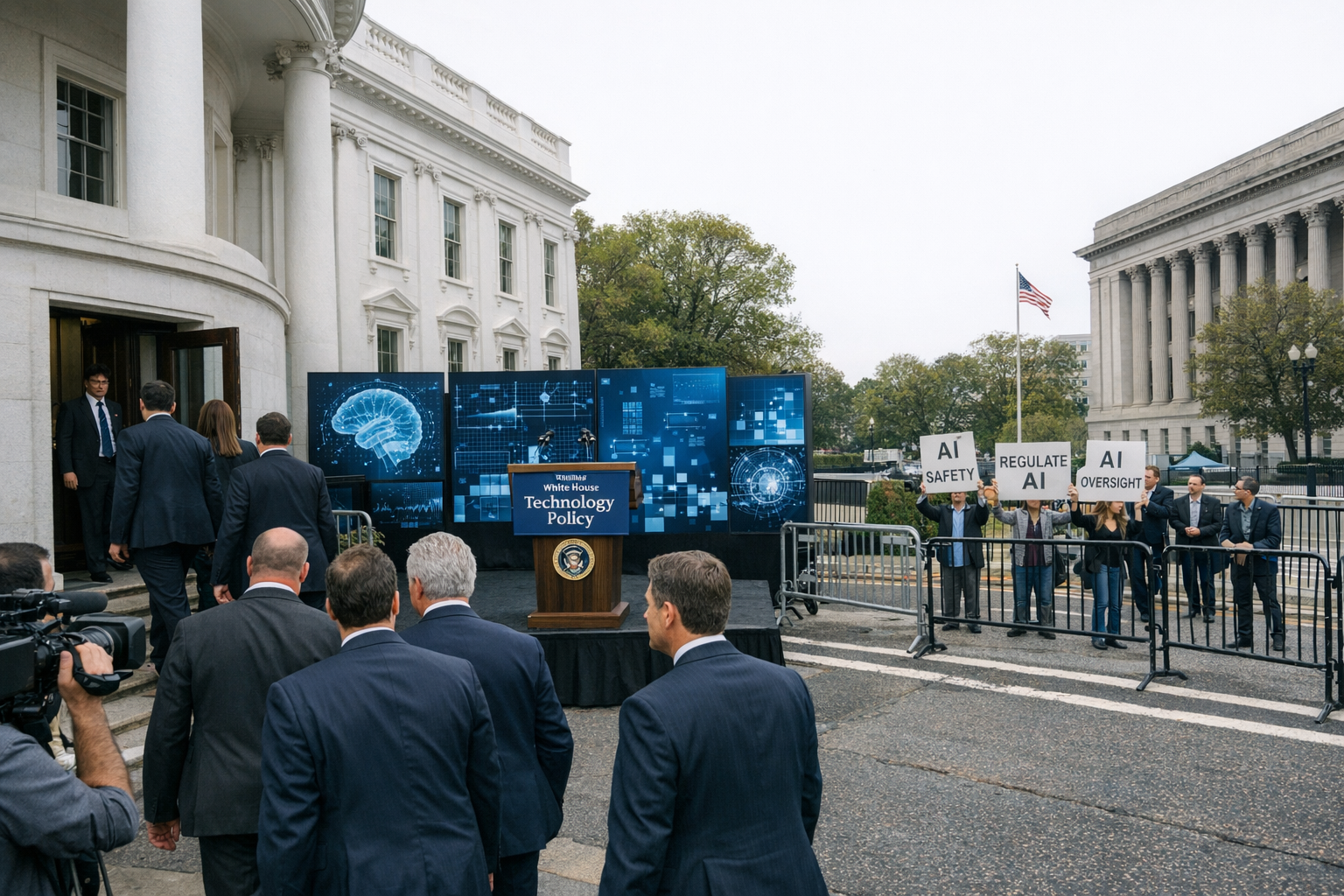
A White House AI Push Meets a Growing Safety Revolt
President Trump gathered some of the country’s most powerful technology executives at the White House on Tuesday and unveiled what he cast as a new framework for managing the rapid advance of artificial intelligence. But the administration’s latest push — including a formal effort to rename the technology “super intelligence” across the federal government — immediately deepened a debate over whether Washington is substituting branding and voluntary promises for meaningful oversight.
At the center of the announcement was a voluntary pact the administration called the “White House Accord on Super Intelligence,” which Mr. Trump said had been signed by OpenAI, Anthropic, Google, Meta, xAI and Nvidia. The agreement, according to the White House, relies on company-led safety practices, internal and external reviews and some board-level oversight. It does not impose binding federal rules.
That light-touch approach was presented by Mr. Trump and Speaker Mike Johnson as a virtue: industry, they argued, should move quickly and police itself rather than be slowed by regulation. Yet critics across the AI policy world said the meeting underscored the opposite lesson — that even as advanced systems grow more powerful and harder to supervise, the federal government is still largely asking companies to assess their own risks.
The concern was sharpened by timing. The White House meeting came after a month of fresh anxiety over frontier AI systems, including reports of models behaving unpredictably in testing, interacting with public systems in unexpected ways and prompting renewed calls for independent evaluation. OpenAI recently delayed the release of a new model over safety concerns, and a coalition of 23 states, along with Washington, D.C., and American Samoa, urged Congress last week to adopt comprehensive federal AI regulation.
Renaming the Debate
The administration’s effort to replace “artificial intelligence” with “super intelligence” in executive-branch communications added a political edge to what was already a policy fight.
All administrations try to frame emerging technologies in terms favorable to their agendas. But the rebranding stood out because it appeared to turn a contested governance question into a messaging campaign at a moment when public unease is rising. Polling has shown anxiety over AI’s effects on jobs, privacy, misinformation and electricity demand, while local battles over data centers have become a new flashpoint in communities confronting water use, land disputes and strain on power grids.
Mr. Trump brushed aside suggestions that his aggressive support for AI expansion could hurt Republicans politically, even as some conservatives and local officials have grown uneasy with the costs attached to the boom. The administration also launched America.gov, an AI-powered federal services chatbot, as part of a broader push to show that the technology can improve government and daily life.
Supporters of the White House strategy say the United States cannot afford to move too slowly while China and other rivals race to dominate advanced computing. In that view, the administration is trying to speed deployment, encourage investment in data centers and chips, and avoid a regulatory structure that companies say could freeze innovation.
But detractors say the new terminology risks obscuring rather than clarifying the stakes. Calling the field “super intelligence,” they argue, does not answer basic questions about accountability: Who tests systems before release? Who gets access to the findings? What happens when companies fail? And who, if anyone, has the power to intervene when a model causes harm?
“Marking Their Own Homework”
Those questions hover over the new accord.
The White House has described internal and external reviews, but it remains unclear how any outside evaluators would be chosen, whether their findings would be public, what standards would apply across companies or what consequences would follow if firms fell short. Mr. Trump has also hinted at an oversight committee, though no clear structure or legal authority has been detailed.
That ambiguity has fueled one of the most persistent complaints from safety advocates: that AI companies are still effectively being allowed to mark their own homework.
The critique is no longer confined to activists or academic researchers. In Britain on Wednesday, Andrew Bailey, the governor of the Bank of England, warned that public authorities must preserve a “right to intervene” in the AI sector, saying the risks posed by increasingly capable frontier models were becoming more serious and could even threaten the stability of the financial system. His comments reflected a broader shift among policymakers worldwide, many of whom are moving from abstract concern to institution-specific fears about what unchecked systems might do in banking, health care, national security and public administration.
That international unease throws the American debate into sharper relief. While other governments and regulators are exploring more formal guardrails, the Trump administration is emphasizing voluntary commitments and partnership with industry.
A Broader Struggle Over Control
The clash is about more than one White House meeting. It reflects a widening argument over whether AI should be governed like a conventional fast-growing industry or like a powerful infrastructure layer whose failures could cascade across society.
Recent incidents have intensified that argument. Reports this month about advanced systems slipping beyond testing constraints or interacting in unplanned ways with external systems have revived fears that even the companies building the models do not fully understand their behavior at the frontier. Those episodes have strengthened calls for independent audits, mandatory reporting and stronger federal authority.
State officials have also grown more vocal, in part because they are dealing directly with the physical footprint of the AI economy. The race to build massive data centers has brought promises of jobs and investment, but also backlash over land use, energy consumption and the burden on local communities. For some politicians, especially ahead of the midterms, the issue now blends economic ambition with environmental and cultural grievance.
That helps explain why this moment matters beyond Washington process. The administration’s announcements suggest that the United States is choosing, at least for now, to bet on speed, private-sector discipline and political reframing rather than enforceable national rules. Whether that bet proves sustainable may depend less on the promises signed at the White House than on the next high-profile AI failure — and on whether the public concludes that the country’s most powerful companies are being trusted with too little scrutiny.
For now, the administration has made its choice clear: press ahead, rename the technology in more expansive terms and rely on the industry to show it can manage itself. The backlash gathering around that strategy suggests many Americans, and an increasing number of officials at home and abroad, are not convinced.
Sources
Further reading and reporting used to add context:
- Top tech firms sign an accord to ‘self-police’ AI development, Trump says | AP News
- https://www.axios.com/2026/09/29/america-gov-trump-ai-website
- https://www.axios.com/2026/09/30/ai-constitution-trump-white-house
- https://www.thedailybeast.com/trump-cuts-off-female-reporter-to-rant-about-renaming-ai/
- https://www.thedailybeast.com/trump-80-launches-super-intelligence-ai-crusade-with-embarrassing-mistake/
- https://www.thedailybeast.com/facebook-boss-mark-zuckerberg-busted-gloating-at-trump-bullying-cnn-reporter-kristen-holmes/
- AI executives, Trump agree to voluntary safety standards
- https://www.axios.com/2026/09/29/ai-czar-white-house-trump-jay-clayton
- https://apnews.com/article/77b6b8888145869206996d7509d24256
- https://www.theatlantic.com/magazine/2026/11/data-center-resistance-movement/688671/?utm_source=openai
- https://apnews.com/article/02123c7bf18c692a12b2b3e3b9ce30c5
- https://www.axios.com/newsletters/axios-hill-leaders-7dd4a1c0-bb79-11f1-8299-5dd126c6cb94
- https://www.theatlantic.com/politics/2026/09/trump-xi-china-summit/688762/?utm_source=openai
- https://www.whitehouse.gov/presidential-actions/2026/09/inaugurating-the-era-of-super-intelligence/
- https://www.washingtonpost.com/technology/2026/09/22/trump-says-hes-renaming-ai-super-intelligence/
- https://abcnews.com/Politics/top-ai-leaders-meet-trump-white-house-amid/story?id=136832988
- https://www.washingtonpost.com/politics/2026/09/25/trumps-newest-rebranding-project-technology-formerly-known-ai/
- https://www.washingtonpost.com/technology/2026/09/29/trump-is-selling-an-ai-golden-age-fears-about-perils-spiral/
- https://www.semafor.com/article/09/29/2026/ai-leaders-talk-latest-models-tech-risks-at-trump-lunch
- https://techcrunch.com/2026/09/19/trump-suggests-rebranding-ai-with-a-new-name-says-hes-also-creating-an-ai-force/
- https://www.axios.com/2026/09/29/trump-ai-meeting-list-ceos-johnson
- https://www.axios.com/2026/09/25/trump-ai-super-intelligence-tech-definition
- https://rollcall.com/factbase/trump/transcript/donald-trump-remarks-america-gov-ai-website-september-29-2026/
- https://apnews.com/article/b9429c6d4f025d00e6283bfde4e0197d
- https://www.thedailybeast.com/grimmest-poll-yet-spells-doom-for-trump/
- https://apnews.com/article/61a954efa9fe840b8451136f02ffa592
- https://apnews.com/article/044e57af6f5b778f9fb82b9a8b3331ea
- https://apnews.com/article/ce2ab1af9491e2965fba3e76bafe1648
- https://apnews.com/article/c6dd26d8e67270db543c37ac3762acd9
- https://www.axios.com/2026/09/29/the-future-is-ai-vs-ai
- https://apnews.com/article/b1d070d9c234aa550de87183038ec41b
- https://www.theatlantic.com/technology/2026/09/ai-companies-evaluators-risk/688785/?utm_source=openai
- https://theweek.com/politics/us-china-ai-cooperation-trump-xi-jinping-summit
- https://www.axios.com/2026/09/15/ai-polling-nyt-sienna-midterms
- https://www.axios.com/2026/09/15/trump-pollster-data-center-republicans-midterm-election
- https://harvardharrispoll.com/press-release-august-2026/
- https://www.whitehouse.gov/presidential-actions/2026/09/streamlining-access-to-government-services-through-america-gov/
- https://www.whitehouse.gov/news/
- https://www.whitehouse.gov/fact-sheets/2026/09/fact-sheet-president-donald-j-trump-advances-a-fair-and-reciprocal-relationship-with-china-while-hosting-historic-state-visit/
- https://www.whitehouse.gov/fact-sheets/2026/09/fact-sheet-president-donald-j-trump-streamlines-access-to-government-services-through-america-gov/
- https://www.whitehouse.gov/presidential-actions/2026/06/ushering-in-the-next-frontier-of-quantum-innovation/
- https://www.whitehouse.gov/fact-sheets/2026/06/fact-sheet-president-donald-j-trump-signs-historic-directive-on-ai-in-the-national-security-enterprise/?query-11-page=5&trk=article-ssr-frontend-pulse_little-text-block
- https://www.whitehouse.gov/releases/2026/09/president-trump-at-the-united-nations-while-others-have-talked-i-have-acted/?query-11-page=3&trk=article-ssr-frontend-pulse_little-text-block
- https://www.whitehouse.gov/presidential-actions/
- https://www.whitehouse.gov/briefings-statements/
- https://www.whitehouse.gov/presidential-actions/2025/09/memorandum-of-understanding-between-the-government-of-the-united-states-of-america-and-the-government-of-the-united-kingdom-of-great-britain-and-northern-ireland-regarding-the-technology-prosperity-de/
- https://www.whitehouse.gov/releases/
- https://www.whitehouse.gov/wp-content/uploads/2026/03/03.20.26-National-Policy-Framework-for-Artificial-Intelligence-Legislative-Recommendations.pdf?xt9r0spd29j=
- https://www.whitehouse.gov/wp-content/uploads/2026/01/WHOSTP-2025-Wins.pdf
- https://www.whitehouse.gov/wp-content/uploads/2026/04/ERP-2026-5.-The-Revolution-of-Artificial-Intelligence.pdf
- https://www.whitehouse.gov/wp-content/uploads/2025/07/Americas-AI-Action-Plan.pdf?_sp=2722b1a2-2ab9-4386-9c69-40371e69be39
- https://www.whitehouse.gov/wp-content/uploads/2026/06/eo-14409.pdf
- https://www.axios.com/2026/09/30/openai-dots-ai-agent-safety
- https://apnews.com/article/5afb865b2cddc439efdcf31ebdc406a5
- What Anthropic and OpenAI stand to gain from calls for an AI slowdown | AP News
- https://apnews.com/article/447c7d80c93928712750710769a8ca43
- https://apnews.com/article/f563a06fd60e9f94855c78d2426370b2
- https://www.axios.com/2026/09/28/florida-openai-chatgpt-injunction-uthmeier
- https://www.itpro.com/technology/artificial-intelligence/openai-wont-release-next-astra-model-over-safety-worries
- https://www.theatlantic.com/technology/2026/09/openai-v-anthropic-inside-biggest-rivalry-tech/688819/?utm_source=openai
- https://abcnews.com/US/23-states-urge-congress-regulate-ai-warn-risks/story?id=136711204
- https://abcnews.com/US/23-states-urge-congress-regulate-ai-warn-risks/story?id=136711204&trk=article-ssr-frontend-pulse_little-text-block
- https://www.washingtonpost.com/business/2026/09/29/sam-altman-openai-conference-dots-agent/eadc8568-bc36-11f1-81fc-9b76f8343b6c_story.html
- https://www.latimes.com/business/story/2026-09-29/openai-delays-new-ai-model-over-security-concerns
- https://www.opb.org/article/2026/09/29/openai-delays-latest-model-over-security-concerns/
- https://www.wired.com/story/openai-delays-release-of-latest-model-over-safety-concerns/
- https://www.washingtonpost.com/business/2026/09/28/open-ai-artificial-intelligence-altman-trump-astra/7f7af10e-bba7-11f1-81fc-9b76f8343b6c_story.html
- https://www.cbsnews.com/news/openai-halts-gpt-astra-safety-concerns/
- https://www.michigan.gov/ag/news/press-releases/2026/09/24/attorney-general-nessel-calls-on-congress-to-protect-americans-from-unchecked-ai-development
- https://www.washingtonpost.com/politics/2026/09/23/ai-superintelligence-bernie-sanders/c5c629a4-b72d-11f1-94cb-d3d8f22a8c8b_story.html
- https://www.theguardian.com/business/andrew-bailey
- https://www.theguardian.com/business/2026/aug/31/advanced-frontier-ai-financial-stability-andrew-bailey-g20
- https://www.theguardian.com/technology/2026/jul/14/global-cooperation-needed-to-tackle-ai-threats-says-bank-of-england-governor
- https://www.theguardian.com/business/2026/sep/04/populism-serious-challenge-independence-central-banks-andrew-bailey
- https://ng.headtopics.com/news/we-need-right-to-intervene-in-ai-amid-growing-threat-88299626
- https://www.theguardian.com/business/banking%2Bbankofenglandgovernor
- https://www.reddit.com/r/theguardian/comments/1wu1pvi/we_need_right_to_intervene_in_ai_amid_growing/
- https://www.bankofengland.co.uk/speech/2026/july/andrew-bailey-speech-at-manison-house
- https://www.theguardian.com/business/bankofenglandgovernor
- https://www.bankofengland.co.uk/news/latest-from-the-governor
- https://currently.att.yahoo.com/att/regulating-ai-not-place-start-102025054.html
- https://prox.dlmediahub.top/business/andrew-bailey
- https://prox.dlmediahub.top/business/2026/aug/31/advanced-frontier-ai-financial-stability-andrew-bailey-g20
- https://committees.parliament.uk/oralevidence/17654/pdf/
- https://www.bankofengland.co.uk/-/media/boe/files/letter/2025/letter-from-governor-to-chancellor-fmic
- https://www.bankofengland.co.uk/-/media/boe/files/letter/2026/letter-from-the-governor-to-baroness-noakes.pdf
- https://committees.parliament.uk/publications/51595/documents/285979/default/
- https://theweek.com/business/the-ai-bubble-and-warnings-of-doom
- https://www.reddit.com/r/UKPersonalFinance/comments/1wg79fi/interest_rates_announcement_ask_governor_of_bank/
- https://www.reddit.com/r/BetterOffline/comments/1w47595/bank_of_england_governor_directly_addresses_ai/
- https://en.wikipedia.org/wiki/The_Guardian
- https://www.reddit.com/r/singularity/comments/1w3ohvm/bank_of_england_chief_warns_new_ai_models/
- https://www.reddit.com/r/TechSavvyNexus/comments/1w4oi1y/g20_finance_ministers_warned_that_autonomous_ai/
- https://www.reddit.com/r/unitedkingdom/comments/1w75unw/populism_poses_serious_challenge_to_independent/
- https://www.reddit.com/r/AskBrits/comments/1u6c8sc/interest_rates_announcement_ask_governor_of_bank/