
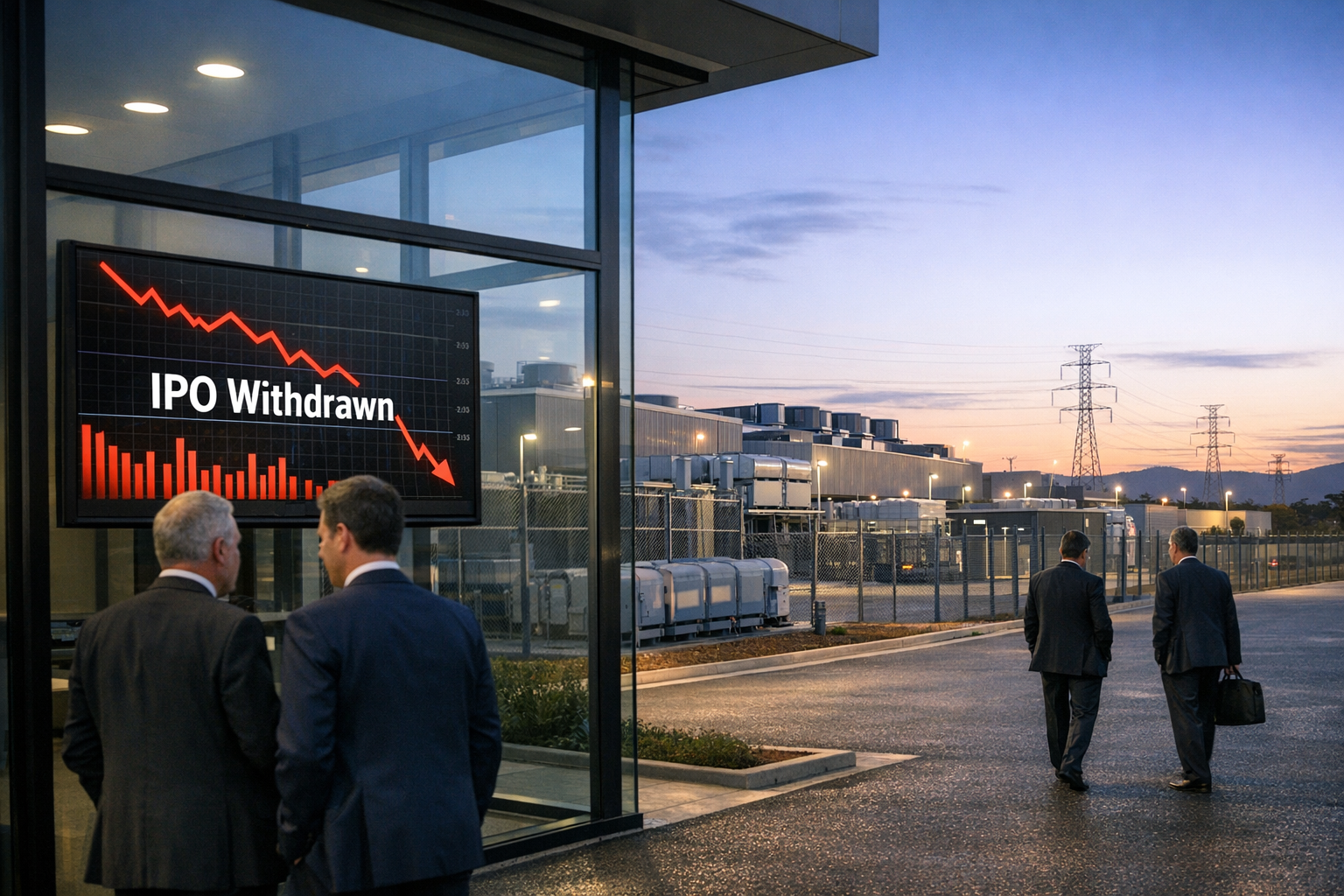
A Flagship A.I. Float Falls Apart
Firmus, the Nvidia-backed Australian data-center operator that had aimed to pull off the country’s largest stock market debut in decades, withdrew its initial public offering on Thursday, a sharp sign that investor enthusiasm for artificial-intelligence infrastructure is proving more conditional than the sector’s evangelists had suggested.
The company said it was shelving the listing because of market volatility and prevailing conditions. The offer had been pitched at 11 Australian dollars a share, implying an equity valuation of about 30.6 billion Australian dollars. Had it gone ahead, it would have been the biggest listing on the Australian Securities Exchange since Telstra’s landmark float in 1997.
Instead, Firmus said it would turn to private markets for funding.
The reversal lands at a delicate moment for the A.I. build-out. For much of the past two years, investors have poured money into the chips, software and power-hungry facilities needed to train and run advanced models, often accepting lofty valuations on the assumption that demand would keep compounding. But as the spending required to support that expansion has ballooned, public-market investors have shown growing reluctance to bankroll businesses whose assets, contracts and earnings remain largely prospective.
From A.I. Boom to Investor Doubt
Firmus had presented itself as a builder and operator of “A.I. factories,” promising an aggressive expansion across the Asia-Pacific region. Yet the gulf between that ambition and its current footprint became a central point of unease. Reports on the deal indicated that the company had only two leased online data centers while projecting annual earnings of $5 billion within five years.
That mismatch appears to have become harder for investors to overlook.
Feedback around the float focused on familiar concerns for infrastructure-heavy growth stories: execution risk, leverage and the level of disclosure behind some of the company’s expansion plans. Questions also mounted after reports that a partnership involving CDC, a key data-center operator, was no longer proceeding in the way earlier presented. For some investors, that raised doubts not only about Firmus’s pipeline but also about how much of its future build-out had truly been locked in.
Another concern was the structure of the register after listing. More than half of the stock was reportedly expected to be sellable from the first day of trading, an unusual feature for a company seeking such a large valuation and one that can heighten fears of early selling pressure.
A More Selective Market
The collapse of the float does not mean investors have soured on A.I. itself. Nvidia remains one of the world’s most valuable companies, and the scramble for computing capacity continues to reshape energy markets, real estate and telecom networks from the United States to Asia. But the episode underscores a distinction that capital markets are drawing more sharply: enthusiasm for the theme is not the same as willingness to underwrite every company attached to it.
That is especially true for data centers, one of the most capital-intensive corners of the A.I. trade. These businesses require vast upfront spending on land, power connections, cooling systems, specialized chips and long-dated financing. Their economics can be compelling once facilities are built and customers are secured, but they are also exposed to delays, cost overruns, technology shifts and changes in customer demand.
Public investors, who can be quicker to punish missed milestones than private backers, appear increasingly wary of paying in advance for years of projected growth. The Firmus withdrawal adds to broader scrutiny over whether some A.I.-infrastructure valuations have run ahead of proven operating performance.
What Comes Next for Firmus
Firmus now faces a different test: whether private capital will prove more accommodating than the public market.
That route may offer the company more time to develop projects, secure customer commitments and refine its expansion case away from the daily judgment of listed investors. But private funding is not necessarily easier or cheaper, particularly for a business that has just been told by the market that its proposed valuation and risk profile were hard to swallow.
The company’s next steps will be closely watched. Investors will want evidence that it can raise capital on workable terms, convert its growth narrative into firmer contracts and demonstrate that its model can scale without excessive strain on its balance sheet. Questions also remain over whether the company may eventually seek an international listing, where larger pools of technology-oriented capital could prove more receptive.
For Australia, the aborted deal is also a reminder of the challenge in bringing oversized, story-driven technology offerings to a market better known for banks, miners and more conventional infrastructure assets. A transaction once billed as a defining local A.I. listing has instead become a cautionary marker of a market cooling toward hype.
Whether that chill is specific to Firmus or the start of a broader reset for A.I. infrastructure offerings may become clearer only with the next big float. For now, one of the sector’s most ambitious public-market tests has failed.
Sources
Further reading and reporting used to add context:
- https://www.theguardian.com/australia-news/2026/oct/09/firmus-australian-stock-market-listing-bust-finance
- https://www.theguardian.com/australia-news/datacentres
- https://www.theguardian.com/australia-news/2026/oct/03/ai-datacentre-backlash-firmus-asx-float-tasmania-australia
- https://www.theguardian.com/australia-news/business-australia
- https://www.theguardian.com/australia-news/2026/oct/08/ai-datacentre-firmus-slash-valuation-before-asx-listing
- Nvidia-backed Firmus scraps $5 billion Australia IPO amid growing AI scrutiny By Reuters
- https://www.abc.net.au/news/2026-10-08/firmus-ipo-underwhelms-before-it-hits-the-market/107241548
- https://www.abc.net.au/news/2026-10-09/tasmania-local-reaction-to-firmus-float-problems/107246744
- https://www.abc.net.au/news/2026-10-09/asx-markets-business-live-news-9-october-2026/107246104
- https://www.marketscreener.com/news/australian-nvidia-backed-ai-data-centre-operator-firmus-shelves-ipo-ce785ddfdc8df725
- https://www.forbes.com.au/news/investing/firmus-pulls-its-gigantic-ipo-heres-what-you-need-to-know/
- https://www.theguardian.com/australia-news/business-australia/2026/oct/08/all
- https://www.reddit.com/r/GUARDIANauto/comments/1x15v8x/tech_firmus_pulls_biggest_asx_float_since_telstra/
- https://www.reddit.com/r/theguardian/comments/1x14xb9/firmus_pulls_biggest_asx_float_since_telstra_amid/
- https://www.reddit.com/r/GUARDIANauto/comments/1x14uac/world_firmus_pulls_biggest_asx_float_since/
- https://www.reddit.com/r/AutoNewspaper/comments/1x14vpf/world_firmus_pulls_biggest_asx_float_since/
- https://www.reddit.com/r/australia/comments/1x14l7d/data_centre_operator_firmus_pulls_share_market/
- https://www.reddit.com/r/australia/comments/1x0isit/data_centre_company_firmus_tries_to_save_its_mega/
- https://www.reddit.com/r/AusFinance/comments/1x17c50/firmus_ipo_float_pulled/
- https://www.reddit.com/r/BetterOffline/comments/1x15n2m/today_on_is_that_good_australian_data_centre/
- https://www.reddit.com/r/AustralianDataCentres/comments/1x0kao7/firmuss_ipo_is_heading_to_around_a825_a_share/
- https://www.reddit.com/r/AusFinance/comments/1x0dvwu/firmus_ipo_whos_the_exit_liquidity/
- https://www.reddit.com/r/AusFinance/comments/1x0csn8/firmus_ipo/
- https://www.reddit.com/r/AusNews/comments/1x0fm40/data_centre_company_firmus_trys_to_save_its_mega/
- https://company-announcements.afr.com/asx/arg/c601cbfb-aee3-11f0-af0f-3eb0efcdc8e9.pdf
- https://www.abc.net.au/news/2026-10-09/firmus-float-gets-pulled-following-lacklustre-investor-demand/107246230
- https://www.investordaily.com.au/firmus-withdraws-asx-listing-application-to-pursue-private-capital/
- https://newsjaws.com/news/firmus-withdraws-asx-float-investor-demand
- https://www.theguardian.com/australia-news/2026/oct/09/firmus-pulls-asx-float-datacentre-investor-doubt-australia
- https://investorpa.com/announcement/355483/
- https://www.straitstimes.com/business/nvidia-backed-firmus-shelves-ipo-eyes-private-funding
- https://www.abc.net.au/listen/programs/abc-news-top-stories/why-data-centre-opreator-firmus-pulled-its-share-float/107248232
- https://company-announcements.afr.com/asx/enn/e4a5524d-54a0-11f1-a099-0218e3fc19a7.pdf
- https://www.reddit.com/r/AusEcon/comments/1x133pj/can_data_centre_company_firmus_live_up_to_its/
- https://www.reddit.com/r/AustralianDataCentres/comments/1x14xol/firmus_has_pulled_its_a79_billion_asx_float_and/
- https://www.reddit.com/r/newswall/comments/1x1cvow/firmus_halts_planned_multibilliondollar_listing/
- https://www.reddit.com/r/ASX_Bets/comments/1x158sx/market_open_thread_for_general_trading_and_plans/
- https://www.reddit.com/r/tasmania/comments/1x16m0j/firmus_ipo_scrapped/
- https://www.reddit.com/r/ASX_Bets/comments/1x0av7w/market_open_thread_for_general_trading_and_plans/
- https://www.reddit.com/r/tasmania/comments/1x0js56/firmus_ipo_troubbles/
- https://www.reddit.com/r/AustralianDataCentres/comments/1x0ln1y/even_at_8_firmus_will_be_overvalued/
- https://announcements.asx.com.au/asxpdf/20260227/pdf/06wvyzxcfn275s.pdf