
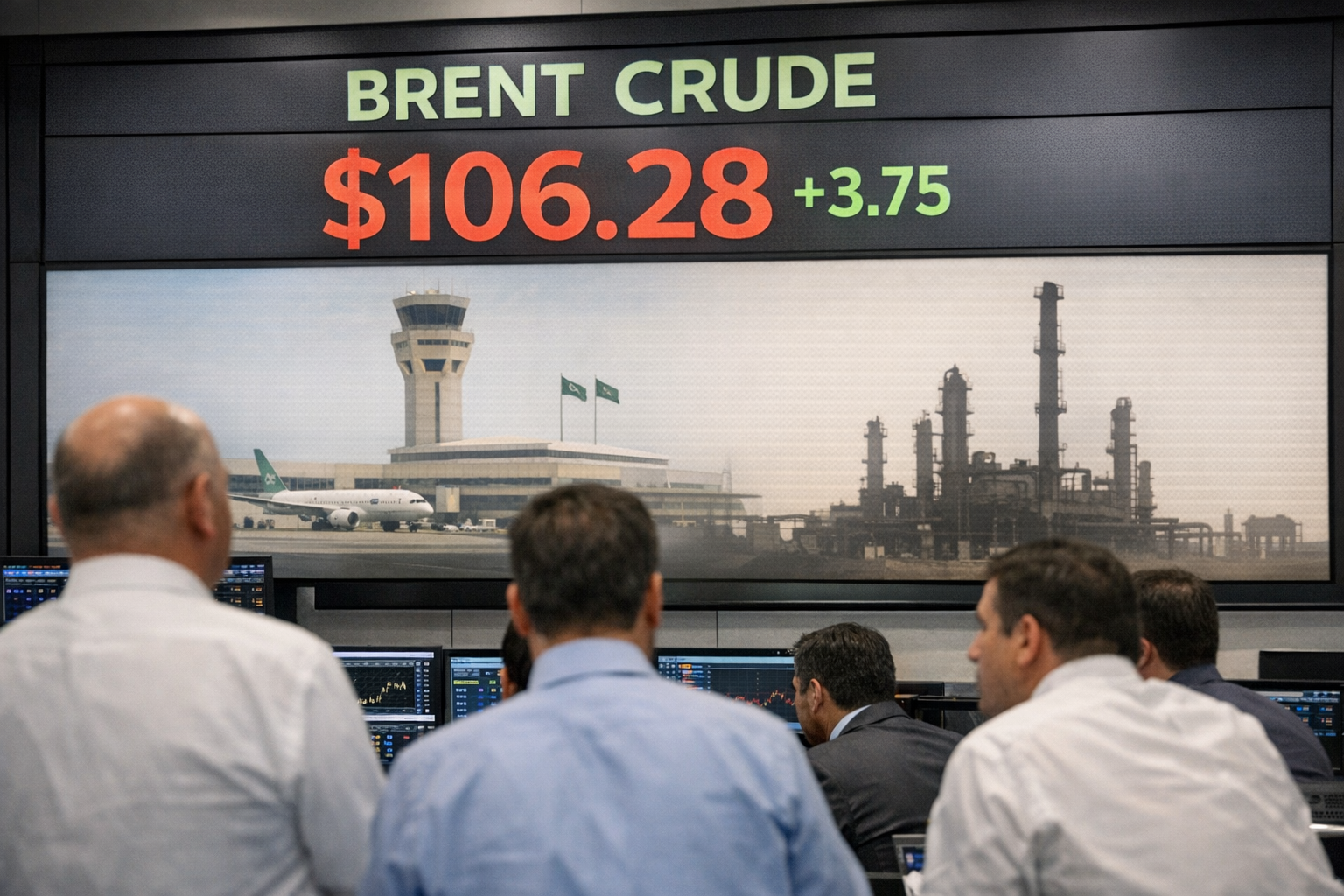
Oil prices climb as traders weigh Saudi attack against shaky hopes for relief
Oil markets swung sharply on Monday as a deadly attack on Riyadh’s international airport in Saudi Arabia revived fears of wider disruption in the Middle East, while doubts over Russian fuel supplies and an uncertain pause in attacks on Ukraine’s energy system undercut hopes for any near-term easing in diesel prices.
Brent crude rose back above $106 a barrel after the assault on the Saudi airport killed 13 people and injured more than 300, pushing geopolitical risk back to the center of trading. The attack overshadowed a competing narrative that had briefly steadied markets in recent days: that additional Russian diesel and an apparent Russia-Ukraine “energy ceasefire” might help loosen an exceptionally tight fuel market.
Instead, traders confronted a familiar conclusion: even when governments promise more supply, political violence and wartime uncertainty can quickly erase any sense of relief.
Ukrainian President Volodymyr Zelensky said Russia had continued striking Ukrainian energy infrastructure, casting immediate doubt on whether any ceasefire existed in a meaningful or enforceable form. “Ukraine supports the ceasefire, and it is important that Russia support it as well,” he said.
That skepticism mattered well beyond the battlefield. Since Russia’s full-scale invasion of Ukraine, attacks on power plants, fuel depots and export infrastructure have become a recurring source of volatility across oil, natural gas and refined-product markets. Any sign that such strikes are continuing tends to harden expectations that energy flows will remain vulnerable.
Russian diesel move seen as too small to change prices
At the same time, the Trump administration’s effort to bring in more Russian diesel has done little to convince analysts that consumers will soon see meaningful relief.
On Oct. 9, the administration said Russia would supply more than 300,000 tons of diesel immediately, with additional cargoes expected in November and beyond. The plan was paired with a temporary waiver of U.S. sanctions on Russian diesel imports, a striking shift in policy as the White House tries to contain fuel costs before the Nov. 3 midterm elections.
Diesel occupies a particularly sensitive place in the economy. It powers freight trucks, farm equipment, industrial machinery and, in some regions, home heating. When diesel prices remain high, the effects spread quickly through food distribution, manufacturing and household budgets.
But analysts have questioned whether the promised Russian volumes are large enough, or logistically flexible enough, to significantly lower prices in a market already strained by limited refining capacity and disrupted global trade routes. Russian refineries themselves have faced pressure, and moving additional barrels into the right markets at the right time is not always straightforward.
In other words, more diesel on paper does not necessarily mean cheaper diesel at the pump or for wholesale buyers.
A market pulled in opposite directions
The result is a market being tugged by opposing forces.
On one side is geopolitical risk, now heightened again by the Saudi attack. Saudi Arabia remains central to global oil supply, and any suggestion of escalating insecurity in the kingdom can prompt traders to add a premium to prices, even before actual output is disrupted. The memory of previous attacks on Saudi infrastructure still lingers in energy markets, where physical damage is only one part of the equation; the threat of further escalation can be enough to move prices sharply.
On the other side are official efforts to increase supply and calm consumers, including the push for more Russian diesel. In theory, those steps should ease pressure on refined-fuel markets. In practice, traders appear unconvinced that the measures are either big enough or reliable enough to offset broader risks.
That disconnect helps explain why oil and diesel markets have remained so reactive. Every new headline — a strike, a sanctions waiver, a ceasefire claim, a denial — is being tested against the same question: will it actually change physical supply?
So far, the answer has largely been no.
Why it matters now
The timing is especially fraught. Northern Hemisphere demand for heating fuels typically rises as colder weather approaches, while diesel inventories in key markets have already been closely watched. High fuel prices also carry immediate political consequences, particularly in the United States, where the administration is under pressure to show progress on energy costs ahead of voting in November.
Yet the latest moves suggest how narrow policymakers’ room for maneuver may be. If Middle East tensions worsen, or if promised Russian diesel shipments arrive late or in smaller quantities than expected, the cushion in fuel markets could prove thin. And if attacks on Ukrainian energy infrastructure continue despite talk of a ceasefire, traders are likely to treat any diplomatic claims with caution.
For now, the market’s message is that relief remains uncertain. The promised barrels are real enough to draw attention, but not yet credible enough to outweigh the risks posed by war, politics and violence across two of the world’s most important energy-producing regions.
Sources
Further reading and reporting used to add context:
- https://apnews.com/article/6fdef6ff4d033b379c74e1d62183d078
- https://apnews.com/article/93fa63c8a88e538f1456e7d448fc550d
- https://www.thedailybeast.com/republicans-break-ranks-to-revolt-against-trumps-putin-diesel-deal
- https://www.thedailybeast.com/murdoch-paper-torches-trump-over-desperate-putin-deal
- https://www.axios.com/2026/10/11/russia-ukraine-oil-energy-ceasefire-trump-putin-zelensky
- https://www.axios.com/2026/10/11/trump-russia-ukraine-energy-ceasefire-zelensky
- https://apnews.com/article/8428a31b39e20a3a3f1fa3f0e15b8f99
- https://www.theatlantic.com/ideas/2026/10/trumps-diesel-deal-sells-out-ukraine/688964/?utm_source=openai
- https://apnews.com/article/9f01941a843fbd8ba64240e296c43f1b
- https://www.axios.com/2026/10/05/trump-red-diesel-tax-energy
- https://www.thedailybeast.com/trump-cuts-desperate-deal-with-putin-to-save-magas-skin
- https://metapress.net/world/2026/10/12/trump-turns-to-russian-diesel-ahead-of-midterms-but-analysts-see-little-price-relief/
- https://www.marketscreener.com/news/oil-falls-on-hopes-russia-ukraine-energy-ceasefire-will-boost-supplies-ce785ddcdc8fff21
- https://www.investing.com/news/commodities-news/ukraine-accuses-russia-of-violating-trumps-energy-ceasefire-as-eu-imposes-new-sanctions-4943687
- https://zot.news/article/analysts-see-little-relief-trumps-russian-diesel-plan-ahead-isuyt
- https://allmind.ai/news/2c774277dd5870330fb7ba58fe1458d7b88f3e02eaeaf2055d5529ef67390d23
- https://www.marketscreener.com/news/trump-says-russia-to-supply-diesel-to-us-and-global-market-ce785ddcd881f12d
- https://www.kitco.com/news/off-the-wire/2026-10-09/trump-says-russia-supply-diesel-us-and-global-market
- https://www.investing.com/news/commodities-news/morning-bid-diesel-diplomacy-4943888
- https://au.investing.com/news/commodities-news/oil-climbs-as-mideast-conflict-tanker-attacks-persist-4683285
- Oil prices rise as attacks on Saudi Arabia overshadow Trump’s Russian supply announcements By Reuters
- Trump says Russia to supply diesel to US and global markets | MarketScreener
- Ukraine accuses Russia of violating Trump’s energy ceasefire as EU imposes new sanctions By Reuters