
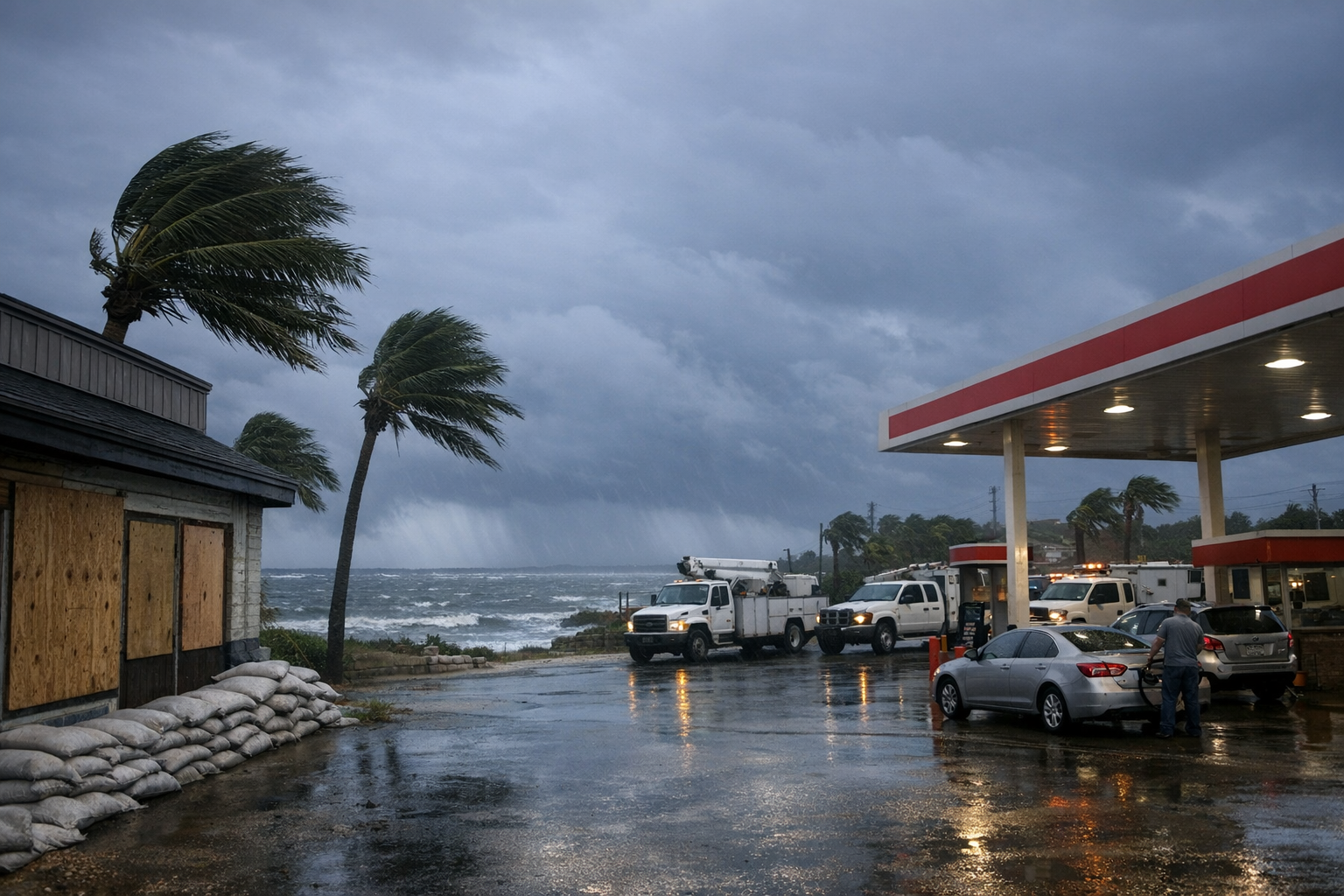
A Late-Season Hurricane Bears Down on the Gulf
Hurricane Isaias strengthened rapidly in the Gulf of Mexico on Friday, becoming the first Atlantic hurricane of the 2026 season and aiming at the northern Gulf Coast with threats of storm surge, destructive winds and flooding rain.
Forecasters said the storm was expected to make landfall later Friday within a stretch of coastline under hurricane and storm-surge warnings. By early morning, National Hurricane Center data showed maximum sustained winds near 110 miles per hour, making Isaias a dangerous Category 2 storm as it approached shore.
Officials warned that the greatest dangers could extend well beyond the point of landfall. Low-lying coastal areas faced the risk of life-threatening surge, while communities farther inland were bracing for flash flooding and isolated river flooding as bands of heavy rain swept northward.
The storm’s arrival is significant not only for the hazard it poses, but for its timing. After an unusually quiet Atlantic season shaped in part by strong El Niño conditions, Isaias is the first hurricane to form in the basin this year. According to reporting citing federal weather officials, the Atlantic had not gone this late into a season without its first hurricane since October 8, 1905.
A Test for a Thinned Federal Agency
As residents rushed to finish preparations, emergency managers were also confronting another question: whether the federal government’s disaster-response system is prepared for a major landfall.
Isaias is expected to be the most serious test yet for the Federal Emergency Management Agency after a period of deep staffing losses and internal upheaval. The agency entered this hurricane season after more than 4,300 employees left in fiscal year 2025 — about 17 percent of its work force — according to a Government Accountability Office report. The same report said FEMA had rescinded its strategic plan and reduced staff without conducting the kind of work force analysis that would show whether it could still meet its statutory obligations.
That has raised alarms among emergency-management specialists, who say FEMA’s value in a large disaster often depends on its ability to quickly assemble a surge work force, move supplies, coordinate with states and stay engaged through the long recovery that follows landfall.
The central concern is not whether FEMA will respond at all. It is whether a diminished agency, stripped of personnel and experience, can respond at the scale and speed demanded if Isaias causes widespread damage.
States Say They Are Ready
Officials across the Gulf Coast have said they are prepared for the storm, and state and local emergency systems have spent years refining their hurricane playbooks. Evacuation guidance, shelter planning, utility staging and swift-water rescue preparations were underway as Isaias approached.
But major hurricanes can quickly overwhelm even well-practiced state systems, especially when storm surge, power outages and inland flooding strike multiple jurisdictions at once. In those moments, FEMA’s role typically becomes crucial: reimbursing emergency costs, coordinating logistics, helping deliver temporary housing and supporting debris removal and longer-term recovery.
The Trump administration has pushed to shrink or dramatically downsize FEMA, arguing that states should bear more responsibility for disaster response. That policy direction now collides with the practical realities of hurricane season, when large storms can demand a level of manpower and coordination that few states can sustain on their own.
What Comes Next
The immediate uncertainties remained meteorological. Forecasters were watching whether Isaias would strengthen further before landfall, exactly where its center would cross the coast and how far inland its flood threat would reach.
Just as important may be what happens after the winds subside. If the storm leaves behind extensive damage, prolonged outages or flooded communities, the response could become an early measure of how much federal disaster capacity has been weakened — and whether the country’s emergency system can still perform as residents expect when a hurricane arrives.
Sources
Further reading and reporting used to add context:
- https://apnews.com/article/919a46d4bd705726b4e57f18ce677ac5
- https://apnews.com/article/733c6a028547ee832c885274cf11589e
- https://apnews.com/article/8ab63c748db4549f6bd96fb977fe98d0
- https://www.axios.com/local/new-orleans/2026/10/08/hurricane-isaias-landfall-louisiana-evacuaions
- https://www.axios.com/local/nashville/2026/10/08/rain-nashville-isaias-forecast
- https://apnews.com/article/440bdecf97a5340547ca3ad291b361df
- FEMA Workforce: Staff Reductions and Lack of Planning May Impact Mission Readiness | U.S. GAO
- https://files.gao.gov/reports/GAO-26-108427/index.html
- https://www.fedweek.com/federal-managers-daily-report/gao-questions-disaster-readiness-following-fema-workforce-cuts-lack-of-strategic-plan/
- https://www.gao.gov/products/gao-26-108583
- https://www.nhc.noaa.gov/archive/2026/al09/al092026.public_a.009.shtml
- https://www.gao.gov/assets/gao-26-108427.pdf
- https://www.gao.gov/federal-workforce
- https://www.gao.gov/products/gao-26-107813
- https://www.fedtools.com/blog/fema-workforce-gao-report-2026
- https://www.gao.gov/products/gao-26-108100
- Hurricane Isaias at 27.0°N – 87.7°W – NOAA / NESDIS / STAR
- https://www.fedtools.com/blog/fema-staffing-cut-ruling-employee-guide-2026
- https://weather.com/2026/10/08/storms/hurricane/tropical-storm-hurricane-isaias-gulf-coast-louisiana-florida
- https://deceleration.news/content/files/d3l0i86vhnepo5-cloudfront-net/wp-content/uploads/2025/09/30113835/gao-disaster-assistancne-high-risk.pdf
- https://www.govinfo.gov/content/pkg/CHRG-119shrg63380/pdf/CHRG-119shrg63380.pdf
- https://www.govinfo.gov/content/pkg/BILLS-119hres1035ih/pdf/BILLS-119hres1035ih.pdf
- https://www.reddit.com/r/fednews/comments/1vgawck/gao_lambasts_fema_workforce_reductions_in_a/
- https://www.nhc.noaa.gov/archive/2026/ISAIAS.shtml
- https://www.nhc.noaa.gov/?linkId=18200562
- https://www.nhc.noaa.gov/text/refresh/MIATASAT4%2Bshtml/082353.shtml
- https://www.nhc.noaa.gov/text/refresh/MIATCMAT4%2Bshtml/090857.shtml
- https://www.nhc.noaa.gov/text/refresh/MIATWDAT%2Bshtml/261656_MIATWDAT.shtml
- https://www.nhc.noaa.gov/mobile/text/refresh/MIATCDAT4%2Bhtml/080856.shtml
- https://www.nhc.noaa.gov/text/refresh/MIATWDAT%2Bshtml/082205_MIATWDAT.shtml
- https://www.nhc.noaa.gov/?_bhlid=f7379595997c84a47f9e97d1114a402e2a94b212
- https://www.nhc.noaa.gov/text/refresh/MIATCMAT4%2Bshtml/082057.shtml
- https://www.nhc.noaa.gov/text/refresh/MIATCDAT4%2Bshtml/081457.shtml
- https://www.nhc.noaa.gov/?gsid=34bc5afd-8d08-4175-8d68-4bf897b6ecfa
- https://www.fema.gov/sites/default/files/documents/PDAReport_FEMA4567DR-NY.pdf
- https://www.fema.gov/vi/print/pdf/node/661669
- https://www.fema.gov/sites/default/files/documents/fema_notice-to-congress_august2025.pdf
- https://www.fema.gov/print/pdf/node/686211
- https://www.fema.gov/sites/default/files/2020-08/fema_p-1801_sc_dam_failure_assessment_advisement.pdf
- https://www.fema.gov/pdf/government/grant/pa/pagprnt_071905.pdf
- https://www.fema.gov/uk/businesses-organizations/doing-business/advanced-contracts
- https://www.fema.gov/pdf/about/regions/regioniii/fy05.pdf
- https://www.fema.gov/sites/default/files/documents/fema_p_938_isaac_mat.pdf
- https://emilms.fema.gov/_is0700b/groups/203.html
- https://www.fema.gov/ht/locations
- https://www.fema.gov/sites/default/files/documents/fema_oehp-spea-berm-final_2182021.pdf
- https://gis.fema.gov/arcgis/rest/services/FEMA/DECs/MapServer/0
- https://www.fema.gov/sites/default/files/documents/fema_covid-19-initial-assessment-report_2021.pdf
- https://www.dhs.gov/sites/default/files/2025-08/2025_0520_fema_review_council_meetingminutes.pdf
- https://emilms.fema.gov/is_1190/groups/143.html
- https://www.fema.gov/disaster/206/news-media
- https://gis.fema.gov/arcgis/rest/services/FEMA/STATE_EOC/MapServer/find
- https://www.usfa.fema.gov/nfirs/coding-help/disaster-response/
- https://gis.fema.gov/arcgis/rest/services/FEMA
- https://www.fema.gov/disaster/declarations?field_dv2_state_territory_tribal_value=CA
- https://gis.fema.gov/arcgis/rest/services/FEMA/IPAWS_Archive/MapServer
- https://emilms.fema.gov/is_1190/groups/17.html
- https://www.theguardian.com/us-news/2026/oct/09/hurricane-isaias-fema-trump-cuts
- https://www.theguardian.com/environment/2026/oct/09/isaias-strengthens-first-atlantic-hurricane-2026
- https://www.theguardian.com/world/2026/oct/07/tropical-storm-isaias-mexico-hurricane
- https://www.theguardian.com/us-news/2026/oct/06/tropical-depression-gulf-hurricane
- https://www.theguardian.com/business/2026/oct/08/oil-prices-rise-middle-east-tensions-us-hurricane-threat
- https://www.theguardian.com/environment/2026/sep/04/weather-tracker-hurricanes-pacific-none-yet-in-atlantic
- https://www.theguardian.com/world/2013/sep/11/hurricane-humberto-gabrielle-weather-us
- https://www.theguardian.com/us-news/2026/apr/30/fema-letter-katrina-declaration
- https://www.theguardian.com/us-news/2026/may/09/trump-council-fema-disaster-preparedness
- https://www.theguardian.com/us-news/2026/may/21/hurricane-season-2026-noaa
- https://www.theguardian.com/us-news/2025/may/05/trump-cuts-disaster-preparedness
- https://www.theguardian.com/us-news/2024/oct/08/trump-project-2025-hurricanes
- Isaias strengthens to become first Atlantic hurricane of 2026 season | Hurricanes | The Guardian