
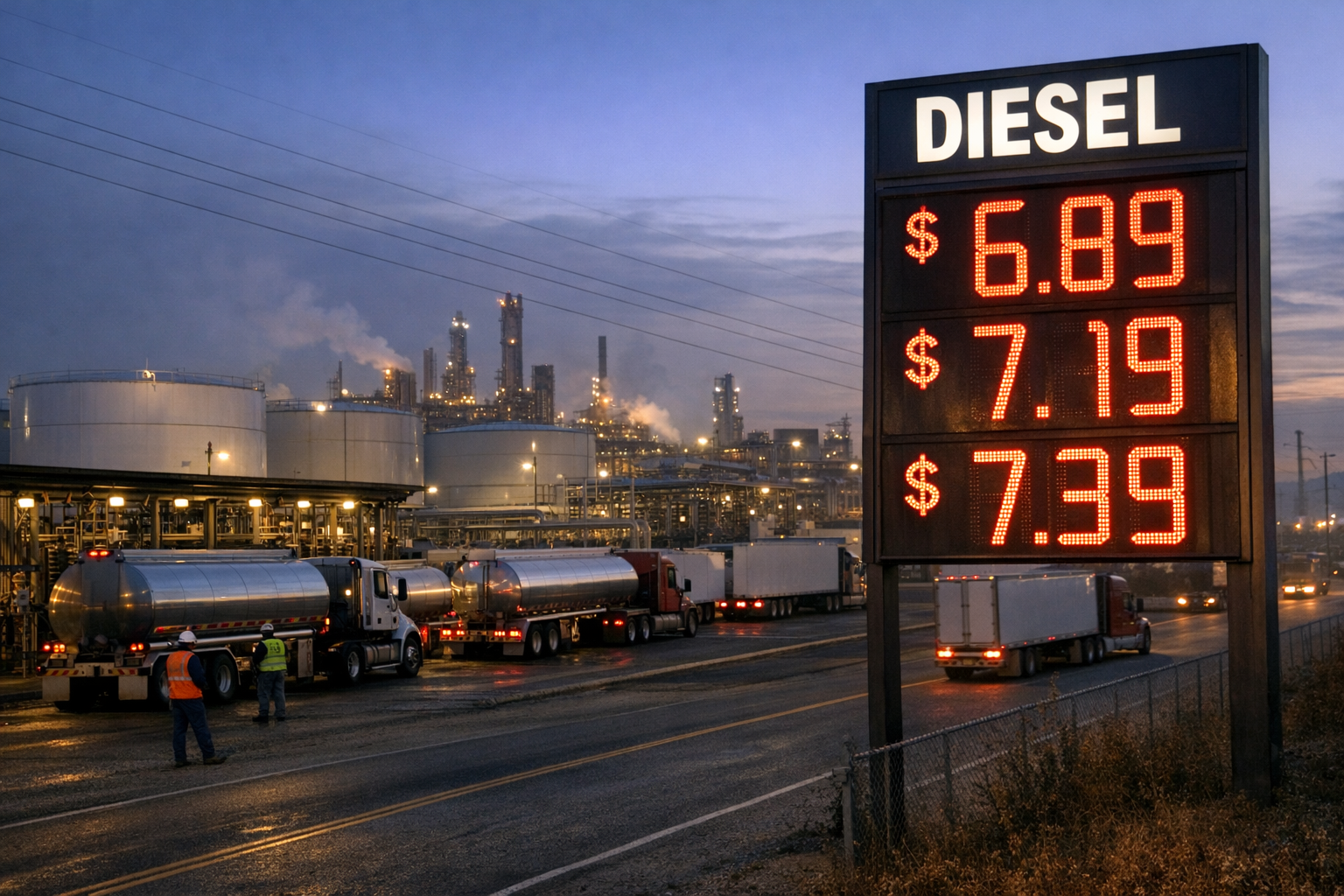
Governments and energy companies are moving from broad promises on oil to a more targeted scramble for diesel, as persistently high fuel costs squeeze truckers, farmers and factories and deepen political pressure in the United States and Europe.
The International Energy Agency said on Oct. 15 that member countries would accelerate the remaining releases from their emergency action launched in March, with plans to put more than 20 million barrels of diesel onto the market “as soon as possible.” At nearly the same time, Secretary of State Marco Rubio is set to travel to India, including to Jamnagar, home to Reliance Industries’ vast refinery complex, in a sign that Washington is looking beyond its borders for relief.
Taken together, the moves underscore a hard reality of the current energy crunch: the immediate problem is not simply crude oil, but the availability of the refined fuels that keep goods moving and economies running.
A shortage where it hurts most
Diesel has become the most acute pressure point in fuel markets since supply disruptions tied to the Middle East conflict and the near-closure of the Strait of Hormuz upended trade flows earlier this year. While oil prices have drawn the most public attention, diesel’s role in the real economy makes its scarcity especially painful. It powers freight trucks, farm equipment, construction machinery and parts of industry, meaning higher prices ripple quickly into food, shipping and consumer costs.
In the United States, the Energy Information Administration said retail diesel prices averaged $6.29 a gallon in September and are expected to remain above $6 in October. Those levels have kept inflation concerns alive and pushed the administration to seek more visible supply responses.
The IEA’s announcement is the latest step in a collective action first agreed on March 11, when members said they would make 400 million barrels available after the regional crisis threatened one of the world’s most important maritime chokepoints. The agency said about 330 million barrels have already been released, leaving roughly 100 million barrels still to be deployed. This time, however, the emphasis is narrower and more urgent: diesel specifically.
The agency linked the move to calls from Group of 7 leaders earlier this month and said diesel markets remained particularly tight. Still, the practical effect may depend on more than the headline number. More than 20 million barrels is substantial, but it amounts to less than a day of global diesel demand, and getting those barrels to the most stressed markets will require shipping, storage and commercial coordination that cannot be arranged overnight.
India’s refining muscle draws attention
That helps explain the significance of Mr. Rubio’s planned visit to India from Oct. 17 to 22. The State Department has said he will discuss energy cooperation in Mumbai and Jamnagar, where Reliance operates what the company describes as the world’s largest single-site refinery.
The Jamnagar complex can process about 1.4 million barrels of crude a day, giving India an outsize role in refined-product markets at a moment when many countries are struggling to secure diesel cargoes. Reliance has also become a closely watched player because of its ability to source crude from multiple regions and redirect fuel exports to where margins and demand are strongest.
For Washington, the outreach reflects both diplomacy and arithmetic. The United States cannot quickly build new refining capacity, and domestic refineries have limited room to sharply increase diesel output in the near term. India, by contrast, has the scale and flexibility to influence global product flows, even if only at the margin.
That does not mean Jamnagar can simply be turned into an emergency spigot for American consumers. Refinery output is sold into a global market, often under existing commercial arrangements, and barrels sent one way can leave another market tighter. Any relief from closer U.S.-India coordination is likely to come through redirection of cargoes and broader confidence in supply rather than an immediate, dedicated stream of fuel to the United States.
Why this matters now
The latest developments signal a shift in how governments are responding to the energy crisis. Earlier interventions focused mainly on crude releases meant to calm benchmark oil prices. But the bottleneck has increasingly been in products, especially diesel, where refining capacity, shipping routes and regional inventories matter as much as raw supply.
That distinction is crucial for households and businesses. A lower crude price does not necessarily translate into cheaper diesel if refineries are constrained or if inventories are low in the wrong places. By moving to release diesel stocks directly and by engaging one of the world’s most important refining hubs, policymakers are acknowledging that the market’s stress is more specialized — and more difficult to solve — than a simple shortage of oil.
Whether the effort works may become clear quickly. If the released barrels reach the market smoothly and additional cargoes are redirected from major refiners such as Reliance, diesel prices could ease from recent peaks. But if shipping delays persist or disruptions in the Middle East continue, the relief may prove fleeting.
For now, the message from governments is that they are trying to attack the problem where consumers feel it most: at the pump, in the field and across the supply chain.
Sources
Further reading and reporting used to add context:
- https://apnews.com/article/811b5e2f17b74f81de9e5f9f6128497c
- https://www.spglobal.com/energy/en/news-research/latest-news/crude-oil/101526-iea-accelerates-oil-stock-release-plans-over-20-mil-barrels-of-diesel
- https://www.investing.com/news/commodities-news/iea-to-decide-details-of-g7-diesel-and-oil-stocks-release-on-october-1415-sources-say-4934649
- https://www.fidelity.com/news/article/top-news/202610020421RTRSNEWSCOMBINED_KBN3VI0NE-OUSBS_1
- https://www.investing.com/news/stock-market-news/iea-to-meet-wednesday-over-proposed-release-of-reserves-say-two-eu-diplomats-4935702
- https://www.aol.com/articles/iea-speed-oil-stocks-release-103115000.html
- https://www.internazionale.it/ultime-notizie-reuters/2026/10/07/iea-to-meet-wednesday-over-proposed-release-of-reserves-say-two-eu-diplomats
- https://finance.yahoo.com/energy/articles/iea-release-more-20-million-212018887.html
- https://live.euronext.com/en/financial-news/diesel-shortages-could-persist-well-2027-iea-says
- https://political.org/2026/10/15/secretary-of-state-marco-rubio-to-tour-mukesh-ambanis-jamnagar-refinery-in-india-as-u-s-diesel-prices-stay-near-records/
- https://uk.marketscreener.com/news/iea-to-speed-up-oil-stocks-release-including-over-20-million-barrels-of-diesel-ce785dd3df80f025
- https://www.business-standard.com/external-affairs-defence-security/news/marco-rubio-to-visit-india-as-trade-talks-with-us-near-landing-point-126101401299_1.html
- https://incenews.com/article/iea-accelerates-emergency-diesel-stock-release-october-2026
- https://www.reddit.com/r/energy/comments/1x6twpl/international_energy_agency_to_release_more_than/
- https://www.reddit.com/r/oil/comments/1x4eji4/the_iea_wants_to_empty_its_oil_reserves_faster_a/
- https://www.reddit.com/r/MarketFluxHub/comments/1x6qxby/iea_members_commit_to_releasing_remaining_100/
- https://www.reddit.com/r/Economics/comments/1x4dd7j/the_iea_wants_to_empty_its_oil_reserves_faster_a/
- https://apnews.com/article/774a360d1646d9ce8aba764fdd9959d2
- https://www.iea.org/news/iea-governing-board-statement-on-energy-markets-and-security
- https://www.iea.org/news/update-on-iea-collective-action-decision-of-11-march-2026
- https://www.iea.org/topics/energy-security
- https://www.iea.org/news/executive-director-meets-with-prime-minister-of-australia-to-discuss-urgent-energy-challenges-facing-asia-pacific-region
- https://www.iea.org/reports/sheltering-from-oil-shocks/summary
- https://www.iea.org/news/iea-statement-on-responding-to-the-global-diesel-market-situation
- https://www.iea.org/commentaries/how-global-oil-supplies-have-readjusted-to-help-fill-the-huge-gap-left-by-the-strait-of-hormuz-shock
- https://www.iea.org/about/oil-security-and-emergency-response
- https://www.iea.org/podcasts/everything-energy/the-ieas-largest-ever-emergency-oil-stock-release
- https://www.iea.org/news/statement-by-iea-executive-director-on-meeting-of-iea-member-governments-on-7-october-2026
- https://www.iea.org/commentaries/oil-markets-strain-to-plug-the-gap-left-by-middle-east-supply-shortfall
- https://www.iea.org/news/statement-by-iea-executive-director-fatih-birol-on-meeting-of-g7-energy-ministers-at-iea-headquarters
- https://travel.state.gov/content/dam/visas/Statistics/Immigrant-Statistics/MonthlyIVIssuances/OCTOBER%202025%20-%20IV%20Issuances%20by%20FSC%20or%20Place%20of%20Birth%20and%20Visa%20Class.pdf
- https://travel.state.gov/content/dam/visas/Statistics/Non-Immigrant-Statistics/MonthlyNIVIssuances/OCTOBER%202025%20-%20NIV%20Issuances%20by%20Nationality%20and%20Visa%20Class.pdf
- https://travel.state.gov/content/dam/visas/Bulletins/visabulletin_October2026.pdf
- https://adoption.state.gov/content/dam/visas/Bulletins/visabulletin_October2026.pdf
- https://adoptions.state.gov/content/travel/en/legal/visa-law0/visa-bulletin/2027/visa-bulletin-for-october-2026.html
- https://history.state.gov/historicaldocuments/frus1876/d231
- https://history.state.gov/historicaldocuments/frus1946v11/d1005
- https://history.state.gov/historicaldocuments/frus1893/d397
- https://adoptions.state.gov/content/travel/en/legal/visa-law0/visa-bulletin.html
- https://history.state.gov//historicaldocuments/frus1961-63v10-12mSupp/d273a
- https://history.state.gov/historicaldocuments/frus1931v02/d774
- https://history.state.gov/departmenthistory/people/rubio-marco
- https://history.state.gov/historicaldocuments/frus1946v11/d1012
- https://history.state.gov/historicaldocuments/frus1931v02/d775
- https://history.state.gov//historicaldocuments/frus1946v11/d1007
- https://history.state.gov/departmenthistory/travels/secretary/rubio-marco
- https://www.ril.com/businesses/energy/refining-marketing
- https://www.ril.com/sites/default/files/2023-02/PR04092007.pdf
- https://www.ril.com/businesses/petrochemicals
- https://ppac.gov.in/infrastructure/installed-refinery-capacity
- https://www.ril.com/sites/default/files/2022-12/1400665256661_AR21052014.pdf
- https://pngrb.gov.in/pdf/press-note/PRV_03032023/T5/SPR.pdf
- https://environmentclearance.nic.in/writereaddata/Online/TOR/27_Dec_2021_16305618795707294Coverletter.pdf
- https://www.ril.com/sites/default/files/2023-01/rilagm1_2007.pdf
- https://www.cht.gov.in/refineries
- https://ibm.gov.in/writereaddata/files/1733387072675163402ac2bIMYB_2022_Volume_I.pdf
- https://www.ril.com/ar2016-17/mda.html
- https://www.bechtel.com/projects/jamnagar-oil-refinery/
- https://en.wikipedia.org/wiki/Jamnagar_refinery
- https://www.ril.com/ar2021-22/oil-to-chemicals.html
- https://www.ril.com/ar2018-19/refining-and-marketing.html
- https://timesofindia.indiatimes.com/india/after-musks-ambani-meltdown-rubio-to-visit-reliance-refinery/articleshow/134950481.cms
- https://www.hydrocarbonprocessing.com/news/2018/01/reliance-declares-30-higher-refinery-capacity-at-export-plant
- https://legalclarity.org/largest-oil-refineries-in-the-world-ranked-by-capacity/
- https://en.wikipedia.org/wiki/Jamnagar
- https://en.wikipedia.org/wiki/List_of_oil_refineries_in_India
- https://en.wikipedia.org/wiki/Oil_refinery
- https://www.marketscreener.com/news/us-top-diplomat-marco-rubio-to-visit-india-and-uzbekistan-ce785dd2d88af725
- https://news.bloomberglaw.com/environment-and-energy/rubio-set-to-meet-ambani-signaling-steady-ties-despite-musk
- https://www.tribuneindia.com/news/india/rubio-to-meet-reliance-officials-during-gujarat-visit-says-us-envoy-sergio-gor/
- https://www.jansatta.com/international/usa-external-minister-marco-rubio-visit-india-reliance-industries-jamnagar-investment-energy-sector/4744657/
- https://cssm.etimg.com/news/india/marco-rubios-india-visit-begins-from-saturday-as-new-delhi-awaits-us-decision-on-russian-oil-import-waiver/articleshow/134949088.cms
- https://www.livemint.com/companies/news/venezuelan-crude-comeback-puts-reliance-s-refining-edge-back-in-focus-11791800830505.html
- https://www.mid-day.com/news/india-news/article/marco-rubio-to-visit-reliances-jamnagar-refinery-during-india-trip-next-week-23654987
- https://timesofindia.indiatimes.com/india/after-musks-ambani-meltdown-rubio-to-visit-reliance-refinery/amp_articleshow/134950481.cms
- https://www.thedailystar.net/business/global-economy/news/india-may-be-best-placed-fill-china-sized-hole-fuel-exports-4291371
- https://zot.news/article/rubio-visit-ambanis-jamnagar-refinery-us-seeks-ease-diesel-z761v
- https://www.reddit.com/r/neoliberal/comments/1wzy877/reliance_drives_indias_venezuela_oil_imports_to/
- https://kuwaittimes.com/uploads/pdf/2026/03/12/kt_pdf-20260312-1.pdf
- https://www.reddit.com/r/CitizenWatchNews/comments/1wy4mpm/europe_closed_refineries_for_years_now_it_depends/
- https://epaper.indianchronicledaily.com/media/2026-01/ic-jan-8-2026.pdf
- https://kuwaittimes.com/uploads/pdf/2026/01/12/kt_pdf-20260112-1.pdf?ts=222412
- https://www.reddit.com/r/GeopoliticsIndia/comments/1tx8767/india_sees_perfect_complimentarity_with_venezuela/
- https://2021-2025.state.gov/secretary-travel/travel-to-kazakhstan-uzbekistan-and-india-february-26-march-3-2023/
- https://2001-2009.state.gov/secretary/trvl/2008/110576.htm
- https://video.state.gov/detail/videos/secretary-of-state/video/6371274721112/secretary-rubio-meets-with-uzbekistan-foreign-minister-bakhtiyorv-saidov?autoStart=true&page=1
- https://2017-2021.state.gov/senior-state-department-officials-previewing-secretary-pompeos-travel-to-india/
- https://2021-2025.state.gov/special-online-briefing-with-karen-donfried-assistant-secretary-of-state-for-european-and-eurasian-affairs-and-geoffrey-r-pyatt-assistant-secretary-of-state-for-energy-resources/
- https://history.state.gov/historicaldocuments/frus1969-76v37/d107
- https://history.state.gov/departmenthistory/travels/secretary/uzbekistan
- https://2021-2025.state.gov/press-briefing-with-deputy-secretary-of-state-wendy-sherman/
- https://www.state.gov/bureaus-archive/secretary-of-state/page/41
- https://adoptions.state.gov/content/travel/en/us-visas/visa-information-resources/iv-wait-times.html
- https://2017-2021.state.gov/briefings/department-press-briefing-october-4-2017/
- https://2017-2021.state.gov/readout-of-u-s-india-22-dialogue/
- https://2009-2017.state.gov/documents/organization/209089.pdf
- https://www.eia.gov/dnav/pet/hist/LeafHandler.ashx?f=W&n=PET&s=EMD_EPD2D_PTE_NUS_DPG
- https://www.eia.gov/dnav/pet/pet_pri_gnd_a_epd2d_pte_dpgal_w.htm
- https://www.eia.gov/todayinEnergy/detail.php?id=68164
- https://www.eia.gov/outlooks/steo/archives/oct26.pdf
- https://www.eia.gov/dnav/pet/pet_move_top.asp
- https://www.eia.gov/dnav/pet/hist/LeafHandler.ashx?f=W&n=pet&s=EMD_EPD2D_PTE_NUS_DPG
- https://www.eia.gov/petroleum/gasdiesel/?os=vbkn42tqhopmkbextcdF
- https://gasprices.aaa.com/?_sp=b8ed17ef-8552-406f-a4cb-65ac7b8ab54b&state=CA
- https://www.eia.gov/petroleum/gasdiesel/?os=win
- https://newsroom.aaa.com/category/fuel-prices/
- https://www.eia.gov/outlooks/steo/report/petro_prod.php?trk=article-ssr-frontend-pulse_little-text-block
- https://www.eia.gov/petroleum/gasdiesel/?r=campaignium
- https://energynewsbeat.co/crude-oil/irans-tanker-attacks-keep-pump-prices-high-even-as-gulf-oil-exports-rebound/
- https://www.eia.gov/petroleum/supply/weekly/pdf/table14.pdf
- https://www.eia.gov/outlooks/steo/pdf/steo_charts.pdf
- https://insights.ever.ag/wp-content/uploads/2026/04/Key_Indicators_042026.pdf
- https://www.reddit.com/r/NJPrepared/comments/1x472bc/nj_gas_diesel_price_check_12_oct_2026_431_632/
- https://www.eia.gov/outlooks/steo/pdf/steo_text.pdf?os=ios0
- https://www.reddit.com/r/PoursTea/comments/1x4vtzu/us_diesel_drops_by_just_1_cent_to_627gal_despite/
- https://www.reddit.com/r/gasbuddy/comments/1wg6sr6/we_broke_the_record_for_highest_recorded_national/
- https://www.reddit.com/r/CaliforniaUncensored/comments/1wux9jf/california_gas_prices_near_alltime_record_mark/
- https://www.eia.gov/outlooks/steo/archives/dec25.pdf
- https://www.reddit.com/r/StockMarket/comments/1x2j1yz/diesel_prices_628_aaa_above_2022_peak_levels_will/
- https://www.reddit.com/r/dataisbeautiful/comments/1v5pv1b/removed/
- https://www.reddit.com/r/CaliforniaUncensored/comments/1wyp5np/ca_gas_prices_see_current_fuel_costs_relief/
- https://www.reddit.com/r/ViceroyTransporter/comments/1t5vm4e/i_remember_a_time_when_diesel_fuel_was_cheaper/
- https://www.reddit.com/r/stocks/comments/1wdazw1/us_diesel_prices_hit_record_highs_to_605_per/
- https://www.reddit.com/r/AutoTransportopia/comments/1wsxosm/fmcsa_should_drug_test_these_super_high_fuel/
- IEA Governing Board statement on energy markets and security – IEA
- October 2026
- Update on IEA collective action decision of 11 March 2026 – News – IEA