
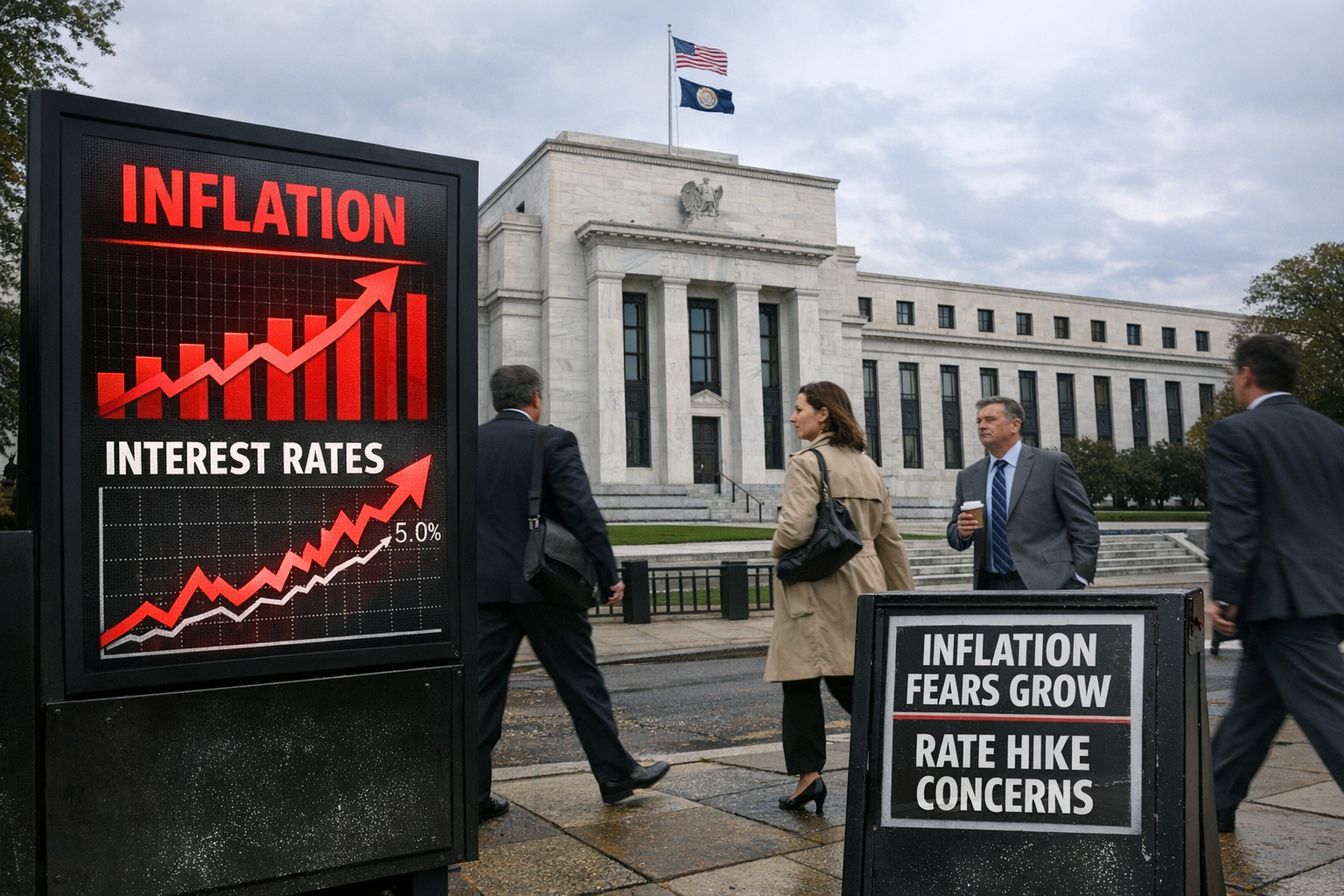
Hotter-than-expected inflation readings this week have complicated the Federal Reserve’s effort to convince investors that price pressures are moving decisively lower, sharpening expectations that another interest-rate increase could come as soon as this month.
A government report on Tuesday showed that wholesale prices rose 1.3 percent in September from the previous month and 6.3 percent from a year earlier, a much stronger reading than economists had anticipated and the biggest annual gain since December 2022. The producer-price figures arrived a day after consumer inflation also surprised on the upside, reinforcing concerns that the recent cooling in prices may be faltering.
Together, the reports have stiffened the hawkish case inside and around the central bank at a sensitive moment, just ahead of the Fed’s Oct. 27-28 policy meeting. While officials have not committed to another move, the latest data and recent messaging suggest that the option of a rate increase remains very much alive.
Kevin Warsh, the Fed chair, declined in public remarks to signal what the central bank would do this month, saying he would not “prejudge” upcoming meetings. But he praised the broader pattern of global central-bank tightening, describing a world in which there were “no free riders” in the battle against inflation — a formulation that investors took as a reminder that the Fed does not believe the fight is over.
Inflation’s rebound clouds the outlook
The inflation surprise has been notable not only for its size, but for its timing. After months in which price growth had seemed to be on a gradual downward path, September’s data suggested renewed pressure.
Consumer prices rose 0.6 percent in September and 3.7 percent from a year earlier, with gasoline playing a major role in the increase. Core consumer inflation, which strips out food and energy and is closely watched by policymakers for signs of underlying persistence, rose 2.6 percent from a year earlier.
The producer-price report added to those worries. Because wholesale costs can feed into prices paid by consumers and businesses later on, the acceleration in producer inflation raised fresh questions about whether the cooling in broader inflation can continue without further policy restraint.
Energy was a common thread in both reports, underscoring how vulnerable the inflation outlook remains to swings in oil and fuel markets. That has left economists debating whether September marks a temporary energy-driven bump or the start of a wider reacceleration in prices.
A rate hike is back in focus
The Fed last month raised interest rates by a quarter point, lifting its benchmark federal-funds rate to a range of 3.75 percent to 4.00 percent — the first increase in three years. At the time, officials signaled that policy would remain data dependent. But minutes from that meeting, released this month, showed that most participants believed another increase by year-end would likely be appropriate, and Fed staff had revised up their inflation outlook.
The latest inflation data fit squarely into that more cautious view.
Some economists said the reports materially increased the risk that the Fed could move again in October rather than waiting until December. Others argued that policymakers may still want more evidence, particularly because the recent surge has been concentrated in energy-related categories and because markets remain sensitive to any sign of overtightening.
That uncertainty over timing — not whether the Fed is done, but when it acts next — has become the central question for investors.
Markets turn uneasy
Financial markets reflected that ambiguity. Hotter inflation data initially pushed up expectations for another rate increase and put pressure on stocks and bonds, as traders recalibrated the path of monetary policy. Treasury yields rose at first, while risk assets, particularly rate-sensitive technology shares, came under strain.
Later trading was more mixed, with yields pulling back even as caution lingered. The reversal suggested that investors remain divided over whether the Fed will respond immediately or wait, and over how much of the inflation pickup is likely to persist.
Still, the week’s data have made one point harder to dismiss: the path back to price stability is proving uneven. For households, businesses and markets that had hoped inflation was settling into a cleaner downtrend, the latest reports were a reminder that the Fed’s campaign against rising prices may require more time — and possibly more pain.
Sources
Further reading and reporting used to add context:
- https://www.cnbc.com/select/fed-rate-pause-perfect-time-to-pay-down-debt/
- https://www.cnbc.com/select/purchases-money-experts-are-holding-off-on-making-now/
- https://www.cnbc.com/select/interest-rate-hike-pros-cons-how-to-benefit/
- https://www.cnbc.com/2025/08/29/cnbc-daily-open-main-street-and-wall-street-are-still-alive-and-kicking.html/
- https://www.cnbc.com/select/feds-increased-rates-how-to-take-advantage/
- https://www.cnbc.com/amp/2025/08/25/cnbc-daily-open-all-roads-lead-to-jerome-powell.html
- https://www.cnbc.com/select/fed-rate-cut-means-mortgages-loans/
- https://www.cnbc.com/2023/10/12/asia-pacific-stocks-set-to-rise-ahead-of-key-us-inflation-data.html
- https://www.cnbc.com/latest/?msockid=1733aab28248689c32e6bcd383a2694d
- https://www.cnbc.com/video/2022/09/21/fed-raises-rates-by-75-basis-points-to-fight-inflation.html
- https://www.cnbc.com/select/how-does-the-fed-rate-impact-mortgage-rates/
- https://www.cnbc.com/economy/?msockid=106152509c936d283f3f440c9d736c90
- https://fm.cnbc.com/applications/cnbc.com/resources/editorialfiles/2022/12/28/IC_5_KEY_STORYLINES_WHITE_PAPER_v07.pdf
- https://fm.cnbc.com/applications/cnbc.com/resources/editorialfiles/2023/03/10/CNBC_INVESTING_OUTLOOK_2023_VOL_01.pdf
- https://fm.cnbc.com/applications/cnbc.com/resources/editorialfiles/2024/12/12/fulleconomicsurvey.pdf
- https://apnews.com/article/ff5adf8283a770c2ca9897b10a09dda7
- https://apnews.com/article/4c80750c113a82a464a46f58a4fdab43
- https://apnews.com/article/28ffc9c856377d468a2fb231712806b1
- https://www.axios.com/2026/10/16/warsh-federal-reserve-interest-rates
- https://apnews.com/article/3985019a54c82421e6112fb57baba048
- https://www.federalreserve.gov/monetarypolicy/files/fomcminutes20230920.pdf
- https://www.federalreserve.gov/monetarypolicy/fomcminutes20230920.htm
- https://www.federalreserve.gov/newsevents/pressreleases/monetary20231011a.htm
- https://www.bls.gov/news.release/archives/ppi_10112023.htm
- https://www.calculatedriskblog.com/2023/10/fomc-minutes-majority-of-participants.html
- https://www.scrippsnews.com/politics/economy/fed-minutes-show-most-officials-expected-another-rate-hike-before-years-end
- https://www.bls.gov/opub/ted/2023/producer-prices-up-2-2-percent-from-september-2022-to-september-2023.htm
- https://www.bls.gov/ppi/detailed-report/
- https://www.bls.gov/news.release/archives/ppi_09142023.htm
- https://www.bls.gov/news.release/archives/ppi_10112023.pdf
- https://www.benzinga.com/economics/macro-economic-events/23/10/35201015/fomc-minutes-hint-at-necessity-for-another-hike-highlighting-ongoing-inflation-co
- https://finance.yahoo.com/news/majority-of-fed-officials-predicted-one-more-rate-hike-this-year-meeting-minutes-190041299.html
- https://www.washingtonpost.com/business/2023/09/20/fed-september-meeting-inflation/
- https://www.clarin.com/us-news/september-ppi-report-why-wholesale-prices-jumped-13-vs-the-05-expected-by-the-market_0_j8fUTCymDc.html
- https://www.newyorkfed.org/medialibrary/Microsites/tmpg/files/october-2023-tmpg-meeting-minutes
- https://www.govinfo.gov/content/pkg/ECONI-2024-06/pdf/ECONI-2024-06.pdf
- https://www.reddit.com/r/Economics/comments/1x6kfx4/wholesale_prices_jumped_63_annually_in_september/
- https://www.bls.gov/news.release/archives/ppi_10112024.pdf
- https://www.reddit.com/r/WhatTrumpHasDone/comments/1x6l94a/wholesale_prices_jumped_63_annually_in_september/
- https://www.axios.com/2026/10/15/fed-inflation-ppi-warsh
- https://www.kiplinger.com/investing/stocks/nasdaq-nosedives-as-ai-boosts-consumer-prices-stock-market-today
- Consumer Price Index News Release – 2026 M09 Results
- https://www.federalreserve.gov/monetarypolicy/fomcminutes20260916.htm
- https://www.federalreserve.gov/monetarypolicy/fomcminutes20260916.htm?trk=article-ssr-frontend-pulse_little-text-block
- https://research.thesismemo.com/articles/september-2026-fomc-minutes-year-end-hike-conditional
- https://www.dol.gov/newsroom/economicdata/cpi_10142026.pdf
- https://view.asiae.co.kr/en/article/2026100804564226796
- https://www.stocktitan.net/articles/fed-minutes-september-2026-second-rate-hike
- https://marketintellabs.com/research/fomc-minutes-september-2026-rate-hike-explained
- https://www.federalreserve.gov/monetarypolicy/fomcminutes20250917.htm?mod=article_inline
- https://www.thepoliticalgroup.com/forecasts/will-the-fed-raise-rates-october-2026
- https://www.investing.com/analysis/fed-rate-hike-looks-locked-in-after-hot-cpi-200687549
- https://www.cutoday.info/site/layout/set/print/Fresh-Today/Fed-Minutes-Point-To-Another-2026-Rate-Hike-But-October-Move-Looks-Unlikely
- https://www.investing.com/analysis/the-hike-that-moved–and-the-hike-that-disappeared-200689249
- https://www.federalreserve.gov/monetarypolicy/files/fomcminutes20250917.pdf
- https://www.youtube.com/watch?v=-iYa8I28PqQ
- https://apnews.com/article/ae938216d9d45a4e2c829845b40d83f5
- https://apnews.com/article/a0a577dfd12f63ee6780a56ab02b55c4
- https://www.kiplinger.com/investing/stocks/stocks-climb-a-wall-of-worry-ahead-of-earnings-stock-market-today
- https://workplace.schwab.com/story/stock-market-update-open
- https://www.investing.com/news/stock-market-news/us-stock-futures-fall-as-hot-inflation-revives-fed-hike-concerns-4950317
- https://finance.yahoo.com/markets/stocks/articles/us-equity-indexes-mixed-hot-165927840.html
- https://ca.marketscreener.com/news/gold-climbs-over-1-on-softer-dollar-yields-ahead-of-us-inflation-data-ce785dd3da88f721
- https://in.marketscreener.com/news/gold-climbs-over-1-on-softer-dollar-yields-ahead-of-us-inflation-data-ce785dd3da88f721
- https://tv.nyse.com/market-storylines/videos/10-15-2026-hot-cpi-and-ppi-yield-reversal-ai-angst-staples-rally
- https://finance.yahoo.com/markets/stocks/articles/us-equity-indexes-mixed-hot-174638915.html
- https://ca.marketscreener.com/news/wall-st-slides-as-hot-cpi-data-fuels-rate-hike-bets-chips-banks-weigh-ce785dd2de8af72d
- https://ca.marketscreener.com/news/dollar-pulls-back-from-18-month-high-as-treasury-yields-fall-fed-hike-bets-ease-ce785dd3db8ff22c
- https://finance.yahoo.com/markets/stocks/articles/us-equity-indexes-shrug-off-195343083.html
- https://www.bls.gov/news.release/archives/ppi_10152026.htm
- https://www.bls.gov/news.release/ppi.toc.htm
- https://www.bls.gov/schedule/news_release/ppi.htm
- https://www.bls.gov/news.release/ppi.t03.htm
- https://www.bls.gov/charts/producer-price-index/
- https://www.bls.gov/news.release/ppi.t01.htm
- https://www.bls.gov/ppi/news-release/home.htm
- https://www.bls.gov/news.release/archives/ppi_01142026.htm
- https://www.bls.gov/bls/news-release/ppi.htm
- https://www.bls.gov/news.release/ppi.htm
- https://www.bls.gov/bls/newsrels.htm
- https://www.bls.gov/news.release/archives/ppi_11252025.pdf
- https://www.bls.gov/news.release/archives/ppi_01142026.pdf
- https://www.bls.gov/news.release/archives/ppi_03182026.pdf
- https://www.bls.gov/news.release/pdf/ppi.pdf
- https://www.federalreserve.gov/newsevents/pressreleases/monetary20260916a.htm?gsid=87b91d1f-16c6-4734-b6ca-fc4fd9bc7a42
- https://www.federalreserve.gov/newsevents/pressreleases/monetary20260916a1.htm?trk=article-ssr-frontend-pulse_little-text-block
- https://www.federalreserve.gov/newsevents/pressreleases/2026-press-fomc.htm
- https://alfred.stlouisfed.org/release?rd=2026-09-10&rid=101
- https://www.federalreserve.gov/monetarypolicy/fomcpresconf20260916.htm
- https://www.atlantafed.org/news-and-events/2026/09/16/fomc-statement
- https://www.federalreserve.gov/monetarypolicy/openmarket.htm?trk=article-ssr-frontend-pulse_little-text-block
- https://www.federalreserve.gov/monetarypolicy/fomcprojtabl20260916.htm
- https://fedpolicy.org/federal-reserve/september-2026-fed-meeting/
- https://www.frbdiscountwindow.org/?mf_ct_campaign=msn-feed"=
- https://www.federalreserve.gov/newsevents/pressreleases/monetary20200916a.htm?source=news_body_link
- https://www.federalreserve.gov/monetarypolicy/files/monetary20260429a1.pdf
- https://www.newyorkfed.org/medialibrary/media/markets/survey/2026/mar-2026-sme-results.pdf
- https://www.federalreserve.gov/monetarypolicy/files/fomcminutes20250917.pdf?ftag=YHF4eb9d17
- https://www.youtube.com/watch?v=13MbVGpZtmk
- https://en.wikipedia.org/wiki/History_of_Federal_Open_Market_Committee_actions
- https://en.wikipedia.org/wiki/Federal_funds_rate
- https://www.reddit.com/r/NoSpinMedia/comments/1wmnazj/feds_kashkari_says_inflation_remains_too_high/
- https://www.reddit.com/r/u_Fluid_Connection_703/comments/1wifvpj/federal_reserve_issues_fomc_statement/
- https://www.reddit.com/r/u_Limp-Yam-1899/comments/1wij0d0/2026917_federal_reserves_interest_rate_hike/
- https://www.reddit.com/r/centrist/comments/1wi5nsc/federal_reserve_unanimously_voted_120_to_raise/
- https://apnews.com/article/8d645bd4cbf32974e68c5bc4cfaa1f61
- Federal Reserve Board – Federal Reserve issues FOMC statement